Back when my children were young, and my partner and I struggled to keep them entertained, our motto was always, When in Doubt, Go Out. Even when the weather was nippy, it was worth the struggle to get on the snowsuit and the boots for a change of scenery and an infusion of fresh air. I was glad they never minded taking a walk in the stroller, and I enjoyed watching them get up close and personal with grass, rocks, snow and mud.
My 19-month old grandchild, Manu, doesn’t like the stroller. It can take half an hour to get him outside, but once he’s there, he does like walking around his neighborhood, exploring the lawns with the animal ornaments, looking out for cars and trucks passing by and planes flying overhead. Like my children, he loves substances and can happily entertain himself moving handfuls of grass clippings from one place to another, or splashing in a puddle, or sifting through piles of rocks. Really, it’s all about discovery.And discovery shouldn’t end when you’re 2, or 3, or 4. One of the best parts about playing with kids is that I can also enjoy the feel of clipped grass in my hand, or pay extra attention to the crescendo and decrescendo of a soaring plane as it enters and exits my orbit. There are many days sitting in the sun and having an hour-long rock exchange with Manu feels far more enticing than staring at the screen with its brain numbing cathode rays and all those murky words, even if I was the one who wrote them.
Especially if I was the one who wrote them.
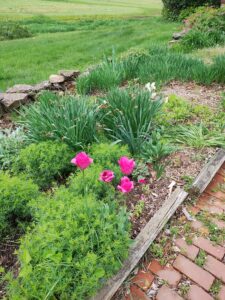
Photo: D. Dina Friedman
So, whenever I get stuck in my writing, I go outside.
In the spring and summer, my go-to activity is gardening. I swear, I get my best ideas from pulling weeds.
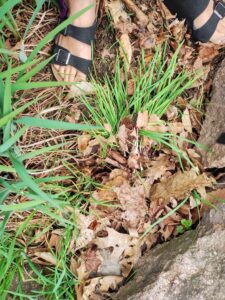
Photo: D. Dina Friedman
Some people hate weeding, but to me getting rid of weeds feels like chaos I can control, as opposed to trying to get rid of the clutter in my house, which feels like chaos I can’t control. There’s nothing like the feel of dirt on my hands, and the satisfaction of digging up and tossing out clumps of stuff I know I don’t want. Way easier than chopping out paragraphs I struggled to perfect only to realize they just don’t serve the story.
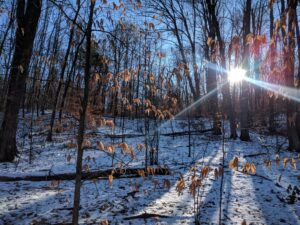
Photo: D. Dina Friedman
In the winter, I walk in the woods and say “wow” every time I come to a landscape that delights me. I have a soft spot for the Hansel-and-Gretel look of a path through the snow-covered trees, especially when illuminated by the bright sun. But even when there’s no snow and the air is damp and raw, I try to find beauty in the gray light. This is also a good lesson for disentangling my writing messes. Somewhere in a draft that may seem hopeless, there’s often a spot worthy of a photo-op, a place to explore close-up, long view, and from different angles.
And this coming winter, I’m looking forward to exploring the tactile pleasures of the snow with a 2-year-old, feeling the joyful tingle of cold on my back as I wave my arms back and forth making angels.
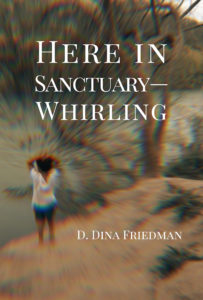 But now that I’m–thankfully–about 80% recovered, and preparing for my
  He was reportedly the only person in weeks that people had heard about who received a positive outcome form the infamous tent courts. And as witnesses gathered around to offer him a place to stay for the night and assistance to get to his brother in Florida, he told us the key to his “success.” I told them the gangs had killed my entire family. Other than my brother, I have no one.
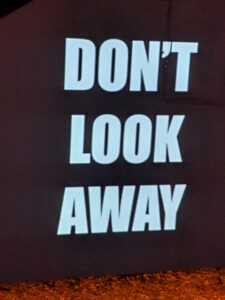 Don’t Look Away! the sign read on the American side of the border, where witnesses stood every day, reminding us of our responsibility not to tune out.
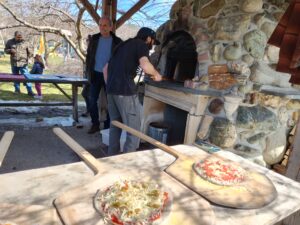
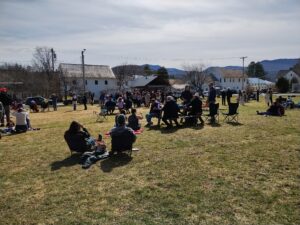 Things seemed pleasantly normal in the hour before the big event. People donned eclipse glasses to sneak views of the disappearing sun, children ran through the grass playing, and adults waited in lines for free pizza cooked in the community stone oven or to silk-screen a t-shirt as an Eclipse Day souvenir.
  But when totality hit, something shifted in the energy. There was a hush among the crowd, a kind of collective “wow.” My eclipse glasses now dark, I was nervous about viewing the corona with unprotected eyes, but there it was, eerie and other-worldly, the tiny ring of light flaring in asymmetrical bursts before settling to a steady glow like a small spark of hope.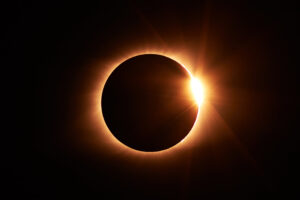
 We held up paper hearts and waved at them when they came out in their bright orange hats for 15-minute stints of exercise. Te amo (I love you) we shouted. Occasionally the children would take off their hats and wave them at us, though they were always reprimanded by the guards when they did.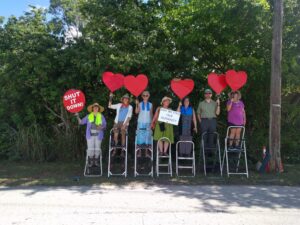
 Unfortunately, we were not in a position to engage in civil disobedience, so we had to settle for supporting the people on the bus with hearts and words of encouragement as they walked shackled into the plane’s belly and departed under the cover of the night.
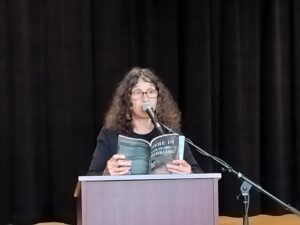
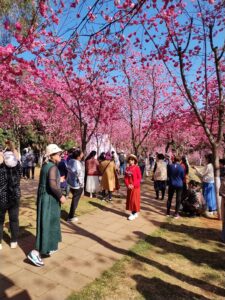 Though being forced to write was a good thing, I have to admit I regretted not getting the immediate gratification of people’s reactions to the cherry blossoms in Kunming, or my musings on Substack, which made me wonder–what is it about we humans in the social media age that makes us feel that everything we do needs to be immediately validated? True confessions, I am one of those people who obsessively looks for likes and feedback for anything I post on the big cyber cloud. Sometimes I worry that this has a negative impact on my writing–whether in sharing groups, I’m too quick to read something half-finished, simply for the joy of hearing people’s reactions to it. But I do like to think that reading things out loud, even early drafts, sharpens my own ear for what’s working or not working in a piece. In fact, one of my favorite revision techniques is to read a piece out loud even if I’m the only person listening.