When I was around 6, I never felt that any of the images I saw in the mirror, twirling around in my powder blue party dress, school bound in my navy blue jumper with the gold buttons, or lounging in my light cotton pants and Danskin turtle-necks was really me. Other children in my class looked like themselves–in and out of the mirror–but I could barely recognize myself as a body with a face and curls and skinny limbs. Who was that apparition that stared back at me? It didn’t look anything like the way I envisioned myself. What did I–whoever I was–really look like? When I ran the “me card” in my mind, there was no face or body. “Me” was a wispy, invisible thing rooted in my brain’s fuzz: airy and intangible. And even after decades of body-grounding practices, that little germ of me is still that flighty, fuzzy thing, nearly impossible to see.
So, for this reason, I’ve always been wary of mirrors, or any item like video or audio recorders, that attempts to cast some aspect of myself back at me. It’s hard for me to watch images of myself in motion or listen to myself speak. When I taught my classes on Public Speaking, I told my students that while recording themselves could be helpful in noting areas they could improve on, it would be better not to record if they didn’t have the stomach for stepping out of their own self-perceptions and seeing themselves as others saw them.
Over the years, I’ve grown more immune to this schism in self-perception. Now, when I look into a mirror, I have an expectation of what I’m going to see, and the resulting reflection doesn’t surprise me, even as my aging body is becoming more angular, my hair slowly more gray. I can laugh when I see interviews of myself using my hands when I talk, and enjoy listening to myself reading poems. While I still don’t like my voice, which seems to be growing grainier and more old-ladyish by the minute, its New Yorker inflections continuing to underly my roots despite 40 years out of the homeland, I can appreciate my expressiveness as well as the echoes of my family legacy–poignant inflections that sound so much like my mother and grandmother.
But last night, I took a big step into the void between self-perception and reality. I recorded myself singing.
As I mentioned in a previous post, I completely lost my ability to sing without croaking a few years ago, and it took a year of lessons before I could get my voice back. This felt like a big investment because didn’t have a strong solo voice that felt worth preserving. But I missed being able to sing in choruses or community gatherings so much, it felt essential to my mental health. One of the most fun things about voice lessons was practicing solo songs, so since then, I try to devote a couple of evenings a week to doing vocal exercises and singing along to Karaoke tracks or accompanying myself on the piano. It’s a blast!
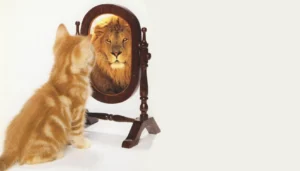
Truth be told, when I think of myself as a singer, I’m kind of like that picture of a cat who looks in the mirror and sees a lion. At least, that’s what the wishy part of me wants to see. Mirror, mirror on the wall, whose the fairest singer of them all? I knew that recording myself might quickly put a pin in my inflated self-perception, but I felt that it was finally time to do what many public speakers do: listen to themselves with minimal self-deprecating judgment, but a clear focus on what they can improve.
1_jFtg4OKUNLHnFjETiizx_A
So I turned on my cellphone recorder and hit play, totally prepared to delete the recordings if they were too painful to listen to.
What did I hear? Yes, my grainy, New York, old lady voice. But good breath control and good vibrato. On pitch nearly all the time with just a few flat notes I could work on.
Did I sound like someone I’d want to listen to on Spotify? No. Could I sing competently in a group, or lead a song if I wanted to? Absolutely.
And that’s what I used to tell my public speaking students. You may never speak like Martin Luther King, but that’s not the point. You can get to a place where you feel more competent, more confident, and hopefully begin to like what you’re doing.
Truth: I did delete the recordings after I listened to them. But not because I was ashamed. I think I just wanted to hold onto the illusion of the cat seeing the lion in the mirror. Better than the little girl who couldn’t see herself, even when she was dancing.
Subscribe at http://ddinafriedman.substack.com