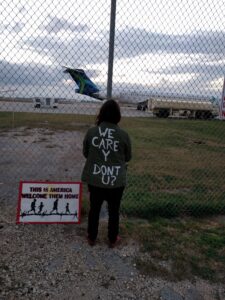
 In 2020, I stood at the Brownsville, Texas airport on Valentine’s Day watching shackled people hobble up the runway of this plane. And every day in 2026, all over the country, people are being arrested, detained, and deported without due process and often to countries where their lives are in danger. Even where I live in Massachusetts, where many towns and cities have passed sanctuary and other protective laws and resolutions, and where the state has recently passed legislation limiting ICE activities in courts, schools, and health care facilities, no one is truly safe.
So, in addition to spending significant time as an activist and advocate for immigrants, I have pledged each November to write 30 poems to support the Center for New Americans, an organization that provides English classes, legal advocacy, and countless other kinds of assistance to immigrants in our community.
Writing 30 poems in a month isn’t easy, and every October as I think about signing up again, a part of me panics at the thought of having one more thing to accomplish on my daily to-do list, even if there’s no pressure for all of the poems to be good–or even finished. But I do this anyway as a way of speaking out against the horrendous unleashing of ICE in our communities, and their blatant disregard for human life as they separate children from parents; arrest and detain American citizens, green card holders, and immigrants with legal status as well as those who lack documentation; and recklessly break into people’s homes, shoot people in cars, and murder Americans who have shone up to witness in peaceful protest.
It is a f-ing scary world we’re living in right now. And while we can be hopeful for the midterms, history has shown us that we can’t depend on Democrats to take care of things if they do attain majorities. We need to keep speaking up and speaking out. For a list of easy actions, Massachusetts residents can check out this link from DeICEhanscom.org. And people throughout the country can sign up at https://www.de-iceaction.org/ for one quick action to be delivered to your inbox each week.
Also, we can donate to some of the many immigration support networks that are out there. I’d be totally honored if you’d like to include the Center for New Americans on your list by donating to my fundraising page, here. In appreciation, I promise to send you my 30 poems at the end of the month. And I also promise that you are under no obligation to read them. Life is short and time is precious.
I do need to be honest and say that this is not a totally selfless mission. As a writer, I’ve gotten great benefit out of past 30 Poems in November efforts–and even a few good poems in the process. The obligation to face the blank page every day is helpful, even if words don’t always flow as smoothly as I might like them to. And coming together several times a month by attending workshops and readings with other community writers who are involved in this effort has been incredibly nurturing, because, utlimately, community feels like the only thing that will save us–and save those most vulnerable around us.
Subscribe at https://ddinafriedman.substack.com




 Subscribe at