Why Can’t This Night Be Different From All Other Nights?

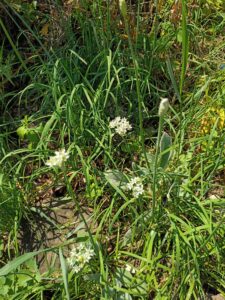
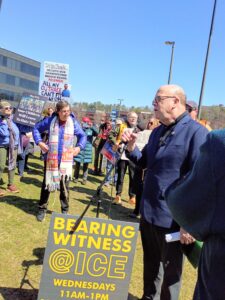
Photo: D. Dina Friedman

Of all the Jewish holidays, Passover is my favorite,  I’ve always liked that the Passover Haggadah (the book that is read during the seder that tells the story of the Jews’ liberation from slavery in Egypt) has so many metaphors that are easily adaptable to modern times. Over the years, I’ve spent many hours adapting the text to whatever issue is plaguing (pun intended) me most at the moment, as well as enjoying the contributions of my family and community in making the text and the rituals it includes meaningful and relevant.

But this year, with all the conflict going on in the world and in our own country, it’s hard to get into the mindset for celebration, even with the holiday’s themes of liberation against oppression and hope for the future. The small group I celebrated with last night started the night by acknowledging our fear, anger, and unease at what’s going on in our country and in the wider world. And yet, I was also so glad to be in this circle of friends, most of whom I’ve known for decades. When it was my turn it speak, I said, To me, Passover is about community, more than it’s about God, or Egypt, or any of that. 

As I think about that comment a day later, I’m wondering whether it’s actually true, or if I was just thinking off the top of my head. I’m not saying there’s no truth in what I said. Community is definitely a big factor, and I really don’t care that much about most of the traditional Passover story. But Passover does comprise more than community. It even comprises more than the yearly menu-squabbling and “back-seat cooking” as my partner and kids and I all pile into the kitchen to grate and chop the vegetables. Or the reminiscences of all the goofy things we used to do to keep it light and entertaining: putting the dog on the porch so he could walk in when we opened the door for the prophet Elijah, or the years we told the story through improvisation games, or through parodies of songs from musicals, or raps.

But there’s serious stuff, too: I love the metaphor of the internal journey through “the narrow place” (Egypt) and the casting off of internal “chomaytz” (the leavened products you don’t eat during Passover) as a way of ridding yourself of excessive ego, pride, or unresolved emotions. I love some of the side stories: the midwives who helped the Jewish women hide their babies instead of following orders to kill them; Nachsun, whom I wrote about last year, who jumped into the Red Sea, before the waters parted an act of incredible hope when it seemed there was no hope to be had.

And, there are some troublesome parts: Like the ten plagues as collective punishment against an entire people for the actions of a tyrant. Or, really, any aspect of “us” and “them,” as two separate entires with a winner and loser. I’m not saying that oppression of the Israelites in Biblical Egypt didn’t exist, but I wish I could think we were past oppressing others, and celebrating victories where innocent people, like the first-born children of the Egyptians, lost their lives.

And, of course, the elephant in the room: the actions of the Israeli government in Gaza where 64,000 children were killed or injured in 23 months of war. And the current U.S./Israel war agains Iran whose victims include 168 elementary school girls whose school was bombed. Hard to say, “next year in Jerusalem,” (the closing words of the seder) after that. I’d like to think that after 3,000 years we’ve moved beyond killing children, I’d even like to think we’ve moved beyond war, or beyond tyrants, but I guess that’s too much to hope for.

So I can understand why our host last night opened the seder by expressing how hard it was to even sit down and celebrate Passover. Yet, it was the small community of like-minded people I celebrated with that helped me feel able to take a small step back into my Jewish identity. We still can use the metaphors and inspiring parts of the story to envision a better world. And after that, act on them to make that vision more of a reality.

Chag Sameach!

Subscribe at https://ddinafriedman.substack.com



My Little Life

Yesterday, catching-up on the phone with a friend, I said in response to our mutual lament on the state of the world, I just keep doing my piece of the work, along with the rest of my little life.

My little life! echoed the depressed, despairing child that lives inside of me. It’s one of the things that keeps me up at night when the inner critics are jazzed on caffeine and partying away. Why should anything in your little life matter and why aren’t you doing enough to stop the tidal wave of horror that’s sweeping over everything around you? 

It gets to the point where I can’t read the news stories any more, like this one where ICE tricked a father with no criminal record and arrested him when he went to ICE to reunite with his children. Or the emails from friends in the community about people they know personally–caregivers, neighbors, friends being kidnapped and sent to Texas or Louisiana with no hope of bail. Not to mention the horror of a new war. And the constant twisting of language into an unrelenting spewed and venomous hatred of any one who is “other” in any way, shape, or form.

But enough ranting. What is “my little life,” anyway? Is it enough?

Here’s a snapshot:

Wake up. Open the shade and consider the sky. Sunny or cloudy? Spend a moment taking in the potential of the day. Center on the long reach of the naked trees. They’re still here, so you can be, too. Sit somewhere you can look out the window at the tree, and do your 5 minutes of breathing practice. Turn on the phone and play a 10 minute meditation tape. Do NOT open email or social media until you’ve done this. Then, quickly scan your email, but only for 5 minutes max. Go downstairs, where your partner is waiting, for 30 minutes of exercise: cardio, yoga, or strength-training. Segue into breakfast. Take your vitamins.

Finally, get to your computer with a large cup of tea. Consider the choices spread before you if you’re lucky enough to have a morning with no appointments. Generate new writing, revise writing, send out writing, work through the never-ending pile of house/admin; and all the activist tasks–emails, articles and letters to read or write, writing from others to edit, phone calls. Ask yourself two questions: which option calls the most right now, and which option is most urgent? You may get two different answers. You may get seven different answers, but try to make a choice. Try, despite your dopamine-craving brain to focus on whatever choice you made. Try NOT to stop what you’re doing to check your email and read more horror stories (a.k.a news).

If you do have appointments. Sit by your computer and talk to the people in the Zoom squares. Admire people’s writing. Chew on nuances in political strategy. Volunteer for more than you think you can do easily, and get overwhelmed. Or know this is your tendency, and only volunteer for half of what draws you.

Interrupt writing blog post for urgent phone call about flyer for Street Theatre Presentation at No Kings Day in Easthampton and Amherst that needs to be sent to the printer this morning. Interruption for all of you: Please go to a No Kings Day protest this Saturday, March 28th!! And bring a friend, or three!

Eventually it will be lunch time. After lunch, try to set aside time for a walk in the woods. Visit your favorite tree. Try to do this even if it’s cloudy, or nasty. If it’s really nasty, go to the Y. Or go to the Y anyway if you’re going into town to run errands, or see a friend, or if you’re on your way home from taking care of your grandson.

Photo by Shel Horowitz

Take care of your grandson as often as you can. Jump fully into the world of a three-year-old who knows nothing about wars. Don’t think about the three-year-olds in detention. Don’t think about the three-year-olds whose parents are in detention. Don’t think about the three-year-olds who were killed in the wars in Gaza or in Iran, or the ones whose parents are dead.

When it’s your turn to cook dinner, spend mindful time preparing a nourishing meal. After dinner, call your 92-year-old mother and listen to the details of her day. Study Spanish, then practice piano or do your voice/yoga exercises and sing your heart out with karaoke tracks on you-tube. Chat with a friend. Watch a show. Do the crossword puzzle together with your partner or curl up with a book. Give your brain a rest from its obligations. Take a hot, relaxing shower and try to turn off the light before midnight. Try to sleep at least 7 hours. 8 is better, though it will skew your day so that you’ll feel behind as soon as you wake up.

Rinse. Repeat. And remember, spring is coming, so, soon, it will be all this, plus gardening.

Subscribe at https://ddinafriedman.substack.com


Art for the Joy of It

My partner, Shel, and I are fans of Northampton’s monthly Arts Night Out. It’s fun to run into people we don’t see very often and enjoy a glass of wine and some juicy, guilty bites of food we don’t stock at home. But most importantly, it’s a great way to support the galleries and the artists whose work they showcase.

Last Friday, we were delighted to see an exhibit called Headspace, by Connor O’Rourke, an installation of over 150 large-scale, “heads” made of recycled cardboard, paint, hot glue, crafting scraps, and trash.

After a day (like many recent days) where I was feeling down because of the onslaught of distressing world news, being immersed in a room whose walls were covered by these whimsical and colorful figures gave me just the shot of joy and hope I needed.

I’ve written a lot about how art can be used for political and social change, but now I’m realizing that art has a strong role to play just a mood changer. And while I don’t want to grind people’s desire to make change to a halt by urging them to default to a state of perpetual inactive bliss, we absolutely need moments of lightness to inspire us and to counter all the dark in our lives. This might be another tall order for artists of any modality to try to make this happen, but hopefully it can be done in a context that might be more fun than our usual.

I was even more struck by O’Rourke’s comments, which he printed on the discarded cartons from the kitchen where he worked, the same base material he used to make his heads.

 I spent a long time trying to be the artist I was supposed to be and I kept letting myself down, but you can’t let yourself down when you’re just goofing around with paint and trash. It feels good to make a mess–to work with your hands, turn nothing into something and revel in a process you find delightful, whatever that thing might be for you, know that you can just love it, it doesn’t owe you anything and you don’t need anything in return. It’s yours, be vulnerable and unconditional with it and give it what it needs to grow. 

Wow!

Couldn’t we say the same thing about a poem? A story? A song… or anything else we might create?

So often we get stuck in the idea of producing something of merit, rather than just having fun, forgetting that the freedom of letting go of expectations and self-judgment can often lead us to surprising and illuminating places.

Headspace is at the Anchor House of Artists New England Visionary Arts Museum, a gallery on the edge of Northampton that is known for its support for artists with neurodivergence and mental health challenges. They describe themselves on their Facebook page as “a place where professionals & the self-taught find equal stance within a mission of creative freedom.” I’ve seen many great exhibits there, so if you’re in Western Mass., I urge you to check them out.

Subscribe at https://ddinafriedman.substack.com

Body, Mind, Spirit

A couple of mornings ago, by the window where I sit to meditate, a robin perched on one of the bare branches of my elderly-but-still-hanging-in-there maple tree, painted so evocatively here by my friend, Janet Morgan, several springs ago. (Check out her work at https://www.janetmorgan-art.net/)

Art by Janet Morgan

Afterwards, I took my first outdoor race-walk of the season, grateful that the snow, had *finally* melted. As I trotted along the road, I heard a cacophony of birds, and again I felt grateful that I was both being mindful enough to pay attention, and that my crappy hearing was allowing their songs to come through. My route started with a gradual but long uphill, and I found myself huffing and puffing a little more than I would have liked. Even though I had been maintaining my fitness with indoor cardio, strength-training, and yoga, as well as taking sloggy snow walks all winter, I hadn’t really pushed myself. But some recent (relatively minor) health issues have made it clear that I need to up the ante.

I’m grateful to have a body, I told myself, even if it can sometimes be an annoying place to live. And then I thought about how much of my day is devoted to taking care of my body, mind and spirit. Really, now that I’m retired, nearly all of my day touches on one–or more–of these aspects of my being that will only thrive if I give them love and attention.

I’m not a categorizer by nature. My recent “Kondo-izing Poems” project, while gratifying, also had many excruciating moments where I couldn’t decide whether a poem belonged into the folder of poems to be worked on, the totally inactive poems, or the “Meh” poems, which is kind of like the minor leagues. And let’s not even talk about my bookshelf, my closet, or my filing cabinets. Yet, I did find myself pondering my daily activities and thinking about whether I would classify each of them as body, mind, or spirit. And [no] surprise! So many had overlap, I quickly gave up on the categorization game.

But maybe that’s the point: taking care of the body through meditation and exercise–two staples of my daily diet–is essential for my spirit. And writing, while a mostly mind-massage practice, can also be a big spiritual uplift, at least during the times I’m in the groove. Spending time focused on others, rather than oneself, can be invigorating in opening up some mental pathways that generally go unused, or opening the heart/spirit through emotional connection. And for me, engaging in the nitty-gritty of activism engages the part of my mind that likes to problem-solve and helps my spirit through connecting to others and giving me a lifeline to hope.

I guess it doesn’t really matter what categories our activities fall into. What does matter is to choose a diet that will create a sense of uplift, gratitude, and grounding in our own beings so we can do the work in the world that we’re meant to do.

Subscribe at https://ddinafriedman.substack.com

Writing in Hard Times

A couple of nights ago, I went to see my friend Ellen Meeropol read from her new book, Sometimes an Island, a novel about human resilience and connection after a climate catastrophe. One of the questions she was asked packed a punch for me–and I believe it also resonated for many others in the room. How Do You Keep Writing in Hard Times? 

While the audience did contain a large number of people who identified as writers, activists, or both, I think the question is universal. How do any of us do anything in hard times? How do we get out of bed in the morning? How do we engage in the regular routines of the day without falling into mental pits of excessive worry and paralysis? Is it truly enough to follow the clichéd but still useful advice of embracing gratitude, staying in the moment, and appreciating the small joys? And if we find a way of staying on the gratitude/small joys path, how do we balance our own mental health with confronting the monsters of climate change, war, racism, and countless other forms of injustice, so they don’t grow even bigger?

When Elli opened this question to other people in the room, I said, I can’t not write in hard times, because writing is my way of processing the hard stuff. And I think this is true for other creative beings (musicians, visual artists, etc.) whether or not you directly engage with political issues in your artistic life. Writing a poem, even a poem I won’t do anything with, can help me deal with paralyzing feelings. And when I’ve produced a piece of writing that feels more polished and finished, the process of creating and sharing that with others enhances my sensitivity, and hopefully provides readers a window in which to reconsider the view of their previous perceptions and gain new insights.

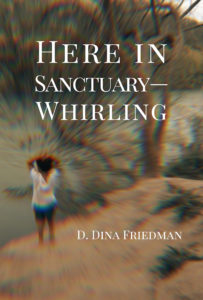
Elli also said that she doesn’t set out to provide answers in her writing, only to explore questions. I think this is an important direction and distinction for writers and other creative artists. After keeping my writing mostly separate from my politics because everything I tried to write sounded fake and didactic, I realized that I needed to center on the nuance, not the solution.  When I finally put together my immigration-justice themed short story collection  Immigrants, and my chapbook of poems, Here in Sanctuary–Whirling in a sense, all I was doing was whirling around my own questions. I had no answers (and no evidence that any so-called “answer” I came up with would be the right answer). I only wanted to expose what had been ignored by a harsh rationalistic rhetoric that focuses on question/answer, right/wrong and completely ignores its potential impact on human beings.

I haven’t yet read Elli’s newest book, but based on what I heard from her reading and how much I enjoyed her previous novels, I can happily recommend it. And even if it doesn’t solve these bigger questions, I’m sure it will help me think more deeply about them.

Subscribe at http://ddinafriedman.substack.com

Marie Kondo-izing My Poems

Every two years in late February/early March I go through a process of reviewing my file of “active poems:” and revise my send-out A and B lists by consigning the poems that are no longer speaking to me as well as I want them to, to one of three places: “Poems to Work On,” “Meh,” or “Inactive.”

Anyone who has seen my house will know immediately that while I might admire Marie Kondo in theory, I don’t put any of her principles into practice. But for some reason, I find revisiting and re-categorizing my poems highly soothing. And I like her simple criteria for deciding on whether or not to “keep” a poem: Does it spark joy?

Diarmuid Greene / SPORTSFILE / Web Summit, CC BY 2.0 <https://creativecommons.org/licenses/by/2.0>, via Wikimedia Commons

So far, I’ve gone through all the poems in my send-out list re-evaluating them according to the following criteria:

  • If it still packed a meaningful punch (at least in my own mind) when I read each of my A-list poems over, the poem stayed where it was.
  • If I wavered, or if the poem felt still good, but just not as crucial to what I wanted to say to the world right now, it went to the B-list.
  • If there seemed to be something missing or unfinished, I stuck it into my folder of “poems to work on”
  • If the poem felt as finished as it was going to be, but held no energy for me, it went to the “Meh,” folder
  • And for the poems that no longer sparked any joy, either because they lacked craft, clarity, or relevant meaning for me. Or, if they felt dated in some way (too connected to a past event) off they went into the Inactive folder

Like Kondo, I tried not to overthink my choices. I simply read each poem and thought, Does it spark joy? 

After I went through the A-list poems, I went through the same process for the B-list poems, leaving some where they were and moving the rest to one of the folders. The best moments were finding a few B-list poems that sparked a lot of joy for me, which I moved to the A-list, either before or after some minor tweaking.

Part of my B-list consists of the poems that have “been around…” i.e. rejected more than 20 times. If I like these poems, I still send them out, just not as often. And while I didn’t move any of these back to the A-list, I found a few that I thought could be improved with some work and others that no longer held interest for me, whittling down my list a little further.

Then I read through the poems in the “Meh” folder, many of which I demoted to “Inactive.” But there were a couple of surprises that found themselves on the A or B lists, and a few others I put into “poems to work on.” And, of course, several stayed where they were.

Next up will be the poems in my Inactive folder. There’s nowhere lower on my classification that these poems can go–I don’t throw anything in the digital trash unless it’s so embarrassing or so personal I wouldn’t want anyone to find it after I’m dead. But I do try to sift through this pile every couple of years to find a few sparkles of joy in the dust. Unlikely any of these will go straight to the A-list, but I’m hoping a few will find their way into poems to work on.

And finally–where the real work will begin–the now swollen folder of poems to work on promises to keep me busy for several weeks, if not months. I won’t necessarily “finish” all the poems here to any level of satisfaction. In fact, some I’ll grow frustrated with and put back in the “Meh” or “Inactive” folders. And some poems have already been sitting in this folder for months or years. They will also need a Kondo assessment as to whether they still spark joy. But I am hoping that with some intensive revision, some of these poems will make it into either the A or B lists.

Of course, my favorite folder is the one marked “Published.” I don’t Kondo-ize this folder because once someone else has “claimed” the poem for their little corner of the universe, the best thing is to let it go–even if I can still find its imperfections. Yet, I do enjoy looking through this folder when I’m searching for poems to read at readings, or come across journals willing to accept reprints, or when I simply want to read some poems that spark joy for me.

But the big question remains: even though I do find “Kondo-izing” my poems so satisfying, will I ever get up the nerve to tackle my closet?

Subscribe at https://ddinafriedman.substack.com


Calm, balanced, and focused

Daily intention-setting has become a regular practice for me. And I’ve finally managed to veer away from the laundry list of all I’d might like to get done to more helpful guiding questions like: How would I like to feel today? Or, With what qualities will I approach my day? Sometimes I lean into joy, or appreciation, or kindness. But what comes up more than anything else are three words: calm, balanced, and focused.

Calm has never been my modus operandi. And I may have even convinced myself at various points in my life that it was fine not to be calm, because too much calmness would flatten the angsty juice that drives my writing and other modes of creative expression. But especially in the last ten years, as my anxiety and blood pressure increased and I began to feel world issues on a more visceral level, the absence of calm began to feel like a tunnel in the shelter I built around myself that kept widening, leaving a clear path for termites.

Calm by Nick Youngson CC BY-SA 3.0 Alpha Stock Images

Still, it’s hard to both lean into calm and also to feel the pain of all that’s askew in the universe. How many violent videos and horrible news stories can we take in before feeling flat and numb? It took me a while to realize that calm is not the same as numb, and that I could let myself feel and acknowledge painful realities without having to feel subsumed by them. In fact, being calm has made me a better activist, and I no longer fault myself for putting down the phone, and choosing not to read a particular post or article because I’ve had enough.

What this is about is being balanced. While I certainly take in my share of bad news and many times find myself ensconced in the sadness of either a personal or worldly situation, I’m at my best when I can stay out of overwhelm and balance my emotional responses with steady and thoughtful action. Balance also means tempering my day by adding nurturing and self-care to the things I put on my task list. And it also means balancing my expectations because I never get everything done on my task list!

And being balanced also means applying a steady focus on whatever I’m doing, rather than being distracted and trying to too many things at once–which, of course affects my ability to stay calm. And I’ll admit, right now, I’m feeling a bit frenetic because I only have 45 minutes to revise and post this blog before I’m called to other tasks that have times assigned to them for the rest of the evening. And I’ll also admit that I haven’t been very focused while writing this, as I keep veering off to answer emails or texts, or check social media. Intentions, at best, are aspirations that aren’t always met. So in addition to addressing my tendency to distract myself instead of focusing, I also need to be gentle–if firm–when corralling myself back to the task at hand, without beating myself up with a barrage of self-criticism.

Despite not always fulfilling my intentions, I find setting them useful. Because the ratio of calm/focus/balance to frenetic/distracted/overwhelmed has definitely increased–significantly–just by putting forth the desire. And the best is when I notice times that I’m deliberately cultivating calm and focus and choosing to ignore the urges toward reactiveness and self-distraction bubbling up inside me.

Subscribe at https://ddinafriedman.substack.com

Detaching Ourselves from Our Stories

One of my favorite self-help books is Byron Katie’s Loving What Is. Katie’s method for getting to self-acceptance is quite simple on the surface; yet, delving into it can reveal all the complicated knots we tie around ourselves to make our lives sadder and more stressful than they need to be.

The process works like this: First, write about the situation that’s affecting your ability to be joyful in as much detail as you can muster, focusing on what angers, upsets or disappoints you. Likely, a “story” will emerge from your writing. This may be a familiar story you tell yourself, emphasizing common themes of self-judgment. (i.e. I’m always so disorganized, I never get things done on time…)


Then, Katie advises, ask yourself the following four questions:


  • Is it true?
  • Can you absolutely know that it’s true?
  • How do you react? What happens when you believe that thought?
  • Who would you be without that thought? Turn it around: Find three specific examples of how the turnaround is true in your life.

For years, the story I told about my piano playing was that I had huge family expectations placed on me because I had perfect pitch and also came from a family with many professional-level musicians. But I realized when I was 14 that I couldn’t play as well as I wanted to, so I quit piano. And that was the worst decision I made in my life, because if I hadn’t quit, somehow, I could have pushed through the technical obstacles and played at a higher level. So, to compensate for my failure, I pushed my children into music and piled all the leftover family expectations on them, which made me a terrible parent.

Is it true? Not really. But I had to wait 50 years, return very cautiously to piano, and write a memoir to figure that out.

Can you absolutely know that it’s true? Apparently not. My children said there was no need for me to ask their forgiveness. And neither they, nor anyone else in my immediate or extended family, experienced the generations of family pressure that I felt.

How do you react, what happens when you believe that thought? Even now, when I replay that familiar story in my mind, tears come to my eyes. I feel sad, angry, and like a complete and utter failure.

Who would you be without that thought? I would be free—able to make music on my own terms without self-judgment or generational baggage.

My Turnaround: I was a musical child with challenged fingers. This prevented me from going on a serious track with piano, but I had an inner understanding of music that shone through my expression. After quitting lessons, I never really gave up playing the piano because I loved it so much. And later, I explored other modes of music—guitar, chimes, klezmer music, singing in choruses. My brain, heart, and soul thrive on music as a staple in my life. Now, I’ve gone back to practicing piano more diligently and I’m amazed at how much progress I’ve made. What’s most gratifying is that I’ve stopped putting myself down for mistakes. Instead, I’m focusing on transmitting mood, color, and the ebullience I’m feeling as I vary tempos and dynamics. I’ve gotten to a place where I’m owning the piano again.

What stories do you tell yourself? How can you turn them around?

Subscribe at https://ddinafriedman.substack.com