Photo by D. Dina Friedman
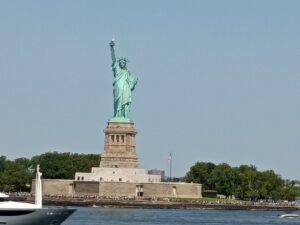
Back in the 1980s when I was working as a VISTA volunteer in Brooklyn and had very little money for entertainment, the Staten Island Ferry was one of the best bargains and a most pleasant way to spend a summer afternoon. You could ride back and forth as much as you wanted back then. Now, you have to get off the boat and get back on, but the ride is free (in the 1980s it was a quarter.) If you don’t want to pay a lot of money or deal with the crowds at Liberty Island, the ferry can give you a pretty darn good view of the Statue of Liberty, which still stirs something in me–maybe even more so in these turbulent times. So, I was excited to ride the ferry again on my way to visit friends in Staten Island when I was in NYC last weekend.
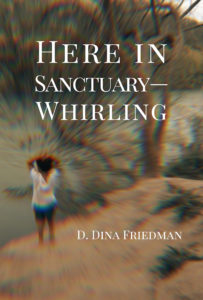 Once again, as we passed through the harbor, I thought about my own history with the Statue of Liberty, which I wrote about shortly after going to the refugee camp on the Mexican border in 2020. Here’s the piece. It was originally published in Prose Online in 2023 (You can hear me reading it, here) and then republished in my chapbook, Here in Sanctuary Whirling.
STATUE OF LIBERTY
I.
You can’t really forget a green statue, because when you’re a kid you know that statues are not supposed to be Comet-vomit-green. We took a boat. I was little, maybe four or five, and I couldn’t see over other people’s heads. We might have gone into the statue, but maybe we didn’t because the line was too long and my mother hates waiting in lines. My mother told me you used to be able to go all the way to the torch, but they closed that part off because someone fell, or maybe they jumped. I looked up at the torch and felt cheated. That’s the only part I remember.
II.
I took my boyfriend here when I was in college. He was from suburban Illinois, a land of tall, white, blond people. It was a windy day in January, so there was hardly anyone on the boat. We couldn’t go into the statue because it was closed for renovations. Or maybe we went in and walked up all those stairs to look out the crown’s windows to the harbor, and beyond it, to the open sea. To tell the truth, I don’t remember. To tell the truth, I couldn’t see over his head.
III.
I broke up with my boyfriend because he was blond. That’s the simplified version, though perhaps I broke up with him because he was from not-New York, or because the Statue of Liberty was closed the day we made the trip, or because the statue was open. I broke up with my best friend several years earlier when I was still in high school. She was the Chinese daughter of immigrants. We were on the subway. She was reading Ayn Rand. I told her I was a socialist and she stopped talking to me. Her stop came first. She got off the train and I watched the closing doors.
IV.
I never thought I could leave New York, but I did. That break-up was harder than leaving my blond boyfriend and harder than the day my best friend stopped talking to me. Now I’m living on a farm with tall, blond people and a lot of cows. The cows have the illusion of freedom in the pasture until they graze by the electric fence.
V.
There have been many cartoons of the Statue of Liberty being compromised. There was one where she had a For Sale sign hung around her neck. There was another with the former president, the one who hated immigrants, ripping off her head and holding it as a trophy. Before he was elected, they put a statue of this president in Union Square. He was naked with diaper rash and a sagging pot belly. The statue wasn’t green, but maybe it should have been.
VI.
I think I went once with my kids to the Statue of Liberty, but they were bored and we didn’t go inside. Or maybe we did go inside and they were bored. Or maybe we just went to Ellis Island, where I remember with certainty that they were bored, even when we found the plaques my parents paid for, which had the names of my great-great-grandparents, who came to the Statue of Liberty on crowded boats where they couldn’t see over people’s heads. It’s hard, sometimes, to raise kids in a land of blond people with too many cows.
VII.
My great-great grandmother came here to escape the pogroms. My great grandmother told me her mother said that whenever the Cossacks came to the door, she would make the sign of the cross and say “Christians Live Here,” or maybe my grandmother told me that story about her grandmother. I don’t remember. What I do remember is they both said the Old Country was very bad. Other people I went to school with were children of Holocaust survivors. We played a game in the schoolyard called Concentration Camp. It was kind of like tag, except the “it” person was the Nazi, and if they caught you, they made you do unspeakable second-grade things. In school we sang, “My Country ‘Tis of Thee,” and “God Bless America.” One year we did an assembly program called “Sing, America, Sing.” I wrote a satire called, “Cry, America, Cry.” Even then I had the leanings of a socialist.
IX.
I have recently returned from the refugee camp in Matamoros, Mexico, where there is no Statue of Liberty. Instead, there’s a tall guard at the bridge who won’t let anyone put a foot in the country to claim asylum, or see over his head. A man in the camp tells me of intruders coming to his house with guns. He tells me about being shoved into a car with his eight-year-old daughter by kidnappers demanding ransom. He tells me about being taken by immigration authorities and locked in a cold, windowless room. At least, the statue still has windows. I did climb it at least once. I remember clearly, the day I looked out through the dirty glass.
Subscribe at https://ddinafriedman.substack.com