Grabbing the Stage

A big part of who I am stems from the blessing and curse of coming from a musical family.
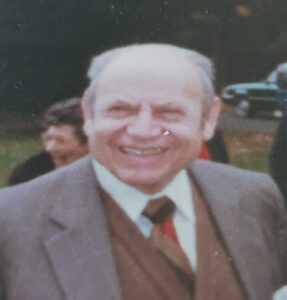
On my mother’s side, my grandfather, Pop-Pop, was a symphony violinist. He lived next door to us when I was a child and I spent many hours watching him frown at the full length mirror as he practiced, carefully positioning the bow and playing each note over and over until he got it exactly how he wanted it. From him, I learned the importance of striving for perfection, even though reaching for it might seem impossible.

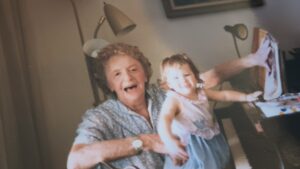
My father’s mother’s family, the Glicksteins, were just as passionate in their love of music and equally accomplished in their ability to play from the heart. My great-grandfather Abe Glickstein, a clarinet player, was known for giving Sunday afternoon living room concerts featuring his seven talented children for his immigrant neighbors at the turn of the 20th century, and for offering the services of a three-man klezmer combo (him and his two sons) to the community if music was needed for a wedding or other simcha. These great uncles, Max and Dave, went on to have notable musical careers, while their sister, my Grandma Jeanne, made her living teaching piano and recorder, and running summer music programs to spread the joy that fueled her life.
The curse of this story, as I wrote about extensively in my yet-to-be published memoir, Imperfect Pitch, was feeling that I had some sort of impossible musical bar to live up to, and I didn’t have either the patience or or the desire that Pop-Pop had to spend agonizing hour after hour at my instrument to achieve it.

But the blessing, which I think comes at least in part from my family constellation, is a love of the stage. Not so much for musical performance, since I’m still not as confident as I might want to be in that area. But give me a podium, and I’m in my happy place, whether I’m reading my poems or stories, talking on a panel about some aspect of writing craft, recounting my witness trips to the border and the Homestead Detention Center, standing up impromptu in front of a group of protesters on the street, or teaching the basics of classical argument theory to a room of bored college students.

There is something so magical about being listened to.

So, I get how disappointed my three-year-old grandson Manu felt when his parents told him they were going to take him to see the Tokyo Paradise Ska Band, which he has been totally obsessed with for a year, but, no, he was going to be on the stage with them, as he enacts when he listens to the videos, donning his sunglasses and strutting around his stage set of stacked mats, toy saxophone in one hand, mic in the other.

Because even though a seat in the audience can be a safe place, a time to relax, reset, and feel comfortably anonymous, there is something about getting out there on stage that can add a bit of technicolor to our often muted sense of self. Even if the journey there might feel like you’re standing on a balance beam above a pot of boiling oil, as I know it does for many who experience very real stage fright.

If that’s your story, I recommend, as my co-facilitator and I taught for many years in a course we developed called Public Speaking for the Terrified, to start small: read your work, share your art, play a song, or speak your heart to a trusted group of friends in your living room, making them promise that they will give you only praise for what they liked and what resonated. At some point you may be ready for a combo of both praise–never forget the praise–and critical feedback, but make sure to have a notetaker to write both of these things down. Otherwise, all you’ll remember is the criticism.
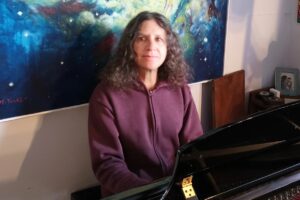
Whether it’s genetic or environmental or some of both, I’m grateful to my forbears for modeling not only their love of their art, but their passion for sharing it. And grateful that, for the most part, stage fright is not an issue for me. Perhaps some day I’ll take a more terrifying step and sign up at some large, anonymous karaoke bar. Or not.

Subscribe at https://ddinafriedman.substack.com

I Hear You

Last night, I received an amazing gift–a long email from my cousin (someone I don’t see or talk to very often) containing heartfelt and thoughtful reflections on my music memoir manuscript, Imperfect Pitch. What struck me most was that even though his experience was different from mine, being 18 years younger and on the other side of the family tree, he could resonate with the way family messages contributed to the themes of the book, particularly around perfectionism. In other words, he heard me.

And as feedback about Immigrants oozes in slowly, I feel gratified for the readers who have mentioned the ways the book has touched them. I was particularly taken with the Amazon review that referred to the book as a “journey of the heart.”

Also last night, I attended a reading around 40 minutes away at the Lava Center in Greenfield, MA to hear my friend D.K. McCutchen read from her book, Whale Road. Before she read, many poets shared work at the open mic., much of which was–by their own admission–work in progress; some of it was written that day. While my inner perfectionist-in-recovery was awed by some of this risk-taking, especially when hearing a few hesitations as people paused over scratched out words and read phrases that my inner editor was ready to cut, the point wasn’t to read “perfect work.” The point was to be heard. Many people read highly vulnerable material, that exposed them in all their rawness. And the response from the audience, as appropriate, was simply, I hear you. 

This Third Tuesday reading series seems to have created a warm, accepting, enthusiastic and tight-knit community. While it’s doubtful I’ll attend regularly because of the distance, I’m glad it’s there. We all need to find “our people,” those who will honor our need to be heard.

At yet another writing event I attended this past week, a round table discussion by Straw Dog Writers Guild entitled Your Writing Practice: Pitfalls and Solutions, facilitated by two faves in my writing community, Michael Favala Goldman and Lindsay Rockwell, many writers who were there talked about community as one of their biggest needs. And as some attendants lamented about losing their “inner oomph,” others discussed how community is one of the best cures for getting that inner oomph back–someone (or someones) who can say I hear you, and who will give you encouragement to share your work with others, even when it’s not (yet) perfect.


Showing Up

Last night I participated in an on-line reading organized by Colossus Press to celebrate their newest anthology of writing about the body. I was happy to be one of eight featured readers sharing deeply personal and compelling material. Tonight, I’m heading to our local monthly reading, Writers Night Out, to see my friend Carolyn Cushing, the poet laureate of Easthampton. Tomorrow night, if I didn’t have another meeting, I’d be hanging out on Zoom with my poetry gals extraordinaire, an invaluable support and critique group that someone I met at Writers Night Out invited me to join. Had I not come that night, I never would have found these folks. Yet, as usual, I had to ignore my introvert leanings and force myself to go.

Showing up pays off–nearly all of the time. As much as I might not be able to totally void myself of the notion that the ideal writer lives alone in a cabin in the woods and doesn’t speak to anyone for days in order not to interrupt the precious chantings of the muse, I’m happiest in my writing when I know there are others on my team who are all rooting for each other–supporting each other through challenges and celebrating successes.

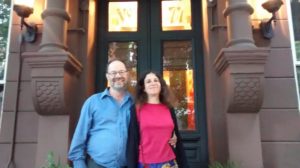
I met my life partner, Shel at the first poetry reading I dared go to, in Greenwich Village when I was in my early 20s. My inner hermit screamed for mercy as I walked up five floors of smelly stairs in a green-walled brownstone tenement, finally landing in a messy closet kitchen, where poet Emilie Glen, a woman in her 70s with dyed blond hair wearing a frilly pink negligee, greeted me effusively. Welcome! Her accent had a tinge of south in it. Would you like orange juice, lemonade, or passion fruit? 

Shel and me in front of 77 Barrow Street in 2014. We met at a reading in this building in 1978.

Emilie’s reading attracted a quirky crowd, from established New York beat poets to street people, and getting to know them opened the gates of my world. I quickly made a new set of friends, as I did again when I moved to western Massachusetts and got involved with Amherst Writers & Artists and the National Writers Union (where I found my fiction group that’s been meeting for more than 30 years). More recently, I’ve made new relationships from my involvement locally with Straw Dog Writers Guild and the Forbes Library Writing Room, and–more peripherally–with my Lesley MFA alums and people around the country I’ve connected with through offering work to their journals and anthologies. What I love about these communities is that they’re mixed: containing people who’ve accomplished far more than I have as a writer and also people who have not yet been published. Yet, there’s no hierarchy. Everyone’s work is taken seriously.

As shameful as it is to admit, there was a time in my life, shortly after my two YA novels were published in 2006 by “the big guys” (Simon & Schuster and Farrar, Straus, Giroux) that I broke away from many of these community writing groups. I’m a real writer, now. I told myself. I don’t need to hang with the “wannabees” any more.

I could not have been more wrong.

In hindsight, I equate my bad behavior as analogous to suddenly being accepted into the “mean girl clique,” and thinking that to stay there, I, too, had to act like a “mean girl” –better than everyone else. But when the “big guys” didn’t accept any more of my books and I was metaphorically kicked out of the clique, I found myself with much less of a writing community. While my inner hermit enjoyed the reprieve from being “on” so much of the time, the rest of me felt lonely and depressed.

It’s taken years to build back to a place where I have many friendships and mutual support networks with other writers. And I feel so much gratitude that they (along with my other networks of friends and family) are supporting me by buying and spreading the word about my new book, Immigrantsjust as I will continue to make the effort to buy and spread the word about their books.

And, whenever I can, I will show up.


Vulnerability, Writer’s Block, and Performance Anxiety

I’ve fallen in love with a new Chopin Nocturne I’m learning, Op. 9, No. 2. There are a few different versions of this on youtube, but my favorite is this one by Tiffany Poon. Sometimes it’s hard to listen to professional pianists play the pieces I’m learning, as they remind me, even after I get the basics down, how far away I am from ever playing with such fluidity and ease.

A friend of mine who is co-authoring a book I’m editing writes about his past experience with writers block: I labored under the mistaken notion that writing was a gift from the muse, he says. You either had that gift or you didn’t–and obviously and sadly, I wasn’t one of the chosen few. This is how I feel about piano, except that when I was a child my parents and extended family led me to believe that because I had perfect pitch, I was one of the chosen few. But I couldn’t actualize “that gift” because my fingers were never as good as my ear, especially in a performance setting. I played exactly one piano recital when I was nine–a special concert for “teachers’ best pupils” in a fancy hall in New York City–and it was an unqualified disaster, as I wrote about in detail in an earlier post: Reframing a Past Mess-Up.

I want to feel that spending the last three years returning to piano, a process that has required not only frequent practicing but also a deep dive into my family history in order to decode and defuse a long line of harmful generational messages, would put me past some of my performance anxiety. However, I don’t play the piano if anyone other than my husband, Shel, is in the house. (And if he went out more, I’d probably wait until he was gone, as well.) Even as I’ve managed to turn the screech of my inner music critic down to a low murmur and generate enjoyment from my own flawed renditions, I’m terrified of anyone else’s judgment. So, it was an odd leap of faith to impulsively ask my visiting younger child, Raf–who is a professional musician, nonetheless–if they wanted to hear this new piece I loved and was in the middle of learning. I could do this–even if it made me more vulnerable, I told myself.

How wrong I was.

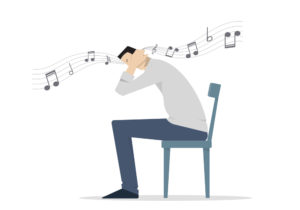
Man sitting on a chair covering his ears. Earworm concept, also know as brainworm, sticky music, or stuck song syndrome. <a href=”https://depositphotos.com/vector-images/places.html”>Earworm Concept. Man Sitting on a Chair Covering His Ears. – depositphotos.com</a>

Even though I could already play the piece decently with just a few rough spots, knowing Raf was listening made me miss the easy notes as well as the hard ones. My baseline totally fell apart and it seemed to be a matter of chance as to whether I was going to hit the right chords or the wrong ones. Keep playing! I told myself, even as I could barely breathe. Focus on the expression–why you love this piece. Somehow, I managed to finesse the melody, finally landing pianissimo on the last few chords, their soft reverberations calming my shaky insides.

It will be a long time before I do that again, I said to myself. But something had shifted. Unlike the time I was nine, the minute I stood up and walked away from the piano bench, I left the incident behind me. My inner critic didn’t take this little blip as a chance to screech with delight. It stayed at its current murmuring level, which I could easily drown out the next time I tackled the Chopin.

My friend writes about writers’ block, Now I accept without pain that I am a reasonably competent writer. I don’t need to be special in order to enjoy the writing I produce. While I prefer to use “aspiring,” rather than “reasonably competent” to describe my musicianship, the last sentence rings true. I don’t need to be special in order to enjoy my piano playing. Even if I may not be ready to play for others very often–or at all; for myself, I can play well enough to express what’s in my heart. And in any art we might pursue at whatever level we might be at, that’s what should matter–whether or not we choose to make ourselves vulnerable by sharing.

To subscribe, sign up at ddinafriedman.substack.com


Who is Your Audience?

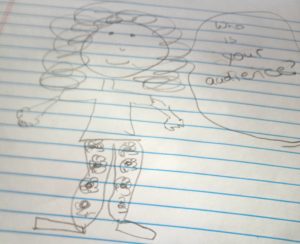
Back when I started teaching business communication and my children were still young, my daughter drew a cartoon picture of me: a frizzy-haired cartoon stick figure with my signature hippie flowered pants and a huge dialogue bubble coming out of my mouth that said, “Who is your audience?”

The picture, a light-hearted attempt at making fun of the teaching adventures and insights I talked about incessantly at the dinner table, lived on the refrigerator for a long time. I wish I still had it, but somewhere along the way, it joined the big compost pile in the sky.

More recently than that, I finally stopped teaching business communication, but the message lives on in my creative life. Every time I write something, I need to think, who is going to read this? Whom do I want to read this? My parents? My children? Other writers in my various circles of creative community? The general public? The literary public? The snotty branch of the literary public? My intimate friends who know and love me, but don’t really know me as a writer? Or is this something I’m writing only for myself that doesn’t really need a home in the wider universe?

Like many, I often feel driven to share my work because I want the affirmation–not so much to be told I’m a good writer, but to know that the reader got whatever important thing I was trying to express. That it mattered. That something I said moved them.

So it can be devastating when that doesn’t happen. Especially when a piece is brand new and I’m high from the excitement of having just birthed it. Later, as I gain perspective and see the piece as a work-in-progress that will likely continue to evolve, I feel more ready to hear whatever comments people might have, even if they didn’t get what I was trying to do (perhaps because I hadn’t really done it yet).

So, I tend to think about levels of audience when deciding to share a piece. The safest places–and pretty much the only places where I share raw work–are my various writing communities, because there’s a sense of all of us being in it together, and often the type of “allowable” comments are set in advance by the norms of the group. Therefore, I know I’m not going to get deluged with negative comments, irrelevant asides about how my experience is like theirs, or grammar corrections,

The least safe places, somewhat surprisingly, are in my close circle of family and friends– partly because their opinion matters too much, and I so desperately want them to grok what I’m saying. When they don’t, I feel crushed. It’s so hard to let go of the time my mother said, Can’t you write about anything other than death? Or when my husband, who usually gets it, reacted to a brand new, raw heavy heartfelt dump by telling me there was a comma missing in the second sentence.

And then there’s the bigger question of when to offer your work to an outside audience, which can set you up for tons of rejection, putting you at risk at denting the foundation of your inner confidence. And even if you’re lucky enough to get something accepted and published, you can end up as fodder for trolls on social media sites or critics who might give your work bad reviews.

If you take this scary plunge into the depths of different on audiences, on whatever level, affirm yourself for being brave. Here’s my brave attempt at recreating that picture from the refrigerator. It’s a good reminder to think about our goals for writing and our reasons for sharing with others.

To subscribe sign up at ddinafriedman.substack.com