Mirror, Mirror on the Wall…

When I was around 6, I never felt that any of the images I saw in the mirror, twirling around in my powder blue party dress, school bound in my navy blue jumper with the gold buttons, or lounging in my light cotton pants and Danskin turtle-necks was really me. Other children in my class looked like themselves–in and out of the mirror–but I could barely recognize myself as a body with a face and curls and skinny limbs. Who was that apparition that stared back at me? It didn’t look anything like the way I envisioned myself. What did I–whoever I was–really look like? When I ran the “me card” in my mind, there was no face or body. “Me” was a wispy, invisible thing rooted in my brain’s fuzz: airy and intangible. And even after decades of body-grounding practices, that little germ of me is still that flighty, fuzzy thing, nearly impossible to see.

So, for this reason, I’ve always been wary of mirrors, or any item like video or audio recorders, that attempts to cast some aspect of myself back at me. It’s hard for me to watch images of myself in motion or listen to myself speak. When I taught my classes on Public Speaking, I told my students that while recording themselves could be helpful in noting areas they could improve on, it would be better not to record if they didn’t have the stomach for stepping out of their own self-perceptions and seeing themselves as others saw them.

Over the years, I’ve grown more immune to this schism in self-perception. Now, when I look into a mirror, I have an expectation of what I’m going to see, and the resulting reflection doesn’t surprise me, even as my aging body is becoming more angular, my hair slowly more gray. I can laugh when I see interviews of myself using my hands when I talk, and enjoy listening to myself reading poems. While I still don’t like my voice, which seems to be growing grainier and more old-ladyish by the minute, its New Yorker inflections continuing to underly my roots despite 40 years out of the homeland, I can appreciate my expressiveness as well as the echoes of my family legacy–poignant inflections that sound so much like my mother and grandmother.

But last night, I took a big step into the void between self-perception and reality. I recorded myself singing.

As I mentioned in a previous post, I completely lost my ability to sing without croaking a few years ago, and it took a year of lessons before I could get my voice back. This felt like a big investment because didn’t have a strong solo voice that felt worth preserving. But I missed being able to sing in choruses or community gatherings so much, it felt essential to my mental health. One of the most fun things about voice lessons was practicing solo songs, so since then, I try to devote a couple of evenings a week to doing vocal exercises and singing along to Karaoke tracks or accompanying myself on the piano. It’s a blast!

Truth be told, when I think of myself as a singer, I’m kind of like that picture of a cat who looks in the mirror and sees a lion. At least, that’s what the wishy part of me wants to see. Mirror, mirror on the wall, whose the fairest singer of them all? I knew that recording myself might quickly put a pin in my inflated self-perception, but I felt that it was finally time to do what many public speakers do: listen to themselves with minimal self-deprecating judgment, but a clear focus on what they can improve.
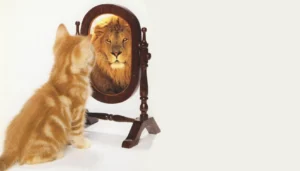
1_jFtg4OKUNLHnFjETiizx_A

So I turned on my cellphone recorder and hit play, totally prepared to delete the recordings if they were too painful to listen to.

What did I hear? Yes, my grainy, New York, old lady voice. But good breath control and good vibrato. On pitch nearly all the time with just a few flat notes I could work on.

Did I sound like someone I’d want to listen to on Spotify? No. Could I sing competently in a group, or lead a song if I wanted to? Absolutely.

And that’s what I used to tell my public speaking students. You may never speak like Martin Luther King, but that’s not the point. You can get to a place where you feel more competent, more confident, and hopefully begin to like what you’re doing.

Truth: I did delete the recordings after I listened to them. But not because I was ashamed. I think I just wanted to hold onto the illusion of the cat seeing the lion in the mirror. Better than the little girl who couldn’t see herself, even when she was dancing.

Subscribe at http://ddinafriedman.substack.com


All or Nothing

In these turbulent times in the world, I’ve seen the point of celebrating the wins and not sinking too deeply into the quagmire of yes-but…

But in my own personal life, I’ve realized that one of the key manifestations of my struggle with perfectionism is the way I can so easily frazzle into an “all-or-nothing” mindset, berating myself for the things I didn’t get done, rather than acknowledging with gratitude what I’ve accomplished.

Take the last few days where I feel I’ve been spinning my wheels, unable to ground myself in my writing, eschewing any activism-related task that didn’t affect other people or didn’t have a deadline, and once again putting the pile of administrivia I told my partner I’d finish last week (or was it last month) on the I don’t have the mindset to deal with this right now pedestal. And yet, I still felt so harried and busy I didn’t even have time for walking the ersatz dog in the woods, a nurturing and healthful habit I’ve resolved to keep up ever since my four-legged personal trainer passed away many years ago.

So, what did I do instead? I took care of my grandson; worked out at the Y (where I need to do weight training for osteoporosis), did some PT exercises and yoga/cardio at home, made an elaborate dinner trying to use up as much cilantro as I could from our generous farm share, tried to catch up on a week’s worth of local newspapers, had a long impromptu strategy call with an activist colleague, picked several pints of blueberries and raspberries that are coming in and ripening faster than we can gather them, and pulled just enough weeds in the garden to keep them from taking over.

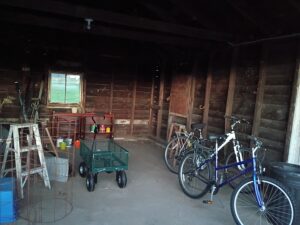
And I cleaned the garage.

This mucky job has been so low on the list it’s underwater. But we’re getting some work done on it, and our contractor offered us quick and easy debris removal if we could clear it out now.

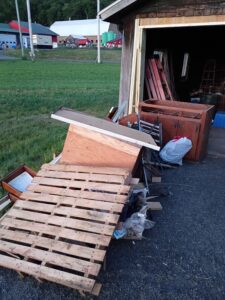
(Everything has been moved to the middle in order for the contractors to complete their work, but about half the stuff is gone!) Photo by Shel Horowitz

So, for the first time in years our garage looks habitable, though sweeping the floor alone took at least 45 minutes and required a good dust mask. We’ve added considerably to the heap of construction debris and put a few things out on the corner for people to take if they want them.

Photo by Shel Horowitz

So, I should feel good, right?

But in the all-or-nothing mentality that my perfectionist brain lives in, I keep pivoting to what I didn’t do. Even though I am finally getting the insight that this kind of thinking does not serve me. It’s what prevented me from truly enjoying the piano for so many years, because I couldn’t accept my imperfect playing. (Side note: Another thing I’m annoyed with myself about is that due to what feels like other must-do time commitments, I’ve barely played the piano in weeks! ☹️)

And this is what also gets me feeling so down in the dumps in my social change work, and shut down and triggered by others who do more than I do, or who are purer in some way in the political and lifestyle choices that they make.

So now it’s time to think about other ways I can be sabotaged by an all-or-nothing mindset, so I can try to make some changes. And I’d better do this all the time, because otherwise, I will be a total failure in eradicating (another good all-or-nothing word) my perfectionism. 😊

I’d love to hear about other people’s struggles with all-or-nothing. And what you do to address it.

Subscribe at https://ddinafriedman.substack.com


Taming “the Shoulds”

Now that I’ve been prescribed 40 minutes of physical therapy exercises every night on top of everything else I try to do daily (or, if not daily, several times weekly) for my physical, mental or creative health–not to mention my incessant compunction to at least try to do what I can to make the world a better place–I feel like I’m collapsing under the final straw of “shoulds” that broke the (clichéd) camel’s back.”

A differently wired person might approach this conundrum with a higher degree of rationality. Pick the 3–or 4, or 5–most important things. Focus on them and forget the rest.

But it’s all important! I argue. I might enjoy some activities more than others, but when I think about the overall benefits of the things I choose to do with my life: whether it’s writing or music; spending time with friends, family, or my grandson; walking in the woods; gardening or food prep; activism; or all my meditation/exercise protocols; there’s not a single thing I want to cut down on. And while I don’t like most other household maintenance tasks, there’s just so much I can afford to let my anxiety rise at the worry of leaving them undone.

So, instead, I’ve been experimenting with how I’m looking at the totality of my life and the activities and tasks that comprise it–a circle, that if anything, keeps widening rather than shrinking. For the last few days, I’ve set the intention to focus well on one thing at a time, rather than getting distracted by all the other “shoulds” that constantly ping like little cat bites on my ankles reminding me that they’re still here and need my attention. This has been somewhat successful–at least more successful than dealing with my cat, who really does bite my ankles all the time when he wants attention.

Photo: Shel Horowitz

It’s true that at the end of the day, the list of things I didn’t get to is still much longer than what I got to, but the “consolation prize” of feeling more happy and content, and ensconced in the minute-to-minute experience of whatever I’m doing, has definitely been a mood booster. And, as consolation to my perfectionist overachiever self, I can absolutely sense how allowing everything else to blur into the background while keeping my attention on whatever I’ve chosen to do has enabled me to do whatever I am doing much better and with much more satisfaction.

What’s also important to acknowledge is the immense privilege and gratitude I have in being able to lead the life I want, even if I might consistently want to do more than I’m able to achieve. This isn’t a consolation prize. It’s a huge way of shifting how I look at the whole Issue.

I don’t think I’m ever going to cure my “ADHD of the Soul,” nor am I willing to take any real or metaphorical drugs to taper my plethora of interests and desires. There’s just too much out there that begs to be engaged with. But any interventions I can employ to stop making myself feel bad because I “should” be doing more of it–if not all of it–are certainly worth trying. I’d love to from others about how you’ve addressed this all-too-common problem among those of us trying to live satisfying, meaningful and creative lives in a creatively challenged universe.

Subscribe at https://ddinafriedman.substack.com


To-Do List Hypermode

I’m excited to tell you that my next post will be from Croatia!

I’m looking forward to meanders by the sea, exploring hiking paths with gorgeous lakes and waterfalls, old towns with narrow alleys and medieval buildings. Most of all, I’m looking forward to a break from my life’s nurturing but relentless to-do list, even as I know that all those to-dos in my regular life will somehow seem much sweeter and more meaningful on my return.

Meanwhile I’ve been scurrying around for the past few days in “To-Do List Hypermode,” trying to get things done that I don’t want left hanging when I get back in early May. Already, I know I have to figure out a way of giving myself dispensation because I know won’t get to all of it, and sadly, a lot of the administrative and deeper household maintenance tasks that I often put off for months will likely still be waiting for me. In the meantime, I’ve done the things that feel more essential and time-sensitive, like drafting a thank-you letter to our fabulous Congressman, Jim McGovern, for his unannounced visit to the Burlington ICE office/detention holding facility last week, writing an article for our immigration justice newsletter, and starting on an agenda for the next monthly meeting of our regional immigration advocacy network, which I’ll miss, but am still committed to helping with planning.

And I completed my April writing submissions goals (I usually aim for around 10/month).

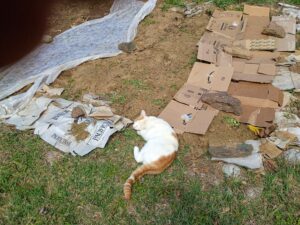
I also planted the peas this morning. It’s a bit early, but if I wait until I come back, it will be too late. This involved digging up and composting a big chunk of my cover crop, covering the peas with seed cover to protect them from the birds, and carpeting the rest of the exposed area with as much cardboard as I had to keep the weeds from a three-week party.
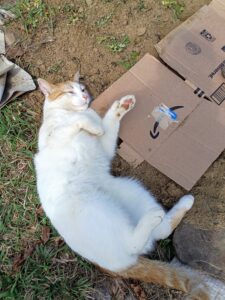
I could list tons of other stuff that’s still a hopeful maybe on my list. And that doesn’t even include the essentials of packing, acquiring last minute stuff we need, using up perishables in the fridge, and making sure the house is tidy enough for our friend who is coming to live here and take care of Andre the cat. But I’m trying to let myself off the hook for most of it. What did I write about a few weeks ago: calm, balanced, focused…? So much of my battle with myself is to stick with the task at hand, rather than get distracted by something else.

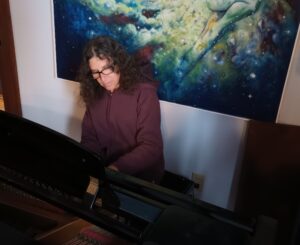
Of course, weekly blogging is always on the to-do list. So, I’m glad to get this task checked off, even if this isn’t the most profound blog I’ve ever written. It’s an interesting process, trying to figure out what to blog on each week. I usually get to a topic by thinking about what’s gone on in the past week (either in my own life and/or in the wider world) and then–hopefully–connecting that incident or event to some bigger theme related to art for change, writing, activism, or a niggling question about the universe that I hope others share.

But today, it’s just about that endless to-do list and the way it gets so bloated before traveling. I guess that might be universal–our inclination not to leave too much undone. I do take solace in the fact that the minute I get on the plane, the memory and thoughts of what I didn’t do will disappear like wisps of cloud sinking far below my view-scape.

At least, until I get back home…

Subscribe at https://ddinafriedman.substack.com

Vacation–And Motivation

Often when I dream of vacation, I dream big. In a few weeks (provided the world and my family life hold stable), my partner, Shel, and I are headed to Vietnam and Cambodia. We’ve already been to more than 40 countries in 5 out of 7 continents and in all 50 states in the U.S. And while we’ve occasionally repeated a destination, the draw of going somewhere we haven’t been, with its promise of experiencing something entirely new and wonderful, has usually been a greater pull. We’re determined to get to many more hard-to-reach places before age or health drags us down.

And while all this travel has had its bumps, I can honestly say I haven’t regretted going anywhere I’ve been. I remember everything fondly: from the hours waiting on the side of the road for nearly non-existent buses to take us to the next town in Mexico, to trying to cross a street in India with eight lanes of cars, tuk-tuks, bicycles and motorcycles going every possible way and giving up, to randomly pointing at vegetables in the cooler at a restaurant in western China in expectation of a stir fry and ending up with ten separate vegetable dishes, to driving for days through the gorgeous but mostly deserted Quebec countryside to reach “au bout du monde” the place where “the world ends,” dropping off into the sea on the eastern edge of the stunning Gaspé penninsula.

But sometimes the small get-aways can pack a similar sense of wonder. Last week, to celebrate our 42nd wedding anniversary, we drove a whopping two hours across the state and spent three days exploring nature preserves and beaches in southeastern MA and southern Rhode Island. It was just what I needed.

Photo: D. Dina Friedman

While my home landscape (the one that evokes feelings of comfort, security and spiritual peace) feels firmly footed in deciduous forest here in Western Mass. and elsewhere in the Northeast (despite my birth roots in the littered concrete of Queens) I adore fresh breaths of beach: not only the damp salty air and heartbeat of the waves, but also the plants–rosehips bullrushes, searocket, and the quiet marshes with occasional glimpses of egret. All of it is just different enough to open up the wonder of being elsewhere. And my absolute favorite time to go to the beach is in October, when there’s nearly no one else there, especially when it’s tinged with fog, though we were blessed with the last of the sun before the winds picked up and a Nor’easter set in.

Going to a deserted beach, or really on any kind of vacation, is one of the ways I have of showing compassion for myself, which is not an easy thing for me. Today, as part of a 10-day meditation challenge focused on attaining a more positive self-belief mindset, I was asked to pick one thing I was annoyed with myself for. I guess I shouldn’t have been surprised that what popped into my head was: Not doing enough. That’s too general, I told myself. Pick one thing. But I couldn’t. Because, it’s rarely about one thing I’m not doing that I think I should do. It’s about everything I’m not doing–an onslaught of tasks, real or imagined, that spreads out before me like a “whack-a-mole” field.

But when I’m on vacation–whether, I’m in China or eastern Massachusetts, I’m able to put that ridiculous perfectionist-derived list aside and take pleasure in the beauty and wonder of the moment.

After we picked our “one” (or in my case–many) things we felt annoyed with ourselves about, we were instructed to first pay attention to the feelings this engendered. For me, that was sadness and a deep sense of inadequacy. Then we were asked to speak to ourselves with kindness and compassion, as we might speak to a close friend. I immediately flashed back to a conversation I’d had with a friend the day before who has been struggling with a number of challenges–how I told him, you are one of the most motivated people I know. Which was the absolute truth.

Now, can I say that to myself? Yes, I can probably give myself an A for motivation. Perhaps the issue is not my aspirational desire to do all the tasks I set before myself. I just need to give myself a reality check on what’s feasible, so I’m not mentally beating myself up for my inability to do more than I can possibly do.

It’s something to think about anyway as I look forward to another self-compassion break when we’re in Vietnam. Meanwhile, the blog is done. On to the next thing on my to-do list!

Putting Your Work Away and Bringing It Back

My daughter’s piano teacher used to tell her that when you put a piece away for a while and then bring it back, it comes back better.

I think this is also true for writing–at least it’s true for me.

Most recently, I “put away” my piano memoir, Imperfect Pitch, for several months. I had been shopping it around unsuccessfully for a couple of years, and then I was offered a consultation with an agent who told me she thought it would be more marketable if I turned it into a “self-help memoir.” So, last summer I added a bunch of short sections reflecting on the themes I’d raised and offering prompts and prescriptions people could use to tackle perfectionism and self-judgment while amplifying joy and forgiveness. I was excited to give that version to a few readers, but then disappointed when they uniformly said that the self-help voice was intrusive and detracted from the thread of the story.

I put the book away for a couple of months so I could read it fresh. But other than realizing that they were right, I couldn’t figure out what to do.

Then winter hit, along with the new administration and my father’s illness and death, and I was too depressed to do any substantive writing for a while. But the book was there at the back of my mind, niggling me. The project was too important to me to abandon. In fact, of all the things I’ve written, this is the book I most want people to read, because I believe its messages about creativity and mattering are essential to healing ourselves–both individually and as a culture. That was why I was going for an agent and the big publishing houses, rather than the small ones–and why I was willing to take this agent’s advice about so-called “marketability.”

But as the months passed and my writing fog started to clear, I realized it was ok for me to loosen my expectations on the marketability angle. I’ve always personally been an outlier when it comes to popular culture. So why should my book be any different? Yet, there was something in the added sections I liked–a wiser voice that could look back on the memoir incidents I wrote about and make sense of them. It was the poplike “you-too” voice that felt insincere and inauthentic to my newly attuned ears.

So, I took out that voice and shortened the reflections, making sure they all sounded like me–a wiser, calmer me than the me in the throes of wrestling all my musical baggage, but still me, without artifice. I hope they now feel like a cool wave momentarily breaking the heat. We’ll see. I’ve given the book to at least one more reader. And then, after what will likely be another round of revisions, it’s off to market one more time–perhaps no longer exclusively on the big press circuit. While I’ll continue to attempt to build my platform, I’m no longer interested in being anything less (or more) than who I am, whether or not my messaging ever gets popular enough to build a huge following.

Photo by Shel Horowitz

Incidentally, I also put away the Brahms Intermezzo I fell in love with and worked diligently on for two months. I got it down pretty well, but far from perfect. Which is ok, now that I’m no longer mentally beating myself up for piano imperfections. Still, I hope I’ll be able to make it way better when I pull it out again.

Have a listen here from pianist Jean Marc Luisada.

Subscribe at https://ddinafriedman.substack.com


You’re Supposed to Say, Bravo!

My two-and-a-half-year-old grandchild, Manu, loves to play songs on the piano, which he does by pressing down on random groups of notes in the song’s rhythm. Often he sings along, eradicating any question I might have about what song he’s playing, Sometimes I sing with him, but mostly, what he wants me to do is listen–and then burst into wild applause as soon as he plays the final note.

But a few weeks ago, suddenly that wasn’t enough. He turned to me and said, “You’re supposed to say, bravo!”

“Bravo!” I willingly added.

“No!” he said. “Bra…Vo” emphasizing each syllable with equal force and leaving a breath of air in between.

“Bra…Vo!”

“No, Braah…..Vo…oh..”

“Braah….Vo..oh.”

We went through this a few times. Apparently I couldn’t say bravo exactly the way his babysitter said it, but after a while he let it go and went on to something else. Thank goodness for two-year-old attention spans.

But I’ve been thinking about the message, regardless of whether I can pronounce the word bravo to Manu’s liking. We could all use more bravo in our lives.

As some readers of this blog know, four and a half years ago I started playing the piano again after pretty much abandoning it for most of my adulthood. This required way more than beefing up my music reading and finger dexterity. It involved delving into and confronting baggage that had plagued me my entire life–my debilitating perfectionism and the resulting shame at not being able to live up to the standards enshrined in our family legacy of professional musicians.

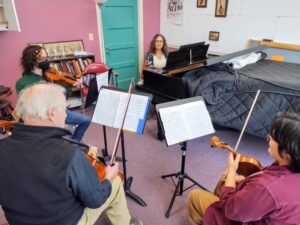
But I slogged through, one note, one phrase, one piece at a time until I eventually got the minimal piano chops I’d had up to snuff. I only played by myself in the living room. I didn’t want a teacher, or even anyone in my family to hear me play. Yet, in the back of my mind, I wondered, was I competent enough to join a chamber group? My kids had loved doing chamber music when they were teenagers and I’d been so envious. It looked like so much fun.

It took a year between the time I first started thinking about it before I called the local community music center and then another six months (until last February) to find a group. I’d like to say that being in this chamber music group was a sublime experience and a dream come true, but it wasn’t. On the other hand, it wasn’t awful, either. On a scale of sweet/sour, it skewed acidic, but the tangy taste was at least somewhat pleasurable. I felt gratified that I could play the music, and even if the coach seemed to give me more direction than she gave others, she always addressed me in a kind and respectful way. The other players all seemed friendly and no one stood out as being way above or below the level of the others–or unable to do what the piece demanded. But I didn’t get much of a sense of who they were as people, which I think lessened our ability to connect musically. And I didn’t particularly feel like we got into the nuances and phrasing of the piece, which made the experience rather boring (though in all fairness, maybe it was enough that we learned how to play together).

For all these reasons, and because I still am highly judgmental when it comes to music (despite how hard I try not to be), I really did not want to play at the end of semester recital. But the other musicians did, and I certainly wasn’t going to sabotage them–even though I told my partner and my daughter very definitively that no, I did NOT want them to come.

So, last Sunday I sucked it up and drove through the foggy, drizzly rain to the performance venue, arriving half an hour early so we could get in one last run through. I noticed that without depending on the coach to tell us what to do that we were able to stop ourselves to talk about problem spots and address them, and this made me feel more connected to the other musicians. And I was pleased that our actual performance of the piece, while not perfect or wonderful or exciting, was better than we usually played it, despite the nerves of having to play in front of an audience.

No one said, bravo, or (bra… vo…) but that’s okay. I can say bravo to myself for my bravery.

Subscribe at https://ddinafriedman.substack.com


Worrying

On the pre-visit questionnaire for a recent medical appointment, I once again came face-to-face with the familiar anxiety screening questions:

–Are you feeling nervous, anxious, or on edge?
–Are you worrying too much about different things?
–Are you feeling like you can’t stop or control your worrying?
–Are you feeling afraid, as if something awful might happen?

Though I dutifully clicked the “no” box for each of these questions, I wanted to add in a “but” and a nervous giggle. I knew I didn’t have what they were looking for in terms of clinical anxiety, but how could I not feel anxious, depressed and on edge every time I scroll social media, hear a blip on NPR, or open my email?

Vincent Le Moign, CC BY 4.0 <https://creativecommons.org/licenses/by/4.0>, via Wikimedia Commons

How could I not be worried?

And what weighs on me more: how do I balance my mental health by controlling worry, with the stories of people being literally kidnapped and sent to CECOT, a torturous prison in El Salvador. (Despite the media hype and MAGA speech about gang affiliations, 75% of the people in CECOT have no criminal history!)

How can I not worry when students are arrested, detained, and threatened with deportation for peaceful protesting, when visas of international students are revoked for no apparent cause, when long-time foreign residents are suddenly kicked out of the country?

How can I not worry when due process has been suspended and court orders are being ignored? And when collateral arrests in ICE raids include U.S. citizens with no rectification or apology?

How can I just let these stories slide off me like a momentary annoying wave that rolls out to sea as I continue with my life? And what’s happening to immigrants is only one of many disturbing developments since the new administration took office. How can I not worry about the BIPOC and LGBTQ communities? About women? About children in poverty?

Like many American Jews who came of age in the 60s and 70s, I grew up in the shadow of the Holocaust. Even though my family wasn’t directly impacted, the stories were told: The Germans watched as the Jews were rounded up… marched off…

Of course there were many good people in Nazi Germany who risked their lives trying to help those who were targeted. And I don’t believe the rest were all bad people. I’m sure there were some who naively believed the lies being told. And there were probably others who were told not to worry. Take care of yourself. As we’re being told every day. Even by our colleagues in the activist world.

I know I do need to take care of myself–and that spending more time worrying is not going to help. But the same perfectionist tendency that tries to rule my artistic life has been clawing at my activist self. If I’m not doing everything I could possibly do at this moment as perfectly as possible, than I’m likely not doing enough, it tells me. So the conundrum is figuring out ways to do even more than I’m doing and to be as effective as possible, without succumbing to the paralyzing guilt of perfectionist demands that minimizes the impact of my actions and just leads to more worrying.

As much as I like this video, the Bobby McFerrin song,  “Don’t Worry, Be Happy” doesn’t seem to apply right now. I need to worry AND I need be happy, but not so worried or so happy that I don’t take every opportunity I can to act.

Subscribe at http://ddinafriedman.substack.com