Stories from Trieste

As promised, I’m posting from Croatia, but I’ve spent the last few days in Trieste, Italy—a town with 5,000 Jews in 1938 and only 500 now.

I hadn’t been much aware of Italy’s Jewish history other than the obvious knowledge that their population was impacted by the Holocaust. What drew me to starting my trip in Trieste was not this gruesome history, but the current joie de vivre I’ve come to associate with Italy based on previous trips: outdoor cafes lining all the little alleys offering good coffee, good wine, stellar desserts I’d deny myself at home, and places to watch the sunset over the deep blue Adriatic Sea.

But I generally have checked out Jewish museums and synagogues in my travels, so it was totally in character for us to visit the small Museo Ebraico in the old city. Now that many synagogues in the U.S. are often under police protection, I shouldn’t have been surprised to see a security vehicle in front of the building, patrolled by two men in army camouflage gear, but of course, I was. It’s hard not to cling to the illusion of feeling safe wherever I go.

Even though I’ve been to many Holocaust museums before and had to do extensive research when writing Escaping Into the Night, something about visiting this museum hit me harder than usual. Perhaps it was the emphasis not on the Shoah itself, but on the period leading up to it: how the encroaching fascism in the 1930s split so many of Trieste’s Jewish families—some supporting the move toward greater order and authority, and others eschewing it in favor of communism or socialism.

Sound familiar?

Or perhaps it was the slow creep of laws restricting rights for Jews and others targeted by the rise of the new regimes. Or the longer overview of all the the times Jews didn’t have rights in Europe, which even though I knew that from past studies, it’s still a concept that’s hard for me to wrap my 21st Century American brain around.

Even with what’s happening right now in our country.

And with what has continued to happen in many places throughout the world.

It’s much easier to embrace the daily joie de vivre, even when I’m not on vacation. And on the days that joie de vivre seems out of my grasp, to focus on the day-to-day household and life problems I can solve, rather than things that are out of my control.

And ultimately it was the deportation stories that tied the threads between then and now. Photos of person after person deported to Auschwitz, never to return. And in front of the pension where we were staying, several blocks away from the museum, plaques commemorating the Jewish family that used to live in that building–all of them ending their lives in Auschwitz.

The owner of the pension, who asked in a whisper if we were Jewish, told me her mother, now 102, lived in Trieste at the time of the Shoah, but escaped with her family to Assisi, where they were hidden in a convent. If it weren’t for that, I wouldn’t have been here, she said.

Some of the families in Trieste didn’t go to Auschwitz. And most were sent originally to Risiera di San Sabba, an old rice mill just outside of town that was converted into a holding facility and deportation center.

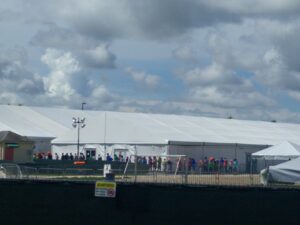
Sound anything like current plans to convert warehouses into massive detention camps?

We could have visited the site, but we chose not to. We were on vacation and I didn’t want to see the crematorium. So we chose to go to Miramare Castle instead, and bask for a few hours in lifestyles of the rich and famous, while enjoying the views of the sea.

When we came back we sat outside at a gelato bar enjoying mixed cups of cioccolato nocciola, fragola, tiramisu, e pistachio while listening to a street musician play My Way and Hit the Road, Jack on the saxophone. Later that evening, we walked a few blocks to an Indian restaurant for dinner in order to take a break from all the white flour pasta and pizza we’d beem eating. When the owner said he looked forward to coming to the United States again, we told him he’d be better off waiting a few years until things changed.

And now it’s up to all of us to make sure things do change. Soon.
A Chanukah Tribute to My Dog, Lefty

As we lit the Chanukah menorah on the first winter at our new house twenty-six years ago, my ten-year-old wanted to know if people could see the lights from the road. I think she was sensitive to ours being the only house in the neighborhood that wasn’t strung with Christmas lights and blinking Santas.

“I don’t know,” I said. “Let’s go see.”

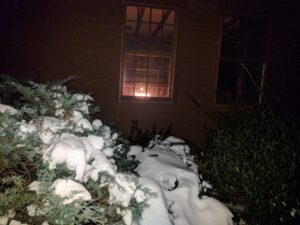
We removed the curtain, placed the menorah in the front window, then bundled up and went outside. In the New England snow, our house, on top of a small hill next door to a farm with a Star of Bethlehem on the silo, looked gorgeous with the small menorah light twinkling at the window. I just wanted to stay out there forever under the amazing mass of stars.

We got in the car and drove down the hill, then turned so we could pass the house from below. “There it is!” I pointed. But to see our little menorah would clearly involve knowing that it was there, and a questionably dangerous maneuver of looking up at the house when you should be looking at the twisty road.

My children were not persuaded. “I want it to be like the star on the silo,” my six-year-old insisted as we pulled back into the driveway. “I want to see the menorah from far away.”

“It doesn’t matter. We can see it,” I tried to convince them. And then I had an idea. “Hey, let’s put menorahs on all sides of the house, and then we can walk around and see them, and the neighbors can see them, too!”

We lit three more menorahs, bundled back into our coats and boots, and crunched all the way around our snowy yard. One of the kids started to sing, and we all joined in: “Chanukah, oh Chanukah, come light the menorah/Let’s have a party, we’ll all dance the hora/every day for eight days, dreidels to spin/crispy little latkes, tasty and thin… When we got to the slope at the back of the house, the children stopped singing and flopped down dramatically, rolling all the way to the bottom of the hill. I felt my heart catch, but only until I heard them laughing.

This was so much fun that we did it again on the second night of Chanukah, and the third, and the 4th, 5th, 6th, 7th, and 8th. Each time we got to the back of the house, the kids would engage in a dramatic fall and roll down the hill. Some nights were bitter cold with wind-chills below zero. Others were slick with ice. It didn’t matter. Going out to see the Chanukah lights became a test of our resolve and our fortitude. A tradition was born.

Photo: D. Dina Friedman

Photo: D. Dina Friedman

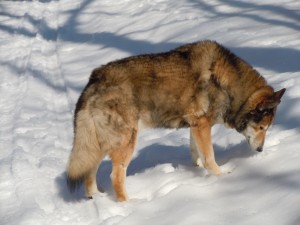
There’d be quiet as we waited. Sometimes we’d have to call a second time, or a third, but then we’d hear a rumble in the distance, as out of the dark he’d come bounding back, jumping on all of us over and over again as if giving an exuberant thank you for his special Chanukah present.

Lefty died in 2011, the same year my youngest left for college. My older child had already graduated and was living in New York City, so on the first night of Chanukah that year, the nest was truly empty. After Shel and I lit the Chanukah candles, I insisted on going out despite the fact that it was four degrees and the grounds were covered with a solid glaze of ice. We took ski poles and crept carefully down the ice-coated steps. At the front window, the small light of the menorah exuded warmth, the blanket of stars above us, magnificence, but I felt sad. I missed the kids, even though they were coming in a couple of days to celebrate Chanukah over the weekend. I missed the dog even more.

“We can walk the other way around the house,” Shel said. “It’s less steep.”

I knew the kids would have rebelled at any break in tradition, but I humored him and our old bones. We sang the song. At the end of the last line, I added “Lef–ty!” Like, “Play ball,” at the end of the Star Spangled Banner, the words just belonged there. I even looked across the field, half expecting to see him running toward us, but no Chanukah miracle.

When the kids came that weekend, they insisted on walking in the direction they’d always walked, and stopped, as usual, at the back of the house to dramatically roll down the hill. We sang the song, and of course, they too added, “Lef–ty!” to the last line—as we’ve done every year since then. At least one night every year, we still celebrate Chanukah with the children, their long-term partners, and now, a grandchild. But I still find myself looking across the field, waiting for that moment of rumbling and the speck of distant movement to get larger and clearer, our joyful dog coming back to us.

Originally published in Chicken Soup for the Soul, The Wonders of Christmas, 2018.

Subscribe to my blog at https://ddinafriedman.substack.com

Holding Onto the High Moments

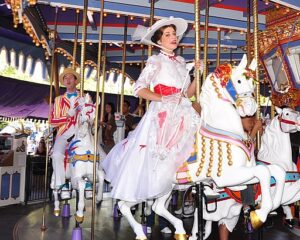
When I was a child, I wanted to be a Broadway star. I’d been on raised on musicals and nothing made me happier than singing and dancing in the living room while belting out the entire sound track of Mary Poppins or The Sound of Music. In my fantasies, I sounded fantastic, totally ready for the special day I’d be discovered and spend the rest of my life singing on stage.

Disney-Grandpa https://www.flickr.com/photos/8674970@N04/ modified by Dr. Disney Wizard https://www.flickr.com/photos/disneywizard/, CC BY-SA 3.0 US <https://creativecommons.org/licenses/by-sa/3.0/us/deed.en>, via Wikimedia Commons

Sometimes I still feel this way—not as a singer, or a pianist, but in my writing, which ended up being the creative channel I pursued the most seriously. I’ll draft a poem, or a story, a blog, or an essay and say to myself, Wow, this is fantastic! This is the best thing I’ve ever written! It’s such a buoyant and exhilarating feeling, the sheer joy, the high, from having created this precious piece! And there are even times I feel a similar high when playing the piano—for a brief phrase or two, where I’m playing smoothly and I’m really down deep in expressing the music—or when I’m singing exuberantly in complicated harmony with a chorus of uplifted voices.

But, alas, the high moments fade. The next day, I look at whatever I’d written that I was so excited about and think…Hmm. I think I need to …

 This isn’t a bad thing. As a professional, I know that writing needs polishing, and I actually enjoy the revision process and discovering what a piece can become. I’m sure it’s the same for musicians, artists, dancers, actors, etc. to see where they can take their art as they continually hone their skills.

As a perfectionist with a ruthless inner judge, I need to be careful not to let the high moments sink too deep and transform into the low places. We all need to find ways of holding onto that initial joy, even when those moments continue to hold some unrealistic fantasies about outcomes. Chances are this poem will never make it into Poetry, no matter what I do to it. And nope, I’m not going to be a Broadway star. But that doesn’t mean my little joyful fantasy was a bad thing, as long as I don’t fall into the either/or trap of labeling something as awful that I once thought was fabulous.

According to the Mayo Clinic, people who think positively, even when faced with obstacles, are happier and healthier. Experts suggest vigilance in converting negative self-talk to positive self-talk. So, instead of thinking about your revision as something you’ll never be able to do successfully, think of it as a positive challenge, and affirm how much you’ve already accomplished.

And next time you’re in that high moment of feeling fabulous, write down the feelings and decorate them in bold and bright colors, paste them on the wall so you can see them while you work on your revisions. Or record yourself talking about how you’re feeling when you’re in the high time. Your recording could include a little dance or a bursting into song, if you feel like it. When you get stuck, play that back.

Chances are your inner judge will not let this go without objection. Boy do you look/sound like an idiot! It might say. You were so stupid to think this was good. But just be prepared for that and mentally pack that nasty voice away. Stuff it in a box, dig a hole in the earth, then rain the dirt on top of it.

Remember, the goal isn’t necessarily to feel 100% in the high place, just to capture a spark of it, like a memory of being at the ocean. Close your eyes and listen to the waves rolling in.

Subscribe at ddinafriedman.substack.com


Grandmothers, Chopin, Cats

I’ve been back at the piano nearly four years, and lately I’ve noticed that occasionally I can zone into what I want to express in a piece, rather than flounder around in the notes. It’s such a liberating feeling–like I’ve finally acquired some basic tools in my kit that I can use to deepen my experience of playing. I’m trusting my fingers more to do “the right thing,” giving my heart an opening to put in its own two cents.

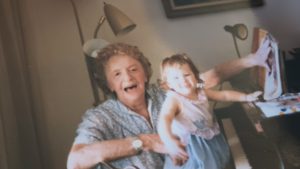
Grandma Jeanne with baby Alana (my daughter) 1989. Photo by Shel Horowitz

This got me to thinking again about my Grandma Jeanne, who, in her eighties, still played the piano for at least three hours every day, re-visiting old pieces and learning new ones. In the hot, flat days of her retirement, where she rarely left her Florida condo, itt was piano that gave her days shape, made her life matter–until she developed severe arthritis and couldn’t play anymore.

One of the last times I visited her, she tried to play for me, anyway. Her face was hopeful as she positioned herself on the piano bench, set her hands with their bright red nail polish, straightened her back, took a sweeping glance at the music, a large breath, and placed her hands on the first chord. I watched her wince, as she tried to push through the pain. A few more chords. A run, and then she stopped. Banged her hands down on the piano. Closed the lid.

“You play!” The bark in her speech made it clear this was not a request. It was an order.

At the time, I didn’t have much in my repertoire, but I found her copy of Beethoven’s Moonlight Sonata and began to read through it. She stopped me somewhere in the third line.

“Listen to the melody. These are the important notes. Play them with everything you’ve got! Everything!” Her thinning voice rose to a crescendo, as if she were my coach in one of those Hollywood sports movies, giving the Oscar-moment speech in the scene before the perpetual underdog was about to emerge victorious.

How much did I have to give these notes?

That’s what I think about now, as I play a Chopin Prelude. Instead of worrying so much about the individual notes, I’m focusing on the shapes of the phrases, the interplay of loud and soft. It’s kind of like thinking about the arc of a story. And I’m also thinking, as I often do when playing, about my grandmother cheering me on. “Yes, like that!” I could hear her exuberance as she leaned over close that day, marking the important notes.

I had a cat, Fudge, that died under the piano–a metaphor that seemed more than coincidental, though at the time of his life (and death) the piano was my daughter’s domain more than mine. But he clearly liked music and always seemed to slink into the living room whenever either of the kids were practicing. And while he has no connection to Grandma Jeanne, they somehow both ended up in a poem, that was recently published in Humana Obscura. Even more cool–someone I don’t know read the poem and made this video. (Not exactly what I might have done if I made videos, but I’m extremely touched that the poem affected her enough to do this–just more evidence that our creativity matters!)


My Whirl Into Immigration Activism

In November 2016, waking up to the dystopian reality of Trump being elected, I told myself: complacency is no longer an option. I’ve been an activist all my life, though in the years leading up to 2016, I hadn’t done that much. But all of a sudden, everything took on a new frantic urgency.


Of all the horrible things Trump was doing, the issue that spoke to me most was immigration. While the babies in cages broke my heart, what scared me even more was the way Trump continues to talk about immigrants—as “invaders poisoning the blood of America,” language which edges far too close to my Jewish roots and the collective generational trauma we carry from the Holocaust.


So, when volunteers were needed to spend time at a local church that was harboring a man in sanctuary, I signed up. And this was where I saw the note seeking people interested in traveling to Florida to witness at the children’s detention center in Homestead, a horrid converted air force base, whose fenced boundaries were now lined with black paper to keep on-lookers from seeing what lay within.


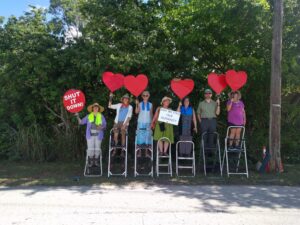
For three days in June 2019, the eight of us who made the trip stood on ladders in the heat so we could look over the barrier at the children. We held up paper hearts and waved at them when they came out in their bright orange hats for 15-minute stints of exercise. Te amo (I love you) we shouted. Occasionally the children would take off their hats and wave them at us, though they were always reprimanded by the guards when they did.
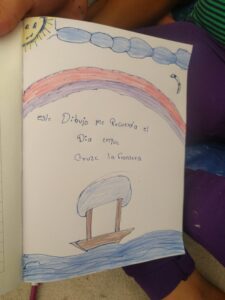
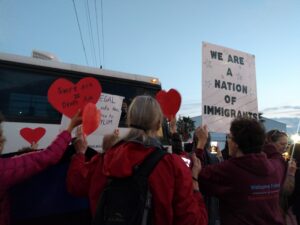
 

When we came home, we spread the word about what we’d seen in speaking events with a variety of community groups. We also organized our own educational events and demonstrations, and started planning a trip to the border. This involved working in conjunction with a number of immigration support groups based in that region, including Witness at the Border, Team Brownsville, and the Resource Center of Matamoros. We prepared and served meals, observed the infamous tent courts, stood at the bridge with signs, and spoke to many of the people who were stuck in Mexico as they waited for their turn to apply for asylum, which they had an extremely low chance of getting. We also led a writing/drawing workshop for children to express their feelings about leaving home and a similar workshop for the women in the camp in a room filled with tears as each woman shared stories of loved ones killed by gangs or children left behind.


On the morning of Valentine’s Day, we woke before dawn to stand at the fence and stare at the wing of the deportation plane, (the only part not purposely blocked by a truck). Then we linked arms and headed for the parking lot, trying for a few moments to block the bus of deportees from arriving until we were warned by the cops to disperse or get arrested. Unfortunately, we were not in a position to engage in civil disobedience, so we had to settle for supporting the people on the bus with hearts and words of encouragement as they walked shackled into the plane’s belly and departed under the cover of the night.
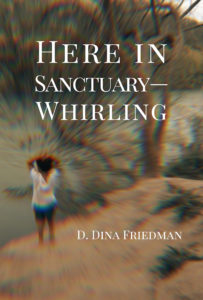
 

The cover Here in Sanctuary—Whirling is from a photo taken at the refugee camp, where children followed us through the maze of crowded tents, as eager as their grown-up counterparts to talk to us.The poems in the book were born directly from our experiences. While I’ve written the occasional political poem over the years, this type of writing was a departure for me. For most of my life, my writing and my activism were separate. But my writing has always come from my heart, and my heart is now intrinsically linked with these people who are far braver than I am. While I recognize that their stories ultimately belong to them and not to me, I’m glad they gave me permission to share these hard truths about their lives, which counter the rhetoric of even the supposedly liberal people in our government, because these stories need to be heard, loudly, by as many people as possible.

(Originally posted on my publisher Querencia Press’s Blog: in response to why I wrote this book. )

Subscribe at ddinafriedman.substack.com