Body, Mind, Spirit

A couple of mornings ago, by the window where I sit to meditate, a robin perched on one of the bare branches of my elderly-but-still-hanging-in-there maple tree, painted so evocatively here by my friend, Janet Morgan, several springs ago. (Check out her work at https://www.janetmorgan-art.net/)

Art by Janet Morgan

Afterwards, I took my first outdoor race-walk of the season, grateful that the snow, had *finally* melted. As I trotted along the road, I heard a cacophony of birds, and again I felt grateful that I was both being mindful enough to pay attention, and that my crappy hearing was allowing their songs to come through. My route started with a gradual but long uphill, and I found myself huffing and puffing a little more than I would have liked. Even though I had been maintaining my fitness with indoor cardio, strength-training, and yoga, as well as taking sloggy snow walks all winter, I hadn’t really pushed myself. But some recent (relatively minor) health issues have made it clear that I need to up the ante.

I’m grateful to have a body, I told myself, even if it can sometimes be an annoying place to live. And then I thought about how much of my day is devoted to taking care of my body, mind and spirit. Really, now that I’m retired, nearly all of my day touches on one–or more–of these aspects of my being that will only thrive if I give them love and attention.

I’m not a categorizer by nature. My recent “Kondo-izing Poems” project, while gratifying, also had many excruciating moments where I couldn’t decide whether a poem belonged into the folder of poems to be worked on, the totally inactive poems, or the “Meh” poems, which is kind of like the minor leagues. And let’s not even talk about my bookshelf, my closet, or my filing cabinets. Yet, I did find myself pondering my daily activities and thinking about whether I would classify each of them as body, mind, or spirit. And [no] surprise! So many had overlap, I quickly gave up on the categorization game.

But maybe that’s the point: taking care of the body through meditation and exercise–two staples of my daily diet–is essential for my spirit. And writing, while a mostly mind-massage practice, can also be a big spiritual uplift, at least during the times I’m in the groove. Spending time focused on others, rather than oneself, can be invigorating in opening up some mental pathways that generally go unused, or opening the heart/spirit through emotional connection. And for me, engaging in the nitty-gritty of activism engages the part of my mind that likes to problem-solve and helps my spirit through connecting to others and giving me a lifeline to hope.

I guess it doesn’t really matter what categories our activities fall into. What does matter is to choose a diet that will create a sense of uplift, gratitude, and grounding in our own beings so we can do the work in the world that we’re meant to do.

Subscribe at https://ddinafriedman.substack.com

Sun on Snow

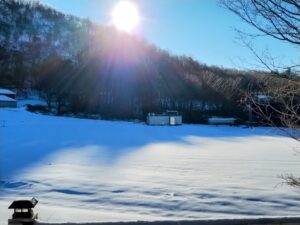
As I get close to my “blogging day,” I generally start thinking about what I might want to write about. This week, I’ve been contemplating a post about villainizing (what the administration is now doing to all Afghans and many other brown-skinned people after the National Guard shooting in DC), making soup in a storm (what I did yesterday) and what to do when you’re in the middle of sending out your work and you realize you absolutely hate every single word (also what I did yesterday and a common challenge I go through). I may write about each of these topics in future weeks, but when I actually sit down to write, I’m compelled to go with what’s in my gut at that very second. And right now, it’s the surprising and stunning delight of the radiant sun on the snow outside my window.

There is absolutely no landscape I like better than a snowy vista sparkling in the sun, whether I’m cozy and warm and looking out the window (as I am now) or skiing, walking or snowshoeing through winding trails with heavy snow-coated conifers, or even when I’m shoveling the driveway–as I was earlier this morning, enjoying the workout even as my partner and i struggled with our (temporarily) compromised respiratory systems to lift the heavy snow.

When it’s not sunny, snow loses most of its appeal for me. The angry sky can be evocative, but it’s also off-putting. As someone who’s sensitive to Seasonal Affective Disorder, I often feel like I’m trying to frantically gulp fleeting slivers of unsatisfying light. I did get out briefly in the storm yesterday because I knew I needed the air and to be closer to whatever diffuse light there was. It was unpleasant–though not undoable, the pellets and wind stinging our faces to the point where I had to keep my face covered head lowered to the ground.

But with sun on snow, there’s definitely a metaphor, and I’m hoping it transcends the clichéd (though useful) advice of being thankful for small things. Or the cliché of clouds having silver linings. What I think it brings me is a hopefulness, an expansiveness of possibility that I don’t sense on snowless sunny days or on cloudy snowy days. So, on this gorgeous morning, I’m determined to see my creative work in a new, sunnier light. And I’m also dedicating myself to the belief that we as a society won’t fall into the trap of villainizing propaganda and strive to embrace our commonalities rather than our otherness. I just read a very compelling post from the 50501 movement about that, and about the dangers of basking in one’s own privileged comfort–highly recommended, even though it’s sobering.

And there’s also a metaphor about making soup in a storm, though I’m not going to go down that rabbit hole right now. Other than to recommend making a big pot. That you can share with others.

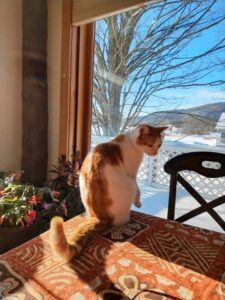
Even Andre likes the sun on the snow, though he prefers to soak it up through the warm window.

Subscribe at https://ddinafriedman.substack.com
 

Is Gratitude Enough?

Despite my daily meditation practice, which includes listing one thing I’m grateful for each day, I have an ambivalent relationship with gratitude. It often feels unsettling to focus on the abundant amount of privilege I have–health, relationships, financial security–when so many others have more challenges in their lives. And while I do understand the benefits of centering gratitude in both the big and small moments, I worry about focusing on it too much, to the point where I’m less motivated to do what I can to make the world a better place for others.

Dtobias, CC BY-SA 4.0 <https://creativecommons.org/licenses/by-sa/4.0>, via Wikimedia Commons

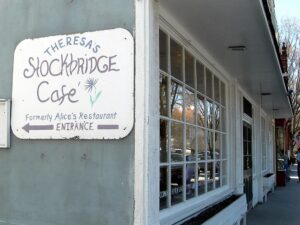
But today is Thanksgiving, a day we’re directed to give some attention to gratitude. For me, no Thanksgiving is complete without listening to Alice’s Restaurant, Arlo Guthrie’s classic song about how he manages to avoid being drafted into the Vietnam War by embellishing the story of his arrest for littering on a Thanksgiving Day 60 years ago. I feel grateful for Arlo: his irreverence, creativity and dry humor in a somber situation. I’ve just returned from Vietnam, where I visited the War Remnants Museum in Saigon, and saw many of the horrors close up: the countless bombs, the generations of disfigurement and health challenges from Agent Orange, the My Lai Massacre, the number of people dead on both sides.

The question weighed on me as it often does–Why do people do this sh*t to each other? What is it in the human psyche that wires us toward committing acts of cruelty that go far beyond the battlefield–as if the battlefield isn’t horrific enough. What makes it ok to shoot children, rape, torture and kill innocent civilians? I’m not just talking about the Vietnam War. These atrocities permeate all borders and all countries, stretching from ancient times to the present.

And in the wake of this, what does it mean to draw a faux border around our own Thanksgiving tables, shutting it all out? And how do we reconcile this time of gratitude with our genocidal history against Native Americans, many of whom mark this day as a time of mourning? My younger child has boycotted Thanksgiving for the past two years in order to attend their yearly protest in Plymouth. I am grateful for their activism, even though I’m not personally ready to abandon Thanksgiving, yet. But I think we need to see the holiday as aspirational, rather than celebratory. We can be thankful for the blessings in our lives, but we also need to address the holes and shadows in a tableau that falsely centers on the horn of plenty.

I’m not trying to make Thanksgiving a downer. I’m looking forward to our family cooking extravaganza, and time around the table, and pumpkin pie. And while I’m grateful for the many blessings in my personal life, I’m feeling even more grateful to the people who are following Arlo’s footsteps in being creatively subversive in not accepting the status quo: the dancing frogs in Portland, the whistle blowing in Chicago, the moms in Charlotte arranging transportation and food drop offs for immigrant families so that parents did not have to risk their safety. 

As Arlo says, “…fifty people a day walking in singing a bar of Alice’s Restaurant and
walking out. And friends they may think it’s a movement.” Today I’m grateful to all who have comprised this movement by taking actions in the last year to make life better for those endangered and at risk: whether that was protesting, donating money to people in need, writing letters to elected officials, having a difficult conversation with someone with an alternative point of view, or engaging in any small (or large) act of kindness.

Happy Thanksgiving!

Rage, Rage Against the Dying of the Light

The day I arrived in New York to help deal with my father’s medical emergency, they were repairing the sewer pipe under my parents’ house.

The onslaught of noise was deafening as workers cut through an entire square of concrete then lowered themselves into the cavernous maze of underground pipes to search for the blockage. It took them two days to find the troubled spot, which had already plagued my parents for a week: no showers, no laundry, minimal dishwashing, and a directive to flush the toilet only when absolutely necessary. And after all that noise and digging, the blockage turned out to be not in the area where they’d dug at all. They found the problem in the sad little brick-enclosed square of dirt my parents call the “front yard”–under a rosebush that had already been reduced to small rootball and a few aspiring fronds.

The next day, when my father was officially referred to hospice and people rained all that “death is a passage” stuff on us, I thought about that sewer pipe–also a passage. And I also thought about the Dylan Thomas villanelle and its repeating haunting lines: Do not go gentle into that good night … Rage, rage against the dying of the light.

It isn’t that I want my father to fight against the reality of his dying. I feel grateful that he is not–and has never been–an angry or vengeful person. Even in his compromised state, while depressed about what is happening, he continues to exude kindness and express love and gratitude to those around him.

But I feel like raging. Not at the inevitability of my father’s death, but at the sadness of seeing him so frail and unable to do things for himself–the “dying” of my image of my 90+ year-old parents as timeless icons of longevity.

And I feel myself raging against the barely flickering “light” of my country. Yet this rage feels like a fruitless kick-the-floor-and-flail-my-arms temper tantrum. Pundits tell us to keep breathing and find joy. The sun is brilliant on the half-inch of freshly fallen snow today. But where is the balance between digging and doing what we can and totally abandoning ship, closing our doors and taking out whatever might constitute our modern-day “opium pipe” to lose ourselves in a stupor of disempowerment and apathy.

I’m forever grateful to Bishop Marianne Edgar Budde, who was able to channel her rage into a calm and quiet plea for mercy, focusing the whole time she spoke, toward whatever light might be left that’s still shining on who we could be–individually and collectively. And I’m wondering if that’s the kind of light that flashes before our eyes as we near the end of our lives in addition to reliving all of our life’s significant moments. I’m wondering what my father, an Emmy Award-winning journalist, is thinking as he sits hooked up to his oxygen machine with the New York Times spread on his lap, trying to stay awake long enough to get through more than a paragraph and make sense of all that’s happening around him.

Rage, rage, against the dying of the light.

While we all have to accept death, as hard as it is, we mustn’t go gentle into this dark time, or accept the numerous attacks on our Constitution as the legitimate prerogative of a new leader. I feel grateful for the many in our community who are joining together and channeling their quiet rage into action. Death may be a lonely endeavor, but raging can be a community enterprise. I’m grateful to the many who are standing up to support immigrants, transgender people, the environment, and the many other important issues that are under attack.

In fact, what keeps me finding joy is knowing I have community–both to support me during this difficult personal time and to work together on keeping the light shining.

Subscribe at https://ddinafriedman.substack.com


Getting to Carnegie Hall

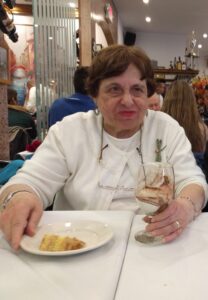
Today my mother turns 90!

While I have many reasons to be grateful in my life, one of my biggest sources of gratitude is having healthy parents who are still enjoying and making the most of their later years. My mom–and my dad, who is 92–are cultural aficionados. They love going to Carnegie Hall and Broadway. In fact, often when I announce my plans to come into New York, they search for tickets to something they think I would enjoy. In their eyes, tickets are one of the best forms of showing love.

The COVID years were hard for them. “It’s like jail!” my father would grumble. But as vaccinations have become abundant and restrictions have relaxed, they’re out in the world again.

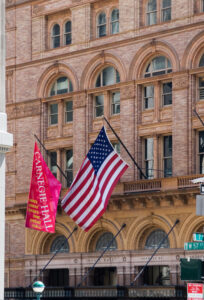
© Jorge Royan / http://www.royan.com.ar

How do they get to Carnegie Hall? I know you’re thinking–practice! But they’ve paid their family musical dues and don’t need to practice any more. They take the subway–about a 30-minute ride. That they’re still able to do this is a wonderful privilege for people in their 90s, but when I mention it my mother looks confused. How else would we get there? she asks.

When I wrote my memoir, Imperfect Pitch, about the generational baggage of coming from a family of musicians and my struggle to meet what I perceived as a family expectation to be the next in a line of musical “prodigies,” I was pretty nervous about sharing the book with my parents. Not everything in the book I wrote about them was complimentary (LOL). But I realized, as I delved into the material, that they were just as much victims of the generational expectations as perpetrators. Like me, my parents both played music through high school, but didn’t have the ability–or (unlike me) the desire–to play professionally. And also unlike me, both of them accepted their limitations and went on with their lives, getting their “musical fixes” at Carnegie Hall, rather than from their own playing.

While I had a much harder time letting myself off the hook for not being able to play better than I could, I also moved on to my own life, spilling my creative passions into writing. But in 2020, my way of dealing with “COVID jail” was to return to the piano bench–tentatively at first, with a lot of finger stumbles and tears–and now, with a fluidity that pleases me. Even if I’m never going to win accolades for performing music, I’m happy to spend around 30 minutes every evening (the same amount of time it takes my parents to get to Carnegie Hall) to play for an audience of one–me! This is another thing that I’m profoundly grateful for.

And a final note of gratitude: when my parents did read my book, my mother said, I think this book will be very helpful to people in our family. We’ve gone through many birthdays together, and seen many shows at Carnegie Hall, but of all the gifts I’ve received, this affirmation is the one I cherish the most.

Happy birthday, Mom!

Subscribe at ddinafriedman.substack.com

Silver Linings in a Snowstorm

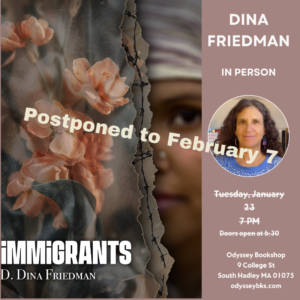
Yesterday I was supposed to have my book launch reading for Immigrants at the Odyssey Bookshop, but the weather gods had other ideas. The forecast was for snow, sleet, and/or freezing rain starting in the late afternoon and continuing all the way into this morning. While accumulations were not expected to be significant, the roads were expected to be slippery.

While I’m an admitted snowphobe when it comes to driving, I knew I’d likely be able to make it to the bookstore, which is only 5 minutes away from my house. But I also knew that others who were planning to come were driving much longer distances. I didn’t want to ask people to risk their safety. And I didn’t want to risk a low turnout. Even though I’d already bought the snacks and the ingredients for brownie-making, I decided it would be best to postpone.
I don’t know if it’s from being born under the sign of Gemini, but communication has always been huge value for me. My pet peeve is when people don’t return my calls or texts, and it infuriates me when I’m not communicated information I need. So, even though the bookstore was willing to post on social media and notify the people who’d actually signed up to attend the event, I wanted to make sure that people who were thinking about coming, or might have been planning to come and not signed up, didn’t make an unnecessary drive through the slush or ice only to find out the event had been cancelled.

This meant a whole lot of texting, emailing, FB messaging, social media posts, etc. And it meant I ended up connecting with people I hadn’t spoken to directly, which felt really lovely. While my core identity is introvert, I definitely have an extroverted side, and all that communication gave me a surge of energy that kept me going and focused on the task. I was so touched by how many people answered my messages in a warm and personal way who thanked me for making a call on the side of safety. And I was surprised by the number of  people who said they had planned to come, or that they couldn’t have come tonight but they could come on the new date. It felt like such an overwhelming bubble of support from my community, this big universal love…

Between all this, I was also using that surge of energy to attend to political issues involving real immigrants, working with my immigration justice affinity group on a short emergency mailing to drive calls to Congress against the potential Senate deal that would trade away current protections and due process for people at the border seeking asylum and expand deportation of people who are already here, all in exchange for more military weapons for the Ukraine, Israel, and Taiwan. You can read more about that here.

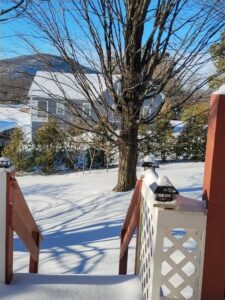
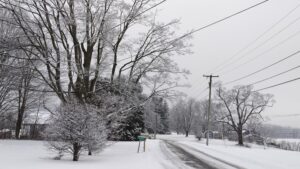
So, I guess there are silver linings in a snowstorm–including the beautiful scenery when I woke up on Wednesday morning.

And, I was told by one friend that the new date February 7, has much better numerology–#8, a number which supposedly resonates with self-confidence, inner strength, and inner wisdom, among other things. I don’t know very much about numerology, but I’ll take it.

Hope to see some of you local people at the Odyssey Bookshop on February 7.

Gratitude

It seems fitting to start the new year with a post on gratitude.

Even if it at times it might feel like too much of a cliché to switch up the angst of the day with thoughts about what we’re grateful for, I do believe the recipe works. Expressing gratitude may not always result in the gourmet meal of your life, but it can be like a sauce you pour over your food to make it taste better. Or what was that line from Mary Poppins, Just a spoonful of sugar helps the medicine go down. In the most delightful way. Emphasis on delightful. 

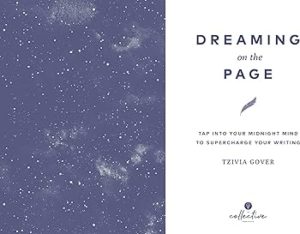
And for the new year, I’m trying a new way of thinking about gratitude. Instead of generically thinking about what I’m grateful for, which often brings up variations on the same list: my partner, my children and grandchildren, my close friends, the beautiful area in which I’m lucky to live, having good health and privilege, yada, yada, I’m mentally cataloging my day with discrete moments that brought me gratitude. I got this idea from my friend and colleague Tzivia Gover’s book, Dreaming on the Page.

Tzivia suggests the prompt, If I could preserve just one thing from this day it would be….

On Monday, January 1, what sprung to the top of the list was the long, leisurely brunch conversation over homemade crepes in our dining room with my partner, Shel, my younger child, Raf, and their partner, Nick. It wasn’t so much that any topic stood out as much as an ease of being and connection that felt precious. And even sweeter: gone was the usual nagging voice reminding me of all the tasks I had yet to complete and should be doing instead.

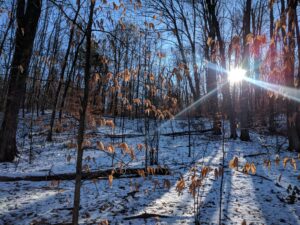
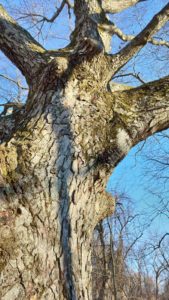
Yesterday (Tuesday January 2), the moment that edged its way to the top was visiting the tree I call my friend–a stout and stately presence on the Bachelor Brook Trail. I always stop to say hello, and this time, I took a picture of the view upward, made even more special in the bright blue sky on the first sunny day we’ve had in over a week.

Today (Wednesday January 3) is young yet, but in the running at this moment is that feeling of my chest expanding and energy releasing from my body when doing a cardio-work out earlier this morning. It’s not uncommon for me to experience those endorphin rushes, but it was still different to stop and appreciate the feeling as a discrete and special moment.

I often feel flummoxed and shut down when I think about what I can do to prepare for aging, because ultimately, none of us know what challenges might lie on the horizon. But I do think gratitude can be an important foundational practice, and better to institute now when I’m healthy and strong, rather than waiting to find silvers of good in the midst of more challenging times.

So I’m looking forward to continuing this practice for a while, and perhaps, mining these moments that give me joy and finding homes for some of them in poems and stories.


TAKING STOCK OF 2023

As the year draws to a close, here’s what I’ve done in the publication/submission universe:

POETRY:

  • 86 rejections
  • 18 journals accepted 22 poems (Including one poem in Rattle!)
  • 1 chapbook accepted–Very excited about Here in Sanctuary–Whirling, which is forthcoming from Querencia Press in 2024. This dedicated and spirited small press has been a dream to work with. Cover reveal is coming soon!
  • 2 Pushcart Prize Nominations: Thank you so much to Gyroscope Review and the River Heron Review for this recognition.
  • 20 submissions still pending

SHORT FICTION:

Since I knew Immigrants was coming out soon, I only sent out one short story that wasn’t in the collection. That story got 12 rejections, with 2 pending.

The more exciting news on this front was that Immigrants did come out just last month and has already gotten some lovely reviews on Amazon and Goodreads. (Of the 13 stories in this book, 8 have been previously published by other journals.)

For those of you playing the submission game, be aware that stories, especially those on the longer side are harder to publish than poems, especially for a print journal that has to deal with space considerations.

CREATIVE NON-FICTION:

Essays I sent out were rejected 11 times, with 6 submissions still pending. One of the rejections made it to a final round and one of the pending submissions is in the final round. Also in this category–2 guest columns submitted to and published by our local newspaper, The Daily Hampshire Gazette: Losing the Light and Let Them Wear Tutus.

LONGER WORK:

I queried 27 agents this year about my music memoir, Imperfect Pitch. Three agents sent actual rejection letters, 3 are still pending (sent within the last three months), and 21 ghosted me. Of those that ghosted, 2 of them first asked to see a proposal and then ghosted when I followed up.

I also sent the book to three small presses and received 2 rejections. One small press submission is still pending.

And finally, I did take another stab at submitting a novel I’d given up on when I found out that Delphinium was considering unagented queries. The editor asked to see the whole book, and rejected it a month later with a letter that began, “Deer Dina…”

All these rejections may sound depressing, but I’m really okay with them. I’m glad to have far exceeded my goal of getting 100 rejections, and as I’ve said to many fellow writers, I make a point of not letting any rejection bother me for more than 10 minutes.

Besides the successes are incredibly sweet, and I’m grateful (and, quite honestly, also terrified) any time some of my words make it past my computer into the big, wide world.

Onward to 2024. Happy New Year!