Confessions of a Closet Sports Fan

True confessions! I’ve been addictively following the NBA playoffs.

This doesn’t fit in with image I project to most who know me, or the words I might use to describe myself: writer, activist, gardener, nature-lover. And like most, I abhor the money that casts its dark shadow over this and other big sports events. $10,000 for a ticket to Madison Square Garden is obscene. Even $1,000 that Mayor Mamdani spent for standing room at the top of the arena is obscene. And unnecessary. Sports should be for the people. All the people. Not a commodity that can be manipulated to squeeze as much money out of hopeful hearts as possible.

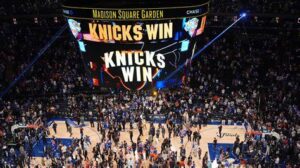
Yet, every night of the playoffs, I’ve tuned in on my free-trial Youtube TV subscription (which I will cancel at the end of its 21 days) my heart with the hordes and multitudes at the watch parties in Central Park. I have not lived in New York for 46 years, yet, this doesn’t make many any less of a New Yorker. There’s a certain “Only in New York” way we have about how we relate that transcends our diverse backgrounds and brings us together. I still remember being on the subway in 1969 when the Mets were in the World Series. Everyone who had one had their transistor radios glued to their ears. When Tommie Agee homered in Game 3, the entire subway car erupted in cheers.

Photo by Mark Dixon from Pittsburgh, PA, CC BY 2.0

This is the kind of comeraderie I often long for, a swelling excitement and connection among strangers for a common goal. I hate to say that I’ve felt this more often at sports events than at peace demonstrations, but unfortunately that’s true. There have been occasional exceptions–The Women’s March in DC in 2017; March for Nuclear Disarmament in New York 44 years ago today on June 12, 1982. But I can often feel a more compelling swell of excitement huddled around a television with people rooting for a similar outcome, even if that outcome is random and doesn’t really matter in the wider world. Or maybe because the stakes are lower, it’s easier not to feel the thick of fear and disappointment one might feel in the wake of a devastating Supreme Court decision or a harmful act committed by our government or another country.

To put this all in a little more context, I grew up in a sports-dominated household. No one played, but the TV was always on: baseball, football, basketball, hockey…I don’t know if I would have survived my teenage years without the Mets and the Knicks to divert my attention from my own angst to something random that was totally outside of my control, yet–at the time–mattered deeply. Finding friends who shared that passion made it easier to stay away from experimenting with the wilder world of drugs and alcohol and sex. We could ground ourselves in the safer land of fandom. I guess we could have also been as passionate about other things that I might consider more in my bailiwick now, like music or art. But sports was what was offered in my house–and in my city–as a balm of connection.

There’s a lot more to my sports story, but even now, I’m self-conscious about nerding out on too many extraneous details people are unlikely to want to hear. In fact, due to some hard-to-shed embarrassment, I’ve been procrastinating about writing this since Wednesday (the day I usually blog). But I guess that’s a good thing, because then I wouldn’t have been able to end with the Knicks’ amazing comeback in Game 4.

playitusa.com

(And yes, I totally believe T jinxed Game 3. If only instead, he’d donated some of his billions to buy everyday New Yorkers some tickets–what a PR coup that would have been!)

Subscribe at https://ddinafriedman.substack.com

 

To-Do List Hypermode

I’m excited to tell you that my next post will be from Croatia!

I’m looking forward to meanders by the sea, exploring hiking paths with gorgeous lakes and waterfalls, old towns with narrow alleys and medieval buildings. Most of all, I’m looking forward to a break from my life’s nurturing but relentless to-do list, even as I know that all those to-dos in my regular life will somehow seem much sweeter and more meaningful on my return.

Meanwhile I’ve been scurrying around for the past few days in “To-Do List Hypermode,” trying to get things done that I don’t want left hanging when I get back in early May. Already, I know I have to figure out a way of giving myself dispensation because I know won’t get to all of it, and sadly, a lot of the administrative and deeper household maintenance tasks that I often put off for months will likely still be waiting for me. In the meantime, I’ve done the things that feel more essential and time-sensitive, like drafting a thank-you letter to our fabulous Congressman, Jim McGovern, for his unannounced visit to the Burlington ICE office/detention holding facility last week, writing an article for our immigration justice newsletter, and starting on an agenda for the next monthly meeting of our regional immigration advocacy network, which I’ll miss, but am still committed to helping with planning.

And I completed my April writing submissions goals (I usually aim for around 10/month).

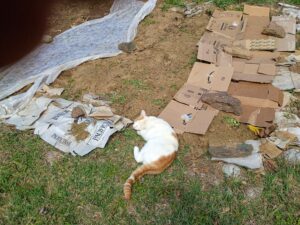
I also planted the peas this morning. It’s a bit early, but if I wait until I come back, it will be too late. This involved digging up and composting a big chunk of my cover crop, covering the peas with seed cover to protect them from the birds, and carpeting the rest of the exposed area with as much cardboard as I had to keep the weeds from a three-week party.

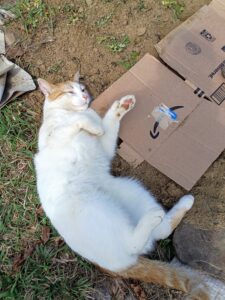
I could list tons of other stuff that’s still a hopeful maybe on my list. And that doesn’t even include the essentials of packing, acquiring last minute stuff we need, using up perishables in the fridge, and making sure the house is tidy enough for our friend who is coming to live here and take care of Andre the cat. But I’m trying to let myself off the hook for most of it. What did I write about a few weeks ago: calm, balanced, focused…? So much of my battle with myself is to stick with the task at hand, rather than get distracted by something else.

Of course, weekly blogging is always on the to-do list. So, I’m glad to get this task checked off, even if this isn’t the most profound blog I’ve ever written. It’s an interesting process, trying to figure out what to blog on each week. I usually get to a topic by thinking about what’s gone on in the past week (either in my own life and/or in the wider world) and then–hopefully–connecting that incident or event to some bigger theme related to art for change, writing, activism, or a niggling question about the universe that I hope others share.

But today, it’s just about that endless to-do list and the way it gets so bloated before traveling. I guess that might be universal–our inclination not to leave too much undone. I do take solace in the fact that the minute I get on the plane, the memory and thoughts of what I didn’t do will disappear like wisps of cloud sinking far below my view-scape.

At least, until I get back home…

Subscribe at https://ddinafriedman.substack.com
Limbo

I think my mother nailed it when she said on Tuesday, “4 PM: Mets; 7 PM: Yankees; 8 PM: end of civilization.”

Luckily we seem to have sidestepped that disaster–for now, but it does give pause to think about how fragile the trajectories of our lives can be, how we’re living in a perpetual state of limbo.

This feels true for me on on a personal level, as well. There’s no more fighting the notion that I’ve entered the senior citizen demographic, where obstacles to the body’s ability to maintain optimal function (all the risk factors and things one has to worry about) have seemed to increase exponentially. I’ve emerged relatively unscathed, so far, but many of my friends have had far more serious challenges than I have maintaining their health, mobility, and in some cases, their lives.

As I address my own (relatively minor) challenges of aging with a frenzied oscillation between fretfulness over the inevitable and a can-do attitude on how much weight I can dead-lift to improve my bone density, bigger questions continue to loom on the horizon, especially in these tumultuous times. How long do any of us–even those nowhere near the age for decline–have to lead full and happy lives?

And no matter what their age, how many people’s lives are unfairly upended by loss of a loved one through war or other unnecessary acts of destruction?

Finally, what’s been at the forefront of my mind: how many people’s lives have been compromised through personal harm and separation from their families due to our country’s cruel and inhumane detention policies?

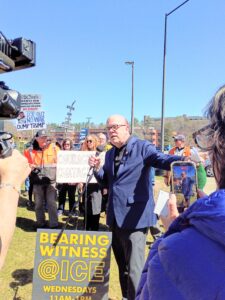
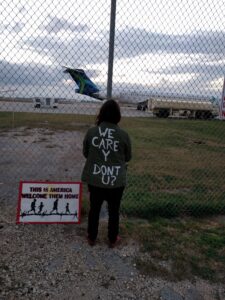
Yesterday, I traveled two hours with a friend to the ICE office in Burlington, MA, which is also being used as a detention center, despite not having adequate facilities–i.e. no showers, minimal food, and one exposed toilet for 40 people captured by video camera. We had just learned that our Congressman, Jim McGovern, whom we’d been urging during a recent meeting, was planning to make an unannounced oversight visit. All previous Congressional visits to Burlington have been pre-arranged, giving ICE time to clean up their act (with one unannounced Congressperson turned away at the door), but a recent court order reaffirmed the right of Congress to conduct oversight inspections without needing to make advance plans.

Photo: D. Dina Friedman

This time, they did let McGovern in. He confirmed that what he saw was a jail. He also had the opportunity to speak to a young man from Honduras–not “the worst of the worst” but someone who had a job, paid taxes, and had no criminal record and an asylum claim in process. This man has now been separated from his wife and two children–ages 12 and 7, with his future in limbo. McGovern’s visit is covered in this short news story. His recount of his observations to the people attending the weekly Wednesday witness in Burlington is here.

I know this post has gone a long way from annihilation, to aging, to bearing witness, but in all these cases, limbo stays with us, setting us on edge. Being alive right now feels a little like being on the balance board my grandson has. No matter how firmly my feet feel grounded, there’s always that possibility of sudden toppling. And I can only imagine what it’s like for those in the direct “line of fire”: people in war zones, people being targeted by ICE. How to wake up each day and just hope that you can go about your life and things will turn out okay? In the meantime, as long as my aging body holds up, I’m determined to do what I can to not only improve my chances of living well, but those of others, too.

Subscribe at https://ddinafriedman.substack.com


My Little Life

Yesterday, catching-up on the phone with a friend, I said in response to our mutual lament on the state of the world, I just keep doing my piece of the work, along with the rest of my little life.

My little life! echoed the depressed, despairing child that lives inside of me. It’s one of the things that keeps me up at night when the inner critics are jazzed on caffeine and partying away. Why should anything in your little life matter and why aren’t you doing enough to stop the tidal wave of horror that’s sweeping over everything around you? 

It gets to the point where I can’t read the news stories any more, like this one where ICE tricked a father with no criminal record and arrested him when he went to ICE to reunite with his children. Or the emails from friends in the community about people they know personally–caregivers, neighbors, friends being kidnapped and sent to Texas or Louisiana with no hope of bail. Not to mention the horror of a new war. And the constant twisting of language into an unrelenting spewed and venomous hatred of any one who is “other” in any way, shape, or form.

But enough ranting. What is “my little life,” anyway? Is it enough?

Here’s a snapshot:

Wake up. Open the shade and consider the sky. Sunny or cloudy? Spend a moment taking in the potential of the day. Center on the long reach of the naked trees. They’re still here, so you can be, too. Sit somewhere you can look out the window at the tree, and do your 5 minutes of breathing practice. Turn on the phone and play a 10 minute meditation tape. Do NOT open email or social media until you’ve done this. Then, quickly scan your email, but only for 5 minutes max. Go downstairs, where your partner is waiting, for 30 minutes of exercise: cardio, yoga, or strength-training. Segue into breakfast. Take your vitamins.

Finally, get to your computer with a large cup of tea. Consider the choices spread before you if you’re lucky enough to have a morning with no appointments. Generate new writing, revise writing, send out writing, work through the never-ending pile of house/admin; and all the activist tasks–emails, articles and letters to read or write, writing from others to edit, phone calls. Ask yourself two questions: which option calls the most right now, and which option is most urgent? You may get two different answers. You may get seven different answers, but try to make a choice. Try, despite your dopamine-craving brain to focus on whatever choice you made. Try NOT to stop what you’re doing to check your email and read more horror stories (a.k.a news).

If you do have appointments. Sit by your computer and talk to the people in the Zoom squares. Admire people’s writing. Chew on nuances in political strategy. Volunteer for more than you think you can do easily, and get overwhelmed. Or know this is your tendency, and only volunteer for half of what draws you.

Interrupt writing blog post for urgent phone call about flyer for Street Theatre Presentation at No Kings Day in Easthampton and Amherst that needs to be sent to the printer this morning. Interruption for all of you: Please go to a No Kings Day protest this Saturday, March 28th!! And bring a friend, or three!

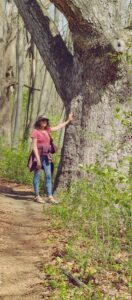
Eventually it will be lunch time. After lunch, try to set aside time for a walk in the woods. Visit your favorite tree. Try to do this even if it’s cloudy, or nasty. If it’s really nasty, go to the Y. Or go to the Y anyway if you’re going into town to run errands, or see a friend, or if you’re on your way home from taking care of your grandson.

Photo by Shel Horowitz

Take care of your grandson as often as you can. Jump fully into the world of a three-year-old who knows nothing about wars. Don’t think about the three-year-olds in detention. Don’t think about the three-year-olds whose parents are in detention. Don’t think about the three-year-olds who were killed in the wars in Gaza or in Iran, or the ones whose parents are dead.

When it’s your turn to cook dinner, spend mindful time preparing a nourishing meal. After dinner, call your 92-year-old mother and listen to the details of her day. Study Spanish, then practice piano or do your voice/yoga exercises and sing your heart out with karaoke tracks on you-tube. Chat with a friend. Watch a show. Do the crossword puzzle together with your partner or curl up with a book. Give your brain a rest from its obligations. Take a hot, relaxing shower and try to turn off the light before midnight. Try to sleep at least 7 hours. 8 is better, though it will skew your day so that you’ll feel behind as soon as you wake up.

Rinse. Repeat. And remember, spring is coming, so, soon, it will be all this, plus gardening.

Subscribe at https://ddinafriedman.substack.com


Body, Mind, Spirit

A couple of mornings ago, by the window where I sit to meditate, a robin perched on one of the bare branches of my elderly-but-still-hanging-in-there maple tree, painted so evocatively here by my friend, Janet Morgan, several springs ago. (Check out her work at https://www.janetmorgan-art.net/)

Art by Janet Morgan

Afterwards, I took my first outdoor race-walk of the season, grateful that the snow, had *finally* melted. As I trotted along the road, I heard a cacophony of birds, and again I felt grateful that I was both being mindful enough to pay attention, and that my crappy hearing was allowing their songs to come through. My route started with a gradual but long uphill, and I found myself huffing and puffing a little more than I would have liked. Even though I had been maintaining my fitness with indoor cardio, strength-training, and yoga, as well as taking sloggy snow walks all winter, I hadn’t really pushed myself. But some recent (relatively minor) health issues have made it clear that I need to up the ante.

I’m grateful to have a body, I told myself, even if it can sometimes be an annoying place to live. And then I thought about how much of my day is devoted to taking care of my body, mind and spirit. Really, now that I’m retired, nearly all of my day touches on one–or more–of these aspects of my being that will only thrive if I give them love and attention.

I’m not a categorizer by nature. My recent “Kondo-izing Poems” project, while gratifying, also had many excruciating moments where I couldn’t decide whether a poem belonged into the folder of poems to be worked on, the totally inactive poems, or the “Meh” poems, which is kind of like the minor leagues. And let’s not even talk about my bookshelf, my closet, or my filing cabinets. Yet, I did find myself pondering my daily activities and thinking about whether I would classify each of them as body, mind, or spirit. And [no] surprise! So many had overlap, I quickly gave up on the categorization game.

But maybe that’s the point: taking care of the body through meditation and exercise–two staples of my daily diet–is essential for my spirit. And writing, while a mostly mind-massage practice, can also be a big spiritual uplift, at least during the times I’m in the groove. Spending time focused on others, rather than oneself, can be invigorating in opening up some mental pathways that generally go unused, or opening the heart/spirit through emotional connection. And for me, engaging in the nitty-gritty of activism engages the part of my mind that likes to problem-solve and helps my spirit through connecting to others and giving me a lifeline to hope.

I guess it doesn’t really matter what categories our activities fall into. What does matter is to choose a diet that will create a sense of uplift, gratitude, and grounding in our own beings so we can do the work in the world that we’re meant to do.

Subscribe at https://ddinafriedman.substack.com

Writing in Hard Times

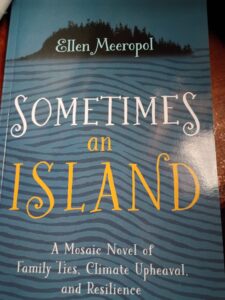
A couple of nights ago, I went to see my friend Ellen Meeropol read from her new book, Sometimes an Island, a novel about human resilience and connection after a climate catastrophe. One of the questions she was asked packed a punch for me–and I believe it also resonated for many others in the room. How Do You Keep Writing in Hard Times? 
While the audience did contain a large number of people who identified as writers, activists, or both, I think the question is universal. How do any of us do anything in hard times? How do we get out of bed in the morning? How do we engage in the regular routines of the day without falling into mental pits of excessive worry and paralysis? Is it truly enough to follow the clichéd but still useful advice of embracing gratitude, staying in the moment, and appreciating the small joys? And if we find a way of staying on the gratitude/small joys path, how do we balance our own mental health with confronting the monsters of climate change, war, racism, and countless other forms of injustice, so they don’t grow even bigger?

When Elli opened this question to other people in the room, I said, I can’t not write in hard times, because writing is my way of processing the hard stuff. And I think this is true for other creative beings (musicians, visual artists, etc.) whether or not you directly engage with political issues in your artistic life. Writing a poem, even a poem I won’t do anything with, can help me deal with paralyzing feelings. And when I’ve produced a piece of writing that feels more polished and finished, the process of creating and sharing that with others enhances my sensitivity, and hopefully provides readers a window in which to reconsider the view of their previous perceptions and gain new insights.

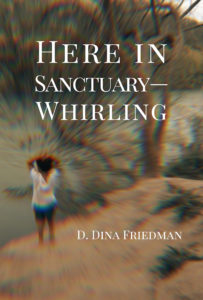
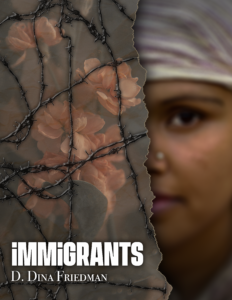
Elli also said that she doesn’t set out to provide answers in her writing, only to explore questions. I think this is an important direction and distinction for writers and other creative artists. After keeping my writing mostly separate from my politics because everything I tried to write sounded fake and didactic, I realized that I needed to center on the nuance, not the solution.  When I finally put together my immigration-justice themed short story collection  Immigrants, and my chapbook of poems, Here in Sanctuary–Whirling in a sense, all I was doing was whirling around my own questions. I had no answers (and no evidence that any so-called “answer” I came up with would be the right answer). I only wanted to expose what had been ignored by a harsh rationalistic rhetoric that focuses on question/answer, right/wrong and completely ignores its potential impact on human beings.

I haven’t yet read Elli’s newest book, but based on what I heard from her reading and how much I enjoyed her previous novels, I can happily recommend it. And even if it doesn’t solve these bigger questions, I’m sure it will help me think more deeply about them.

Subscribe at http://ddinafriedman.substack.com

Calm, balanced, and focused

Daily intention-setting has become a regular practice for me. And I’ve finally managed to veer away from the laundry list of all I’d might like to get done to more helpful guiding questions like: How would I like to feel today? Or, With what qualities will I approach my day? Sometimes I lean into joy, or appreciation, or kindness. But what comes up more than anything else are three words: calm, balanced, and focused.

Calm has never been my modus operandi. And I may have even convinced myself at various points in my life that it was fine not to be calm, because too much calmness would flatten the angsty juice that drives my writing and other modes of creative expression. But especially in the last ten years, as my anxiety and blood pressure increased and I began to feel world issues on a more visceral level, the absence of calm began to feel like a tunnel in the shelter I built around myself that kept widening, leaving a clear path for termites.

Calm by Nick Youngson CC BY-SA 3.0 Alpha Stock Images

Still, it’s hard to both lean into calm and also to feel the pain of all that’s askew in the universe. How many violent videos and horrible news stories can we take in before feeling flat and numb? It took me a while to realize that calm is not the same as numb, and that I could let myself feel and acknowledge painful realities without having to feel subsumed by them. In fact, being calm has made me a better activist, and I no longer fault myself for putting down the phone, and choosing not to read a particular post or article because I’ve had enough.

What this is about is being balanced. While I certainly take in my share of bad news and many times find myself ensconced in the sadness of either a personal or worldly situation, I’m at my best when I can stay out of overwhelm and balance my emotional responses with steady and thoughtful action. Balance also means tempering my day by adding nurturing and self-care to the things I put on my task list. And it also means balancing my expectations because I never get everything done on my task list!

And being balanced also means applying a steady focus on whatever I’m doing, rather than being distracted and trying to too many things at once–which, of course affects my ability to stay calm. And I’ll admit, right now, I’m feeling a bit frenetic because I only have 45 minutes to revise and post this blog before I’m called to other tasks that have times assigned to them for the rest of the evening. And I’ll also admit that I haven’t been very focused while writing this, as I keep veering off to answer emails or texts, or check social media. Intentions, at best, are aspirations that aren’t always met. So in addition to addressing my tendency to distract myself instead of focusing, I also need to be gentle–if firm–when corralling myself back to the task at hand, without beating myself up with a barrage of self-criticism.

Despite not always fulfilling my intentions, I find setting them useful. Because the ratio of calm/focus/balance to frenetic/distracted/overwhelmed has definitely increased–significantly–just by putting forth the desire. And the best is when I notice times that I’m deliberately cultivating calm and focus and choosing to ignore the urges toward reactiveness and self-distraction bubbling up inside me.

Subscribe at https://ddinafriedman.substack.com

Washing Away the Numbness

Like most writers, I’m constantly trying to strike the perfect balance between time for my writing and time for the rest of my life. And, like many activists, I struggle to balance responding to the demands of a situation, while setting boundaries so I can stay focused and not burn out too quickly. This past week has certainly been a test in maintaining all these balances. Nearly every day I’ve had 2 or 3 long meetings, some of them highly frustrating in the amount of disappointing new information revealed, or in their lack of productive outcomes.

This doesn’t even include time dealing with the text threads and email chains to plan and debrief these meetings, and sorting through the hundreds of issue-related texts and emails that have come into my inbox–many of which need to be responded to or forwarded to the right people.

Nor does it include the demonstration a few of us planned last Saturday as part of a regional day of action to boycott Citizens Bank, one of the few banks that still provides loans to CoreCivic and GeoGroup, two major players that run most of the ICE detention centers. And it doesn’t include the insomniac hours I spent worrying about the zero-degree wind chill forecast for that day and pondering whether or not we should postpone. (We decided to go for it, but set a shorter time frame. Happy that we got a good turnout and the sun kept the cold tolerable.)

It also doesn’t include dealing with the numbing grief as one shocking news story after another unfolds in Minneapolis and elsewhere. A second murder of a protester, the abduction of a preschooler used as bait to detain his parents (my grandson has the same bunny hat), a gunpoint wrongful arrest of a US citizen who was taken in his underwear in the frigid cold, and 5-year old twins being denied release after 8 months in detention in Texas because the judge said they have no access to collateral.

These are just a few of the horrific stories that can easily send me reeling into a state of numbness.

While people now seem to be galvanized by DHS’s murders of Tim Pretti and Renee Nicole Good, it’s important to know that they are only 2 of the 8 people who died in dealings with ICE just in the past month. Perhaps it’s easier to see ourselves in Pretti and Good, since they were protesters, but let’s not forget the other six people who died in ICE detention centers this January, often under questionable circumstances: Luis Gustavo Núñez Cáceres, Geraldo Lunas Campos, Víctor Manuel Díaz, Parady La, Luis Beltrán Yáñez–Cruz, and Heber Sánchez Domínguez. Campos’s case is particularly disturbing, as ICE claimed he committed suicide, but the medical examiner determined that his death was clearly a homicide.

So, yes, friends, it has been hard to find balance. And hard to find the psychic space to write, though in some ways being inundated with all these meetings and emails and events and projects does make me feel like I’m doing something to fight the tsunami, even if at times, I worry that I’m just wading right into it with my surfboard. Still, the cold water pouring over me does help wash away the numbness. And somehow, I’m still managing to stay afloat. And if you’re moved to take a small but important action right now, you can ask your Senator to vote against continued funding for ICE, using this call script from Indivisible.

Image by Elias from Pixabay: https://pixabay.com/photos/wave-ocean-sea-storm-tsunami-1913559/

Subscribe at https://ddinafriedman.substack.com