Reflections on a Year of Loss

Happy New Year! I was intending to write my annual post of my submissions stats for the year (which I will do in the near future) but a prompt suggested by poet Meg Hartmann, who offers a self-led write-a-poem-every-day course and other goodies for writers on her website Ah The Sea, led me in a completely different direction. The prompt, by sheer coincidence, turned out to be a line from my first writing teacher and long-time mentor, Pat Schneider, founder of Amherst Writers & Artists.

What could be more generous than a window? 

I have a gorgeous set of floor-length sliding windows in my dining room, where I often work in the winter in order to take in the maximum amount of sun. Looking out that window, I ended up meandering down a wider path and considering all of 2025–the good, the bad, and the ugly.

For me personally, the salient event of 2025 was my father’s death on March 1. Despite my gratitude for his long life (he was 93) and relatively short illness before his passing; and despite our not being exceptionally close even though our overall family bonds were strong, I couldn’t shake the feeling that a foundation of my world had come undone. My father’s illness and death, as well as its aftermath, have forged me into an entirely new relationship with my mother. Before 2025, I’d speak to both my parents on the phone every week or two, casually recounting the newsy highlights of my life while they shared theirs. This past year, I spoke to my mother no less than every other day: at first providing emotional and logistical support in navigating my father’s care, and then, after his death, occasionally helping her problem-solve life’s relentless administrative demands but mostly providing someone to talk to in the unbearable dark loneliness of isolation.

This has made me so grateful for my partner, Shel, and our 46-year relationship. I have major hermitic tendencies (and I’m grateful that he’s learned to dance around them) but ultimately, I will always choose connection over isolation.

I’m also grateful that my mother, at age 91, is cognitively sharp and physically able to care for herself. As with my father, my mother and I are not exceptionally close, though we share the same family-bonded loyalty. And we probably have less in common than my father and I did in terms of personality, outlook and values. But I’m determined to be the best daughter I can be and provide whatever support I can in this inconceivable transition. (My parents were married for 72 years.)

As I look out the window and watch 2025 recede into the distance, I can’t close out this reflection without considering how many people in our country have suffered losses, even if, due to luck and privilege, I haven’t been as deeply affected: loss of safety due to hate crimes and ICE overreach, loss of economic security, loss of access to health care, loss of access to food, loss of due process. I continue to be distraught as news story after news story reinforces the conjecture that cruelty is not only a result of the administration’s policies–it is the point. Yet, I’m hoping that some of the pundits are correct in predicting that the swelling tide of resistance will continue to rise in 2026.

Happy New Year! May it be joyful, peaceful, and cruelty-free! And may all your windows be generous!

Subscribe at https://ddinafriedman.substack.com

 

Is Gratitude Enough?

Despite my daily meditation practice, which includes listing one thing I’m grateful for each day, I have an ambivalent relationship with gratitude. It often feels unsettling to focus on the abundant amount of privilege I have–health, relationships, financial security–when so many others have more challenges in their lives. And while I do understand the benefits of centering gratitude in both the big and small moments, I worry about focusing on it too much, to the point where I’m less motivated to do what I can to make the world a better place for others.

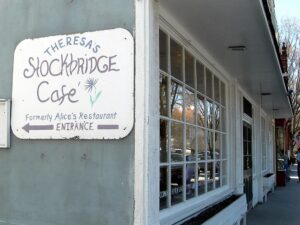
Dtobias, CC BY-SA 4.0 <https://creativecommons.org/licenses/by-sa/4.0>, via Wikimedia Commons

But today is Thanksgiving, a day we’re directed to give some attention to gratitude. For me, no Thanksgiving is complete without listening to Alice’s Restaurant, Arlo Guthrie’s classic song about how he manages to avoid being drafted into the Vietnam War by embellishing the story of his arrest for littering on a Thanksgiving Day 60 years ago. I feel grateful for Arlo: his irreverence, creativity and dry humor in a somber situation. I’ve just returned from Vietnam, where I visited the War Remnants Museum in Saigon, and saw many of the horrors close up: the countless bombs, the generations of disfigurement and health challenges from Agent Orange, the My Lai Massacre, the number of people dead on both sides.

The question weighed on me as it often does–Why do people do this sh*t to each other? What is it in the human psyche that wires us toward committing acts of cruelty that go far beyond the battlefield–as if the battlefield isn’t horrific enough. What makes it ok to shoot children, rape, torture and kill innocent civilians? I’m not just talking about the Vietnam War. These atrocities permeate all borders and all countries, stretching from ancient times to the present.

And in the wake of this, what does it mean to draw a faux border around our own Thanksgiving tables, shutting it all out? And how do we reconcile this time of gratitude with our genocidal history against Native Americans, many of whom mark this day as a time of mourning? My younger child has boycotted Thanksgiving for the past two years in order to attend their yearly protest in Plymouth. I am grateful for their activism, even though I’m not personally ready to abandon Thanksgiving, yet. But I think we need to see the holiday as aspirational, rather than celebratory. We can be thankful for the blessings in our lives, but we also need to address the holes and shadows in a tableau that falsely centers on the horn of plenty.

I’m not trying to make Thanksgiving a downer. I’m looking forward to our family cooking extravaganza, and time around the table, and pumpkin pie. And while I’m grateful for the many blessings in my personal life, I’m feeling even more grateful to the people who are following Arlo’s footsteps in being creatively subversive in not accepting the status quo: the dancing frogs in Portland, the whistle blowing in Chicago, the moms in Charlotte arranging transportation and food drop offs for immigrant families so that parents did not have to risk their safety. 

As Arlo says, “…fifty people a day walking in singing a bar of Alice’s Restaurant and
walking out. And friends they may think it’s a movement.” Today I’m grateful to all who have comprised this movement by taking actions in the last year to make life better for those endangered and at risk: whether that was protesting, donating money to people in need, writing letters to elected officials, having a difficult conversation with someone with an alternative point of view, or engaging in any small (or large) act of kindness.

Happy Thanksgiving!

Speaking Truth to Power

A few years ago, shortly after George Floyd’s murder by the Minnesota police, my late brother, Danny, asked me if I believed in critical race theory. He wasn’t particularly interested in my answer; he was just trying to goad me as he’d done all our lives, making fun of my favorite baseball players when we were kids, dissing the few rock stars I admired that he didn’t like when we were teens, and later tuning into our political differences as he sunk deeper and deeper into the influence of Fox News.

“I don’t call it critical race theory,” I told him. “I call it truth.”

I earnestly began to explain why I thought it was so important that we learn a true accounting of our history–the good, the bad, and the ugly–rather than a white-centered version that discounted or trivialized the experience of black people in the US. He didn’t really listen. I would have liked to chalk that up to ADHD rather than to our past history, except that he kept interrupting me with sound bites he’d clearly heard on TV that had little to do with the points I was trying to make.

Not so different from the sound clips from news pundits about a recent assassination of a right wing leader that Jon Stewart used in his “government-approved monologue” recorded after Jimmy Kimmel’s firing.

Just to be clear, I don’t condone political violence. No matter who does it to whom, and no matter what the underlying motivations might be.

But I also don’t condone this administration’s vilifying those that oppose their policies. I don’t condone their outright lying, or–as they would call it–“alternative facts.” I don’t condone their attempts to simply remove information that doesn’t speak to their political agenda, such as scrubbing DEI from government websites, removing the mention of slavery from national parks, and targeting exhibits at the National Museum of African American History, just to name a few of many examples.

While I agree that those grieving the dead should be respected, I don’t condone the administration’s and right-wing news media’s sanctification of the recently assassinated MAGA influencer after they ignored they ignored the assassination of Minnesota State House Speaker, Melissa Horton, for whom the flag was not lowered.

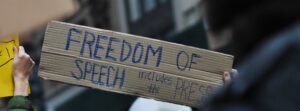
Narih Lee, CC BY 2.0 <https://creativecommons.org/licenses/by/2.0>, via Wikimedia Commons

Sadly, this is the first time in my life that I feel I need to choose my words very carefully. The freedom of the press and the freedom to express our opinions that our (quite conservative) teachers taught us about so proudly in elementary school is at risk. Even though Jimmy Kimmel has now been reinstated on some, but not all, of the ABC-affiliate stations, others who commented with concern about some of the things this leader said about black people, Jews, LGBTQ, women and other marginalized groups permanently lost their jobs.

But as writers and as human beings, our moral imperative is to speak truth to power, no matter how much we might dislike being goaded, or cowed, or threatened to stay quiet. Coming out of Rosh Hashanah, I realize this one of the things I need to do more of in the New Year.

Poet Ilya Kaminsky nails it here:

WE LIVED HAPPILY DURING THE WAR
And when they bombed other people’s houses, we
protested
but not enough, we opposed them but not
enough. I was
in my bed, around my bed America
was falling: invisible house by invisible house by invisible house.
I took a chair outside and watched the sun.
In the sixth month
of a disastrous reign in the house of money
in the street of money in the city of money in the country of money,
our great country of money, we (forgive us)
lived happily during the war.
#art for change


Chainsaws Gone Wild

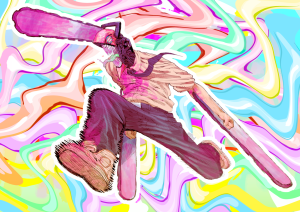
Photo by haemd: https://art.ngfiles.com/medium_views/ 6994000/6994772_2373943_haemd_ chainsawman.88461deeb7794d08f5f 382a77717451f.webp?f1756587284

Last fall, I was outside with my grandchild, Manu, when he heard a motorized noise and asked me what it was.

It didn’t exactly sound like a lawn mower, or a weed whacker. “Maybe it’s a chainsaw,” I said.

“Let’s go see it.”

He got in the stroller and we took off in search of the noise, taking a few wrong turns before we found the perpetrator–a very scary industrial-size leaf-blower, sucking up everything around it.

“I want to go home!” Manu shouted as soon as he realized what it was. He’s always hated leaf blowers.

At the time I didn’t find this incident particularly significant, except that Manu wouldn’t let go of his desire to see a chainsaw. In fact, for nearly a year after, every time he heard any kind of motor after that, he asked me if it was a chainsaw, even if the lawn mower, or the motorcycle, or the helicopter was clearly in sight. And he also asked me–often–to tell him the story of “Manu and the Chainsaw,” where I’d recount the chainsaw-turned-leaf-blower-search” in detail, embellishing shaggy dog style with my purplest toddler-appropriate prose.

The story always ended like this: Manu was very, very sad that he didn’t see a chainsaw, but Grandma said, ‘That’s okay, Manu. We’ll get to see a chainsaw some day.’

Last week, two houses down from his, the neighbors were cutting up a dead tree. Manu stood mesmerized, holding my hand at the edge of the grass, a little scared, a little awed, as the neighbors ran the chainsaw over and over through the dead wood.

***

I’ve been thinking a lot about this story, and its relationship to how we deal with things we anticipate once we see them.

Especially things that are unpleasant.

For months, we’ve been told fascism is coming, hovering at the edges of our democracy, eating away at it in small bites. We’ve been told that if we don’t turn the tides in three months, six months, nine months, or by the mid-terms at the latest, we’ll be doomed.

But fascism is here. Because ICE is here: Masked thugs over-running our communities, lawlessly breaking car windows, pushing their way into houses, taking undocumented people who have been here for years, as well as people with legal status, green card holders and even U.S. citizens.

In other words, kidnapping.

We may not have personally seen ICE yet; those of us who are privileged may feel like we still have time because in our day-to-day lives, everything is normal. We still wake up in the morning, work, exercise, garden, parent, make dinner, watch our daily TV shows. If we don’t pay attention to the news, we can live happily in a pretend world where nothing has changed.

On Labor Day, I went to a rally in support of a local farmworker who is one of over 2500+ victims taken by ICE in Massachusetts alone. An organizer who spoke said she was in the car accompanying this man to a court hearing when three cars surrounded them, threatening a head-on collision if they didn’t stop. Six men surrounded the car, pointed a gun at her face, and dragged him out.

This man’s only crimes: a broken tail light and wanting a better future for his family.

The whole incident took two minutes.

This man was following government protocols. He was on his way to a court hearing. If the government wanted to get rid of him so badly, they could do that through due process. But due process is no longer a given in our fascist state.

I’m pretty sure Manu had no idea what a chainsaw was when he first asked to see one. And while he’s now seen one in action, I’m still pretty sure he has no idea what a chainsaw can do when used inappropriately. If his parents, and I, and the other caring adults in his life have our way, he’ll never find out about the Texas Chainsaw Massacre.

But too many of the authorities in our country–ICE, CBP, and any police department that cooperates with them–are chainsaws out of control.

Meanwhile, like my grandchild, too many of us are just standing at the edge of the sidewalk gaping. Not because we’re bad people, because we just don’t know what else to do.

This is not meant to guilt-trip. If I knew what to do, I would happily end this post by saying so. I do believe, however, that acknowledging the reality of what’s happening is an important first step. And that art and activism; connection, community, and kindness all have a role in bringing about the world we want to see. Let’s hope it will ultimately be enough. #artforchange

To subscribe: https://www.ddinafriedman.substack.com


Art for Change

Next week, I’ll be launching a month-long series of social media posts on the theme of Art for Change. I’ll be spotlighting various artists and artistic projects, posting questions for us to contemplate in our own creative journeys, and offering thoughts in text and short videos on issues related to writing in dark times. I hope you’ll stay tuned and tell others who might be interested. (People can follow me on Substack, Facebook, or Instagram.)

But today, I want to write about joy.

We could think of joy as the flip side of darkness, but I think it’s more integrated than that. As I walked through the woods early this morning, contemplating my Elul challenges this year (Elul is the month before Jewish New Year, where it’s traditional to do an extensive “soul-accounting” of places where you’ve “missed the mark” and then work on setting new intentions and forgiving both yourself and others you may have inadvertently wronged), I had an insight that the biggest challenge for me would be figuring out how to simultaneously hold onto the joy and gratitude of being alive without abandoning my responsibility to do as much as I can to work for a more just, equitable and humane world.

As beloved Charlotte’s Web author E.B. White articulated so perfectly,

“I arise in the morning torn between a desire to improve (or save) the world and a desire to enjoy (or savor) the world. This makes it hard to plan the day.”

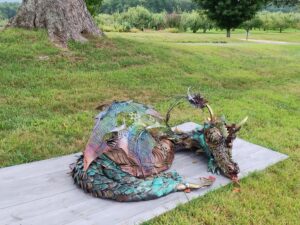
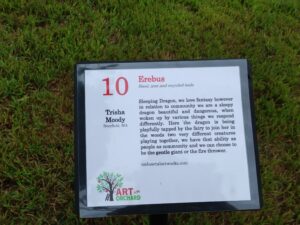
I got some inspiration from the offerings of our local biennial Art in the Orchard show, which I went to this past Monday. So many of this year’s works evoked fantasy or whimsy, and many of the artists said in their statements that the darkness of the times inspired them to look even more purposefully for a way to showcase joy. Maybe we need a little bit of magical thinking, like imagining this sleeping dragon playing with a fairy, rather than breathing fire, as explained in the artist’s statement below the photo. (All the pictures are mine.)

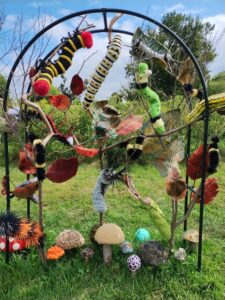
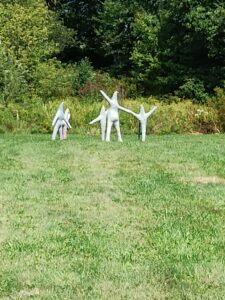
And I loved these playful caterpillars–and these rocks, dancing for joy.


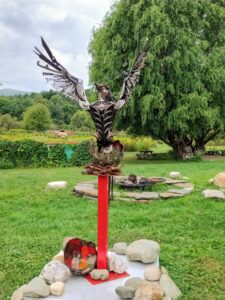
And here’s another image worth holding onto: the phoenix rising again!

My first question (a bonus before we get to the campaign): How do you manage to balance the heaviness and the joy? I’d love to hear your thoughts.

Subscribe at https://ddinafriedman.substack.com
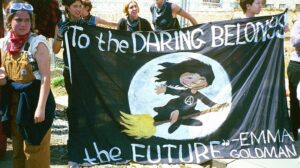


Or one of my favorites–the phoenix rising again.

Protest Poems

Today I woke up to some good news. Two more of my poems were today’s offerings on the Substack site Second Coming, a poem-a-day protest against the threats to our democracy by our current administration.

And last night, I went to hear a writing colleague, Bill Mailler read from his new book of social justice poetry, Trauma, Truth, and Outrage. Bill’s poems tend to be gut-punches. He doesn’t shy away from horror or attempt to beautify it through language. His work is like that sign our small group of witnesses illuminated at the border in 2020: Don’t Look Away.


What I liked most about Bill’s work were the questions relating to our human capacity for meanness, a key component of the poem, Meditations on My Whiteness, where he asks directly:

For what possible reason
could good or well-meaning people perpetuate or participate….

before offering a long lamentation of possibilities including:

because we are cowards and cannot acknowledge
the consequences of our actions?

because we teach our children to deny their natural empathy
for others, themselves, animals, and the earth itself? 

I also think constantly about the issue of human cruelty. Though my own work tends to take a less direct approach to writing about political issues, neither is wrong or right. They’re just different. The point, I think, is to enter the world through a lens of empathy, rather than simply ranting or trying to be prescriptive about what you think should be done. Poet Kwame Dawes talks eloquently about this issue in his own writing: When I write the poems about Haiti, people living with the disease, I’m not writing poems so that people will give.. but so the person who experiences when they read the poem, they’ll say to me… that’s it. That’s what I’ve been feeling but I didn’t know how to say it.

As many of us are staggering through these times with deep and heavy feelings about what’s happening in the world, reading a protest poem or a political piece of artful prose can help us feel less isolated as we try to make sense of our grief and uncover a path through it into some kind of meaningful action. That’s why when I’ve read my own protest poems at workshops or readings, even raw and unfinished generative responses to prompts, I often got more positive feedback than I expected because I was able to verbalize something that someone else had not yet been able to verbalize–touched a nerve, so to speak.

This isn’t to say writing protest poetry is easy. While I do believe that all attempts at creative expression should be acknowledged, respected, and validated, it’s difficult not to fall into ranting, generic abstractions, slogans, self-pitying, etc. And the problems with these pitfalls is that it becomes easier to lose the reader, who’s likely heard it all before and can gloss over or check out. Keeping empathy in the forefront can help. So can paying careful attention to language–using sensory details, fresh verbs, and unexpected metaphors. In prose, this might mean creating vivid scenes where the viewer can watch what’s happening to characters and form their own judgments.

What has made the process of writing protest poems and stories slightly easier for me in the past decade has been my being able to more fully integrate my life as a writer and an activist. While this wasn’t true in my earlier life, I now feel the fallout from political issues as viscerally as the other subjects I feel urged to write about. Allowing myself to deeply feel the horrors of all I read about in the news has certainly made it more difficult to maintain emotional balance, but I do think it’s necessary. We need, somehow, to find a path into a more deeply rooted empathy if we really want to break the pattern of ignoring atrocities–often done in our name by a system in which we are all still passively participating.

Subscribe at https://ddinafriedman.substack.com
Empathy

My 2.9 year old grandson, Manu, loves the playground, especially when there are no other children and he has the whole place to himself. A few days ago when we arrived, we saw another kid in the sandbox who waved to him enthusiastically. “That kid wants to play with you,” I said.

He hesitated before answering, then said, “I don’t play.”

Photo by Shel Horowitz

This surprised me because I have clear memories of being 2 and wanting nothing more than for other kids to play with me. I remember Linda, who lived a few houses down in the apartment complex we lived in and how I liked nothing better than running down the hill with her at top speed in our shared yard. And in kindergarten, I remember Mary Ann, with her perfect blond braids, how I cried because the teacher wouldn’t let me sit next to her.

While I don’t remember the specific incident, I also remember the day I came home from kindergarten crying  because some kids had said or done something mean to me. My mother simply shrugged and said, “Children are cruel.”

I was shocked! Children? My tribe? (I was already aware of divisions: that I was a child in a land of adults and a girl in a culture where boys ruled.) But how could children as an entity be labeled as cruel? I was a child and I wasn’t cruel. And why was being cruel something to be shrugged about and accepted as a fact of life?

Unfortunately, cruelty is not something confined to children. Our human history of wars, torture, and the oppression of one group by another is all the proof we need. And if we want to fast forward to the present and our own country, all we need to do is look at the initial reports from “Alligator Alcatraz” (aka “Alligator Auschwitz”) where inmates are reporting no bathing facilities, one maggot-infested meal per day, elephant-sized mosquitoes, 24-hour lights, and alternating periods of sweltering heat and chilling cold.

What should we do? Shrug, and say, “People are cruel?”

In both my most hopeful and most devastated days, I find myself pondering why we humans as a species are the way we are. How can we possibly have the capacity to harm each other in the ways we do? The “hopeful me” looks at this question as a puzzle that, once solved, can change the entire trajectory of how humans can live together on the planet, while the “devastated me” wants to curl up somewhere and cry–with many more tears than I ever shed because I couldn’t sit next to Mary Ann.

Elon Musk recently said, “the fundamental weakness of western civilization is empathy.” But that’s the voice of the dark side. Empathy is the only thing that might be able to save us from ourselves. It’s empathy for others that can catalyze those of us who have the privilege and the capacity to speak out. And we must speak out–despite empathy’s ability to also render us paralyzed because we feel the pain of others so deeply.

On a recent day at the playground, Manu wanted to climb on a rock where another little boy was standing. He stayed at the bottom of the rock for minutes looking up at the boy, who stared down at him from the top, neither of them saying anything, just staring each other down and holding their position. Finally the boy on the rock made a fist and released his index finger, as if he were shooting a fake gun. It was subtle gesture, and I wasn’t sure if I was interpreting it correctly, but I think I was, because he did it several more times.

Where did he learn that? I wondered, with horrified distaste. Who taught him?

Then I tried to use my empathy, and reason from the kid’s perspective. He was enjoying being on the rock and didn’t want anyone encroaching on his space. We humans have an innate tendency to protect what is ours, and when we’re young we often have to learn not to grab or be aggressive towards others to get what we want.

Even though neither of the little boys thought so, there was enough room on the rock for both of them. Just as there’s enough room in our country for all of us who are here to live peacefully with each other.

Eventually, the boy’s mother finally came over and picked him up, enabling Manu to climb on the rock unimpeded. Eventually, Manu, too, will need to learn how to share his space. Hopefully he’ll get to a point where he thinks it’s much more fun when other kids are also at the playground. Hopefully, we’ll also get to that point. Somehow. Some way.

Subscribe at https://www.ddinafriedman.com 


Out of the Cage

Last night, I had the special treat of seeing Ocean Vuong talk about his new novel, The Emperor of Gladness. I haven’t read the book yet, but I was wowed by his first novel, On Earth We’re Briefly Gorgeous–and struck by the sensitivity, depth and humor in the brief excerpt he read from this one. Most of all, I was moved by his thoughts on what it means to be a writer–what it means to be a human, actually–in these troubling times.

Vuong talked about “the cage” that all of us are trapped in, meaning the large set of sociocultural stereotypes and mores that hinder the definitions of who we are and the possibilities of who we can be. In his first novel, the main character, Little Dog, says: To be an American boy, and then an American boy with a gun, is to move from one end of a cage to another.

As I thought about this idea of cages, I realized that my lifelong pursuit of writing is absolutely an attempt to break out of the cages of expectation, to come as close as I possibly can to exploring absolute truth and authenticity. And perhaps that’s what makes Ocean Vuong’s work so great. He may be writing fiction, but he’s doing it without artifice. Vuong insists that his novels are not autobiographical, nor are they specifically about anyone in his actual life and claimed that he would never appropriate anyone’s life story to feed his art. Yet, there’s a truth that seeps through whatever he’s invented that pulls back the veils under which we hide.

And I do believe it’s not only the revelation, but the acceptance of our own and each other’s authenticity–provided we can even find it in ourselves–that may be our only hope of changing the world.

Alligator Alcatraz: From Heute.at (cropped)

Of course, I couldn’t think about cages without the intrusive images of “Alligator Alcatraz” the newest prison being build in Florida and the memories of children in cages during this administration’s first term, a practice that ended after huge public outcry.

Also, yesterday, earlier in the day, I joined eight other people dressed in black, carrying signs with names and information about people who have been disappeared in Massachusetts and sent to caged prisons near and far. We walked in silence through the streets of Northampton, banging a drum, and bearing witness, creating a stunning visual effect that made people stop what they were doing and notice.

Said Vuong in a recent interview, Maybe in another 15 years, I will write about trying to be an artist while our civil liberties are being eroded and our country is run by oligarchs who are bordering on fascism. If we make it to 15 years later, hopefully I can write a book about that. 

Hopefully, he can. And in the meantime, hopefully we’ll all continue to access whatever creative sparks we all can make to raise awareness, claw out our own truth, and make it through.

Subscribe at https://ddinafriedman.substack.com