A Glorious Cascade

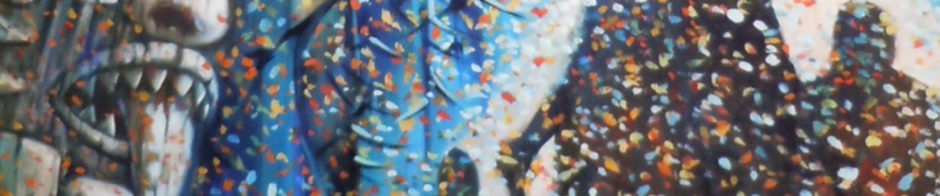
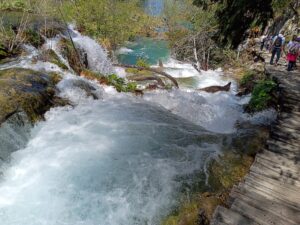
One of my favorite days on our recent trip to Croatia was the day we went to Plitvice Lakes National Park, on an incredible three-hour meander with more waterfalls than I could possibly count. Some were the gigantic gawker spray-in-your face variety, while others were trickles of various intensity sheltered by rocks and shaded by trees that stretched out over the lake, often merging into a more significant outpour. Whatever their size or relative ferocity, all of them pressed the happy button. So much beauty in the sound of the spill and the patterns it creates: a glorious cascade. A day of glorious cascades.
At the same time I was reading a book, I didn’t want to finish because it was so good: Apeirogon by Colum McCann, a novel, about Combatants for Peace, a group of Israelis and Palestinians who have lost close relatives in the conflict and yet have been moved to embrace trust and mutual respect for each other, rather than fear and revenge. Based on real life characters, that was enough of a reason to read it. But what made the book SO exceptional was the way it was written, in small and larger bursts of intensely poetic but also clear and accessible prose, with some sections going on for a few pages and others compressed into just a paragraph or two, sometimes a single sentence. In every section, a cascade of images, emotions, history, context, and open ambiguity circled around and around in itself like the whirlpool of a fall once it hits the water.

In his poetic cascades, McCann weaves through many topics that seem to be unrelated to the plot and theme of the book, but he brings them back beautifully again and again, showing how everything reverberates on everything else and nothing can be viewed without looking at it from an infinite number of angles. In fact, the book’s title, Apeirogon, refers to a mathematical shape with an infinite number of sides and vertices. And that’s how I felt when reading this book. Whether I was reading about birds, or a 19th century failed expedition across the Dead Sea, or the tragic stories of one man’s daughter killed by a rubber bullet shot by Israeli border guards and another man’s daughter dead from a suicide bomb in Jerusalem, I wasn’t asked to park myself in any given spot. I was just asked to sit and observe what felt like a beam of light bouncing off a room full of angled mirrors.
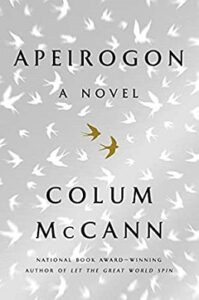
https://www.abebooks.co.uk/ servlet/BookDetailsPL? bi=30665233510, Fair use, https://en.wikipedia.org /w/index.php?curid=67793592

In my MFA program as well as in previous fiction writing workshops, lectures, and books, there’s a strong emphasis on the notion of scene. In very basic terms, a novel or a story should consist of a set of scenes where action happens based on what the characters do within these scenes. And these actions are motivated by what the characters need or want. There is certainly room for exposition, description, and (if one wanted, but it wasn’t required) poetic prose, but the basic questions asked at workshops were things like What’s at stake? Who are these characters? What do they want? We were warned, strongly, not to let our love of the written word go wandering off into nowhere.

I’m not dissing these questions and this approach. It’s definitely important to understand these basic fictional elements. And I also know that once someone becomes skilled in a convention, they can more easily and successfully break it. This book’s strength was in its exposition and description; yet, all of it masterfully flowed back to the main theme. It stood out from other so-called “experimental” books I’ve read that broke from heavy scene/character mold because each “cascade” was a mini-story that landed somewhere and I could be on its journey as it sheeted over rocks, or pooled in a corner, or joined another tributary and kept on swirling.

I’m tempted and inspired to see if I can write a selection of prose poems that works as story. Or a story in the shape of a heartbreakingly beautiful series of cascades. Perhaps some of you may be as well, but whether or not that idea calls, and no matter where you might stand on issues regarding Israel and Palestine, I highly recommend this novel. It will open your heart and your sense of what’s possible–on the page, and perhaps even in the world.

Subscribe at https://ddinafriedman.substack.com

 

Fan Bases, Humility, and Publication Success

Up until about a week ago, 2026 felt like an off-year for writing. I’d done my homework: 40 poetry and 8 Fiction/Essay submissions so far. However, nearly all of it, except for a very small smattering, was coming back with a no.

This is not a complaint or a boo-hoo moment, and, as I’ve counseled others, I didn’t take it personally. But I’d been used to a slightly higher (10-12%) batting average than what I’d been getting. True, I might have been skewing my submission strategy to a higher number of “reach journals” from which I’d be more likely to get rejected, but I still always made sure to include many others that seemed in my ballpark.

Until this past week, where three journals accepted seven poems.

It’s important to recognize that what happened this week didn’t start this week. Two of the journals that accepted my work were places I’d published before, and though I don’t know either of these editors personally, I was touched that they each went out of their way to personally solicit a submission from me. There’s little more gratifying to get an email out of the blue that says, Hey Dina, we haven’t heard from you in a while. Our next theme is __________ and we would love you to submit your work. I’m paraphrasing the wording, but it’s the implication, rather than the words, that matters. Your work touched me. It was memorable and I’d like to see more of it. And share it with others.

Wow! Do I really have a fan base? Part of me feels uncomfortable even thinking such a thought. I tend to bristle in spaces where writers and other creatives get too blatantly self-promotional. I know there’s a certain amount of PR that has to be done, but I can usually discern when people are a little too connected to their egos, rather than seeing themselves as merely a conduit for the work they’re doing. I know that is a highly judgmental statement, and I’ll probably need to unpack it–and apologize to anyone I might have offended. But I will continue to stand firmly in an aura of humility, rather than arrogance, though hopefully maintaining enough balance not to fall into self-effacement, as one Jewish spiritual practice, the Mussar, teaches.

And taking that significant step away from self-effacement, I’m glad to take this moment to affirm that it’s ok–more than ok–to acknowledge that somewhere there are people out there who love my work.

Retrieved from Open Access: grfpublishers.org

Which is why I do all these submissions. And write this blog. Because I want to expand my reach beyond the boundaries of my communities to others in the ether, whom I hope will be touched in some small or large way by my words and the messages behind them. Ultimately, what I want is connection, whether it’s through my words or (in the cases of writers/artists/musicians, etc. of whom I’d call myself “a fan”) theirs.

Note: this is not a quick process. It has taken years, and many, many rejections and disappointments to cultivate these relationships. Likely there are editors out there who will love your work once they become aware of it, but the amount of time this takes will try your patience and fortitude. However, it is a great way to feel connected–and to get your words out there to a wider audience. It’s also been personally gratifying to friend some of these editors on social media and get to know just a little bit about them as people, as well as to follow journals I like and get a deeper sense of why these editors have devoted so much time to the unpaid labor of love of spreading words into the universe.

So thanks to Katherine McDaniel at Synkroniciti, Michael Broder at Second Coming, Abby Murray at Collateral, Elizabeth MacDuffie at Meat for Tea, Nadia Arrioli at Thimble, Emily Perkovich at Querencia Press, Matthew Krajniak at Consequence, Hayley Haugen at Sheila-Na-Gig, Lee Desrosiers at  Wordpeace and the Naugutuck River Review, Sally Zaino at Earthshine, and many others that I’m missing here for your dedication to forging connections between writers–and readers.

Subscribe at https://ddinafriedman.substack.com
When Is Your Work Finished?

How do you know when something is finished? Is everything a draft until you die?

Photo Credit: StevenDePolo on Flickr

This question was posed last night to three writers from my community at a reading last night: John Shierer, Darlene Elias, and Fin Finley. These are writers I’m happy to know and even happier to listen to, all of whom were authentic in using language beautifully, clearly, and compassionately to tell their own truths. John is a master of the 100-word story whose turn at the end leads you right back to wanting to hear the whole thing again. Fin always impresses me with her eye for detail and a voice that straddles a perfect edge between snarkniness and vulnerability. Darlene writes passionately about her own life as a Puerto Rican woman with roots in the barrios of the Bronx and Holyoke, MA, evoking much deeper questions about racism, generational trauma and womanhood.

People asked several questions at the end, but the one about knowing when your work is finished was the one that stuck with me. I hadn’t heard the “it’s a draft until you die” quote, but I’d heard a similar sentiment: Projects are never done they’re just abandoned. Still, I appreciated what each writer had to say on the subject.

Even as I was reading my story tonight, I was rewriting it in my head, John said (paraphrased as best as I can remember). I had to laugh, because I do exactly the same thing. Sometimes I’m swift enough to change a phrase on the spot from the inferior phrase that’s written on the page, even as the cruel inner judge starts its rampage–How did that crappy sentence ever make it into print?

Fin had a more positive response, (also paraphrased): There’s often just a point when you feel something. It could be tears, or some kind of oomph or other emotional reaction. And then you know that you’ve said whatever it is you really wanted to say. I resonate with that one, too. Some snotty writing pundits decry such sentimentality, but ultimately, while most of my writing is intended for an outside audience, it still has to get through the gatekeeper audience of one: me. So if I’m moved, that’s a good beginning. The question is whether I’ll still be moved when I read the piece tomorrow, and the day after that, and the week, month and year after that…Is the impact momentary or can it hold?

Darlene talked about the importance of deadlines–timelines in which pieces had to be done, perfect or not. And this is also a good thing to remember–especially for recovering perfectionists. I make it a point to spend no more than one-to-two (well, occasionally three) hours on a blog post, and I’m determined complete each one in a single day. So, while I do read over my drafts several times before hitting the post button, making little tweaks here and there, I don’t obsess on getting getting my posts perfect and think of them more as musings in progress. They might turn out very differently if I gave them a week to simmer, but I’ll never know.

Poems, stories, or essays targeted for journals are an entirely different matter. I can’t read over prose I’ve written without omitting at least a few sentences and words that clearly don’t need to be there, though in most of my “finished” stories (which have gotten to a point where I have the emotional oomph) I don’t tend to mess around too much with the plot or the characters. But I have often deleted a page or two at the beginning or end. Or a random paragraph in the middle, or added something to a scene that felt chopped off.

And I do have some poems in my file that have 5 or 8 or 10 different versions.  Sometimes when I take them out to work on, the tenth version seems no better than the first version. Often it seems worse, but the first version also feels like an idea that’s only half-baked. These are the projects that are abandoned. No flood of tears or emotional oomph in sight. But every once and a while a year or two will go by and when I’m going through my files and “Kondo-izing,” I’ll find a gem in these abandoned piles that I can polish into sparkle–and, dare I say, finish it!

Everything will be grand, then–until I read that piece at a reading somewhere and rewrite the whole thing in my head.

Subscribe at https://ddinafriedman.substack.com