Stories from Trieste

As promised, I’m posting from Croatia, but I’ve spent the last few days in Trieste, Italy—a town with 5,000 Jews in 1938 and only 500 now.

I hadn’t been much aware of Italy’s Jewish history other than the obvious knowledge that their population was impacted by the Holocaust. What drew me to starting my trip in Trieste was not this gruesome history, but the current joie de vivre I’ve come to associate with Italy based on previous trips: outdoor cafes lining all the little alleys offering good coffee, good wine, stellar desserts I’d deny myself at home, and places to watch the sunset over the deep blue Adriatic Sea.

But I generally have checked out Jewish museums and synagogues in my travels, so it was totally in character for us to visit the small Museo Ebraico in the old city. Now that many synagogues in the U.S. are often under police protection, I shouldn’t have been surprised to see a security vehicle in front of the building, patrolled by two men in army camouflage gear, but of course, I was. It’s hard not to cling to the illusion of feeling safe wherever I go.

Even though I’ve been to many Holocaust museums before and had to do extensive research when writing Escaping Into the Night, something about visiting this museum hit me harder than usual. Perhaps it was the emphasis not on the Shoah itself, but on the period leading up to it: how the encroaching fascism in the 1930s split so many of Trieste’s Jewish families—some supporting the move toward greater order and authority, and others eschewing it in favor of communism or socialism.

Sound familiar?

Or perhaps it was the slow creep of laws restricting rights for Jews and others targeted by the rise of the new regimes. Or the longer overview of all the the times Jews didn’t have rights in Europe, which even though I knew that from past studies, it’s still a concept that’s hard for me to wrap my 21st Century American brain around.

Even with what’s happening right now in our country.

And with what has continued to happen in many places throughout the world.

It’s much easier to embrace the daily joie de vivre, even when I’m not on vacation. And on the days that joie de vivre seems out of my grasp, to focus on the day-to-day household and life problems I can solve, rather than things that are out of my control.

And ultimately it was the deportation stories that tied the threads between then and now. Photos of person after person deported to Auschwitz, never to return. And in front of the pension where we were staying, several blocks away from the museum, plaques commemorating the Jewish family that used to live in that building–all of them ending their lives in Auschwitz.

The owner of the pension, who asked in a whisper if we were Jewish, told me her mother, now 102, lived in Trieste at the time of the Shoah, but escaped with her family to Assisi, where they were hidden in a convent. If it weren’t for that, I wouldn’t have been here, she said.

Some of the families in Trieste didn’t go to Auschwitz. And most were sent originally to Risiera di San Sabba, an old rice mill just outside of town that was converted into a holding facility and deportation center.

Sound anything like current plans to convert warehouses into massive detention camps?

We could have visited the site, but we chose not to. We were on vacation and I didn’t want to see the crematorium. So we chose to go to Miramare Castle instead, and bask for a few hours in lifestyles of the rich and famous, while enjoying the views of the sea.

When we came back we sat outside at a gelato bar enjoying mixed cups of cioccolato nocciola, fragola, tiramisu, e pistachio while listening to a street musician play My Way and Hit the Road, Jack on the saxophone. Later that evening, we walked a few blocks to an Indian restaurant for dinner in order to take a break from all the white flour pasta and pizza we’d beem eating. When the owner said he looked forward to coming to the United States again, we told him he’d be better off waiting a few years until things changed.

And now it’s up to all of us to make sure things do change. Soon.
To-Do List Hypermode

I’m excited to tell you that my next post will be from Croatia!

I’m looking forward to meanders by the sea, exploring hiking paths with gorgeous lakes and waterfalls, old towns with narrow alleys and medieval buildings. Most of all, I’m looking forward to a break from my life’s nurturing but relentless to-do list, even as I know that all those to-dos in my regular life will somehow seem much sweeter and more meaningful on my return.

Meanwhile I’ve been scurrying around for the past few days in “To-Do List Hypermode,” trying to get things done that I don’t want left hanging when I get back in early May. Already, I know I have to figure out a way of giving myself dispensation because I know won’t get to all of it, and sadly, a lot of the administrative and deeper household maintenance tasks that I often put off for months will likely still be waiting for me. In the meantime, I’ve done the things that feel more essential and time-sensitive, like drafting a thank-you letter to our fabulous Congressman, Jim McGovern, for his unannounced visit to the Burlington ICE office/detention holding facility last week, writing an article for our immigration justice newsletter, and starting on an agenda for the next monthly meeting of our regional immigration advocacy network, which I’ll miss, but am still committed to helping with planning.

And I completed my April writing submissions goals (I usually aim for around 10/month).

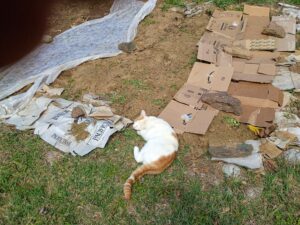
I also planted the peas this morning. It’s a bit early, but if I wait until I come back, it will be too late. This involved digging up and composting a big chunk of my cover crop, covering the peas with seed cover to protect them from the birds, and carpeting the rest of the exposed area with as much cardboard as I had to keep the weeds from a three-week party.

I could list tons of other stuff that’s still a hopeful maybe on my list. And that doesn’t even include the essentials of packing, acquiring last minute stuff we need, using up perishables in the fridge, and making sure the house is tidy enough for our friend who is coming to live here and take care of Andre the cat. But I’m trying to let myself off the hook for most of it. What did I write about a few weeks ago: calm, balanced, focused…? So much of my battle with myself is to stick with the task at hand, rather than get distracted by something else.
Of course, weekly blogging is always on the to-do list. So, I’m glad to get this task checked off, even if this isn’t the most profound blog I’ve ever written. It’s an interesting process, trying to figure out what to blog on each week. I usually get to a topic by thinking about what’s gone on in the past week (either in my own life and/or in the wider world) and then–hopefully–connecting that incident or event to some bigger theme related to art for change, writing, activism, or a niggling question about the universe that I hope others share.

But today, it’s just about that endless to-do list and the way it gets so bloated before traveling. I guess that might be universal–our inclination not to leave too much undone. I do take solace in the fact that the minute I get on the plane, the memory and thoughts of what I didn’t do will disappear like wisps of cloud sinking far below my view-scape.

At least, until I get back home…

Subscribe at https://ddinafriedman.substack.com

Limbo

I think my mother nailed it when she said on Tuesday, “4 PM: Mets; 7 PM: Yankees; 8 PM: end of civilization.”

Luckily we seem to have sidestepped that disaster–for now, but it does give pause to think about how fragile the trajectories of our lives can be, how we’re living in a perpetual state of limbo.

This feels true for me on on a personal level, as well. There’s no more fighting the notion that I’ve entered the senior citizen demographic, where obstacles to the body’s ability to maintain optimal function (all the risk factors and things one has to worry about) have seemed to increase exponentially. I’ve emerged relatively unscathed, so far, but many of my friends have had far more serious challenges than I have maintaining their health, mobility, and in some cases, their lives.

As I address my own (relatively minor) challenges of aging with a frenzied oscillation between fretfulness over the inevitable and a can-do attitude on how much weight I can dead-lift to improve my bone density, bigger questions continue to loom on the horizon, especially in these tumultuous times. How long do any of us–even those nowhere near the age for decline–have to lead full and happy lives?

And no matter what their age, how many people’s lives are unfairly upended by loss of a loved one through war or other unnecessary acts of destruction?

Finally, what’s been at the forefront of my mind: how many people’s lives have been compromised through personal harm and separation from their families due to our country’s cruel and inhumane detention policies?

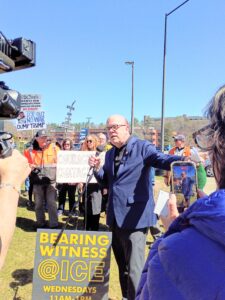
Yesterday, I traveled two hours with a friend to the ICE office in Burlington, MA, which is also being used as a detention center, despite not having adequate facilities–i.e. no showers, minimal food, and one exposed toilet for 40 people captured by video camera. We had just learned that our Congressman, Jim McGovern, whom we’d been urging during a recent meeting, was planning to make an unannounced oversight visit. All previous Congressional visits to Burlington have been pre-arranged, giving ICE time to clean up their act (with one unannounced Congressperson turned away at the door), but a recent court order reaffirmed the right of Congress to conduct oversight inspections without needing to make advance plans.

Photo: D. Dina Friedman

This time, they did let McGovern in. He confirmed that what he saw was a jail. He also had the opportunity to speak to a young man from Honduras–not “the worst of the worst” but someone who had a job, paid taxes, and had no criminal record and an asylum claim in process. This man has now been separated from his wife and two children–ages 12 and 7, with his future in limbo. McGovern’s visit is covered in this short news story. His recount of his observations to the people attending the weekly Wednesday witness in Burlington is here.

I know this post has gone a long way from annihilation, to aging, to bearing witness, but in all these cases, limbo stays with us, setting us on edge. Being alive right now feels a little like being on the balance board my grandson has. No matter how firmly my feet feel grounded, there’s always that possibility of sudden toppling. And I can only imagine what it’s like for those in the direct “line of fire”: people in war zones, people being targeted by ICE. How to wake up each day and just hope that you can go about your life and things will turn out okay? In the meantime, as long as my aging body holds up, I’m determined to do what I can to not only improve my chances of living well, but those of others, too.

Subscribe at https://ddinafriedman.substack.com


Why Can’t This Night Be Different From All Other Nights?

Photo: D. Dina Friedman

Of all the Jewish holidays, Passover is my favorite,  I’ve always liked that the Passover Haggadah (the book that is read during the seder that tells the story of the Jews’ liberation from slavery in Egypt) has so many metaphors that are easily adaptable to modern times. Over the years, I’ve spent many hours adapting the text to whatever issue is plaguing (pun intended) me most at the moment, as well as enjoying the contributions of my family and community in making the text and the rituals it includes meaningful and relevant.

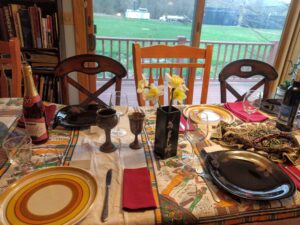
But this year, with all the conflict going on in the world and in our own country, it’s hard to get into the mindset for celebration, even with the holiday’s themes of liberation against oppression and hope for the future. The small group I celebrated with last night started the night by acknowledging our fear, anger, and unease at what’s going on in our country and in the wider world. And yet, I was also so glad to be in this circle of friends, most of whom I’ve known for decades. When it was my turn it speak, I said, To me, Passover is about community, more than it’s about God, or Egypt, or any of that. 

As I think about that comment a day later, I’m wondering whether it’s actually true, or if I was just thinking off the top of my head. I’m not saying there’s no truth in what I said. Community is definitely a big factor, and I really don’t care that much about most of the traditional Passover story. But Passover does comprise more than community. It even comprises more than the yearly menu-squabbling and “back-seat cooking” as my partner and kids and I all pile into the kitchen to grate and chop the vegetables. Or the reminiscences of all the goofy things we used to do to keep it light and entertaining: putting the dog on the porch so he could walk in when we opened the door for the prophet Elijah, or the years we told the story through improvisation games, or through parodies of songs from musicals, or raps.

But there’s serious stuff, too: I love the metaphor of the internal journey through “the narrow place” (Egypt) and the casting off of internal “chomaytz” (the leavened products you don’t eat during Passover) as a way of ridding yourself of excessive ego, pride, or unresolved emotions. I love some of the side stories: the midwives who helped the Jewish women hide their babies instead of following orders to kill them; Nachsun, whom I wrote about last year, who jumped into the Red Sea, before the waters parted an act of incredible hope when it seemed there was no hope to be had.

And, there are some troublesome parts: Like the ten plagues as collective punishment against an entire people for the actions of a tyrant. Or, really, any aspect of “us” and “them,” as two separate entires with a winner and loser. I’m not saying that oppression of the Israelites in Biblical Egypt didn’t exist, but I wish I could think we were past oppressing others, and celebrating victories where innocent people, like the first-born children of the Egyptians, lost their lives.

And, of course, the elephant in the room: the actions of the Israeli government in Gaza where 64,000 children were killed or injured in 23 months of war. And the current U.S./Israel war agains Iran whose victims include 168 elementary school girls whose school was bombed. Hard to say, “next year in Jerusalem,” (the closing words of the seder) after that. I’d like to think that after 3,000 years we’ve moved beyond killing children, I’d even like to think we’ve moved beyond war, or beyond tyrants, but I guess that’s too much to hope for.

So I can understand why our host last night opened the seder by expressing how hard it was to even sit down and celebrate Passover. Yet, it was the small community of like-minded people I celebrated with that helped me feel able to take a small step back into my Jewish identity. We still can use the metaphors and inspiring parts of the story to envision a better world. And after that, act on them to make that vision more of a reality.

Chag Sameach!

Subscribe at https://ddinafriedman.substack.com