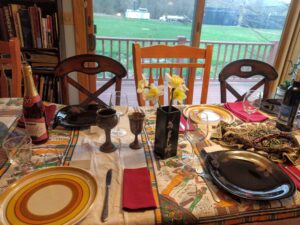
Photo: D. Dina Friedman
Of all the Jewish holidays, Passover is my favorite, I’ve always liked that the Passover Haggadah (the book that is read during the seder that tells the story of the Jews’ liberation from slavery in Egypt) has so many metaphors that are easily adaptable to modern times. Over the years, I’ve spent many hours adapting the text to whatever issue is plaguing (pun intended) me most at the moment, as well as enjoying the contributions of my family and community in making the text and the rituals it includes meaningful and relevant.
But this year, with all the conflict going on in the world and in our own country, it’s hard to get into the mindset for celebration, even with the holiday’s themes of liberation against oppression and hope for the future. The small group I celebrated with last night started the night by acknowledging our fear, anger, and unease at what’s going on in our country and in the wider world. And yet, I was also so glad to be in this circle of friends, most of whom I’ve known for decades. When it was my turn it speak, I said, To me, Passover is about community, more than it’s about God, or Egypt, or any of that.
As I think about that comment a day later, I’m wondering whether it’s actually true, or if I was just thinking off the top of my head. I’m not saying there’s no truth in what I said. Community is definitely a big factor, and I really don’t care that much about most of the traditional Passover story. But Passover does comprise more than community. It even comprises more than the yearly menu-squabbling and “back-seat cooking” as my partner and kids and I all pile into the kitchen to grate and chop the vegetables. Or the reminiscences of all the goofy things we used to do to keep it light and entertaining: putting the dog on the porch so he could walk in when we opened the door for the prophet Elijah, or the years we told the story through improvisation games, or through parodies of songs from musicals, or raps.
But there’s serious stuff, too: I love the metaphor of the internal journey through “the narrow place” (Egypt) and the casting off of internal “chomaytz” (the leavened products you don’t eat during Passover) as a way of ridding yourself of excessive ego, pride, or unresolved emotions. I love some of the side stories: the midwives who helped the Jewish women hide their babies instead of following orders to kill them; Nachsun, whom I wrote about last year, who jumped into the Red Sea, before the waters parted an act of incredible hope when it seemed there was no hope to be had.
And, there are some troublesome parts: Like the ten plagues as collective punishment against an entire people for the actions of a tyrant. Or, really, any aspect of “us” and “them,” as two separate entires with a winner and loser. I’m not saying that oppression of the Israelites in Biblical Egypt didn’t exist, but I wish I could think we were past oppressing others, and celebrating victories where innocent people, like the first-born children of the Egyptians, lost their lives.
And, of course, the elephant in the room: the actions of the Israeli government in Gaza where 64,000 children were killed or injured in 23 months of war. And the current U.S./Israel war agains Iran whose victims include 168 elementary school girls whose school was bombed. Hard to say, “next year in Jerusalem,” (the closing words of the seder) after that. I’d like to think that after 3,000 years we’ve moved beyond killing children, I’d even like to think we’ve moved beyond war, or beyond tyrants, but I guess that’s too much to hope for.
So I can understand why our host last night opened the seder by expressing how hard it was to even sit down and celebrate Passover. Yet, it was the small community of like-minded people I celebrated with that helped me feel able to take a small step back into my Jewish identity. We still can use the metaphors and inspiring parts of the story to envision a better world. And after that, act on them to make that vision more of a reality.
Chag Sameach!
Subscribe at https://ddinafriedman.substack.com