A Memoir of Music and Transformation

Can art change our lives? Why does creative expression matter so much?

And to whom does it matter? Should “great art” be confined to those who’ve achieved some recognized level of skill/talent/recognition in a world where we don’t define value as the impact it makes on others, but on its ability to be commoditized. Or should we equally appreciate all attempts of creative expression (even if some may touch us more than others) as an offering from one soul to another, and perhaps a mutual healing?

These are questions I’ve been thinking about ever since I returned to piano and stuffed all the baggage about my musical family, creativity, and judgment (by both self and others) into Imperfect Pitch, a memoir, I’ve yet to publish. But recently, my good friend, Lanette Sweeney, (whose blog, Paying Attention: A New Mindfulness Method, I highly recommend) told me about Vijay Gupta’s Restrung: A Memoir of Music and Transformation.
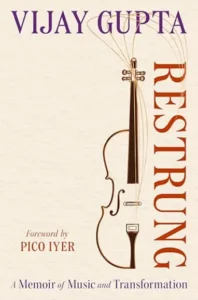
Like me, Gupta had perfect pitch. And like my younger child, he started Suzuki violin lessons at four years old and figured out in a couple of weeks how to play all of Book 1 when he was supposed to be standing on a pizza box and learning how to bow. But unlike either of us, Gupta was, perhaps, a child prodigy, or perhaps pushed into that box. His very scary, overachieving parents, who hit him when he wasn’t practicing enough or to their liking, and several years later shamed him for only coming in second in a prestigious concerto competition, brought him 90 miles into New York City several times a week, so he could train with highly ranked teachers. By the time he was nine, he was touring as a soloist. At the age of 19 he became the youngest player to ever gain an orchestra position with the LA Philharmonic–the dream dangled before many conservatory students who labor and train for years to try to “win” a job with a reputed orchestra.

But for Gupta, this was not the dream. As passionate as he was about the music he played (which is obvious in the memoir from his descriptions of pieces he performed) he felt empty. Still reeling from his parents’ abuse and subsequent estrangement, he turned to overeating and alcohol to numb his pain. Until he found himself with a small group of players giving a “charity performance” on Skid Row in LA, where the audience, not adhering to the classical concert etiquette of deathly quiet listening to the point of doing everything you can to suppress a cough, freely emoted whatever they were feeling as the musicians played.

As Gupta listened to the stories of the audience members sharing their lives and their pain, he began to see the reactions of people in Skid Row as a sort of reciprocal music, a mutual gift. He realized that the musicians weren’t there in the role of experts or to change or heal people. In fact, through the experience, they were the ones being healed. Without knowing it, Gupta says, every time I walked into a shelter or clinic with my violin, I was loosening the grip of my own story, rewriting my relationship to my instrument, to my music, and to myself. 

Gupta founded Street Symphony, an organization where professional musicians and community members engage in musical collaborations and perform in homeless shelters, prisons, transitional housing and other spaces that are often deprived of the ability to create and engage in artistic collaboration. Its core programs include a songwriting and mentorship series led by survivors of homelessness and trauma and a project inside the Los Angeles County jails that brings together professional musicians and incarcerated artists for shared rehearsals and performances.” Gupta explains in this three-minute video why these kind of collaborations matter so much (and also gives us a taste of his juicy playing).

What I loved most about this book was Gupta’s humility and honesty. So many “music memoirs” I’ve read sound snotty, making me feel (as much as I might want to be) like I’m not really “a member of the club,” but this book focuses on the flaws of being human–Gupta’s, his parents, (whom he describes with admirable understanding, despite the way they treated him) and the many people the Skid Row community he encounters in his work with Street Symphony. Highly recommended as a story of #artforchange and why music–or any creative pursuit–absolutely matters.

Subscribe at https://ddinafriedman.substack.com
 

Mirror, Mirror on the Wall…

When I was around 6, I never felt that any of the images I saw in the mirror, twirling around in my powder blue party dress, school bound in my navy blue jumper with the gold buttons, or lounging in my light cotton pants and Danskin turtle-necks was really me. Other children in my class looked like themselves–in and out of the mirror–but I could barely recognize myself as a body with a face and curls and skinny limbs. Who was that apparition that stared back at me? It didn’t look anything like the way I envisioned myself. What did I–whoever I was–really look like? When I ran the “me card” in my mind, there was no face or body. “Me” was a wispy, invisible thing rooted in my brain’s fuzz: airy and intangible. And even after decades of body-grounding practices, that little germ of me is still that flighty, fuzzy thing, nearly impossible to see.

So, for this reason, I’ve always been wary of mirrors, or any item like video or audio recorders, that attempts to cast some aspect of myself back at me. It’s hard for me to watch images of myself in motion or listen to myself speak. When I taught my classes on Public Speaking, I told my students that while recording themselves could be helpful in noting areas they could improve on, it would be better not to record if they didn’t have the stomach for stepping out of their own self-perceptions and seeing themselves as others saw them.

Over the years, I’ve grown more immune to this schism in self-perception. Now, when I look into a mirror, I have an expectation of what I’m going to see, and the resulting reflection doesn’t surprise me, even as my aging body is becoming more angular, my hair slowly more gray. I can laugh when I see interviews of myself using my hands when I talk, and enjoy listening to myself reading poems. While I still don’t like my voice, which seems to be growing grainier and more old-ladyish by the minute, its New Yorker inflections continuing to underly my roots despite 40 years out of the homeland, I can appreciate my expressiveness as well as the echoes of my family legacy–poignant inflections that sound so much like my mother and grandmother.

But last night, I took a big step into the void between self-perception and reality. I recorded myself singing.

As I mentioned in a previous post, I completely lost my ability to sing without croaking a few years ago, and it took a year of lessons before I could get my voice back. This felt like a big investment because didn’t have a strong solo voice that felt worth preserving. But I missed being able to sing in choruses or community gatherings so much, it felt essential to my mental health. One of the most fun things about voice lessons was practicing solo songs, so since then, I try to devote a couple of evenings a week to doing vocal exercises and singing along to Karaoke tracks or accompanying myself on the piano. It’s a blast!

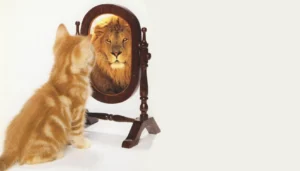
Truth be told, when I think of myself as a singer, I’m kind of like that picture of a cat who looks in the mirror and sees a lion. At least, that’s what the wishy part of me wants to see. Mirror, mirror on the wall, whose the fairest singer of them all? I knew that recording myself might quickly put a pin in my inflated self-perception, but I felt that it was finally time to do what many public speakers do: listen to themselves with minimal self-deprecating judgment, but a clear focus on what they can improve.

1_jFtg4OKUNLHnFjETiizx_A

So I turned on my cellphone recorder and hit play, totally prepared to delete the recordings if they were too painful to listen to.

What did I hear? Yes, my grainy, New York, old lady voice. But good breath control and good vibrato. On pitch nearly all the time with just a few flat notes I could work on.

Did I sound like someone I’d want to listen to on Spotify? No. Could I sing competently in a group, or lead a song if I wanted to? Absolutely.

And that’s what I used to tell my public speaking students. You may never speak like Martin Luther King, but that’s not the point. You can get to a place where you feel more competent, more confident, and hopefully begin to like what you’re doing.

Truth: I did delete the recordings after I listened to them. But not because I was ashamed. I think I just wanted to hold onto the illusion of the cat seeing the lion in the mirror. Better than the little girl who couldn’t see herself, even when she was dancing.

Subscribe at http://ddinafriedman.substack.com


Art for Change

Next week, I’ll be launching a month-long series of social media posts on the theme of Art for Change. I’ll be spotlighting various artists and artistic projects, posting questions for us to contemplate in our own creative journeys, and offering thoughts in text and short videos on issues related to writing in dark times. I hope you’ll stay tuned and tell others who might be interested. (People can follow me on Substack, Facebook, or Instagram.)

But today, I want to write about joy.

We could think of joy as the flip side of darkness, but I think it’s more integrated than that. As I walked through the woods early this morning, contemplating my Elul challenges this year (Elul is the month before Jewish New Year, where it’s traditional to do an extensive “soul-accounting” of places where you’ve “missed the mark” and then work on setting new intentions and forgiving both yourself and others you may have inadvertently wronged), I had an insight that the biggest challenge for me would be figuring out how to simultaneously hold onto the joy and gratitude of being alive without abandoning my responsibility to do as much as I can to work for a more just, equitable and humane world.

As beloved Charlotte’s Web author E.B. White articulated so perfectly,

“I arise in the morning torn between a desire to improve (or save) the world and a desire to enjoy (or savor) the world. This makes it hard to plan the day.”

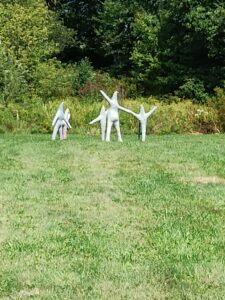
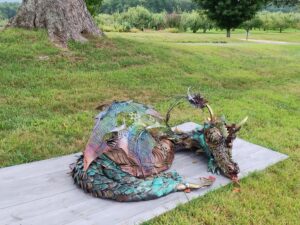
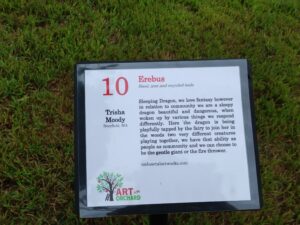
I got some inspiration from the offerings of our local biennial Art in the Orchard show, which I went to this past Monday. So many of this year’s works evoked fantasy or whimsy, and many of the artists said in their statements that the darkness of the times inspired them to look even more purposefully for a way to showcase joy. Maybe we need a little bit of magical thinking, like imagining this sleeping dragon playing with a fairy, rather than breathing fire, as explained in the artist’s statement below the photo. (All the pictures are mine.)

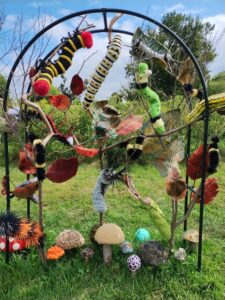
And I loved these playful caterpillars–and these rocks, dancing for joy.


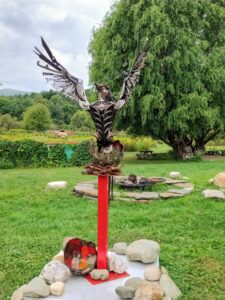
And here’s another image worth holding onto: the phoenix rising again!

My first question (a bonus before we get to the campaign): How do you manage to balance the heaviness and the joy? I’d love to hear your thoughts.

Subscribe at https://ddinafriedman.substack.com


Or one of my favorites–the phoenix rising again.

Intentions

I have a great meditation app called Insight Timer. In addition to guided meditations of various time lengths from a wide range of practitioners, it also has breathwork, yoga, motivational courses, music, and occasional challenges to focus on an area that challenges us from being our calmest, happiest, and most productive selves.

Most recently, I’ve joined a 10-day “morning routine challenge,” where each day introduces a new tip for starting the morning in a more healthy and meaningful way than my current habit of lazing in bed skimming the news and doom-scrolling social media. It’s enough to feel like I’ve started any day on “the wrong side of the bed,” but somehow I can’t bring myself to stop.

Even worse, I usually ignore the daily poems (from Rattle, SWIMM, Only Poems, the Slowdown, and the Academy of American Poets) that pop into my inbox, opting instead for political pundits. True, I may not be awake enough to take a deep dive into the more difficult to decipher poetry, but wouldn’t it still be better to carry a few precious smidgeons of imagery and language into my day, rather than the reminders of all that’s going wrong in the world?

Interestingly enough, today’s morning routine challenge session was about setting intentions. Not a new topic for me, and likely familiar to many of us. But I still need to be reminded that an intention is not a to-do list (which I’m way better at); it’s a mindset, focused on the qualities we want to embody as we go about our day. Insight Timer asks me every day what my intention is, but since (other than during this morning routine challenge) I generally only use it before bedtime, I always ignore the question. Still it’s an important one. Today, I set the intention to be more balanced and focused, as I knew this mostly unscheduled day would offer many choices on how I might spend my time, all of which seem like high priority. And one of my challenges when projects pile up is not being able to focus on anything, because I’m too worried about the things I’m not doing.

Photo: D. Dina Friedman

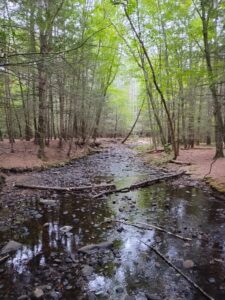
I can’t yet say whether I’m meeting my intention as we close in on midday, although I can say that so far I’m not feeling as worried about all I won’t get done today. And perhaps I was a tad more mindful in focusing on the amazing sunlight and appreciating the cool breeze before the impending heat when I went for a walk earlier this morning at Amethyst Brook in Amherst, rather than thinking too much about all I needed to do when I got home. (One of my priorities is and will always be exercise–especially walking in nature.)

Even though I still haven’t made intention-setting a habit, I can see that this practice would be especially helpful to writers, musicians, artists, etc., because it can help focus our attention on process rather than on product. Instead of mentally beating ourselves up for not writing when we sit down to write, or writing something we think is “bad,” we can set an intention, for example, to simply be open to whatever sensory observation or language pops into our heads. I know that when I returned to playing piano after a many-decade hiatus, what got me through several months of frustration and the heavy weight of generational shame for not originally “making it” as a musician was the very specific intention I set to play without judgment. In fact, I made a deal with myself that whenever I started judging, I needed to close the piano lid and walk away.

However, whenever I walked away from the piano, I felt sad and disappointed because I had enjoyed playing. So, eventually, I was able to quiet my inner judge and simply be open to the moment, complete with all its bliss and all its flaws.

I hope we can all get to a place where our intention-setting leaves us more open to embracing the whole of ourselves–the creative places and the stuck ones.

Subscribe at https://ddinafriedman.substack.com


Out of the Cage

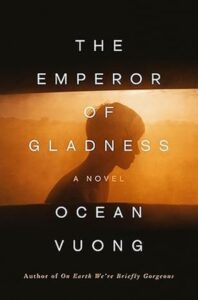
Last night, I had the special treat of seeing Ocean Vuong talk about his new novel, The Emperor of Gladness. I haven’t read the book yet, but I was wowed by his first novel, On Earth We’re Briefly Gorgeous–and struck by the sensitivity, depth and humor in the brief excerpt he read from this one. Most of all, I was moved by his thoughts on what it means to be a writer–what it means to be a human, actually–in these troubling times.

Vuong talked about “the cage” that all of us are trapped in, meaning the large set of sociocultural stereotypes and mores that hinder the definitions of who we are and the possibilities of who we can be. In his first novel, the main character, Little Dog, says: To be an American boy, and then an American boy with a gun, is to move from one end of a cage to another.

As I thought about this idea of cages, I realized that my lifelong pursuit of writing is absolutely an attempt to break out of the cages of expectation, to come as close as I possibly can to exploring absolute truth and authenticity. And perhaps that’s what makes Ocean Vuong’s work so great. He may be writing fiction, but he’s doing it without artifice. Vuong insists that his novels are not autobiographical, nor are they specifically about anyone in his actual life and claimed that he would never appropriate anyone’s life story to feed his art. Yet, there’s a truth that seeps through whatever he’s invented that pulls back the veils under which we hide.

And I do believe it’s not only the revelation, but the acceptance of our own and each other’s authenticity–provided we can even find it in ourselves–that may be our only hope of changing the world.

Alligator Alcatraz: From Heute.at (cropped)

Of course, I couldn’t think about cages without the intrusive images of “Alligator Alcatraz” the newest prison being build in Florida and the memories of children in cages during this administration’s first term, a practice that ended after huge public outcry.

Also, yesterday, earlier in the day, I joined eight other people dressed in black, carrying signs with names and information about people who have been disappeared in Massachusetts and sent to caged prisons near and far. We walked in silence through the streets of Northampton, banging a drum, and bearing witness, creating a stunning visual effect that made people stop what they were doing and notice.

Said Vuong in a recent interview, Maybe in another 15 years, I will write about trying to be an artist while our civil liberties are being eroded and our country is run by oligarchs who are bordering on fascism. If we make it to 15 years later, hopefully I can write a book about that. 

Hopefully, he can. And in the meantime, hopefully we’ll all continue to access whatever creative sparks we all can make to raise awareness, claw out our own truth, and make it through.

Subscribe at https://ddinafriedman.substack.com
 

New Year’s Musings: Forgiveness and Aspirations

For the past five years, I’ve done a self-reflective practice during the month of Elul, the 29 days preceding the Jewish New Year (which we celebrated on October 2-4 this year) where I focus intensely on my aspirations for the coming year, as well as my current short-comings, places where I’ve “missed the mark” in who I want to be as a person. During that month, I try to journal more than I usually do, often in response to inspirational readings and self-reflective questions I find on on-line, or books written by spiritual leaders in various traditions.

Cathryn Lavery cathrynlavery, CC0, via Wikimedia Commons

What comes through loud and clear, no matter how much (or how little) I journal, or what I choose to read, is that forgiveness—especially self-forgiveness–lies at the heart of personal growth. Even when I may be regretting something I’ve done that may have hurt someone else, and feel compelled to ask their forgiveness, I find that I can’t let the incident go until I’ve forgiven myself.

Forgiveness is a hallmark of many faith traditions, but even those of us who don’t follow a strict religious path (and I include myself in that category as a mostly secular Jew), can incorporate it into our personal growth plan. In fact, forgiveness can be kryptonite to the nudgy inner judge. What would our lives be like if every time that nasty voice reared its ugly head with some critical, self-deprecating comment, you simply answered by smiling and saying, yes, but I’ve forgiven myself for this.

The flip side of forgiveness is aspirations. When I went through old papers a few weeks ago, in attempt to create a more sacred space (while practicing forgiving myself for my messiness!) I was touched to find a journal entry from the past secular New Year in January. I wrote:

I was (am) a writer who is setting even deeper roots in a community of writers. The past year brought out that it is ok to be successful. That I have a voice that matters. That others have a voice that matters. That it’s important to me to nurture other people’s voices as well as my own. I value community. I stand for expression and an artistic standard that I would like to encourage others to reach for, and what I would like to keep improving in myself. I want to communicate what deeply matters—to humans, and to the world. My writing is now central to my life. It is what I am.

I followed this with a list of wishes. Some were pie-in-the-sky, like getting a story from Immigrants optioned into a movie. Others were possible, but not likely to happen, such as getting an agent who believed in me and my work and saw it as more than a commodity. But what stood out was this:

My biggest hope was to be taken seriously by everyone as a real writer whose craft is at standard and whose art and messages matter. I would like to be seen by others as a person of integrity and depth whose words and perspectives matter.

This is my New Year’s wish for all of you–in whatever you do. May your words, images, music, movement, actions, thoughts and perspectives matter.

Shanah Tovah!


Truth, Dare or Balderdash

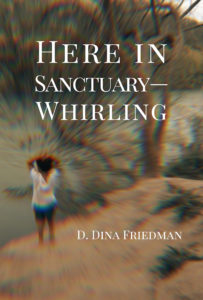
I got my first Amazon review of my new poetry book, Here in Sanctuary–Whirling, a few days ago. It was a 5-star rating, filled with wonderful phrases like “lyrical and evocative,” “alive and immersive,” “a sensory experience that is both enchanting and exhilarating.”

Only one problem: the reviewer depicted the book as “a mesmerizing fantasy novel …set against the backdrop of the mystical land of Sanctuary… At the heart of the novel is Whirling, a young girl with a deep connection to the elemental forces of wind and air.”

Ahem! This is a book of poems centered on my work in immigration justice and my witnessing trip to the border.

LOL!

Apparently, fake reviews–usually written by AI-bots–are a thing. Despite the many times I’ve had to go through hoops to post an Amazon review (I’m often told I hadn’t bought enough on Amazon recently to attain the privilege of posting on their site, or told to wait a few days while they verify my identity and authenticity) several writers in my network recounted similar experiences. “My poetry collection was called More Money Than God,” said Rich Michelson. “And one person gave me a one-star review, claiming I didn’t write enough about hedge funds.”

Still, I can’t help wondering–why are people doing this? Is this the new middle-school equivalent of making prank phone calls? At least then you had the pleasure of listening to someone’s reaction when you asked if their refrigerator was running and told them to catch it. I doubt whoever put up this review is hanging out in Cyberspace waiting for my reaction. (And there’s nowhere to put reactions or comments in Amazon reviews, anyway.)

And, if you’re going to write a fake review, why give a Bot the job? It’s much more fun to write these yourself. My family has spent many laugh-filled hours playing a game called Balderdash where you make up definitions to unusual words, write biographies for people you’ve never heard of, explain what various acronyms stand for, and write brief plot summaries for titles of obscure movies.

So, whoever you are, dear reviewer who goes by the name of Piper N., I dare you: next time, get together with a group of friends and write your own Balderdash. It’ll be a lot more fun–and even if you don’t sound as smooth as the AI-bot, you’ll get to stretch your creative muscles. But thanks for the five stars. And if I ever attempt a fantasy novel, I hope my main character, like “Whirling” will emerge “as a fierce and courageous protagonist who defies expectations and challenges the status quo.”–I’m all for that.

And perhaps, reviewers to come might call my poetry book, just as you called “Whirling’s” journey, “a testament to the power of resilience and determination in the face of adversity.” That would certainly make me feel like the poems in the book had been truly heard.

Any artists out there—I’d love to see what “Whirling” looks like.


How and Why

Back in my business communication teaching days I often shared a tidbit with my classes that I picked up from the career center: To prepare for a job interview, make sure you can answer “how” and “why” to everything you wrote on your resume.

This seems like a good process for writers, too. We can ask ourselves questions like:

  • Why am I choosing to break this line in this spot?
  • Why would my character say–*that*? Or do *that*?
  • How can I convey my character’s emotions from describing the way she’s opening her backpack?
  • How can I integrate setting more effectively here to raise the emotional temperature of this conflict?
  • Why am I using a metaphor here instead of sticking to the actual image?

The questions can be endless. And while I almost never answer them with a logical and well-worded rationale, I do use them as a guiding light through my intuitive fogginess. In other words, the mere act of framing the question can help me figure out if the choices I’m making feel true and right, and also inspire me to try a few different approaches and compare the effects.

Lately, I’ve also been putting some of these questions in play in my piano practicing. How soft should I make this part?  How much rubato is too much? Articulating a rationale is even harder since both my intuition and field of knowledge are on much shakier ground. But framing the questions in order to consider different ways of playing gives me a sense of the options. And since I’m no longer trying to prove anything to anyone about my piano-playing, I end up just choosing what I like.

As I’ve had to sacrifice some of my writing and piano time to tackle book-marketing, I’ve come up against how/why questions that feel more annoying–perhaps because interviewers, bloggers, and podcasters need to have clear and well-worded responses, rather than the multi-directional swirls in my mucky brain.

Q. Why did you become a writer?
True answer: I don’t know. I’ve just always wanted to be one.
Cheeky answer (because true answer is way too bland): Because I knew I didn’t have the chops to make it as a Broadway or Carnegie Hall star. And with writing, you can have as many do-overs as you want before you put your work out in the world.

Q. How do you like to write? With a pen? On the computer? In the morning? Afternoon? Middle of the night?
True answer: Sometimes pen, sometimes screen. Morning is best, but I can force myself to write at any hour if I’m disciplined enough.|
Cheeky answer (because true answer is way too bland, and how I like to write has nothing to do with how someone else might like to write): Actually, I like to carve my thoughts in sand with a stick and then erase them like a Tibetan mandala. And, I guarantee, the muse doesn’t care what time it is and what color pen you’re writing with, even if you might care.

Prof Ranga Sai, CC BY-SA 4.0 <https://creativecommons.org/licenses/by-sa/4.0>, via Wikimedia Commons

So what questions do I hope people will ask me at my book launch reading for IMMIGRANTS on Wednesday night. Here are a few I’d love to chew on:

  • What was the hardest story in the book to write and why?
  • Which of your characters did you fall in love with and why? Which characters were difficult to empathize with and how did you manage to overcome that challenge?
  • How will you deal with reactions to this book from people who aren’t sympathetic to immigrant issues?

True confession: At this moment, I don’t know the answers to any of these questions, but I promise to corral the various options and choose one well-worded answer–just as I would in a job interview!