Grabbing the Stage

A big part of who I am stems from the blessing and curse of coming from a musical family.

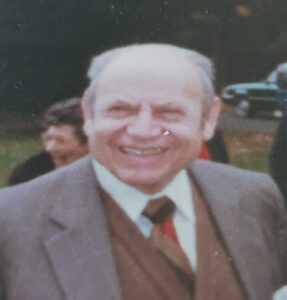
On my mother’s side, my grandfather, Pop-Pop, was a symphony violinist. He lived next door to us when I was a child and I spent many hours watching him frown at the full length mirror as he practiced, carefully positioning the bow and playing each note over and over until he got it exactly how he wanted it. From him, I learned the importance of striving for perfection, even though reaching for it might seem impossible.

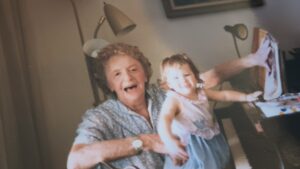
My father’s mother’s family, the Glicksteins, were just as passionate in their love of music and equally accomplished in their ability to play from the heart. My great-grandfather Abe Glickstein, a clarinet player, was known for giving Sunday afternoon living room concerts featuring his seven talented children for his immigrant neighbors at the turn of the 20th century, and for offering the services of a three-man klezmer combo (him and his two sons) to the community if music was needed for a wedding or other simcha. These great uncles, Max and Dave, went on to have notable musical careers, while their sister, my Grandma Jeanne, made her living teaching piano and recorder, and running summer music programs to spread the joy that fueled her life.

The curse of this story, as I wrote about extensively in my yet-to-be published memoir, Imperfect Pitch, was feeling that I had some sort of impossible musical bar to live up to, and I didn’t have either the patience or or the desire that Pop-Pop had to spend agonizing hour after hour at my instrument to achieve it.

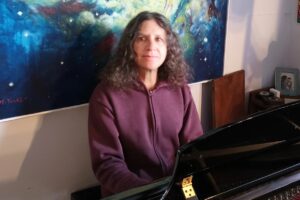
But the blessing, which I think comes at least in part from my family constellation, is a love of the stage. Not so much for musical performance, since I’m still not as confident as I might want to be in that area. But give me a podium, and I’m in my happy place, whether I’m reading my poems or stories, talking on a panel about some aspect of writing craft, recounting my witness trips to the border and the Homestead Detention Center, standing up impromptu in front of a group of protesters on the street, or teaching the basics of classical argument theory to a room of bored college students.

There is something so magical about being listened to.

So, I get how disappointed my three-year-old grandson Manu felt when his parents told him they were going to take him to see the Tokyo Paradise Ska Band, which he has been totally obsessed with for a year, but, no, he was going to be on the stage with them, as he enacts when he listens to the videos, donning his sunglasses and strutting around his stage set of stacked mats, toy saxophone in one hand, mic in the other.

Because even though a seat in the audience can be a safe place, a time to relax, reset, and feel comfortably anonymous, there is something about getting out there on stage that can add a bit of technicolor to our often muted sense of self. Even if the journey there might feel like you’re standing on a balance beam above a pot of boiling oil, as I know it does for many who experience very real stage fright.

If that’s your story, I recommend, as my co-facilitator and I taught for many years in a course we developed called Public Speaking for the Terrified, to start small: read your work, share your art, play a song, or speak your heart to a trusted group of friends in your living room, making them promise that they will give you only praise for what they liked and what resonated. At some point you may be ready for a combo of both praise–never forget the praise–and critical feedback, but make sure to have a notetaker to write both of these things down. Otherwise, all you’ll remember is the criticism.

Whether it’s genetic or environmental or some of both, I’m grateful to my forbears for modeling not only their love of their art, but their passion for sharing it. And grateful that, for the most part, stage fright is not an issue for me. Perhaps some day I’ll take a more terrifying step and sign up at some large, anonymous karaoke bar. Or not.

Subscribe at https://ddinafriedman.substack.com
Confessions of a Closet Sports Fan

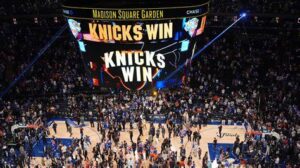
True confessions! I’ve been addictively following the NBA playoffs.

This doesn’t fit in with image I project to most who know me, or the words I might use to describe myself: writer, activist, gardener, nature-lover. And like most, I abhor the money that casts its dark shadow over this and other big sports events. $10,000 for a ticket to Madison Square Garden is obscene. Even $1,000 that Mayor Mamdani spent for standing room at the top of the arena is obscene. And unnecessary. Sports should be for the people. All the people. Not a commodity that can be manipulated to squeeze as much money out of hopeful hearts as possible.

Yet, every night of the playoffs, I’ve tuned in on my free-trial Youtube TV subscription (which I will cancel at the end of its 21 days) my heart with the hordes and multitudes at the watch parties in Central Park. I have not lived in New York for 46 years, yet, this doesn’t make many any less of a New Yorker. There’s a certain “Only in New York” way we have about how we relate that transcends our diverse backgrounds and brings us together. I still remember being on the subway in 1969 when the Mets were in the World Series. Everyone who had one had their transistor radios glued to their ears. When Tommie Agee homered in Game 3, the entire subway car erupted in cheers.

Photo by Mark Dixon from Pittsburgh, PA, CC BY 2.0

This is the kind of comeraderie I often long for, a swelling excitement and connection among strangers for a common goal. I hate to say that I’ve felt this more often at sports events than at peace demonstrations, but unfortunately that’s true. There have been occasional exceptions–The Women’s March in DC in 2017; March for Nuclear Disarmament in New York 44 years ago today on June 12, 1982. But I can often feel a more compelling swell of excitement huddled around a television with people rooting for a similar outcome, even if that outcome is random and doesn’t really matter in the wider world. Or maybe because the stakes are lower, it’s easier not to feel the thick of fear and disappointment one might feel in the wake of a devastating Supreme Court decision or a harmful act committed by our government or another country.

To put this all in a little more context, I grew up in a sports-dominated household. No one played, but the TV was always on: baseball, football, basketball, hockey…I don’t know if I would have survived my teenage years without the Mets and the Knicks to divert my attention from my own angst to something random that was totally outside of my control, yet–at the time–mattered deeply. Finding friends who shared that passion made it easier to stay away from experimenting with the wilder world of drugs and alcohol and sex. We could ground ourselves in the safer land of fandom. I guess we could have also been as passionate about other things that I might consider more in my bailiwick now, like music or art. But sports was what was offered in my house–and in my city–as a balm of connection.

There’s a lot more to my sports story, but even now, I’m self-conscious about nerding out on too many extraneous details people are unlikely to want to hear. In fact, due to some hard-to-shed embarrassment, I’ve been procrastinating about writing this since Wednesday (the day I usually blog). But I guess that’s a good thing, because then I wouldn’t have been able to end with the Knicks’ amazing comeback in Game 4.

playitusa.com

(And yes, I totally believe T jinxed Game 3. If only instead, he’d donated some of his billions to buy everyday New Yorkers some tickets–what a PR coup that would have been!)

Subscribe at https://ddinafriedman.substack.com


Taming “the Shoulds”

Now that I’ve been prescribed 40 minutes of physical therapy exercises every night on top of everything else I try to do daily (or, if not daily, several times weekly) for my physical, mental or creative health–not to mention my incessant compunction to at least try to do what I can to make the world a better place–I feel like I’m collapsing under the final straw of “shoulds” that broke the (clichéd) camel’s back.”

A differently wired person might approach this conundrum with a higher degree of rationality. Pick the 3–or 4, or 5–most important things. Focus on them and forget the rest.

But it’s all important! I argue. I might enjoy some activities more than others, but when I think about the overall benefits of the things I choose to do with my life: whether it’s writing or music; spending time with friends, family, or my grandson; walking in the woods; gardening or food prep; activism; or all my meditation/exercise protocols; there’s not a single thing I want to cut down on. And while I don’t like most other household maintenance tasks, there’s just so much I can afford to let my anxiety rise at the worry of leaving them undone.

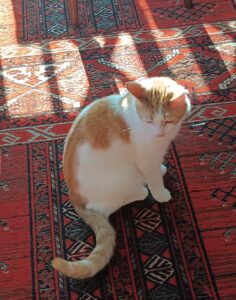
So, instead, I’ve been experimenting with how I’m looking at the totality of my life and the activities and tasks that comprise it–a circle, that if anything, keeps widening rather than shrinking. For the last few days, I’ve set the intention to focus well on one thing at a time, rather than getting distracted by all the other “shoulds” that constantly ping like little cat bites on my ankles reminding me that they’re still here and need my attention. This has been somewhat successful–at least more successful than dealing with my cat, who really does bite my ankles all the time when he wants attention.

Photo: Shel Horowitz

It’s true that at the end of the day, the list of things I didn’t get to is still much longer than what I got to, but the “consolation prize” of feeling more happy and content, and ensconced in the minute-to-minute experience of whatever I’m doing, has definitely been a mood booster. And, as consolation to my perfectionist overachiever self, I can absolutely sense how allowing everything else to blur into the background while keeping my attention on whatever I’ve chosen to do has enabled me to do whatever I am doing much better and with much more satisfaction.

What’s also important to acknowledge is the immense privilege and gratitude I have in being able to lead the life I want, even if I might consistently want to do more than I’m able to achieve. This isn’t a consolation prize. It’s a huge way of shifting how I look at the whole Issue.

I don’t think I’m ever going to cure my “ADHD of the Soul,” nor am I willing to take any real or metaphorical drugs to taper my plethora of interests and desires. There’s just too much out there that begs to be engaged with. But any interventions I can employ to stop making myself feel bad because I “should” be doing more of it–if not all of it–are certainly worth trying. I’d love to from others about how you’ve addressed this all-too-common problem among those of us trying to live satisfying, meaningful and creative lives in a creatively challenged universe.

Subscribe at https://ddinafriedman.substack.com