My Father’s Files

Tomorrow is my father’s birthday. Had he not died a year and a half ago, he would have been 95 years old.

Last month, during a weekend visit to my childhood home in Queens, I read through a chunk my father’s files. My brother had already started this process and created a spreadsheet with name of each folder, a brief description of the contents, and suggestions on what to do after I reviewed it. A few folders were labeled, “keep.” Most said “read and discard.”

And even though I’m the one often chiding my partner about his insistence on holding onto things he doesn’t need, I found it really hard to throw most of these files away. Not because there was anything extraordinary. Mostly I read through correspondence related to his job: thank you letters from people who appeared on the public affairs talk show, Straight Talk, which he produced for WWOR-TV (way before it was owned by Fox) as well as several letters of appreciation and a smattering of complaints. Not surprising, since he didn’t shy away from controversial issues in the talk show, nor in the documentaries he wrote and produced for the station, though he was meticulously ethical about the obligation to present different points of view, back in the days when the FCC’s fairness doctrine demanded balanced media.

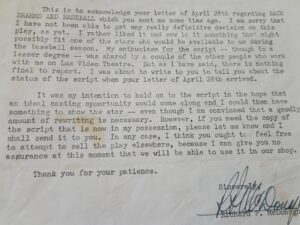
There was another file folder where he kept his attempts to market his outside writing: TV scripts and plays in his early years, before he settled into his professional life, and a memoir he attempted after he retired. That file was filled with rejection letters from agents back in the days when agents actually wrote letters and didn’t simply ghost you. I threw away all the ones that said, blah, blah–doesn’t meet our needs, but I kept the ones that were specific, like this one from May 1, 1952:
I even kept this nastier one, because, hey, chances are we’ve all gotten letters like this once in a while. (I have, at least. I hope those of you who are also writers haven’t.)
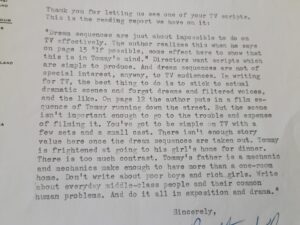
Even though he never sold any scripts, he persisted. Because writing for the sake of writing, whether or not it got published, meant something to him. In fact, falling asleep every night to the clack of his manual typewriter was one of the first inspirations that led me to becoming a writer.

I’m hoping I’ll find just the right moment to shred all my embarrassing teenage diaries, love letters from old boyfriends, angsty journal entries, and more angsty journal entries disguised as faltering poems and thinly disguised failed fiction, because, yes, I also hold onto things I really don’t need, and because–God forbid–I don’t want my children or grandchildren, or any other relatives stumbling upon them after I die. But at the same time, I’m thankful to my father that he kept so much of his life intact in those folders, and that I can choose some of them to hold onto, even if he’s no longer there.

Happy birthday, Dad!
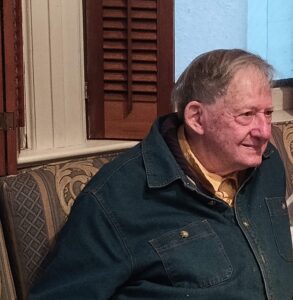
Stanley Friedman, age 91. Photo by Shel Horowitz

Subscribe at https://ddinafriedman.substack.com
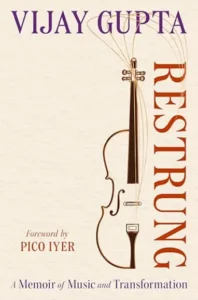
 

A Memoir of Music and Transformation

Can art change our lives? Why does creative expression matter so much?

And to whom does it matter? Should “great art” be confined to those who’ve achieved some recognized level of skill/talent/recognition in a world where we don’t define value as the impact it makes on others, but on its ability to be commoditized. Or should we equally appreciate all attempts of creative expression (even if some may touch us more than others) as an offering from one soul to another, and perhaps a mutual healing?

These are questions I’ve been thinking about ever since I returned to piano and stuffed all the baggage about my musical family, creativity, and judgment (by both self and others) into Imperfect Pitch, a memoir, I’ve yet to publish. But recently, my good friend, Lanette Sweeney, (whose blog, Paying Attention: A New Mindfulness Method, I highly recommend) told me about Vijay Gupta’s Restrung: A Memoir of Music and Transformation.

Like me, Gupta had perfect pitch. And like my younger child, he started Suzuki violin lessons at four years old and figured out in a couple of weeks how to play all of Book 1 when he was supposed to be standing on a pizza box and learning how to bow. But unlike either of us, Gupta was, perhaps, a child prodigy, or perhaps pushed into that box. His very scary, overachieving parents, who hit him when he wasn’t practicing enough or to their liking, and several years later shamed him for only coming in second in a prestigious concerto competition, brought him 90 miles into New York City several times a week, so he could train with highly ranked teachers. By the time he was nine, he was touring as a soloist. At the age of 19 he became the youngest player to ever gain an orchestra position with the LA Philharmonic–the dream dangled before many conservatory students who labor and train for years to try to “win” a job with a reputed orchestra.

But for Gupta, this was not the dream. As passionate as he was about the music he played (which is obvious in the memoir from his descriptions of pieces he performed) he felt empty. Still reeling from his parents’ abuse and subsequent estrangement, he turned to overeating and alcohol to numb his pain. Until he found himself with a small group of players giving a “charity performance” on Skid Row in LA, where the audience, not adhering to the classical concert etiquette of deathly quiet listening to the point of doing everything you can to suppress a cough, freely emoted whatever they were feeling as the musicians played.

As Gupta listened to the stories of the audience members sharing their lives and their pain, he began to see the reactions of people in Skid Row as a sort of reciprocal music, a mutual gift. He realized that the musicians weren’t there in the role of experts or to change or heal people. In fact, through the experience, they were the ones being healed. Without knowing it, Gupta says, every time I walked into a shelter or clinic with my violin, I was loosening the grip of my own story, rewriting my relationship to my instrument, to my music, and to myself. 

Gupta founded Street Symphony, an organization where professional musicians and community members engage in musical collaborations and perform in homeless shelters, prisons, transitional housing and other spaces that are often deprived of the ability to create and engage in artistic collaboration. Its core programs include a songwriting and mentorship series led by survivors of homelessness and trauma and a project inside the Los Angeles County jails that brings together professional musicians and incarcerated artists for shared rehearsals and performances.” Gupta explains in this three-minute video why these kind of collaborations matter so much (and also gives us a taste of his juicy playing).

What I loved most about this book was Gupta’s humility and honesty. So many “music memoirs” I’ve read sound snotty, making me feel (as much as I might want to be) like I’m not really “a member of the club,” but this book focuses on the flaws of being human–Gupta’s, his parents, (whom he describes with admirable understanding, despite the way they treated him) and the many people the Skid Row community he encounters in his work with Street Symphony. Highly recommended as a story of #artforchange and why music–or any creative pursuit–absolutely matters.

Subscribe at https://ddinafriedman.substack.com
 

Open Without Overwhelm

Tonight is the first night of Elul, the month before Rosh Hashanah (Jewish New Year), a time when it’s customary to engage in heshbon hanefesh, searching of the soul. The goal is to attempt to “wipe the slate clean” by engaging in an intense process of forgiving others for past wrongs, forgiving yourself for “missing the mark” and setting aspirations for personal growth during the new year.

Even though I’m a non-observant Jew who’s been leaning further and further toward atheism, I’ve found this process extremely useful over the past five years–ever since a friend and I started engaging in it deliberately and mindfully, sharing things we read or did that inspired us, and checking in frequently over the month to discuss our insights and support each other in our goals for personal growth.

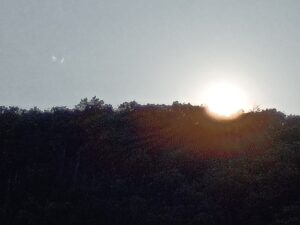
Yesterday, as I went outside to meditate, the sun was just beginning to creep over the mountain, and I thought about the direction I wanted to set for this year: Open without Overwhelm.
I have a pull toward taking on new projects and activities because I enjoy the freshness that they bring to my brain–and to my heart. Yet, I’ve gotten my life to a place where I don’t want to give up any of the things that nurture me, so it’s easy to fall into an anxious frenzy of having too much on my plate.

How can I do both–be open, without overwhelm? Or overload?

The night before, despite some niggling anxiety around confronting new social situations (which I’d never had until years of pandemic isolation left me out of practice) I went by myself to an improvisational singing group of complete strangers. This was one of the few group singing activities I’ve tried since I got my voice back. I keep telling myself I want to join a chorus again, but truth be told, I’m really not sure I’d be able to handle it, yet. What I liked about this group was that it was low-stress. I could drop out whenever I wanted to and there would be plenty of other voices to carry on. Since we were mostly improvising whatever we wanted (occasionally someone in the group would act as a conductor and give us a part), I could sing in a range that was entirely comfortable.  What surprised me was that it wasn’t musically boring, or weird, or like some big cluttered mess–as I feared it might be. Instead, my musical brain felt happily stimulated in figuring out what I could add to fit in to the pieces we were creating.

Yay! But, oh no! Another thing to add to the calendar. Thankfully, it’s only once a month.

I’m still thinking the key to all this is to be fully present and grounded in the joy of the moment–even if at times that’s easier said than done.

Meanwhile, I’m feeling the need to recommit to the soul-nurturing activities I’ve already taken on, because it’s so easy for them to become pro-forma–another thing I check off the to-do list without always being really present when I do it. And if I can’t do something with full presence, attention, and joy, maybe it is time to take it off the list for a while so that when I come back to that activity, it feels new and fresh. This has kind of happened unintentionally, as I’ve had little time for piano because of all the PT I’m needing to do. So the few times I have made time for piano, it’s become especially enjoyable.

And more good news: the PT is paying off! I’m seeing clear improvements in my posture and mobility, especially in my thoracic spine. When the spine is open, the heart is open. And that is the ultimate aspiration.

Writing is another thing I’ll never give up, though I’ve done significantly less of it over the past few months. But yesterday, I decided to start my morning with a prompt from the amazing Seema Reza of A Little Less Lonely.  Seema put out a group of thirty prompts (one/day) in April for National Poetry Month. Here it is, August, and I’m still wading my way through. Her prompt for Day 22: What do you remember about the earth?

My answer:

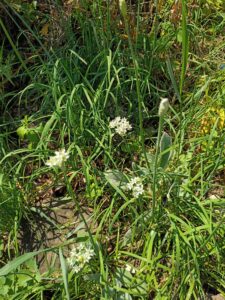
So, every day the sun comes up, and today there’s a solar eclipse. But the view where I am will be minimal–only 16% at the peak. And it’s at the same time I have an appointment with the eye doctor because my new far-sighted glasses are blurry. What a metaphor! But seriously, they only function at a pinpoint distance. Not any closer or farther. And I’m not willing to accept that, because my goal is to be expansive in my sight, not more constrained. So I’ll miss the partial covering of the sun by the moon. Maybe afterwards I’ll spend some time pulling weeds and opening pathways in the garden, where I do know the earth, and where the feel of the earth on my hands will be one of the best gifts of the day. But I must be mindful. The ubiquitous onion grass I spend all year trying to yank is flowering, and the best thing, for now, might be to leave it and enjoy the blossoms.

Subscribe at https://ddinafriedman.substack.com


Overcoming Obstacles

At my Wednesday morning writing group check-in today, nearly everyone talked about being pulled by other obligations, from packing up the literal rubble in their house in preparation for a move, to the growing piles of put-off chores and administrivia. Yet here we all were, attempting to navigate that obstacle for a couple of hours of time to nurture and spark the vibrant and needy creative child inside us that chatters non-stop and keeps tugging at our arm.

I was no exception to the prevailing mood. In fact, I can’t ever remember a time where 100% of my body and mind were full speed ahead focused on writing. There’s always something else that some small (or large) part of my brain fixates on, and tells me I should be doing instead. The trick to my writing success lies with how much I can tune out that nagging voice–which, of course, varies tremendously.

There’s a funny cartoon by Asher Perlman where someone with a truck labeled “Writers Cleaning Service” comes to someone’s door. The caption reads: The process is simple: you tell me to get some writing done and then to avoid getting started I clean your whole house. But chores and administrivia are only a couple of the many obstacles writers can use to distract ourselves. Job responsibilities, young children, vulnerable family members, or personal health issues can legitimately take up a whole lot of our time. And many of us already have other compelling and competing interests that keep us away from our creativity. If I weren’t an activist, I’d have more time to write, but sorry, working to make the world a better place is not a vocation I want to give up on.

Even if we don’t have too many these issues already built into our lives, any project we take on from learning to knit to painting the garage can help us circumvent the feelings of fear and doubt that often arise during the creative process, giving us more reason to avoid it. My writer friend and colleague Linda Castronovo writes about this beautifully in her (highly recommended) blog Starry, Starry Kite, Projects became my Prozac, she says, a coat of armor I constantly reshaped for myself. 

Linda, how did you capture the story of my life in just a handful of words? Friends have challenged me many times on my tendency to load myself up with tasks and projects to the point of overwhelm so that I perceive myself as too busy to attend to the things that really matter–relationships and creativity.  I wish I were as clear as Linda is on the reasons why I’m always overloading myself, but knowledge of this obstacle and the desire to clear its hurdle is, at least, an important first step.

Last night another friend, a visual artist, called me to briefly touch on the malaise of being in between projects–that What should I do now feeling when you’ve managed to corral the adrenaline and engage in a creative spree that enables you to tune out the competing shoulds of daily life, but alas, the project is now done. And whether the end result is flawed or perfect, you’re suddenly adrift. I can relate to that obstacle, too. It’s one of the reasons I’ve started to shy away from longer work. It’s way easier to begin another poem or short prose piece than to figure out what to do next after you’ve dedicated years of your life to a novel or memoir. As someone with eleven full length novels and one memoir to my name, (two published, the rest, not yet) I know how painful that what next moment can be. But I guess I can give myself credit for not quitting after the first longer work and eventually pushing on. And I know that my friend, who has already completed a large number of paintings, will go on the next leg of his creative journey, even if he first needs to take a breather.

I am so glad I went to the check-in at writing group this morning, instead of following the part of me that wanted to lean right away into the administrative tasks toppling over on my plate. And I’m grateful to my fellow writers for inspiring me by example with their determination to push forward in their writing, regardless of obstacles and obligations. And, hey, I got a blog post done, which is kind of in between creative work and other chores, as it is another thing on I can check off the weekly to-do list. But it’s also a place where I can set aside some time to take creativity seriously and practice being mindful with my words and thoughts.

Subscribe at https://ddinafriedman.substack.com