
Beware Your Darlings!

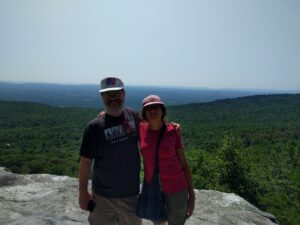
Last Tuesday, as we were walking in the woods, my partner said to me. How come you don’t show me so many of your poems any more? There are some I don’t even know until I see them published. 

He was referring to a poem I’d published the day before in Second Coming, a poem-a-day protest against the current administration’s fascist regime, which we both subscribe to on Substack. I’d mentioned how surprised I was that the poem got so many likes. I’ve published there before and usually only received only one or two reactions. This poem had already gotten 13! And they were mostly from people I didn’t even know.

I was touched that he wanted to see more of my poems. Not that I thought he wouldn’t want to–after all, we met at an open poetry reading in Greenwich Village, and love of poetry has always been a connector for us. But he doesn’t write many poems any more and I have strong connections with other writers, so I don’t generally make him the first stop for feedback. Also, these days, I’m more centered in my writing process and don’t usually share my work with people until I’ve given it a chance to simmer and revised it myself. I also have less of a need for validation for the many things I might jot down in a fit of emotional angst, some of which might end up being publishable poems, but many of which will not.

So, I explained that all to him, gaining my own clarity as we talked about it. And then he told me he had made peace with the idea that he’d likely never be more than a mediocre poet. You’re more of a journalist who occasionally writes in poetic form. You have some great images, but I think what’s often missing is that oomph, I told him.

Our conversation morphed into an exploration of the crevices of mediocrity, and how I also had finally made peace with accepting that I would never be more than a mediocre pianist, though I still feel that as a writer, I can rise above mediocrity by touching people, even if I likely will never make it to the “big leagues.” Then we happily reminisced about our days involved in that Village reading, and the poets we knew there, one of whom had made the jump into national recognition.

It was only after we got home and were in the kitchen trying to declutter the abundance of cucumbers and zucchini, that I asked, So, did you like the poem?

He hesitated. Well… I don’t think it was one of your strongest. 

Really? What didn’t you like?

He hesitated again. Actually, I don’t really remember it. Let me read it again. 

He disappeared and returned a few minutes later. It’s kind of like journalism. I mean I already know about the MAGA fortress on our corner. 

It is true that a lot of the images in this particular poem come from our shared experience. But that didn’t seem like a helpful comment. Maybe he was getting back at me for my comments about his journalistic poetry, but he’d agreed with my assessment. And it’s not his style to be passive-aggressive.

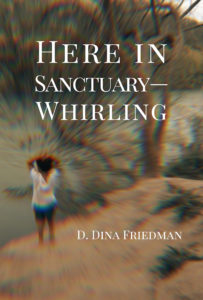
I just don’t think it’s your strongest poem, he repeated, cramming his foot farther into his mouth. I did like the image of the girl in the pink dress dancing. 

I write this not to garner sympathy. Truth be told, I was more inclined to laugh at my partner’s floundering than cry about his lack of support, because I knew he was genuinely trying to be supportive, even though this poem clearly didn’t grab him. He even deliberately went to back to Substack to give the poem a like and make a comment, as he makes a point of doing on many of my posts. However, it is a cautionary tale. Be careful about what you ask for from those you love and whose opinions have extra weight. In other words–beware of your darlings. (This is different from the phrase, kill your darlings, a standard trope of writer advice that warns you not to let something something stay if it doesn’t belong in a particular piece, no matter how precious you might find your crafting of a particular phrase.)

This is why I don’t often share my writing–especially writing that is more raw and still-in-progress–with close friends and family. Instead, I depend on my writing communities, where feedback structures have been specifically designed to provide support and all members share mutual goals and a common understanding, coated in respect without other interfering baggage.

But once something is published, it belongs to everyone. That’s what publishing means–making public. All cards on the table. All comments allowed. From anyone who happens to see it. I’m just happy I haven’t gotten very much hate mail.

So have at it. Would love to hear your stories–the good, the bad, and the ugly–about sharing work with those you love. Or if you want to read the poem in question, it’s here. And BTW, I did share this with my partner before posting to get his okay, out of respect and the deep love we have for each other.

Subscribe at https://ddinafriedman.substack.com
Mirror, Mirror on the Wall…

When I was around 6, I never felt that any of the images I saw in the mirror, twirling around in my powder blue party dress, school bound in my navy blue jumper with the gold buttons, or lounging in my light cotton pants and Danskin turtle-necks was really me. Other children in my class looked like themselves–in and out of the mirror–but I could barely recognize myself as a body with a face and curls and skinny limbs. Who was that apparition that stared back at me? It didn’t look anything like the way I envisioned myself. What did I–whoever I was–really look like? When I ran the “me card” in my mind, there was no face or body. “Me” was a wispy, invisible thing rooted in my brain’s fuzz: airy and intangible. And even after decades of body-grounding practices, that little germ of me is still that flighty, fuzzy thing, nearly impossible to see.

So, for this reason, I’ve always been wary of mirrors, or any item like video or audio recorders, that attempts to cast some aspect of myself back at me. It’s hard for me to watch images of myself in motion or listen to myself speak. When I taught my classes on Public Speaking, I told my students that while recording themselves could be helpful in noting areas they could improve on, it would be better not to record if they didn’t have the stomach for stepping out of their own self-perceptions and seeing themselves as others saw them.

Over the years, I’ve grown more immune to this schism in self-perception. Now, when I look into a mirror, I have an expectation of what I’m going to see, and the resulting reflection doesn’t surprise me, even as my aging body is becoming more angular, my hair slowly more gray. I can laugh when I see interviews of myself using my hands when I talk, and enjoy listening to myself reading poems. While I still don’t like my voice, which seems to be growing grainier and more old-ladyish by the minute, its New Yorker inflections continuing to underly my roots despite 40 years out of the homeland, I can appreciate my expressiveness as well as the echoes of my family legacy–poignant inflections that sound so much like my mother and grandmother.

But last night, I took a big step into the void between self-perception and reality. I recorded myself singing.

As I mentioned in a previous post, I completely lost my ability to sing without croaking a few years ago, and it took a year of lessons before I could get my voice back. This felt like a big investment because didn’t have a strong solo voice that felt worth preserving. But I missed being able to sing in choruses or community gatherings so much, it felt essential to my mental health. One of the most fun things about voice lessons was practicing solo songs, so since then, I try to devote a couple of evenings a week to doing vocal exercises and singing along to Karaoke tracks or accompanying myself on the piano. It’s a blast!

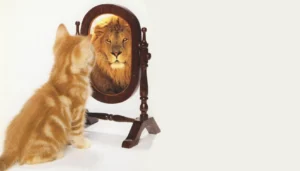
Truth be told, when I think of myself as a singer, I’m kind of like that picture of a cat who looks in the mirror and sees a lion. At least, that’s what the wishy part of me wants to see. Mirror, mirror on the wall, whose the fairest singer of them all? I knew that recording myself might quickly put a pin in my inflated self-perception, but I felt that it was finally time to do what many public speakers do: listen to themselves with minimal self-deprecating judgment, but a clear focus on what they can improve.

1_jFtg4OKUNLHnFjETiizx_A

So I turned on my cellphone recorder and hit play, totally prepared to delete the recordings if they were too painful to listen to.

What did I hear? Yes, my grainy, New York, old lady voice. But good breath control and good vibrato. On pitch nearly all the time with just a few flat notes I could work on.

Did I sound like someone I’d want to listen to on Spotify? No. Could I sing competently in a group, or lead a song if I wanted to? Absolutely.

And that’s what I used to tell my public speaking students. You may never speak like Martin Luther King, but that’s not the point. You can get to a place where you feel more competent, more confident, and hopefully begin to like what you’re doing.

Truth: I did delete the recordings after I listened to them. But not because I was ashamed. I think I just wanted to hold onto the illusion of the cat seeing the lion in the mirror. Better than the little girl who couldn’t see herself, even when she was dancing.

Subscribe at http://ddinafriedman.substack.com


Superstition

I have a designated airplane outfit, which I need to wear each time I fly so the plane doesn’t crash. And the minute I get on the plane, I have to do a complicated 4 x 4 sudoku puzzle and not pay attention to anything else until we reach 10,000 feet, even though I’m not particularly afraid of flying. Nor would I call myself superstitious, other than carrying the inherited “wisdom” of my Jewish ancestors: Don’t make up lies about bad things; otherwise they will happen. For instance don’t say you can’t do something because your grandmother is sick, and—God forbid—don’t say you missed class because your grandmother died, because then she will.

But despite positioning myself clearly in the quadrant of “not superstitious,” it’s still a long road between there and the end of the axis: trusting that the universe will take care of you.

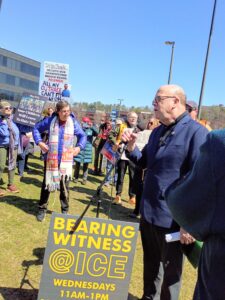
A few days ago, in Burlington, Mass., a six-year-old girl was on her way to her kindergarten graduation. ICE grabbed him out of his car, and brought the two of them to the holding site where my friend was one of several hundred people who show up several days a week to witness. She watched as the little girl came out alone with an ICE agent, crying and screaming, Mami! Papi!

What superstition could this man have adopted to prevent ICE from ripping him away from his family and severing his dreams? If he ends up on the fast track for deportation, which, thanks to two Trump-appointed judges on the DC Circuit Court, was reinstated after being blocked by lower courts, what shirt should he wear to keep the plane from crashing?

Congressman Jim McGovern visits the ICE holding facility in Burlington, MA. Photo: D. Dina Friedman

And the little girl: What inheritance will she carry from her Papi, locked in a crowded room never meant to be a jail, with no showers, one exposed toilet, and no food except what can be bought bulk from Amazon and put in the microwave. Will this girl ever attend another graduation without thinking of this day? What was she wearing? A pink dress? Or overalls—taking the first necessary step we all must take to buck the little girl princess stereotype? What will she carry in the deepest cavities of her heart—an inheritance that will be hers forever? Will she remember the shadow face of the agent who ignored her screams and smirked as he handed her off to a neighbor to bring her back to her mother and baby sister? Will she remember the faraway voice of her Papi in a distant land? How carefully will she choose her clothes to keep her mother safe? Will she trust in a divine benevolence as so many of the people I met at the border did, despite the rapes, the gangs, the loss of loved ones?

Can superstition save us? Any of us? All of us?

Subscribe at https://ddinafriedman.substack.com