The Blank Page

Usually when blogging time rolls around each week, I have an idea I’m inspired to write about. But sometimes the blank page–or in this case, the blank screen–taunts me with its glaring emptiness. And all the judgment  questions start tumbling out:

Have I run out of things to say?

Has anything I’ve said in the past two weeks, two months, two years been remotely interesting?

Why am I even doing this? 

These questions don’t just pertain to blog posts. They attach themselves to poems, stories, essays–anything I might be writing or revising. If I happen to be working on something larger, doubts spill out of the cracks like little cockroaches, making me want to do absolutely anything–clean all the toilets in the universe if I have to–in order not to go back to the sickening slog of that rickety “Work in Progress.”

Not a great place to be right now, as I promised to somehow write 30 poems in the month of November as a fundraiser for the Center for New Americans.

I’m telling myself poems are just words. And this blog post, too–just words.

When I’m stuck, I often start with what’s outside my window. At the moment, two gorgeous maples are shining through the last hurrah of the foliage. I could give myself a skill-building exercise and try to describe them, literally or metaphorically, but instead I think I’ll just include a couple of pictures–which are supposed to be worth a thousand words, far more than I need to write right now.
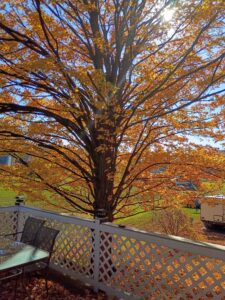
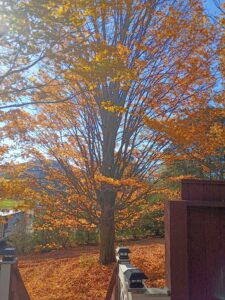
For what it’s worth, instead I’ll touch on the multitude of feelings that arise during this season: the dread of darkness encroaching earlier and earlier into the afternoons and the still coldness settling in, the poignancy of all that superimposed with the current glorious glint of the sunlight on the multicolored leaves. Every day that tinge of foreboding: will this be the last truly beautiful day we’ll have until spring?

And often, a similar question we creatives face: Will this be the last successful poem we ever write? The last painting? Last song? Last story? 

Mindfulness instructs us to stay in the present–not to ruminate on the past or worry about the future. Yet, this is easier said than done. I’m not sure why it feels so important to anticipate more words in my future that need to be spilled and polished, but thinking that there might not be can feel almost as scary as imagining no more food, or no more air.

But in the spirit of mindfulness, I’m just going to enjoy these trees and trust in the universe. After all, spring does eventually return. The land rests, then rejuvenates. Recognizing writer’s block as part of a similar natural cycle can help us ride the troughs in creativity. As one visual artist friend told me, Good coffee needs to percolate. So do we.

Subscribe at https://ddinafriedman.substack.com
 

The Joy Ratio

So many tabs… so little time. That’s what my computer browser window looks like. Picture the virtual equivalent of a very messy desk. I have a tendency to keep things open far longer than I need to, often to the point where I can’t even see what’s up there. And even when I try to do a clean sweep, (which I do attempt every few days) usually half the tabs stay open. There’s my theasaurus, my yoga site, my calendar, text message tab, email, weather–things I do use nearly every day. But also there’s articles I plan to read, actions I’m planning to do and/or publicize, shared docs I’m in the middle of working on, organizations I might donate to, events I might attend–a whole slew of things that sometimes stick around for months.

Like the weekend-long singing workshop I hemmed and hawed over since I found out about it in August.

Yes, I should go, I kept telling myself. But I hadn’t done any serious choral singing since my bout with dysphonia a few years ago. And even though I’d recovered most of my singing ability after a year of voice lessons, I still didn’t trust myself to be able to sustain my part in a chorus, or to be able to sing consistently for more than a few minutes.

What if I just start croaking and can’t sing at all? What if I don’t like it? What if my raspy voice brings everyone down? How am I going to be able to sing for a whole weekend when sometimes I can’t even sing for twenty minutes? The questions streamed through my mind.

Still, I didn’t delete the tab. Even after conflicting events would have provided an easy excuse not to go. It was No Kings Day on Saturday. And on Sunday our immigration justice affinity group had been invited to do our short street theater style performance amplifying stories about people in Massachusetts who had been been abducted by ICE as part of a local church service. I just kept being non-committal about all of these options until a few days before the workshop, when I signed up. Just so I wouldn’t talk myself out of it.

Long story short: The workshop was fantastic.

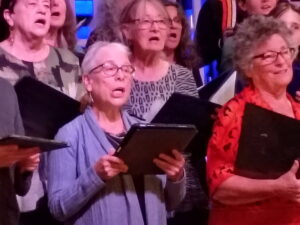
On Friday evening and all day Saturday we learned nine songs. In five different languages. On Sunday we performed them.

Were they perfect? Of course not. But one of the workshop leaders said, Don’t think of any concert as a performance; think of it as a party. 

Photo: Shel Horowitz

And while perfection is always an illusion even when there’s way more time to polish, according to my partner and other acquaintances in the audience–as well as my own discerning ears–the songs we performed were totally pleasing to listen to.

And I was happily surprised how well my voice, buoyed by a large thermos of tea, held up. Even more fun was the challenge of learning parts quickly and the novelty of singing tenor instead of alto for many of the selections. And wonderful to be in a group of strong singers who were absolutely chill about the experience. And with encouraging leaders who said things like, don’t worry if you can’t reach that note, just mouth it and trust that your neighbor can do it.  

I’ve been telling myself for over a year that I want to go “chorus shopping” but I’ll admit I’m picky about singing experiences. Choruses where parts are too easy or where everyone sings in unison tend to bore me after a while, especially when everything is pitched way higher than is comfortable for my new older-age voice. And I’m also realistic about recognizing my singing limitations, so I’ve shied away from harder and more demanding choruses. But this experience was perfect in every way.

I’m so glad I went for it.

Of course, one never knows. It could have turned out not to be as good as it was. I could have hated all the songs, or felt out of my league, or bored, or my voice could have tanked on the first night. So the experience brings up the question in all of us of when we might or might not choose to take a plunge into an unknown outcome. While there’s no clear set of variables to make a decision, I’m thinking about applying what I’ll call a “joy ratio.” If this does turn out the way I want, how much joy will it bring me? I can ask myself. And if the answer is a large amount of joy–I literally felt clouds of stress lifting off me, and (key litmus test) I stopped thinking about all the other things I had to do, then risking the outcome is absolutely worth it.

So, (in the words of Arlo) if you find yourself in a similar situation, you also might want to consider the joy ratio. And if it looks to be large, then take the plunge and go for it.

Subscribe at https://ddinafriedman.substack.com


Why I Write 30 Poems in November

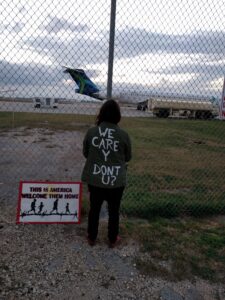
In 2020, I stood at the Brownsville, Texas airport on Valentine’s Day watching shackled people hobble up the runway of this plane. And every day in 2026, all over the country, people are being arrested, detained, and deported without due process and often to countries where their lives are in danger. Even where I live in Massachusetts, where many towns and cities have passed sanctuary and other protective laws and resolutions, and where the state has recently passed legislation limiting ICE activities in courts, schools, and health care facilities, no one is truly safe.
 

So, in addition to spending significant time as an activist and advocate for immigrants, I have pledged each November to write 30 poems to support the Center for New Americans, an organization that provides English classes, legal advocacy, and countless other kinds of assistance to immigrants in our community.

Writing 30 poems in a month isn’t easy, and every October as I think about signing up again, a part of me panics at the thought of having one more thing to accomplish on my daily to-do list, even if there’s no pressure for all of the poems to be good–or even finished. But I do this anyway as a way of speaking out against the horrendous unleashing of ICE in our communities, and their blatant disregard for human life as they separate children from parents; arrest and detain American citizens, green card holders, and immigrants with legal status as well as those who lack documentation; and recklessly break into people’s homes, shoot people in cars, and murder Americans who have shone up to witness in peaceful protest.

It is a f-ing scary world we’re living in right now. And while we can be hopeful for the midterms, history has shown us that we can’t depend on Democrats to take care of things if they do attain majorities. We need to keep speaking up and speaking out. For a list of easy actions, Massachusetts residents can check out this link from DeICEhanscom.org. And people throughout the country can sign up at https://www.de-iceaction.org/ for one quick action to be delivered to your inbox each week.

Also, we can donate to some of the many immigration support networks that are out there. I’d be totally honored if you’d like to include the Center for New Americans on your list by donating to my fundraising page, here. In appreciation, I promise to send you my 30 poems at the end of the month. And I also promise that you are under no obligation to read them. Life is short and time is precious.

I do need to be honest and say that this is not a totally selfless mission. As a writer, I’ve gotten great benefit out of past 30 Poems in November efforts–and even a few good poems in the process. The obligation to face the blank page every day is helpful, even if words don’t always flow as smoothly as I might like them to. And coming together several times a month by attending workshops and readings with other community writers who are involved in this effort has been incredibly nurturing, because, utlimately, community feels like the only thing that will save us–and save those most vulnerable around us.

Subscribe at https://ddinafriedman.substack.com


Friends, Squash, and the Dalai Lama

Tell me the small stuff, my friend says to me on the phone. She hears the hesitation in my voice in the way I say okay after the customary how are you.

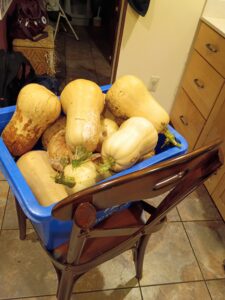
And it is small stuff that’s throwing me off kilter at the moment. Though actually the objects themselves are big. Squash. Fifteen huge butternut squashes dragged in at dusk because of frost warnings. A large recycle bin that was too heavy for two of us to carry, even though the house guest who was helping me was a young 30-something. And because this squash had not grown in the garden, but was a volunteer sprouting out of the compost pile into the grass that we hadn’t cut for months out of fear of damaging our bounty, its skin was wet and mottled, meaning that it was not going to comfortably store until we got around to using it. We had to process the bundle ASAP, before rot or mold set in.

I just picked 15 squashes, I told my friend. And now on top of everything else on my to-do list, I have to cook and freeze them.

Shel will help, right?

Of course, Shel (my partner) will help. Shel will likely insist that in addition to cooking these 15 squashes, we must roast every single seed from their inner cavities, because it would be a travesty to waste them, even though separating the seeds through all that pulp will add hours to the process. But he can do that. I will need to be the one to scrape the pulp out of the squash, because he doesn’t do it to my standards. And likely, I’ll end up doing most of the peeling after it’s cooked, because he’s always been challenged by intensive fine motor tasks. And then likely, he will scrape out whatever smidgeons of squash I’ve inattentively left on the peels, because he sees detail that I will often miss–sometimes consciously, sometimes not.

But in the end, we’ll have squash for the entire winter. So this should be a great project. It could even be fun if it didn’t feel like one more thing in my pile-up of things I never get to, which continue to scratch on the doors of my mind, louder and louder like a Halloween ghost.

I tell my friend, I don’t think of myself as having classic ADD, but what I do have is ADD of “the shoulds”–meaning that whatever I’m doing, my attention keeps wandering to something else I need or want to do, which minimizes both my enjoyment of what I am doing and my ability to pay mindful attention to it. And then I think about a parable I recently heard about the Dalai Lama, who, when asked what was the happiest moment in his life, paused for a moment and said, I think it’s right now. Because in the mindset of mindfulness, the past and the future don’t exist. All that remains is the moment, the right now of where we are.

So, I mentioned this to my friend, who has a much clearer understanding of Buddhist practice and meditation than I do, even though we both still struggle, and she agreed–with the mindfulness part, at least. She hates cooking and would never want to process 15 squashes, mindfully or not.

I was glad to feel a little better when I got off the phone. Gratitude to friends who see through my wimpy “okays” and tell me that’s what friends are for when I apologize for harping on the latest trivial obstacle in my rich and abundant life, for which I truly am grateful. My next to-do was a check-in call to my 92-year old mom. As we talked, I processed 5 of the squashes for roasting. When I got off that call, I found takers for several of the remaining butternuts, leaving us only 2 or 3 more to process. Nothing more gratifying than sharing your abundance.

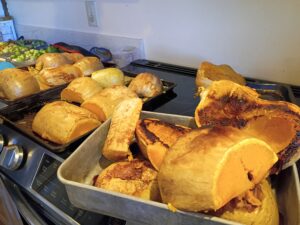
In the morning, I woke to a delicious smell of something baking in the oven. After overcoming the initial disappointment that it wasn’t muffins, I felt grateful to Shel for starting his morning by roasting the squash, along with one tray of seeds he’d picked out of the huge bowl of pulp I saved for him.

In the three minutes I had while waiting for my toast, I managed to peel half of one of the roasted squashes, cut it into chunks, and put it on a tray in the freezer. Still, a long road ahead, but hey, there’s no road. Only the moment.

And though I’m not supposed to think of the future, I know that come winter, I will enjoy squash bread; squash soup; squash pie; squash custard; Chilean-inspired squash with cheese, onions and tomatoes; Indian-inspired squash with curry and coconut milk, Carribean-inspired squash with dried fruit and ginger, and countless other recipes I haven’t yet invented.

And if my friend, who lives far away, comes to visit. I’ll make sure to cook her a nice dinner.

Subscribe at https://ddinafriedman.substack.com


A Post I Don’t Want To Write

Herbert Lanks, Public domain, via Wikimedia Commons

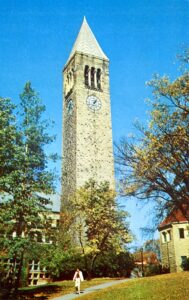
High above Cayuga’s waters
There’s an awful smell
Some say it’s Cayuga’s waters
Some say it’s Cornell…

I can’t honestly say whether the story of the Cornell gang rape would have hit me as hard as it did if I weren’t a Cornell alum. I’m sure that any similar story, no matter where it happened, would evoke the same reactions of revulsion, anger and despair, but its association with a place I idolized as the turning point in my escape into my own life opens up even deeper wounds.

Thankfully, I was not a victim of sexual assault at Cornell. My “me-too” stories–far tamer, but still incidents that never should have happened–took place at other locales. They include gropes on the rush-hour subway when I was a young teen, some asshole in hip, liberal Northampton MA calling out from the parking lot by the Thornes Market walkway to lift up my shirt so he could see my breasts, and a post-graduation trip to southern France with my college boyfriend where a strange hand unzipped our tent in the middle of the night and reached into my sleeping bag to fondle me. When I woke enough from my fuzzy sleep and figured out that this hand was not the hand of the person sleeping beside me, I screamed, and the hand slowly withdrew, zipped up the tent flap, and disappeared into the darkness.

My boyfriend woke up and when I told him what happened he said, “I can understand where he was coming from. He must have been horny seeing all those topless women at the beach.”

Just thinking about his response makes the air stick in my throat all over again. Should I be surprised that he was also a Cornell alum, even if he wasn’t a frat boy? The crowd I traveled in–artsy folks tinged with a love of sci-fi and re-enacting the Middle Ages–stayed as far away from frats as possible. Even 50 years ago, when overt sexism and objectification of women was much more of a cultural norm, the women in my orbit, all knew that frat parties could mean serious trouble,

I’d like to think that 50 years of feminist consciousness raising would have made more of a difference in what’s considered acceptable behavior on a college campus. But despite the administrator’s milquetoast statements–straight out of the crisis communication playbook I taught my business students at UMass for 20 years (deny and minimize offensiveness of the act)–there’s an underlying maxim that boys will be boys. A short suspension, perhaps an essay-writing assignment (which the administration denies, but whether or not it’s true, is it that much different from writing I shall not rape on a blackboard 100 times?) a generic “rape is bad” statement, and a pretense of an investigation where they claim to not have found enough evidence, and all can be well. Until the next incident. Nowhere do they apologize: to the victim, or to the rest of the women on campus. And though the Cornell administration does make a few hand-wringing remarks about the awfulness of the incident, nowhere do they say what strong and definitive steps they’ll take to change a campus culture where drugging and raping women is just part of the party.

But this may be because Cornell can’t singlehandedly change a culture that’s pervasive in all our institutions. Just look at the personal histories of the current leaders of our country. And we wring our hands, because boys will be boys. In 2016 when the current occupant of the White House jolted the airwaves with his “grab ’em by the p*ssy” remark, it should have been the end of his campaign. Instead he got elected. And elected again.

Jane Doe deserves not only an apology from Cornell. She deserves to have her entire tuition refunded (which she requested and they denied). She also should have free access on Cornell’s dime to the school of her choice. And while I’m glad that the prosecutor is re-opening an investigation, I’m not in favor of prison for the Cornell 7, because the prison system is also part of the problem. I do think those that graduated should have their degrees revoked with felonies noted on their record. And if there were an effective program to get these men and others to truly understand the daily harms committed because of this cultural mindset, and a way for them to spend thousands of community service hours educating others on respectful treatment of women, that would be true restorative justice.

And I also think they should be branded as sex offenders for the rest of their lives–as should the many others who commit similar acts and get away with them. But nothing will really change even then, until the term “sex offender” actually means something.

Subscribe at https://ddinafriedman.substack.com