Submissions Game Stats for 2025

Still reeling from the news cycle, but the advice I took away from my trusty meditation app today was to soften into acceptance/resistance, rather than tensing up and making myself crazy, or giving up and crumbling away into some useless ball of powdery nothing.

So, returning to “my little life” with hopes that some of this will inspire others who are also playing (or thinking about playing) “The Submissions Game”–and it really does help to think of it as a game unless you are someone who can’t stand losing, here are my stats for 2025.

In poetry, my biggest focus, 17 journals accepted 28 poems. Of these, 13 of the journals were new to me, and 4 I’d been published in before. Of the poems, 4 were accepted on the first try, 8 had been rejected less than 5 times, 7 less than 10 times, 7 others had been rejected less than 15 times, and 2 were rejected less than 20 times (I generally stop submitting a poem when it hits 20 rejections.)

As for poetry rejections, the grand number was 83, with 25 submissions from 2025 still outstanding.

Short stories and essays, as usual, were less successful, with one acceptance (of a story that had previously been rejected 12 times.) I could also count two of the poems accepted as “flash fiction,” as they were prose poems that bordered on both genres.

Two other stories were rejected 14 times combined, and the essays I submitted were rejected 9 times.

I did get 2 “send more” or “made final round” notes with my fiction/essay submissions. Three essay/fiction submissions from 2025 are still outstanding.

Bigger projects also made little headway. A chapbook I’ve been circulating got 7 rejections. (And 3 more in the first week of 2026). One submission from 2025 is still outstanding.

I didn’t spend too much energy submitting my piano memoir this year, as most of the time I fretted over conflicting advice on how to revamp it into more of a self-help book. Two revisions later, at the end of December, it became clear to me that the new format wasn’t working so I went back to the original version and sent that to seven small press just before New Year’s Day. So far I’ve only heard back from one: a rejection.

I also haven’t done too much with the eleven novels in the drawer, but I did send one of them to three agents. One ghosted me, one answered with a scam offer, and one was nice enough to write an actual letter of rejection. It’s still out at one small press.

So, my grand total of overall rejections for 2025 was 134–well surpassing my goal of 100!

And I’m hitting the ground at a good rate for 2026, with 6 rejections in the first two weeks–that’s like a rejection almost every other day! But two nice things, as well: an acceptance of a poem from a new journal, and notification from a journal that I was accepted in last year that my poem had won one of their prizes, which comes with a cash award and a Pushcart Prize nomination.


https://pngimg.com/image/54797

As I’ve said before, while I’m compelled to keep getting my work out there–mostly so more people will read it than for any uncontrollable need for outside validation–I find I can soften into thinking of this as nothing more than a game I play with myself. So, if you’re interested in offering your work (and totally fine, if you’re not) I encourage you not to take the process too seriously, and certainly not as a judgment on the quality of your writing.

Now onto doing my part to change the world. If only I could approach that with the same softness and ease! Of course, the stakes are much higher!

Subscribe at https://ddinafriedman.substack.com
Grandma, Dance!

Once again, I was in the middle of preparing a blog post on my submissions stats from 2025. And once again, life happened. Or, should I say, death happened.

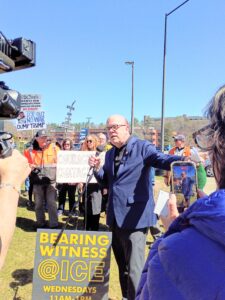
Renee Nicole Good. 37 years old. A poet, and the mother of three young children.  Sitting in her car as a legal observer during an ICE raid in Minneapolis. Shot four times in the face after being harassed by ICE agents as she attempted to drive away.

The feds are spinning this story by painting her as a domestic terrorist who was trying to run over ICE agents with her vehicle. An outright lie, but what else would you expect from an administration who had the audacity to rewrite the events of January 6? The videos made by numerous bystanders show otherwise. No ICE agents were in the vehicle’s path as she attempted to escape. The person who shot her–four times in the face–was standing by the side of the car, not in its path. And besides, as my partner pointed out so matter-of-factly, if you want to stop a car, you don’t need to shoot the occupant. You can shoot the tires.

And after she had collapsed and crashed into a utility pole, ICE refused to allow a physician in the crowd to provide medical treatment, claiming they had their own medics, who, at the moment, were nowhere to be found.

I first read accounts of this story yesterday, sitting in the dark in my grandson’s room while he napped. And two things came to mind. First was a blurry melange from Schindler’s List and other Holocaust movies where Nazi guards randomly and blithely shot any Jew who wasn’t immediately conforming to whatever order was given.

The second was an event that happened to me when I was about Renee’s age. I was backing out of a parking space with my one-year-old in the car, when all of a sudden I heard this man knocking on my trunk. You hit me! he shouted. He told me he had fallen from the impact and re-injured his knee. Mortified, I dropped off the baby to my partner at home, a few blocks away, then drove the man to the ER. When he said he didn’t need me to come and wait with him, I drove to the police station to report the accident. When I gave the name of the victim, the policeman rolled his eyes. That guy’s a known scammer. I’d be very careful, he said. He probably didn’t even go into the ER. You probably didn’t even hit him.

And I had stupidly just shown him exactly where I lived!

The next day he called me and asked for money for medical expenses. I took the easy way out. I met him in town with cash.

I was lucky. I never heard from the man again. I have my life. I watched my children grow up, as Renee never will. The feds’ story circulating about Renee, embellished and exaggerated by Kristi Noem and Donald Trump, is another scam. A scam of out-of-control proportions, which if people start believing it, will give ICE the authority to keep randomly shooting anyone they deem “non-compliant”–to be no different than the Nazi guards were, needing no justification to shoot anyone they pleased.

So today, I’m wearing dark colors, feeling a different kind of grief, a stunned sadness punctured with fear for my country. Renee’s death is not the only senseless death of a protesting activist. I think of Rachel Corrie in Gaza, Heather Heyer in Charlottesville. And I think of the hundreds of African-Americans murdered by authoritarian police for no cause: George Floyd, Sandra Bland, Daunte Wright, Breonna Taylor, Stephon Clark–just to name a few. More profiles and stories are here.

I hope all the readers of this blog–those of you who are inclined toward political action and those of you who aren’t–will think of one thing you can do in response to Renee’s death and this unraveling trajectory towards authoritarianism. Call your Congresspeople. (Jessica Craven has a script here), attend a vigil, write a poem, as Cyn Grace Sylvie did in yesterday’s poetic resistance blog, Second Coming, or make a piece of art. Post your responseon social media/and or share it with friends. Share this blog. Or share something else that might speak to you more deeply.

After I first read the news story about Renee yesterday, I only had a few minutes to absorb the severity of it all before my grandson woke up and wanted listen to clips of his favorite band, The Tokyo Paradise Ska Orchestra (an odd choice for a 3-year-old, but that’s where he’s at). He has about 50 cuts on the playlist his parents made for him, and was happy to put them on shuffle and see what came next.

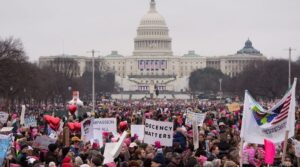
Grandma, dance! He kept shouting as he bounced up and down to the beat,  a different stuffed animal in his arms for each song.

I didn’t feel like dancing. But this is life.

And as I bobbed around, I realized one more time, that this is why we must keep fighting. So we can dance.

Carolmooredc, CC BY-SA 3.0 <https://creativecommons.org/licenses/by-sa/3.0>, via Wikimedia Commons

If I can’t dance, then I don’t want to be part of your revolution.–Emma Goldman

Subscribe at https://ddinafriedman.substack.com


Reflections on a Year of Loss

Happy New Year! I was intending to write my annual post of my submissions stats for the year (which I will do in the near future) but a prompt suggested by poet Meg Hartmann, who offers a self-led write-a-poem-every-day course and other goodies for writers on her website Ah The Sea, led me in a completely different direction. The prompt, by sheer coincidence, turned out to be a line from my first writing teacher and long-time mentor, Pat Schneider, founder of Amherst Writers & Artists.

What could be more generous than a window? 

I have a gorgeous set of floor-length sliding windows in my dining room, where I often work in the winter in order to take in the maximum amount of sun. Looking out that window, I ended up meandering down a wider path and considering all of 2025–the good, the bad, and the ugly.

For me personally, the salient event of 2025 was my father’s death on March 1. Despite my gratitude for his long life (he was 93) and relatively short illness before his passing; and despite our not being exceptionally close even though our overall family bonds were strong, I couldn’t shake the feeling that a foundation of my world had come undone. My father’s illness and death, as well as its aftermath, have forged me into an entirely new relationship with my mother. Before 2025, I’d speak to both my parents on the phone every week or two, casually recounting the newsy highlights of my life while they shared theirs. This past year, I spoke to my mother no less than every other day: at first providing emotional and logistical support in navigating my father’s care, and then, after his death, occasionally helping her problem-solve life’s relentless administrative demands but mostly providing someone to talk to in the unbearable dark loneliness of isolation.

This has made me so grateful for my partner, Shel, and our 46-year relationship. I have major hermitic tendencies (and I’m grateful that he’s learned to dance around them) but ultimately, I will always choose connection over isolation.

I’m also grateful that my mother, at age 91, is cognitively sharp and physically able to care for herself. As with my father, my mother and I are not exceptionally close, though we share the same family-bonded loyalty. And we probably have less in common than my father and I did in terms of personality, outlook and values. But I’m determined to be the best daughter I can be and provide whatever support I can in this inconceivable transition. (My parents were married for 72 years.)

As I look out the window and watch 2025 recede into the distance, I can’t close out this reflection without considering how many people in our country have suffered losses, even if, due to luck and privilege, I haven’t been as deeply affected: loss of safety due to hate crimes and ICE overreach, loss of economic security, loss of access to health care, loss of access to food, loss of due process. I continue to be distraught as news story after news story reinforces the conjecture that cruelty is not only a result of the administration’s policies–it is the point. Yet, I’m hoping that some of the pundits are correct in predicting that the swelling tide of resistance will continue to rise in 2026.

Happy New Year! May it be joyful, peaceful, and cruelty-free! And may all your windows be generous!

Subscribe at https://ddinafriedman.substack.com
 

Don’t Let the Light Go Out

True confessions: I’m not a big fan of Hanukkah. I don’t relate to the military story, nor do I like the commercialism and all the attempts to make it a Jewish alternative to Christmas. But I do love lighting the candles and watching light emerge out of darkness.

Our family has a unique tradition of putting menorahs in the windows on all sides of the house and then going outside and circling the house to see them glowing as we pass by. Over the years, we have done this in all kinds of weather–blizzards, pouring rain, and clear but often bitter cold starry nights. Sometimes, the ground is bare. Other times, it’s been a frozen mess, even more treacherous in the sloping backyard. It was so bad two nights ago that we went to get the hiking poles out of the car. And I wondered, now that I’m older and threatened with osteoporosis, whether my stubbornness in completing this mission had morphed into stupidity. But I did it anyway, hanging onto porch beams and tree branches and feeding my fantasies of being an intrepid explorer.

It was totally worth it.

More true confessions: I’m not a big fan of holiday music. Handel’s Messiah is fine, but not the sappy Christmas songs that start playing on the radio and in department stores shortly after Halloween. Hanukkah songs don’t grab me either. No problem at all if I went through the rest of my life without ever hearing Jingle Bells or I Had a Little Dreidel again.

But one Hanukkah-inspired song has been tugging at my heart this year: Peter, Paul, and Mary’s Light One Candle. The chorus just keeps playing itself over and over in my head:

Don’t let the light go out. It’s lasted for so many years!
Don’t let the light go out. Let it shine through our love and our tears. 

It has been a very dark year. The lights of our democracy are struggling to flicker as the fog and darkness close in. Yet, there have been moments of brightness to hang onto–people coming together and saying no to tyranny and oppression, just as they did in Biblical times and all the times between then and now.

We can’t let these lights go out.

I’m so thankful for everyone who has spoken out against injustice in large and small ways–providing food to neighbors; raising their voices to protect vulnerable members of our community–immigrants, BIPOC, and LGBTQ+; speaking out against war and genocide; speaking out for protecting our planet. Together, we are the lights of Hanukkah!

The part of the Hanukkah story that has always resonated the most with me is how the one small jug pure oil they found to rededicate the Temple was only supposed to last for one day, but miraculously, it lasted for eight days (enough time to make new oil to replace it). It’s not that I really believe in miracles; it’s just a good reminder to not immediately default to the worst possible scenario.

And that’s what I’m trying to take with me as we go through Hanukkah, the solstice and into the new year: the ability to look for light, rather than for darkness. And to trust that even when things seem bleak, with a little bit of hope and patience, we can see light coming up over the horizon.

Happy Hanukkah! Happy Solstice! Merry Christmas! Happy Kwanza! Happy New Year! Happy Whatever Else You Might Celebrate! May we all be blessed with light!

Subscribe at https://ddinafriedman.substack.com

Art Saves Lives

Next week I’ve been invited to participate in Mission Belonging’s annual solstice reading, offering poems that “that invite us to reflect on light and darkness in our lives” and also to say something about how Art Saves Lives, the backbone idea of their mission of “building bridges between veterans and citizens using the language of creative expression to promote empathy, foster understanding, and build authentic community.”

So, I’ve been thinking about how art saves lives. Especially for the core population of the Mission Belonging community: “service members, veterans, military family members, caregivers, and healthcare workers who have been gifted opportunities to use the arts as a tool for narration, self-care and socialization to offset their struggles with emotional and physical injuries caused by trauma.”

While I don’t check the box for any of these categories, I feel completely included as a civilian member of the Mission Belonging poetry workshop I attend every week, an absolute highlight I always look forward to. And I feel blessed and honored by the courage and vulnerability I consistently hear in the writing of my fellow workshop members. In so many ways, their art saves my life. It reminds me that being true to ourselves and then taking action from the core of these truths is one of our most powerful antidotes for dealing with these tumultuous times, whether they’re affecting us directly or indirectly as an individual, culture, country, and/or society. And writing–or any kind of art-making; writing just happens to be my main modality–can help us tunnel our way to this truth, which societal forces and life’s daily challenges tend to obscure.

I’m not sure whether art has directly saved my life. But when I think about the question, that tunnel image continues to come up. Maybe I can live some semblance of life in the darkness of the tunnel, but art is the way get to the truer, clearer, shining life of the light. Art also says that we matter: our stories, our ideas, the fluctuating weight of our feelings, the way we make sense of our often senseless world. And engaging in art with Mission Belonging (or in any supportive community context) assures us that whatever we need to express, there will be witnesses to hold it as the delicate, precious gift that it is. As is the creator of the art in question–also a delicate and precious gift.

Mission Belonging has continued to save many lives by opening more doors to the power of art, despite having lost a lot of government grant support this year. If you’re still working on year-end giving (or even if you’re not), I’d encourage you to consider a donation.

And my wish to you in this season of darkness: Find a way through the tunnel into the light.

Sun on Snow

As I get close to my “blogging day,” I generally start thinking about what I might want to write about. This week, I’ve been contemplating a post about villainizing (what the administration is now doing to all Afghans and many other brown-skinned people after the National Guard shooting in DC), making soup in a storm (what I did yesterday) and what to do when you’re in the middle of sending out your work and you realize you absolutely hate every single word (also what I did yesterday and a common challenge I go through). I may write about each of these topics in future weeks, but when I actually sit down to write, I’m compelled to go with what’s in my gut at that very second. And right now, it’s the surprising and stunning delight of the radiant sun on the snow outside my window.

There is absolutely no landscape I like better than a snowy vista sparkling in the sun, whether I’m cozy and warm and looking out the window (as I am now) or skiing, walking or snowshoeing through winding trails with heavy snow-coated conifers, or even when I’m shoveling the driveway–as I was earlier this morning, enjoying the workout even as my partner and i struggled with our (temporarily) compromised respiratory systems to lift the heavy snow.

When it’s not sunny, snow loses most of its appeal for me. The angry sky can be evocative, but it’s also off-putting. As someone who’s sensitive to Seasonal Affective Disorder, I often feel like I’m trying to frantically gulp fleeting slivers of unsatisfying light. I did get out briefly in the storm yesterday because I knew I needed the air and to be closer to whatever diffuse light there was. It was unpleasant–though not undoable, the pellets and wind stinging our faces to the point where I had to keep my face covered head lowered to the ground.

But with sun on snow, there’s definitely a metaphor, and I’m hoping it transcends the clichéd (though useful) advice of being thankful for small things. Or the cliché of clouds having silver linings. What I think it brings me is a hopefulness, an expansiveness of possibility that I don’t sense on snowless sunny days or on cloudy snowy days. So, on this gorgeous morning, I’m determined to see my creative work in a new, sunnier light. And I’m also dedicating myself to the belief that we as a society won’t fall into the trap of villainizing propaganda and strive to embrace our commonalities rather than our otherness. I just read a very compelling post from the 50501 movement about that, and about the dangers of basking in one’s own privileged comfort–highly recommended, even though it’s sobering.

And there’s also a metaphor about making soup in a storm, though I’m not going to go down that rabbit hole right now. Other than to recommend making a big pot. That you can share with others.

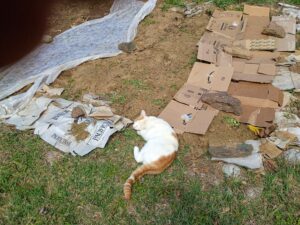
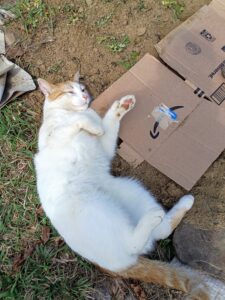
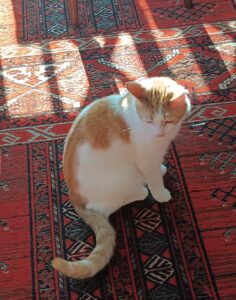
Even Andre likes the sun on the snow, though he prefers to soak it up through the warm window.

Subscribe at https://ddinafriedman.substack.com
 

Is Gratitude Enough?

Despite my daily meditation practice, which includes listing one thing I’m grateful for each day, I have an ambivalent relationship with gratitude. It often feels unsettling to focus on the abundant amount of privilege I have–health, relationships, financial security–when so many others have more challenges in their lives. And while I do understand the benefits of centering gratitude in both the big and small moments, I worry about focusing on it too much, to the point where I’m less motivated to do what I can to make the world a better place for others.

Dtobias, CC BY-SA 4.0 <https://creativecommons.org/licenses/by-sa/4.0>, via Wikimedia Commons

But today is Thanksgiving, a day we’re directed to give some attention to gratitude. For me, no Thanksgiving is complete without listening to Alice’s Restaurant, Arlo Guthrie’s classic song about how he manages to avoid being drafted into the Vietnam War by embellishing the story of his arrest for littering on a Thanksgiving Day 60 years ago. I feel grateful for Arlo: his irreverence, creativity and dry humor in a somber situation. I’ve just returned from Vietnam, where I visited the War Remnants Museum in Saigon, and saw many of the horrors close up: the countless bombs, the generations of disfigurement and health challenges from Agent Orange, the My Lai Massacre, the number of people dead on both sides.

The question weighed on me as it often does–Why do people do this sh*t to each other? What is it in the human psyche that wires us toward committing acts of cruelty that go far beyond the battlefield–as if the battlefield isn’t horrific enough. What makes it ok to shoot children, rape, torture and kill innocent civilians? I’m not just talking about the Vietnam War. These atrocities permeate all borders and all countries, stretching from ancient times to the present.

And in the wake of this, what does it mean to draw a faux border around our own Thanksgiving tables, shutting it all out? And how do we reconcile this time of gratitude with our genocidal history against Native Americans, many of whom mark this day as a time of mourning? My younger child has boycotted Thanksgiving for the past two years in order to attend their yearly protest in Plymouth. I am grateful for their activism, even though I’m not personally ready to abandon Thanksgiving, yet. But I think we need to see the holiday as aspirational, rather than celebratory. We can be thankful for the blessings in our lives, but we also need to address the holes and shadows in a tableau that falsely centers on the horn of plenty.

I’m not trying to make Thanksgiving a downer. I’m looking forward to our family cooking extravaganza, and time around the table, and pumpkin pie. And while I’m grateful for the many blessings in my personal life, I’m feeling even more grateful to the people who are following Arlo’s footsteps in being creatively subversive in not accepting the status quo: the dancing frogs in Portland, the whistle blowing in Chicago, the moms in Charlotte arranging transportation and food drop offs for immigrant families so that parents did not have to risk their safety. 

As Arlo says, “…fifty people a day walking in singing a bar of Alice’s Restaurant and
walking out. And friends they may think it’s a movement.” Today I’m grateful to all who have comprised this movement by taking actions in the last year to make life better for those endangered and at risk: whether that was protesting, donating money to people in need, writing letters to elected officials, having a difficult conversation with someone with an alternative point of view, or engaging in any small (or large) act of kindness.

Happy Thanksgiving!

How Many Words, Really, is One Picture Worth?

As someone who is much more quick to rely on auditory, analytical, or kinesthetic cues than visual ones, I’ve always been bothered by the adage that one picture is worth a thousand words. This is not to diss the importance of visual images for those who prefer that style of learning. I just think it’s important to recognize that one-size does not fit all when it comes to conveying information. There’s nothing that frustrates me more than directions that have only diagrams (no written instructions) on how to put something together. And I’ll admit, I’m a chump when it comes to trying to verify that I’m human by picking out the squares in the grid with bicycles or traffic lights. I just keep missing the images.

And while I do agree with writer/artist Leonardo Da Vinci that “a poet would be overcome by sleep and hunger before [being able to] describe with words what a painter is able to [depict] in an instant,” I find myself wanting to root for the poets, anyway–for the challenge of spending those sleepless, hungry hours trying to describe something. I guess that’s because words are the tools I’m comfortable with, while paints and brushes are not.

Nevertheless, we’re in the second week of our Vietnam/Cambodia vacation and I haven’t written anything, except last week’s blog post and a few emails to my mother. But one thing I have done is taken a lot of pictures. 132 just today at Angkor Wat.

There are some bad ones and repeats, which I’ll delete, but I’ll probably end up with around 100. Then I’ll post somewhere from 8-20 on social media with a very cursory description of what we did. Whatever semblance of poetry will not be in the words but in the pictures.

It’s just so darn easy with the click of a cell phone.

Often I haven’t liked taking pictures when traveling, because I’ve preferred to bask in the experience of being wherever I am without the burden of figuring out how to capture all the special moments in a glossy. I’d rather cherish whatever memories happen to stick. But as I’ve gotten older, fewer memories are sticking.

So I’ve been taking more photos, and learning how to do this better by being more patient–not snapping so spontaneously, but taking the extra second to think more about the frame, waiting for people to pass out of the way, playing more with zooming in and out to get the optimal perspective. I’m sure on some level, this more mindful attention to detail will bear fruition in my writing life, when I’m ready to settle into writing what I see, whether in the present moment, in past memories, or in my imagination.

In the meantime, here are 3 pictures of Angkor Wat and the surrounding temples. Probably better than writing 3,000 more words–or asking you to read them!

Subscribe at https://ddinafriedman.substack.com