Ho Chi Minh is Everywhere

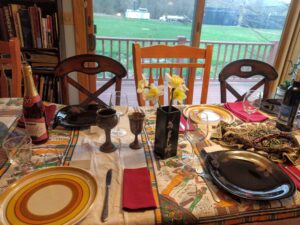
Photo: D. Dina Friedman

Photo: D. Dina Friedman

We’ve been in Vietnam for just a few days and I’ve probably seen the face of Ho Chi Minh more than a hundred times: on statues, on banners along the sides of buildings, in posters in store windows, on book covers, on the money. It’s a name and face from my deep past. I was a child during the Vietnam War (which is referred to here as “the American War,” “the Bomb War,” or “the Destroy War”). I was too young to have much understanding of what was going on. I knew that my family was divided. My parents, while not activists, were firmly against the war, and my grandparents and great aunt were convinced that the war was absolutely necessary to stop the “great evil” of communism. I remember their arguments at the Thanksgiving dinner table, my grandfather reciting the name of Ho Chi Minh as synonymous with an evil my child-brain could only associate with monsters.

Photo: D. Dina Friedman

Yet, here I’m hearing a very different story, of a man who never married because he gave his life to the country, of someone who lived simply, in a two-room house on stilts, saving the opulent government residence for official events. Of someone who had hope and vision, and persistence, and did not give up despite the long struggle to shepherd the Vietnamese people toward independence after 100 years of French colonization, and a thousand years of Chinese colonization before that.

While I know that freedom of speech is not a given here, and that I may not be hearing the entire truth, I think it’s important to acknowledge the varying perspectives  surrounding this important figure in history, who seems so clearly loved and venerated by many as a national hero. And I think this serves as an important lesson for current times in how those in power try to villainize those who challenge that power, especially when these challengers attack the status quo.

Take the recent mayoral election in New York, for example. Zohran Mamdani, the mayor-elect is a 34-year old Muslim Democratic socialist who focused his campaign on affordability. Mamdani’s campaign promises included stabilizing rents, creating more free trasnportation and childcare, and initiating city-owned grocery stores, all of which he proposed to pay for by adding taxes on the 1% and on corporations. Needless to say, these ideas felt threatening to many of those who uphold or are benefited by the power structure, so they went on the attack–but not by refuting the ideas in Mamdani’s campaign platform or offering alternatives. Instead, they tried to delegitimize his platform and brand Mamdani as an enemy by using words like “terrorist,” “communist,” and “anti-semite,” words that are deliberately loaded and are designed to evoke fear and undermine people’s sense of safety and security.

And the more we get sucked into ignoring the nuance and complexity of any individual and rely instead on portrayals of people as cardboard cut-outs of heroes and villains, the less chance we have of truly understanding our fellow humans and making our troubled world more livable for all of us.

In fiction-writing we’re warned to avoid flat characters–two-dimensional stereotypes who have no depth, and may help move the plot but don’t undergo any real change. And one exercise we’re often asked to do to add more nuance and depth is to take a scene we’ve already written and write it from a different character’s point of view. The Nigerian writer Chimamanda Ngozi Adichie also urges us to embrace the multiplicity of perspectives in her excellent TED talk, The Danger of a Single Story.

I don’t want to go all Pollyanna about this. I freely admit to harboring many negative thoughts filled with villainizing loaded words about a certain political leader we won’t honor with a name, who, unsurprisingly has used this villainizing tactic quite effectively to delegitimize his opponents. But I can also see how this isn’t useful in the world of our better angels–both in terms of my own mental health and in terms of creating the world I’d prefer to live in.

I never thought–during the war, and after Vietnam “fell” (as we claimed in our loaded-word way) to the Communists that one day I’d be vacationing in Vietnam. And that the place would be thriving with music and restaurants and people dancing in the streets. But here I am. And Ho Chi Minh is everywhere.

Subscribe at https://ddinafriedman.substack.com



Taming the Baby Raccoon

While I’ve written before about the joy I find in traveling, I haven’t written about the creeping anxiety that looms larger and larger as I get close to departing on a trip.

My to-do list swells so much, it feels like it’s on steroids. I get fixated on things that don’t really need to happen and try to convince myself I can’t leave until I’ve cleaned my closet–even if I haven’t cleaned my closet in the last six months–or six years. Even when I’m aware of the pattern, the niggling will not let go. Here’s the messy closet I will NOT clean before I leave.

But that doesn’t mean, I won’t scour the nooks and crannies of my life for other household and administrative loose ends that would be better off tied. And it’s not just me. My partner, Shel, decided a couple of days ago that it would be good idea to put away all the herbs we hung to dry on the window frames months ago. (So far he’s only gotten through a quarter of them, LOL!)

The rationale is valid, if it didn’t up the ante on the anxiety arising from the pressure of getting all these things done on time. Because time, as any stress management course will tell you, is finite. And at some point, it will be gone. The plane will take off, and, providing all goes according to plan, you will be on it, regardless of what has and hasn’t gotten done. So I’m trying this time to simply laugh at some of these unnecessary inclinations and focus on the things I absolutely have to do to get ready for this trip, while at the same time trying to tame that rising since of dread in my chest.

A recent meditation tape suggested that I think of anxiety not as a monster but as a baby animal that needed love and reassurance. For some reason I envisioned a raccoon, its large eyes and black mask a prominent focal point of its tiny body. Even as the image first arose, I found myself wondering why I’d chosen a feral scavenger and if there was some metaphor about the mask. Not sure, though I think there might be something about the scavenger bit. Anxiety does feed on anything it can find, which may be why I keep adding things to my to-do list that I don’t really need to do. And “feral” makes sense, too, because you can only control anxiety so much.

But you can also let a feral animal go off and do its own thing. And that’s what I intend to do with this pre-trip anxiety: look out the window and wave to it, wishing it well on its scavenging journey. Then I will focus on what’s essential–and if there’s extra time, what’s realistic–to accomplish in the 48 hours I have left before I leave.

And once I’ve closed the door to my house for the final time and checked my bag for the super essentials–passport, wallet, phone, computer, chargers, glasses, etc.–I’ll remind myself that I’m not venturing off into thin air. Likely, if I have a problem with a lost or forgotten item, or something essential that needs to be done, there will be a way to address the issue. And then, I’ll appreciate myself for being resourceful and remind myself of some past travel mishaps that may have been frustrating at the time, but now make good laughable stories.

And I’ll watch as that little raccoon in the corners of my mind trots off and buries itself for a nice nap in that pile of brush I did manage to clear from my garden before we left–even if I didn’t nearly tackle all of it!

Subscribe at https://ddinafriedman.substack.com
Should You Throw Away Your Work?

Yesterday, I found myself meandering through my short story file and opening up some titles of work I didn’t recognize to see what they were.

Sometimes when I do this with an archival file of past writing, I find some pieces with hidden sparkle that I’m inspired to work on. But yesterday, several files that I uncovered brought me nothing but embarrassment and a slight tinge of shame. The situations I’d tried to fictionalize were too close to autobiographical for comfort, revealing truths I might have needed to process at the time, but likely did not have enough relevance or context to be useful, insightful, or enjoyable to outside readers.

And since I’m a big “what-if” fantasizer, I couldn’t help but worry about what might happen if somehow, after I was dead, these thinly disguised files were seen by the people involved. I didn’t want to risk being hurtful, especially with no way to explain, apologize, or make amends.

So I did a radical thing. Command A, Command C, Delete. Move to trash.

https://freebie.photography/concept/slides/throw_away_concept.htm

Four key strokes. The words were gone, the files disappeared.

And then I worried. Had I been too rash in throwing away my work? Was there something salvageable in these pages I could use later? Was the impetus to toss generated by my (somewhat) objective writer-self, or my condemning inner critic, who probably thinks I should throw away everything?

Too late! They were gone.

And while I’m obviously having second thoughts, I do think it was the right decision, mostly because of the hurtful potential of these particular half-drafted stories. But also because they were all so old, I barely remembered them. And because I really was no longer drawn to write about these things. And if I am in the future, I think the stories will be better served starting afresh with whatever wisdom, perspective, and distance I’ve gained between then and now, enabling me to crystallize the issue and contextualize it in a way where the specific situation and actual cast of characters are no longer recognizable.

When you toss something right away, it’s usually because your inner critic is telling you it’s crap, and we all know how unreliable inner critics can be. So I wouldn’t recommend throwing away anything you’ve written in the last year–or maybe in the last five years, especially with the luxury of fairly unlimited electronic storage. But anything older than that–the choice is yours. Is there anything left in the piece that draws you? And if not, do you want this work to be part of whatever legacy you might want to leave?

So now I’m contemplating what else I should toss. A few months ago, a close friend from high school gave me a whole bunch of letters I’d written to her from the ages of 17 to 23. I read through them all and cringed, even if I could have had more compassion for that young, naive, and giddy girl, who comes off as so darn shallow. My first impulse was to build a fire and ritually burn them, as if putting them in the recycle box wouldn’t be good enough. But instead I buried them under a pile on my desk. A month later, I took more time when I re-read them, and was able to be a little more forgiving of my younger self’s flaws, but I’m still inclined to get rid of them soon–along with most of the contents in the boxes of journals in the attic, and the manila envelopes filled with letters friends wrote to me during my teenage years.

And at some point, I intend to go through more of my old writing and figure out what I want to keep, and what really doesn’t need to be anywhere in the universe, especially with my name on it.

Is it Swedish death cleaning, or more carefully constructing the legacy I want to leave? Perhaps a little of both. And yes, I admit to intentionally wanting to curate a picture of my better self, which may not be the whole truth. But how different is that, really, from waking up each day and trying to be that better self in real life?

Subscribe at https://ddinafriedman.substack.com  


Organizing Your Ideas

I’ve often joked that I can organize anything–as long as it isn’t tangible.

I’m skilled in creating focused agendas, facilitating unwieldy meetings, planning schedules, and tackling complicated logistics–all with the goal of keeping things on track.

And having spent the day on a variety of editing projects, I again feel thankful for my superpower–being easily able to make a sentence flow more smoothly into the next, and sensing how to move ideas around to create a more satisfying and compelling arc from beginning to end.

But if you dump a roomful of objects on the floor, even with a set of organizing containers from your local big box store, and tell me to put them away in a logical, accessible and attractive manner–I will scream. Or cry. Or both.

So, I understand the sense of overwhelm many writers have when trying to organize their ideas, even if the process comes to me somewhat intuitively–if not in the first draft, than usually in the beginning stages of revision. Yet, my empathy is not going help those who feel strangled by the vines in the jungle of their unruly mind, as I learned quite humbly, during all the years I worked in a university, attempting to “teach” students the basics of coherent and engaging writing. It’s still a struggle to break down the process of organizing ideas (or anything I do intuitively) into small replicable steps. And it’s even harder to think about how to do this for poets, fiction writers and CNF writers, whose projects depend on a certain degree of unbridled creativity. But here are some things I’ve learned from being in the trenches. I hope they’re helpful:

(1) When generating material, always trust your “wild mind,” and let the ideas flow where they will, even if you don’t immediately sense the connections. There will be plenty of time to rope in (or eliminate) tangents later. And the relationships between things you uncover will surprise you–in a good way.

(2) Don’t self-censor while you are drafting. Sometimes I’ll get to a place and think, I really don’t want to write about that. This could be because it’s irrelevant, too revealing, unpleasant, silly, emotional, etc. But even when I don’t use these blips of material, they often serve as a bridge to the real thing I want to write about. If I don’t let myself build that bridge, the seed of what really matters to me will never sprout.

(3) Once you have your generated material, be playful with it. Feel free to eliminate whatever you want (ideally without judging that material as “bad,” just not needed) and take time to rearrange what’s left several different ways, adding whatever you think needs more context, clarity, or overall “oomph.” This is the time to start thinking about flow and what’s holding the piece together–i.e. what you really want to write about, and the various ways you can get from the beginning of your writing path to the end.

(4) After you’ve done this a couple of times (or perhaps before Step #3, but definitely not before generating material), it may be time for an outline, especially if you have a longer project. For me, it helps to think of an outline as an aspiration and a way to help grasp “the big picture,” rather than as a directive from my inner dictator. This helps me deviate from and then revise my outline as much as necessary, or disregard it entirely once I know where I’m going and feel confident I can get there without it. (Yes, I am one of those people who often turns off the GPS!)

(5) Going through Step #3 several times–with or without an outline–will likely lead to even more cutting and rearranging, and you may be faced with eliminating a line, an image, or even a whole paragraph or several pages that you really love. It’s a writer’s curse–the idea that you have to “kill your darlings,” a phrase that has been attributed to Allen Ginsberg, William Faulkner, Stephen King, Oscar Wilde, Eudora Welty, G.K. Chesterton, and Chekhov, but was likely coined by the lesser known writer Arthur Quiller-Couch in 1914. But you don’t really need to “kill” those precious bits. Just give all the darlings a good home in a separate file on your computer to be potentially resurrected in another piece. Many of them may never see the light of rebirth, but they’ll still be in your files, and perhaps when you die, your archivist will discover all those unpublished little gems!

https://stockcake.com/i/mystical-forest-descent_3147025_1658520

But seriously, what I think is most important here is to have faith that you can get from Point A to Point B, even if you’re not confident in your sense of direction. It just may take you a little longer to find the path. And if you do get lost, make sure to enjoy the walk, rather than worry too much about where it’s taking you.

Subscribe at https://ddinafriedman.substack.com 


Vacation–And Motivation

Often when I dream of vacation, I dream big. In a few weeks (provided the world and my family life hold stable), my partner, Shel, and I are headed to Vietnam and Cambodia. We’ve already been to more than 40 countries in 5 out of 7 continents and in all 50 states in the U.S. And while we’ve occasionally repeated a destination, the draw of going somewhere we haven’t been, with its promise of experiencing something entirely new and wonderful, has usually been a greater pull. We’re determined to get to many more hard-to-reach places before age or health drags us down.

And while all this travel has had its bumps, I can honestly say I haven’t regretted going anywhere I’ve been. I remember everything fondly: from the hours waiting on the side of the road for nearly non-existent buses to take us to the next town in Mexico, to trying to cross a street in India with eight lanes of cars, tuk-tuks, bicycles and motorcycles going every possible way and giving up, to randomly pointing at vegetables in the cooler at a restaurant in western China in expectation of a stir fry and ending up with ten separate vegetable dishes, to driving for days through the gorgeous but mostly deserted Quebec countryside to reach “au bout du monde” the place where “the world ends,” dropping off into the sea on the eastern edge of the stunning Gaspé penninsula.

But sometimes the small get-aways can pack a similar sense of wonder. Last week, to celebrate our 42nd wedding anniversary, we drove a whopping two hours across the state and spent three days exploring nature preserves and beaches in southeastern MA and southern Rhode Island. It was just what I needed.

Photo: D. Dina Friedman

While my home landscape (the one that evokes feelings of comfort, security and spiritual peace) feels firmly footed in deciduous forest here in Western Mass. and elsewhere in the Northeast (despite my birth roots in the littered concrete of Queens) I adore fresh breaths of beach: not only the damp salty air and heartbeat of the waves, but also the plants–rosehips bullrushes, searocket, and the quiet marshes with occasional glimpses of egret. All of it is just different enough to open up the wonder of being elsewhere. And my absolute favorite time to go to the beach is in October, when there’s nearly no one else there, especially when it’s tinged with fog, though we were blessed with the last of the sun before the winds picked up and a Nor’easter set in.

Going to a deserted beach, or really on any kind of vacation, is one of the ways I have of showing compassion for myself, which is not an easy thing for me. Today, as part of a 10-day meditation challenge focused on attaining a more positive self-belief mindset, I was asked to pick one thing I was annoyed with myself for. I guess I shouldn’t have been surprised that what popped into my head was: Not doing enough. That’s too general, I told myself. Pick one thing. But I couldn’t. Because, it’s rarely about one thing I’m not doing that I think I should do. It’s about everything I’m not doing–an onslaught of tasks, real or imagined, that spreads out before me like a “whack-a-mole” field.

But when I’m on vacation–whether, I’m in China or eastern Massachusetts, I’m able to put that ridiculous perfectionist-derived list aside and take pleasure in the beauty and wonder of the moment.

After we picked our “one” (or in my case–many) things we felt annoyed with ourselves about, we were instructed to first pay attention to the feelings this engendered. For me, that was sadness and a deep sense of inadequacy. Then we were asked to speak to ourselves with kindness and compassion, as we might speak to a close friend. I immediately flashed back to a conversation I’d had with a friend the day before who has been struggling with a number of challenges–how I told him, you are one of the most motivated people I know. Which was the absolute truth.

Now, can I say that to myself? Yes, I can probably give myself an A for motivation. Perhaps the issue is not my aspirational desire to do all the tasks I set before myself. I just need to give myself a reality check on what’s feasible, so I’m not mentally beating myself up for my inability to do more than I can possibly do.

It’s something to think about anyway as I look forward to another self-compassion break when we’re in Vietnam. Meanwhile, the blog is done. On to the next thing on my to-do list!

Rejection Blues? Avoid Crushing Out on Your Poems

Last Friday at a workshop, I wrote a poem from the prompt, What is Home? My response went way beyond warm tea and apple pie into the grief, fear and horror I felt after hearing about ICE infiltrating a Chicago apartment complex in the middle of the night, dragging people out of their beds and zip-tying children. As I often do in my poems, I combined these bigger events with moments from my life: flashbacks to my own home as a child, a grief ritual I’d participated in the previous day on Yom Kippur, and a precious innocent moment with my three-year-old grandchild, who, so far, has been sheltered from the onslaught of anxiety-provoking news stories that further threaten the tottering foundations of the country we call home.

I thought the poem was good. Quite honestly, I was smitten with it, as I often am when I feel I’ve been able to use poetry to expel what’s deep inside me in an artful, not-too-didactic, and not-too-ego-driven way. So, even though I generally like to let first drafts sit for a while so I can revise them more objectively, I decided to send the poem to Rattle, which publishes a new poem every week that responds to that week’s current events.

Problem was, the deadline was that night, Friday, at midnight. And I had commitments most of the rest of the afternoon and evening.

10:00 pm is not my ideal writing time. But that was when I got home on Friday night. So I forced myself to sit at the computer and consider the poem, doing what I generally do in revision: cutting out things that didn’t need to be there, condensing lines, considering each verb and each noun image, determining if there were places I could use more metaphors, making language choices to improve the sound and rhythm of each line. As I worked, I felt even more in love with the poem, even as its flaws began to peek through. But, I reminded myself, justifying my crush-like state, if I only sent out poems that I thought were unflawed, I’d never send out anything at all.

At 11:15 pm I decided I was too tired to do anything else to the poem, so I sent it.

I knew that no matter how polished or unpolished the poem was, the chances of it being chosen were pretty slim. Rattle gets hundreds of poems each week for this feature and they publish *one* of them–sometimes two. Nevertheless, on Saturday, the day they respond to all of those who’ve submitted that week, I kept checking my email. Even as I told myself it was unlikely they were going to take the poem, my little fantasy brain couldn’t quite click off. What if they do take it? Wouldn’t that be amazing? While I knew this wasn’t a perfect poem, I still thought it was an important poem, with something crucial that needed to be said–or, at least, something I felt was vital to say.

At about 5:30 pm on Saturday, just as I was getting into my car after a hike that featured a visit to my favorite “best friend” beech tree I checked my phone. There was the rejection–a form one I’d received several times before, kind, as always, reminding submitters of the number of poems received and encouraging people to try again.

I wasn’t crushed. Hard, even, to be disappointed with a result I totally expected. Oh well, I thought, as I backed out of the parking lot and headed onto the road. But I know that for many, a rejection can feel far more more devastating–and even worse if you’ve let yourself fall too deeply in love with your own work.

Later, I looked at the poem again. It still felt relevant and important, but it wasn’t the most amazing poem I’d ever written. As the glow of the poem-crush began to dim, I realized that with a little time and distance, and feedback from my poetry group, I could do more with this poem. And while it was kind of fun to work myself up into a frenzied, deadline-induced revision session, sometimes impatience is really my enemy–like when I can’t even wait for the tea water to boil and end up with an unsatisfying lukewarm cup.

And as with the the other deep loves in my life, things usually get better once the crush phase wears off and I begin to see and appreciate people–and poems–for who and what they are.

Subscribe at https://ddinafriedman.substack.com

Atonement

Tonight at sunset starts Yom Kippur, the Jewish Day of Atonement. And even for mostly secular Jews like me, YK is a big deal.

Because atonement is something none of us should ignore–on both a personal and a macro level.

The synagogue that I attend very occasionally (usually only on Yom Kippur or if a friend is doing a special event there) refers to atonement is “at-one-ment.” I’m interpreting this as the idea that forgiving yourself and others, asking others you’ve wronged to forgive you, and striving to do better can lead to an increased sense of wholeness. Though I think “at-one-ment” could also refer to an aspirational sense of unity between all people, or expanded even further–unity and connection between everything on our planet: people, animals, plants, nature, divinity, the heavens, etc….

And this is the atonement I think we need on a macro-level. To recognize that there’s no such thing as an enemy. All of us are connected as sentient human beings. All of us are one.

I say this not to be perceived as a Pollyanna, or a groovy guru. I’m not particularly enlightened. I can list many people I might perceive as my enemy. Most of them are currently in positions of power in our government. But part of the reason I perceive these folks to be my enemies is because they’re piling up the weight on the “enemy playbook,” and riling people up with an “us vs. them” mentality in order to maintain their power.

But since this is the season of forgiveness, I’m not going to go any farther with “the blame game” right now. Ultimately, we all have our ways of dividing ourselves into us and them. And this is not to guilt-trip, only to recognize. When we spend money on things we want but don’t necessarily need, or give loving but unnecessary gifts to friends, while giving nothing–or only small amounts–to those who are hungry and suffering, isn’t that a type of tribalism? Or when we ignore or glaze over the horror stories of people in Gaza starving to death, or immigrants taken from their children and disappeared into prisons, or black people killed by the police, or countless other issues, and then go about our daily lives as if all this stuff isn’t happening, aren’t we saying in some fashion that it doesn’t matter as much because it’s not about  someone in our inner circle–in other words, not about us?

This morning I read a post from T’ruah, the Rabbinic call for human rights about the holiday. It mentioned that even though personal atonement is only done for acts committed this year, our collective atonement also addresses two incidents in our biblical history as a Jewish people: the Golden Calf, and the sale of Joseph into slavery, which was done by his jealous brothers for 20 pieces of silver, enough to buy each of them a pair of shoes. This second story struck me as hitting far too close to the tribal ways in how we live our lives today–selling out others for our own privilege and convenience, and ignoring their suffering.

The Golden Calf story gave me a little more pause, as I’ve always hated that tale and saw it as a jealous spoiled brat divinity ranting for not being worshipped well enough. But today, I’m thinking that perhaps the Israelites built the Golden Calf because things felt so dark in the desert, they had given up hope and they needed a “quick fix” to lift their spirits. So maybe we revisit this tale to remind us that we even in the darkest times, we must somehow find and hold onto hope. Real hope, not a golden illusion.

That might be a hard lift for me today, but I’m willing to think about it. In the meantime, I invite you to listen to one of my favorite pieces… composer Max Bruch’s interpretation of the haunting melody of the Kol Nidre prayer (traditionally recited on Yom Kippur eve) played by cellist Jacqueline DuPré. https://www.youtube.com/watch?v=GNUkemxvsP4

Subscribe at https://ddinafriedman.substack.com


Speaking Truth to Power

A few years ago, shortly after George Floyd’s murder by the Minnesota police, my late brother, Danny, asked me if I believed in critical race theory. He wasn’t particularly interested in my answer; he was just trying to goad me as he’d done all our lives, making fun of my favorite baseball players when we were kids, dissing the few rock stars I admired that he didn’t like when we were teens, and later tuning into our political differences as he sunk deeper and deeper into the influence of Fox News.

“I don’t call it critical race theory,” I told him. “I call it truth.”

I earnestly began to explain why I thought it was so important that we learn a true accounting of our history–the good, the bad, and the ugly–rather than a white-centered version that discounted or trivialized the experience of black people in the US. He didn’t really listen. I would have liked to chalk that up to ADHD rather than to our past history, except that he kept interrupting me with sound bites he’d clearly heard on TV that had little to do with the points I was trying to make.

Not so different from the sound clips from news pundits about a recent assassination of a right wing leader that Jon Stewart used in his “government-approved monologue” recorded after Jimmy Kimmel’s firing.

Just to be clear, I don’t condone political violence. No matter who does it to whom, and no matter what the underlying motivations might be.

But I also don’t condone this administration’s vilifying those that oppose their policies. I don’t condone their outright lying, or–as they would call it–“alternative facts.” I don’t condone their attempts to simply remove information that doesn’t speak to their political agenda, such as scrubbing DEI from government websites, removing the mention of slavery from national parks, and targeting exhibits at the National Museum of African American History, just to name a few of many examples.

While I agree that those grieving the dead should be respected, I don’t condone the administration’s and right-wing news media’s sanctification of the recently assassinated MAGA influencer after they ignored they ignored the assassination of Minnesota State House Speaker, Melissa Horton, for whom the flag was not lowered.

Narih Lee, CC BY 2.0 <https://creativecommons.org/licenses/by/2.0>, via Wikimedia Commons

Sadly, this is the first time in my life that I feel I need to choose my words very carefully. The freedom of the press and the freedom to express our opinions that our (quite conservative) teachers taught us about so proudly in elementary school is at risk. Even though Jimmy Kimmel has now been reinstated on some, but not all, of the ABC-affiliate stations, others who commented with concern about some of the things this leader said about black people, Jews, LGBTQ, women and other marginalized groups permanently lost their jobs.

But as writers and as human beings, our moral imperative is to speak truth to power, no matter how much we might dislike being goaded, or cowed, or threatened to stay quiet. Coming out of Rosh Hashanah, I realize this one of the things I need to do more of in the New Year.

Poet Ilya Kaminsky nails it here:

WE LIVED HAPPILY DURING THE WAR
And when they bombed other people’s houses, we
protested
but not enough, we opposed them but not
enough. I was
in my bed, around my bed America
was falling: invisible house by invisible house by invisible house.
I took a chair outside and watched the sun.
In the sixth month
of a disastrous reign in the house of money
in the street of money in the city of money in the country of money,
our great country of money, we (forgive us)
lived happily during the war.
#art for change