I was planning to blog about tackling Bruch’s Kol Nidre last week, a piano/cello duet centered on the prayer that opens the Jewish Holiday of Yom Kippur. And then I realized I wrote a piece about this very topic three years ago.
This shouldn’t have been surprising, since every year I tend to drag this piece out of my small collection of sheet music to help me connect to the holidays. I am ambivalent about many aspects of traditional Jewish practice but I absolutely love this piece of music, even as I’m still struggling to play it at a level anywhere near my bar of satisfaction.
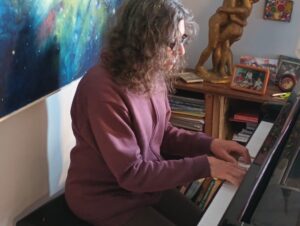
I was surprised when I read my previous post that I described my experience as mostly positive. But perhaps that was because I gave myself more time to dig into it. This year, I didn’t bring out the piece until a week before the holiday, thinking that the arrangement I found on-line, which was solely for piano rather than piano/cello, would be easy enough to re-learn quickly with all those extra years of practice and so much prior familiarity. I don’t know whom I was kidding. What I will confess is that after three days of what felt like torturing myself, I gave up.
Too late to learn this in time for Yom Kippur. Next year I’ll start a month ahead.
Or maybe three months ahead.
Or maybe on Passover.
But what did impress me, and what was different was that I didn’t mentally beat myself up for throwing in the towel, as I might have in previous years. I didn’t unleash the litany of my self-critic, Eloise, nagging on about what a terrible musician I was: yada, yada, yada. I just said to myself, I don’t have the capacity to learn this right now, and put the pages aside.
And on Yom Kippur eve, the only time I go to services outside of b-mitzvahs or my mother requesting my yearly witness for reading the Torah, I went to my local synagogue and heard two high school students, Ben and Amita, play this piece with effortless elegance and grace. This is a wicked hard piece of music (at least, in my humble opinion) but their performance did not center on virtuosity. In fact, I wouldn’t even call it a performance; they just played from the heart.
In one of the Jewish practices I’ve become attached to, taking the entire month before the New Year (Elul) to work in tandem with a chevruta (spiritual friend) to reflect on our life and contemplate renewal for the new year, we’ve talked about the notion of a labyrinth–how each year, it can feel frustrating to be confronting the same issues; yet, we’re still going slowly forward and around, so that we’re not stuck in the same place. We’re facing them from a different point in the circle. So here I am writing about playing Kol Nidre again–but from a different point on the labyrinth. And while next year, I might dream of playing this piece with half the fluidity of Ben and Amita, that probably isn’t going to happen. Even if I decide to start re-learning it tomorrow and make it a year-long project.
Yet, whether I’m curious to see what will happen and where I’ll be on the labyrinth next year. Maybe, I won’t even want to challenge myself with this hard piece of music. Maybe I’ll suddenly become enamored with tap dancing or bungee jumping. Or maybe I’ll decide my true calling is improvising my own musical melodies. Or maybe I will dig in early enough to see what learning it can teach me. In any of these cases, I’ll be learning something about myself, ideally with a focus on the newness of the moment, rather than on all the past baggage.
And if we think of any moment as a brand new opportunity, what a wealth of possibilities that could bring to healing–not only ourselves, but to the many troubles experienced today in the world.
Shana Tovah!
Subscribe at https://ddinafriedman.substack.com