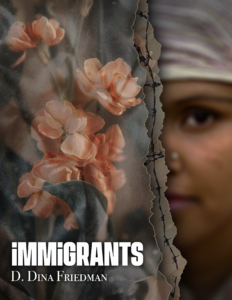
Last night I read at the annual 30 Poems in November reading, an annual event where each writer who participated in the fundraiser is asked to read one poem. Meanwhile, I’ve been overwhelmed by my writing/book-marketing to-do list, at the top of which is wrestling these poems to have something to send to donors by the end of the month, and continuing to spread the word about Immigrants through my web of connected networks while taking the first dips into investigating blogs, podcasts, social media sites, etc. where I don’t have a personal connection. (NOTE: Any suggestions are welcome!!!)
Most moving at last night’s reading was hearing from three of the students at the Center for New Americans who shared heart-felt writing in both English and their native languages, as well as their deep gratitude for the hard-working teachers at CNA who are helping them build their new lives.
As the negative rhetoric around immigrants starts to build again, with Republicans in Congress demanding changes in immigration policy in exchange for aid to the Ukraine that would make it even harder for people threatened by violence to escape to the safety of our country, I’m remembering a writing workshop I co-led for women in the border camp. We introduced the beautiful picture book, Somos Como Los Nubes (We Are Like the Clouds) by Salvadoran poet, Jose Argueta, which talks about the hopes and dreams of Central American children walking thousands of miles in search of safety.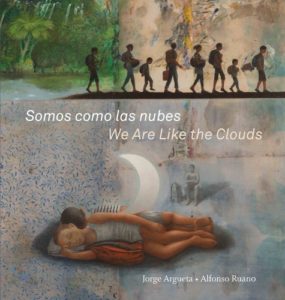
Then we asked the women to write or draw their response to the book. One woman sat and started to cry. “I can’t write,” she told me. Having heard this many times from leading writing workshops for most of my adult life, I mustered up my Spanish to give her a pep talk on writers’ block. But she wasn’t talking about writers’ block. She was talking about illiteracy. I felt so embarrassed as I asked a more fluent Spanish speaker to act as her scribe, but recognized that my embarrassment was nothing compared to hers. And when it was time for her to share, her story, like every story we heard that day about kidnapping, lost livelihoods, rape, threatened or dead children broke our hearts.
While only one of the stories in Immigrants is about the border, I wrote the book to showcase all the ways that immigrants interface in our lives. While some of the stories are more political than others, in all of them, the human story takes center stage. As I worry about all the ways the U.S. is becoming less safe, it feels like an impossible nightmare to think about leaving my home to go somewhere strange and potentially unwelcoming, especially today as the winter sun is slicing a comforting wedge of light through my large porch windows. Yet, that’s what the immigrants coming to this country did–an act of incredible bravery to leave everything you know. And that’s what people displaced in wars have to do, with no opportunity for choice.
But I didn’t read a poem about politics last night. My poem, a cento, was about loving the world despite its difficulties. A cento, which is a collage of lines from other poems, might be a bit of a cheat, but hey, when you have to write 30 poems in a month, sometimes you need to take some shortcuts. And the fun thing about this one was that I only used poems for source material from the prompts that were sent out every day to participating writers.
So next time you’re stuck, leaf through some poems and write down lines that strike you (best if you’re not sure why) and then try to meld them together. I guarantee, this will be fun, even if you’re just tasting other people’s words, whether or not you come up with a poem of your own. Here are the first few lines of my cento. Poetic sources are from Mary Oliver, Dean Young, Mahmoud Darwish, Winnie Lewis Gravitt and Richard Fox.
VOCATION
My work is loving the world.
Because of you, I’m talking to crickets, clouds.
I have a saturated meadow,
where, like plants sprouting where they don’t belong,
sorrow, grief and trouble sit like blackbirds on the fence
scanning the topography of prayer
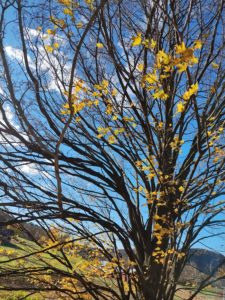 look at things differently. Even today, when I sat down to try to write Poem #9 and came up empty (so I started to write this blog post instead), I found myself intrigued by the leaves’ dance outside my window in that brilliant, but all-too-fleeting sun.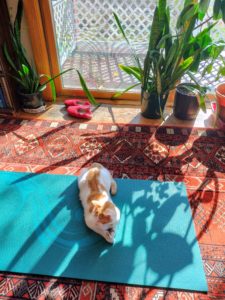

 I highly recommend writing dates with friends (either in-person or on Zoom) as a way of getting going. In addition to enjoying a brief visit before writing, I couldn’t just tweak a poem or two and then get up to succumb to the call of the unpaid bills or the weedy garden, because at the end of the session I knew we’d be reporting to each other on what we’d done and possibly sharing some of our work. Even as I flitted from poem to poem and took several breaks for Wordle and its Dordle and Quordle variants, not to mention checking email and social media, I kept coming back–until I could look at a poem and remember why I wrote it and why it might still matter. And that helped me finally make the shift back to my creative center.