A Sense of Place

I’m always surprised that no matter how much I might originally intend otherwise, the bulk of my fiction (including nearly half of the stories in Immigrants) is set in New York City–with a large percentage in the immediate neighborhood where I grew up. While I’ve often joked, You can take me out of New York, but you can’t take New York out of me, this is really more of a truism than a joke. Each time I visit, I can feel the city’s resonance and vibrancy, even as I recoil at the noise of the subway chugging on the elevated tracks, or the food wrappers and soda cans tossed into people’s yards and the flyers disintegrating into muck in the puddles along the curb.

As a child, I never noticed these kinds of details. Tuning out was my superpower. I kind of had to in order to stay sane. As someone who had a rich fantasy life with imaginary friends since I was very young, it always felt way more easy and pleasant to pay more attention to the world in my head rather than the world around me. So all the ugliness of New York, or anywhere, never seemed like a problem. But tuning out is a problem when you’re trying to establish detail in your writing and develop a strong sense of place.

In the book I’m working on now (in fits and starts), the two teenagers who center the story both live near where I grew up in Queens. One lives in the rows of brick apartments in Jackson Heights, and the other lives a couple of miles closer to Manhattan in a row house on a rundown block in Woodside. So, on my most recent trip to New York to visit my mom earlier this week, I spent some time exploring both neighborhoods for street details I could use, trying to pay attention to who was on the street in both locales, what public places (stores, schools, parks) were nearby, and some precise specifics on what the houses looked like in detail: Peeling paint? Colors of the houses?  The arrangement of numbered addresses on the doorframes? What kind of door frames? Types of gates framing the steps? How many trees and other plantings were on the block and what kind of shape were they in? The list of questions you can ask about the concrete (pun intended) nature of a place can go on and on.

True Confession: I can think of very little that is more boring that developing lists of these kinds of details–even though I know that some people thrive on this. There are writers out there who are marvelous stylists, known for their ability to describe meticulously. And these are people who will happily lose themselves in place research and/or other types of historical research, taking days or weeks to investigate all the nuances and possibilities before committing words to paper. I admire them!

Call me lazy (though I’ll argue than in most aspects of my life I am anything but lazy!) but I just don’t do this. My descriptions aim for just a few salient but highly sensory details, which, when I feel I need to, I flesh out with metaphors, rather than more particulars.

Neither way of describing is better–or worse–they’re just different.

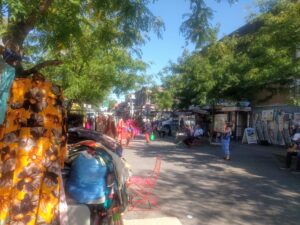
Diversity Plaza, Jackson Heights, NY (I took this pic on a previous trip.)

And another true confession–though not necessarily what I’d recommend: I didn’t take notes on my walks through these neighborhoods. I didn’t even take pictures (though I might be able to rely on some pics my partner, Shel, took.) Instead, I plan to rely on what I remember, perhaps a bit blurred or distorted from what I really sensed, but, hey, I’m writing fiction, not documentary.

And like a watercolor wash over whatever details I try to bring to life will be my long history with the city where I grew up and came of age–a melding of what’s actually there and my inner response to it. Because even as I grooved in my fantasy world in the countless hours where I walked the streets of New York as a younger person, it seeped inside me and will be there forever. As I said, you can’t take New York out of me. 

Subscribe at https://ddinafriedman.substack.com



The Stories You Tell Yourself

Since my father died in early March, my writing has gone from a fairly steady stream to mostly drought with an an occasional faucet drip. I’ve told myself this is okay. It’s hard to write when your mind is fogged in by grief–hard to focus on anything. And when my attention wasn’t focused on my own personal loss, the onslaught of news–particularly the kidnapping and forced disappearance of people off our city streets and reports of humanitarian aid being blocked for the sick and starving in Gaza–has generated a lot of tears, but not too many new words.

Still, like the trouper I am, I’ve kept at it, sitting down at the prescribed moments in my schedule to write, but mostly using the time to send things to journals, which did involve some occasional tweaking, but mostly felt like dropping in on my work for a brief visit, rather than living with it.

However, yesterday I received a gift that might have shifted things.

If you subscribe to Lori Snyder’s Substack, Splendid Mola, you, too, can receive a 5-minute Writers Happiness Exercise delivered to your inbox every Tuesday. This one invited people to “Set the Thermostat for your Heart” by reframing negative stories into positive ones. We were asked to take 30 seconds to focus on one thing that was important in our lives–which could be writing, or could be something else, whatever resonated most at the moment. The next step was to take 3 minutes to brainstorm success stories about what was working well, or–in my case, and perhaps many other people’s cases–what had worked well in the past, even if it wasn’t working well now.

So I chose writing, and this is what I wrote for my brainstorm:

  • Regular times with my words
  • Lots of publications
  • Having the drive to finish and keep going
  • Belief that it mattered
  • Spiritual uplift and “oomph”
  • Wow moments

The final step in the process (1.5 minutes) was to whittle these moments into a one-sentence success story that you can keep telling yourself. Mine was: People care about my message. Lori suggested setting reminders to tell yourself this success story at least once a day, if not more.

But before I even needed to do that, I immediately got the inspiration to pick up with a YA manuscript I’d abandoned after 10,000 words about a neurodiverse middle school girl whose only friend, the daughter of Chinese immigrants, suddenly disappears. Interestingly enough, about an hour after the euphoric high of squeezing out two more pages and the thrill of congratulating myself for inserting new life into what I felt had been a dead project, I started to feel like crap–teary, angry, unfocused. I knew that part of the reason I hadn’t gone back to the book was that I hadn’t yet formulated exactly what had happened to the disappeared girl and her family, and consistently reading real accounts on what happened to similar people for research had become too paralyzing to dive into. But even though I wasn’t writing that part of the book in the smidgeon I drafted yesterday, I realized that being that deep into my words again had brought me to the spiky edge of feelings I might prefer to sidestep. No wonder I’d been playing the avoidance game.

Photo: D. Dina Friedman

What I hope will keep me going this time is that little success story sentence–People care about my message–instead of the story I’ve told myself for the last three months, which is, I’m not writing because I’m grieving. Of course I’m still grieving, but the major fog has cleared. And while I still want to honor the truth of the “not writing/grieving story,” it can’t be the final chapter in the book of my life. There’s never been a more important time to believe in happy endings.

Subscribe at https://ddinafriedman.substack.com


Befriending My Anger

I generally reserve Wednesdays for blogging, because the end of the week is busier, but today, I find myself wondering what to write about. 

It’s likely a spread of the “writer’s block” that has permeated most of the rest of my writing life. It’s more like a silty fog than a blockade on the road. I can still delve into old poems/stories and revise them; I just haven’t been able to generate anything new that feels worth keeping.  

So instead of writing, I’ve been using the time to pour through my lists of submission opportunities, dragging out poems and stories, reading them through, working on a few and then putting things together in batches to send on Submittable. This is not terrible. I’m still spending time with my words; I’m just not birthing new ones.  But I’m missing the thrill of the generative process, saying something that feels important and urgent in the moment–something that matters.

I’m pretty sure the reason I’m feeling blocked is that I just don’t want to access the deep feelings lurking below the surface–my anger, fear and despair at all that’s happening in the world, tinted with the residue of grief from my father’s recent death. It’s not even that I’m feeling a need to write directly about these things, but to write anything of substance still requires a journey outside the carefully constructed contours of my world that I’ve struggled to hold front and center–even as I feel gratitude for having the reassurance of that world: the smiling greenery, the flowering trees, my friends and family, financial and food security.

Today, in writing group, a quote from Percival Everett’s Pulitzer Prize winning novel James, a brilliant and poignant retelling of Huck Finn from the enslaved character Jim’s point of view:
I did not look away. I wanted to feel the anger. I was befriending my anger, learning not only how to feel it, but perhaps how to use it. 

And I realized that somehow I need to befriend my anger, my sadness, rather than keep it as a barely visible apparition on the other side of the fog. And then, simply brace myself, as the dam erupts, letting the rush of water and words spew forward.

Subscribe at https://ddinafriedman.substack.com


Diving Back In

Yesterday, for the first time since my father died, I dived back into my writing.

Actually, it was my poetry critique group on Monday that started the waters churning. I had to come up with a poem, so I started looking through some old ones, and found one that reflected the grief I was feeling, even though I’d written the poem several months ago–after the election, but way before my father took a turn for the worse. Yet, the grief in the poem was so raw, my poetry group was surprised that it wasn’t a new poem. I guess grief has been in the air for a while, as the foundations of the country continue to rumble.

To tell the truth, I’d forgotten I’d even written this poem. I was simply pawing through my files of dribs and drabs, musings and snippets, trying to come up with something that felt like it had potential and held my interest enough to talk about. I got some good feedback–enough to bring the poem up a level or two. But more importantly, I got tacit permission to spend yesterday meandering through my piles of words, reordering, adding on, sloughing off, sewing together a few more poems for the “Send Out” file, piling up others to kiss goodbye before relegating them to the file marked “Inactive.” and leaving the vast majority in the file marked, “Poems to Work On,” but with the magical expectation that at least some of the changes I made might nudge them closer to send-out status soon.

Poet Molly Peacock, in a biography of Mary Delany, who invented the art of mixed-media collage in the 1700s, wrote,  Having a collection, taking it out, looking at it, reordering it, and putting it away is creative in itself. It doesn’t yield a product, like the results of an art, but stops time, as making art does.” 

My style of writing poetry is somewhat like collage. I often seek to combine disparate images and make them add up to a whole. But more importantly, yesterday morning, for a few hours I stopped time as I took a few small steps away from my personal grief and the grief I’m feeling for our nation. Did I create art? That remains to be seen. Was the grief still there when I stepped back in? Absolutely, but I’m beginning to clear away the fallen branches and tangled vines and find a small path forward.

After my little writing vacation, I turned to some activism tasks I also hadn’t been able to do in the past few weeks: drafted a letter to the editor from our immigration justice group and wrote two call-to-action entries for Rogan’s List. It’s still hard not to get paralyzed by the enormity of it all, but taking time to put words together in a hopefully coherent manner made me feel empowered, rather than disheartened.

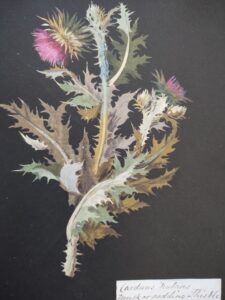
This morning, I’ve taken another step in returning to normalcy, writing with some of my favorite pals in the Forbes Library Zoom Group, where my friend and colleague, Tzivia Gover, with whom I’ve co-blogged a few times, introduced the quote above. Tzivia sent me this beautiful sympathy card featuring one of Mrs. Delany’s collages. I’m looking forward to reading The Paper Garden: Mrs. Delany Begins Her Life’s Work at 72.

Subscribe at https://ddinafriedman.substack.com


Routines

My father lived by his routines. Breakfast was a daily ritual of muesli, blueberries, dates, and apples–eaten dry, since he didn’t like milk or yogurt, accompanied by glass of orange juice, and followed by a cup of green tea with several slices of lemon, steeped for exactly two minutes. The day would unfold with the New York Times, which he read in his chair, often nodding off between stories, and later–as his illness worsened–between sentences. Later: lunch (a can of soup), a Ken-Ken puzzle, a walk, snack-time (two cookies and an orange), and dinner. In the evenings he’d look up what had happened on that calendar day in various other years from the short daily summaries he’d been keeping for decades and read the highlights to my mother, until Alexa reminded him at exactly 10:30 pm that it was time to empty the dishwasher–a task that was followed by the 11 o’clock news and some novel reading before winding down into bed.

Even in his healthier years, routines kept him going. After retirement, he’d go for a mile-and-a-half walk around the neighborhood every day, a distance that decreased as he grew older, but still kept him healthy and vibrant. And before he developed “trigger finger,” he also made sure to practice violin each afternoon, not because he had any expectation of getting good at it–simply because he enjoyed the process.

During these early days of mourning him, I’ve been thinking about the role of routines in my life–both in keeping me going through these sad, hard times, and also how they’ve served me in my creative life. When I’ve given readings or book talks people often ask me what my writing routines are like, as if I’m aware of some kind of magic formula that can propel them into the world of words. Sorry, folks! If I had one, I’d be happy to share it. I will say that sometimes my attempts at routine trick me into sitting down at my computer at the prescribed time. For me, that’s generally after a short breath-work practice, a cardio or yoga video, and breakfast. (Like my dad I’m a cereal and fruit person, but my go-to is my homemade granola with yogurt and frozen or fresh berries from our yard, depending on the season.) However, getting the words to come out when I’m sitting at the computer seems to be a totally different process. Sometimes words flow easily and I’m in the groove. Often, I’m stuck. And when I’m stuck for too many days in a row, the routine starts to feel stale and boring.

What then? Sometimes it helps me to deliberately not follow the routine for a day or two. Instead of getting to my writing after breakfast, I’ll tackle an administrative task that I’d usually save for later in the day, or make a date with a friend, or go for walk–another routine I usually save for the afternoon. In the summer, I go to the garden, where my best ideas come from weeding.

Sometimes, this process of switching up a routine, which ultimately involves letting go of expectation that I’m going to “produce” anything, can be intensely freeing. But other times, like the present, where I’m still floundering in a foggy and disoriented state of grief and sadness, just makes me feel more adrift. So this is why I’m clinging to routines, sitting down at my computer on Wednesday morning, because Wednesday morning is usually my blogging day, and I’m too much of a school girl to want to break my Substack streak of blogging 49 weeks in a row. And knowing that breath-work and exercise are the first things I’m going to do gives me a reason to get up in the morning. And even as I’ve given myself far more permission to do nothing than I usually would, I’m grateful for my evening routines of Duolingo (another streak I don’t want to break), and voice and piano practice, which, when I abandon judgment, makes me feel transported into a place where I can feel my emotions without having to find words for them.

So, I’m grateful for routines, but also glad, that unlike my father, I’m more comfortable flitting in and out of them as needed. And once my latest batch of homemade granola is depleted, I’ll enjoy switching my breakfast routine to the several boxes of unopened muesli I brought home from New York, so I can keep remembering my father, whether or not I make it to the computer right afterwards.
Subscribe at  https://ddinafriedman.substack.com


Lessons from my Father

My father died a week ago, in the early hours of Saturday morning March 1, 2025–in his sleep, in his own bed, at the age of 93 with his wife of 72 years sleeping by his side. While he’d been failing in recent weeks and on hospice, the quickness still came as a surprise, but I’m enormously grateful his death was peaceful and pain-free. 

Last week, I wrote about being in a still space, unable to grasp the words that captured the profound sadness I was feeling about my father’s imminent death. While I remain in that foggy place, punctuated by a few rushes of angry winds and smatterings of quiet rainy weeping, I’ve managed to unearth a few more words about my father and his impact on my life.

As a child, my father played stickball on the streets of the Bronx. He was “the extra man,” which meant that when the other players were chosen, the team captains would once-twice-three shoot for the extra man. And then, whoever won would say to the captain, That’s okay. You can have him. Then they’d send him off to right field, which he had to share with Harry Jupiter. My brothers were lucky to inherit my mother’s athletic ability, but I spent my childhood being picked last on every time in school and day camp, and when I stood at the volleyball net, the team captain made sure to tell me not to even try to hit the ball if it came toward me. Someone else would cover. When I complained to my parents about this shame and humiliation, my father would once again tell me, what I came to think of as the “Harry Jupiter story.” (Underlying message: it’s your genetic fate; there’s nothing you can do about it).

But while I’ve often lamented inheriting my father’s unathletic genes, since his death, I began to wonder if being out there in right field, where there wasn’t too much going on, or being on the bench while Harry Jupiter took his turn, enhanced one of my favorite qualities about my father–a way of stepping outside the face value of the moment and taking a sidelong, irreverent view of the world, which seemed to be the genesis of the ironic and witty one-liners he was known for. I’ve never been a one-line comic, but like my father, I’ve always been a daydreamer. By example, he taught me that it was perfectly okay to take respite in the fog of my own mind and develop my own ways of expressing whatever I perceived.

My father also modeled another way in to the realm of the imagination, which was through playfulness. When I was a kid, all the inanimate objects in the house had their own personalities. Every day at breakfast, my father would flap the tea kettle’s steamy spigot open and shut, and let it utter its croaky greeting, daily kvetch, or philosophical witticism. And bath time was an adventure with Sammy the Soap and Tommy the Towel, characters that my children and nephews grew to love, and which I’ve tried to resurrect with my grandchild. By example, my father taught me that when playing with characters we could be as ridiculous and uncensored as we wanted to be. And this may have been why it felt so easy and normal to have imaginary friends as a kid, when I didn’t have too many real ones. All this childhood practice also made it easier when I started writing fiction. I could just close my eyes, dive in, and imagine my characters’ voices.

I believe this trait of embracing the unbridled mind, whether through play or daydreams, with a no-holds barred first-draft permission to probe the world of the subconscious without editing or self-censorship, is an absolute necessity to becoming a writer, and far more important than any genetic predisposition or so-called talent. But since I came from a family that emphasized the limitations of my genetic inheritance early on, I’m glad that writing was in our family’s genes. I fell asleep every night to the sound of my father’s manual typewriter clacking away at scripts for the documentaries he wrote and produced for WWOR TV.

In sharing stories with my family this past week, one of the key things that stood out was my father’s humility. My nephew, for example, who knew his grandfather only in his retirement years, was unaware until quite recently that my father had received several Emmy nominations and two awards for his documentary work. My father just wasn’t the type to mention it. Somehow this makes me feel validated for choices I’ve made to focus on my writing, rather than hyping my work, my brand, all that sh*t. Even in blogging, which is about the one marketing-related thing I regularly do, I’ve made the choice to keep it personal and hopefully focused on insights that can help others, as my father did. The people I spoke to this week who worked with him told me he always encouraged their ideas and inspired them to take leadership.

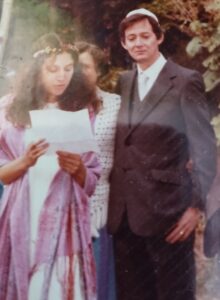
Dad and me at my wedding (Mom in background) October 1983. Photo by Brian Goldman.

So whether it’s genetic or not, thanks, Dad, for showing me the path forward to writing, playing, and dreaming.

Subscribe at https://ddinafriedman.substack.com


Walk-Ons

More than forty years ago, when my grandfather died, my father, who was sitting next to me at the funeral home, gestured to the person giving out the prayerbooks and said, “That man has a walk-on in my life.”

As usual, he was going for the one-liner, squeezing the humor out of a sad situation by taking a step back and focusing instead on a random absurdity.

Even now, at 93 and in the end stages of his life, as he drifts in and out of moments of confusion, he’ll claw his way to clarity by finding a joke. When my mom gave him back his wedding ring, which had to be removed when he was treated in the hospital for swelling due to congestive heart failure last weekend, he put it on, looked into her eyes, and said, “I do.”

It was another sweet moment in their 72-year marriage, a number my mother proudly managed to work into the conversation with all the “walk-ons” of the past week: the doctors, the nurses, the hospice intake workers… I think she would have even told the insurance people, if she hadn’t asked me to make the phone call for her.

I could write about more about my father and about my own struggles with sad moments, of which there have been far too many this week–in my own life, and in what’s happening to our country, and I’m sure I will in weeks to come. But what I really wanted to write about in this post was the idea of “walk-ons”  in writing: how to use what could be considered extraneous details and incidents to our advantage.

One big difference between real life and writing, whether it’s fiction, non-fiction, or even poetry, is that anything one chooses to include in a piece of work needs to matter. Real life is full of irrelevant happenings like the man giving out the prayer books at the funeral, but readers don’t want the minutia unless the minutia means something. The objects, metaphors, place descriptions, and incidents we choose to include in our work need to create an layer of meaning that resonates, adding an extra glow. So, it’s helpful to ask ourselves when writing (regardless of whether it’s fact or fiction) what a particular image or set of details adds to a piece. Is it worth including, or does it simply bog down the pace?

Take the case of the man handing out the prayerbooks at the funeral home. If I describe a heavy man lumbering down the aisle under more prayerbooks than he can comfortably carry, I’m setting a different tone than if I’m describing a man with a nervous tick who grins at everyone as he hands them a prayer book and tells them to have a nice day. Either of these could add to the weight of a story or essay. But if I simply say, “a man handed us a prayerbook,” I’m wasting words with a flat sentence we don’t really need to hear.

Or, as in the case of my father, the point of a “walk-on” might be how one of your “characters” reacts to it–especially if your character is relatively quiet, the way my father is. Sometimes you can do a better job bringing people to life by emphasizing the smaller moments in a scene, rather than the larger ones. And showing people in action, rather than simply writing about them, is nearly always more effective in showing who they really are.

It’s those smaller moments I’ll remember about my father. As well as what they convey about the essence of his character: how he used humor to sidestep difficult emotions, and yes, like all of us deep-secret attention-seekers, he thrived on our laughter and appreciation of his jokes.

So I’m glad to have the memories, and glad for the opportunity to make scenes out of them, as I’m sure I will as the weeks and years unfold, letting the stories tell themselves and hopefully, through those stories, enabling him to live far longer than the time he has left.


What’s In a Name

Juliet might have said, a rose by any other name would smell as sweet, but in the writing world titles matter.

Yet, up to now, I’ve been pretty blasé with my titles. Sometimes I can come up with a good title that adds some extra layers or a bit of wit, but when I can’t do that easily I often resort to something that’s succinct and just descriptive enough without giving away the store. And even then, I haven’t spent as much time as I might on a line of prose or poetry to make sure I’ve gotten exactly the words I want.

Maybe this is because I’m not that much of a title-reader. I often jump right to the first line to see if that draws me in.

But I’ve recently learned that if you send a poetry or short-story manuscript, editors will make snap judgments on the titles in your Table of Contents before they read a word of your prose. It’s a marketing world out there, and much as I might hate that, titles can be another form of clickbait. So, as I’m slogging through revisions for 30 Poems in November, I’m giving a bit more attention to titles and changing more of them than I usually do.

Poem #1: Becoming is now Evolution. Poem #5: The Answer is now Chasing Asclepias. Poem #13: Characteristics of Life is now Impossible Hope. Poem #27: In This Letter… is now In This Bottled Letter Bobbing in the Sea… And Poem #17: Family History is now Stick Figures on the Fascist Horizon.

I did have a few poems whose initial titles I liked as is: Van Gogh and Power Outages; Seeking the Moon; Fathers, Plants, Birds; I Am More than Seeds; and What Keeps Me Sane During Insane Times. As well as one I can’t take credit for because it was given in the prompt: Poem Set in the Present Moment Featuring My Mother’s Voice. 

Most of the rest of my 30 Poems in November titles are okay, but definitely on the mediocre side of okay. Hopefully I’ll be able to come up with a few more improvements–and I’ll make that a point for any I’m serious about and might want to put in a manuscript.

As for the rest, I hope there are other people like me out there who ignore the titles and jump right into the words.

Subscribe at https://ddinafriedman.substack.com