Soon after the presidential election in 2016, I told myself complacency was no longer an option. This “mantra” became my modus operandi as I struggled to figure out what I could do to stop the nightmare. I had taken a break from political activism in the proceeding years, prioritizing writing in the small spaces I had left after my demanding day job. But all of a sudden I was thrown into reading all the political pundits I could get my hands on, searching for some tidbit of info that would tell me what we needed to do to stop the MAGA agenda. There had to be some magic formula–and those folks who were smarter and more in the thick of things had to know what to do.
But, alas, no easy recipes. Everyone–activists, super-activists, previously dormant activists, and non-activists–much as we railed about the state of affairs, seemed clueless about how to put a stop to it.
Since complacency wasn’t an option, I tried to do what I could. I went to dozens of political meetings and started, with the help of my daughter and son-in-law, a weekly call-to-action blog called “3 NoTrump,” which highlighted three simple civic actions people could take in response to unfolding events. I called my MoCs almost daily; I went to countless demonstrations. And while I appreciated myself for not being complacent, none of it seemed very useful.
A year or two later, things fell more into place with my personal activism. While our 3NoTrump blog folded after we never got much traction and no longer had the energy to keep it going, I joined a larger team that wrote for Rogan’s List, another call-to-action site that has recently reached its 50,000th subscriber. And I was able to join with an affinity group of like-minded people who were devoted to immigration justice. Together we went to a children’s detention center in Homestead, Florida, and to the Brownsville/ Matamoros border, each time sharing stories about what we had witnessed in community presentations and written media. These two focuses became the foundation of my current activism. And while we still didn’t stop everything, I’d like to think we made at least a small difference in raising awareness and inspiring people to action.
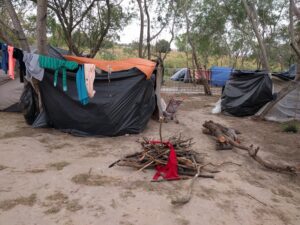
Refugee Camp: Matamoros, 2019. Photo by D. Dina Friedman
By the time of the 2024 election, I was still active in both these efforts, so I didn’t have to worry about complacency. But I had a new enemy: hopelessness.
In addition to many good reasons to feel hopeless (which I don’t have to depress people by outlining) I’ve figured out that my personal hopelessness is exacerbated by my general lack of patience. Heck, I get impatient if there’s someone ahead of me in line or if the computer takes more than five seconds to reload. My partner Shel always says he retains his optimism by seeing how much progress has been made over the years, despite backlash and pushback–MLK’s long arc bending toward justice. But patience is a mixed bag and it’s also good not to be too patient, IMHO. While many campaigns for progress (abolition and civil rights, for example) were eventually successful, they were also excruciatingly long and many people were hurt or killed before change happened.
I think that’s why it’s hard to conjure up patience. The stakes are too high, and, just like in 2016, what I really want is to find someone who can “fix it.”
But ultimately the only one who can “fix it” is me. You. All of us.
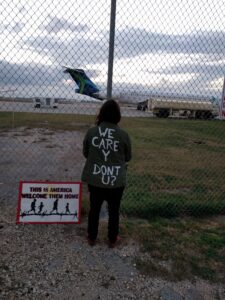
Deportation Plane, Brownsville, TX, 2019. Photo by D. Dina Friedman
And we can’t fix anything by being hopeless.
Thinking about hopelessness also brings me back to our trip to the border in 2019–how the people we talked with, thousands of them waiting months for an appointment at a tent court where only 1% would be granted asylum, didn’t lose hope. They stayed in the squalid and dangerous tent camp waiting and hoping, because to return, for many, would mean death–for themselves and their families.
Hopelessness wasn’t an option for them. It can’t be an option for me.

Refugee Camp, Matamoros, 2019. Photo by D. Dina Friedman

 I’m personally very mixed on the “awards/contest” game for books because it seems like mostly a way of collecting a lot of exorbitant entry fees just to say your book won an award, but my publisher and I did submit to a couple of the more known ones. I was pleased to get a finalist designation (first runner up short-story and all category short-list) for the Eric Hoffer Awards, and a finalist designation in the short story category for the Independent Authors Network.
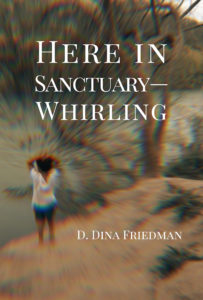 It was a thrill to have my poetry book, Here in Sanctuary–Whirling, which drew heavily on my witnessing trips to the border and the children’s detention center in Homestead, FL, come out in early 2024. With the upcoming administration’s about to take over and put their extreme deportation plans in gear, this book feels even more relevant right now, and I’m continuing to look for ways to publicize it.

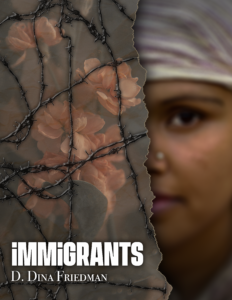 When I wrote my collection of short stories, I wanted to emphasize how immigrants are everywhere, just as they were everywhere in my childhood. Some of my stories are overtly political, drawing on my experiences as an activist, but most of them aren’t. They’re simply tapestries woven with real people–some of whom simply weren’t born in the U.S. I write about humans in situations with issues. That’s what’s always grabbed me in fiction–the ways we struggle to love the world, each other, and ourselves.
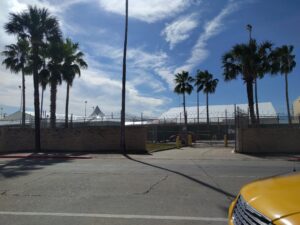 He was reportedly the only person in weeks that people had heard about who received a positive outcome form the infamous tent courts. And as witnesses gathered around to offer him a place to stay for the night and assistance to get to his brother in Florida, he told us the key to his “success.” I told them the gangs had killed my entire family. Other than my brother, I have no one.
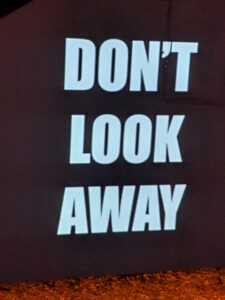 Don’t Look Away! the sign read on the American side of the border, where witnesses stood every day, reminding us of our responsibility not to tune out.