On January 6, 2021, as reports from the Capitol insurrection filtered through the news channels and my social media feeds, I sat at the piano and worked through Bach’s Italian Concerto, note by endless note. Playing enabled me to return to breath, lassoing my mind away from the pictures and videos that were plastering the news. And Bach had an order that could be anticipated, a calming hand on my shoulder saying things would be okay.

Image by Vectorportal.com, CC BY
As my social media feeds heat up again with the war in the Middle East and I find myself holding the pain, fear, and anger of people I love–whose perspectives range from strongly pro-Israel to strongly pro-Palestine–I find myself back at the piano with Bach. This time, I’m trying to learn a fugue. While I can take some pleasure in seeing how far I’ve progressed in my piano skills–especially when I take time off note-learning to play the Italian Concerto and see how smoothly it’s sailing through my fingers–the bigger issue that gnaws at me is how we as human beings can ever pursue paths of peace.
I have no answers to that (even though the ever self-chiding part of me thinks I should) but I keep coming back to Nigerian writer Chimamanda Ngozi Adichie’s TED talk, The Dangers of a Single Story. Someone with a pro-Israel perspective is going to tell a very different story of the situation from someone with a pro-Palestine perspective, and each will be influenced by their own experience and values. Since the situation is so complicated, there will be truth in both versions–as well as in the many versions and perspectives that lie somewhere in between.
In fiction writing, a common character development exercise is to switch the point of view. It’s amazing how much you can learn when you suddenly assign the narration to a different character in the action. In the process of deeply inhabiting someone else’s mind, you discover what previous experiences shaped them, and what’s at stake for them as a result. Taking the time to understand your story from another character’s point of view also helps to make sure you don’t develop flat one-sided characters, and that you understand and are able to project the humanity in your chosen “villains.”
My hope is that wherever we are, we can take a step back from ourselves and see the very real emotions this conflict has raised for everyone involved in it. And to also take a moment–or many moments–to mourn for everyone, especially the children, who have been hurt or killed, regardless of which side they come from. I’ve felt a glimmer of hope from learning about a group called Standing Together, an Israeli grassroots movement pursuing “peace and independence for Israelis and Palestinians, full equality for all citizens, and true social, economic, and environmental justice,” who warn of the dangers of choosing only “one side” of the story to cling to.
So, as I go back to the fugue, I’m going to try to amplify the different voices as best as I’m able to bring them out. And hope that maybe some time in the future, the voices in Israel/Palestine, while still contrapuntal, will resolve from dissonance into harmony. It’s a dream, I know, but as the people in Standing Together say, “where there is struggle, there is hope.”
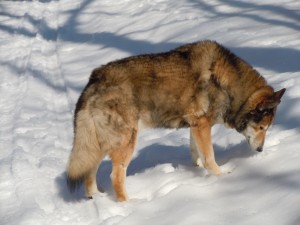 One of my favorite suggestions (and a practice I already regularly engage in) is walking in nature. I learned this from my husky-shepherd, Lefty, who quickly made it clear that the key to keeping him calm was a long off-leash walk in the woods every day. I found this break so nourishing, I’ve continued the practice. Even though he’s been gone for 12 years, I make a point of walking daily in all kinds of weather. And when I need an extra nudge to get my tired or tense torso out the door, I channel the ghost of my four-legged personal trainer, remembering that even at the very end of his life, he’d battle his own demons of arthritis, fatigue and lethargy for the joy of being in the woods.