Last night I finished Christian McEwen’s excellent book, World Enough and Time: On Creativity and Slowing Down. McEwen explores several ways to nurture creativity, a difficult task in a culture that revolves around overactivity and excessive screen-time. 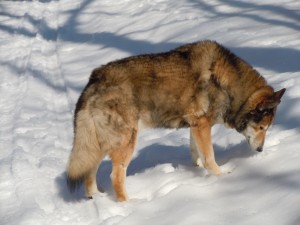 One of my favorite suggestions (and a practice I already regularly engage in) is walking in nature. I learned this from my husky-shepherd, Lefty, who quickly made it clear that the key to keeping him calm was a long off-leash walk in the woods every day. I found this break so nourishing, I’ve continued the practice. Even though he’s been gone for 12 years, I make a point of walking daily in all kinds of weather. And when I need an extra nudge to get my tired or tense torso out the door, I channel the ghost of my four-legged personal trainer, remembering that even at the very end of his life, he’d battle his own demons of arthritis, fatigue and lethargy for the joy of being in the woods.
Many cultures have recognized the benefits of nature walking. The Japanese even have a word for this: shinrin-yoku, which translates as forest-bathing. Devotees of shinrin-yoku recommend that you go into the forest without your phone or your camera, and with as little of an agenda as possible. It’s not even necessary to go anywhere. Simply follow your eyes, ears, nose, and feet, and immerse yourself in all the sensations the woods have to offer. This advice melds nicely with some of McEwen’s other suggestions around cultivating creativity: resisting “hurry sickness” (the idea that you have to complete a task to get to the next one), taking the time to observe your surroundings closely (with all your senses, not just your eyes), and paying more attention to the silence and the pauses between actions.
Having now read McEwen’s book, along with articles on shinrin-yoku, I can see that while I’m glad to have a nature-walking practice, I’m not yet skilled in engaging in it with this kind of quality. I’m often thinking about how long (or how little time) I can spend, and I’m often rushing up the trails I’ve chosen, setting an agenda that will give me good physical exercise, but not necessarily the best workout for my mental and creative health.
So again, I’m going to channel Lefty’s ghost, remembering that he had no agenda when he walked, and often wandered off on his own, following his nose for potentially tasty morsels, finding muddy puddles to roll in, and once making friends with a wandering coyote. I’m not about to squat at every tree or chase squirrels, but other than that, I’m wondering what it would it be like to walk in the woods with the mindset of a dog. To saunter along and sniff at whatever touches my fancy, and occasionally run my heart out for the thrill of the rush of the wind on my face?
How to truly take in the lesson that I don’t always have to have an agenda, a checklist, a time limit? Dogs don’t care about time. Why should I?
Time keeps on slipping… slipping… slipping… into the future. So says the well-known song by the Steve Miller Band. We can’t change that, but we can cultivate a sense of expanded time, by reining in our busy-ness and paying attention to what’s around us, especially the silence and pauses between actions, as McEwen says. Yes, I know that stopping to smell the flowers is a well-worn cliché, but when was the last time we actually did that?
To subscribe to this blog, sign up at ddinafriedman.substack.com

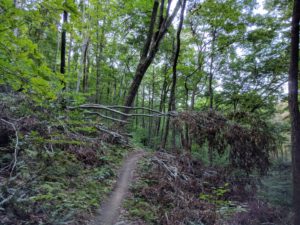 And when a new path opens up (i.e. in the middle of doing submissions, a poem begs for a rewrite or a few lines pop into my head, or I get a brilliant idea for a new story) I let myself wander off the path, the way my husband and I often follow unmarked trails in the woods, confident that we know the local forests (just as I know my own internal map) well enough to find our way back home.
 I highly recommend writing dates with friends (either in-person or on Zoom) as a way of getting going. In addition to enjoying a brief visit before writing, I couldn’t just tweak a poem or two and then get up to succumb to the call of the unpaid bills or the weedy garden, because at the end of the session I knew we’d be reporting to each other on what we’d done and possibly sharing some of our work. Even as I flitted from poem to poem and took several breaks for Wordle and its Dordle and Quordle variants, not to mention checking email and social media, I kept coming back–until I could look at a poem and remember why I wrote it and why it might still matter. And that helped me finally make the shift back to my creative center.
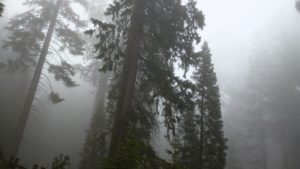 Taking any creative risk is like driving through fog. We may not see the entire landscape of where we’re going in front of us; perhaps we can only see the vaguest contours, or a few inches of the road’s white line and a pair of headlights coming at us from the opposite direction, but we plod on ahead, focused only on what we can see, with the faith that if we keep going, the tops of the trees will slowly come into view.