Into the Vortex

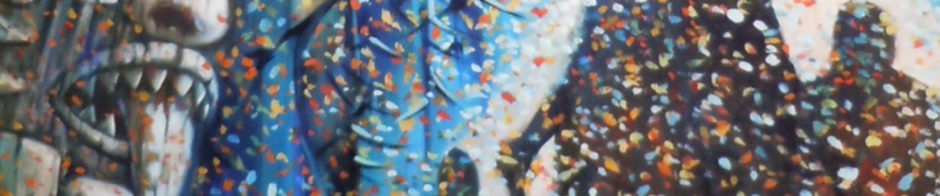
I changed some of the paintings in my bedroom a few weeks ago. Now, every morning when I open my eyes, this painting, by my late father-in-law Michihiro Yoshida, is the first thing to greet me.

I love the comfort of the deep blue, as well as the complementary blue/green, the side of the color palette that has always felt most soothing.  And while I’ve had this painting in the house for years, I’ve never looked at it so closely and consistently until I moved it into the bedroom. In addition to taking it in on first waking, I gaze across at it when I’m meditating, and sometimes, when I feel like I’m foaming at the mouth in frustration because whatever I’m trying to write feels like a stuck and hopeless endeavor.

I just gaze into that blue vortex and breathe. The writing may or may not come, but at least I start feeling a little bit calmer. And eventually, as if I’m standing with my toes curled on the cold mossy edge of a pond surrounded by deep green trees, I’m ready to dive in.

The act of writing, especially when we give ourselves permission to speak our truths–whether real or fictionally dressed– is like entering a vortex, a place where we might lose control of the carefully constructed selves we’ve fabricated to present to the unsafe world. Writing is like the cave journey I took a couple of summers ago in Oregon–how we walked down, down, down, the light evaporating into nothing until we were in a place that was so dark, all we could do was hold on to the rope and trust as we continued to take careful steps on the wet stones. And even when we flicked on the flashlight to get our bearings, all we could see were the dimmest of boundaries.

That’s what writing is about: dimming the boundaries; entering the vortex.

And when/if we can do this, or even take a few small steps closer to this state, we can be rewarded, as this painting reminds us, with the whoosh of our words rising out of us like the funnel cloud of eggs bursting forth from the center.

To subscribe sign up at ddinafriedman.substack.com


Writing Retreats: Enforced or Otherwise

Last Sunday, I had a stuffy nose, and since an out-of-town friend was coming to stay with me, I decided to test for COVID, even though I’d had it a month ago. And WTF, my test was positive! I couldn’t believe it, so I took a second test. Positive again!

So for the past few days (taking isolation seriously in order to try not to give it to my husband) I’ve had an adventure in my room–my own personalized writing retreat.

I love my room, which is where I both sleep and write, and has its own attached bathroom. I usually spend a lot of time here, but somehow it’s different when I know I have to be here, when the rest of the house is off limits except for a few brief masked forays into the kitchen, accompanied by hand-wipes to sanitize everything I might touch.

It’s kind of like facing the terror of the blank page.

After all, there’s nothing here but me, my books, and my computer. And I can only distract myself for so long with email, social media, and Wordle before the real work calls: poems to revise, poems to submit, a knotty novel that needs to be smoothed out, the last round of edits on my short-story collection, this blogging project, posts for Rogan’s list–the Call to Action site I write for (check it out on substack), articles and mailings related to my immigration justice work. In terms of COVID, I feel absolutely fine–healthy enough to write all day.

If only I could.

I’ve generally gotten a good jump start in the morning after a yoga or exercise tape and been able to write until my husband, the saint, brings lunch to the door. Then, a refreshing walk outside, a ritual I’m religious about that’s easy to do in a COVID compliant way in my unpopulated neighborhood. Hell, I even walked in yesterday’s Noreaster! It was, admittedly, unpleasant to forge through the wind with the soggy slush pouring down, but not as unpleasant as it would have been to stay inside all day. And I’m very much looking forward to going outside today when the sun is shining on the snow. The view from the window is already beckoning.

But after my walk, 9 times out of 10, the afternoon doldrums hit, and I don’t want to write a word.

Many people love writing retreats. They feel they get their best work with the quiet and peace of a new environment and uninterrupted time. But I’ve avoided them because to me a retreat means extra pressure on myself to produce. And when I’m in a new environment, I’m drawn to exploring it, rather than sitting somewhere and writing all day. If I’m going to go to Guatemala, I want to spend all my time seeing Guatemala, not a lined page in a notebook or a computer screen.


And, as I’m learning, I can’t even write all day in my very familiar bedroom.

But that’s just how I’m wired. If you’re one of those people who thrives from being creative in a place that’s free of daily household stress and chores, go for the retreat. I’d just advise being gentle with yourself on how much you get done.

And if you’re like me, or you can’t afford the luxury of a retreat right now, trust that there are other ways to get into your groove. We can delude ourselves by saying things like “I can’t write unless I have …. things you might not ever have like a cottage by the sea, a week in the woods with a bottle of whiskey, four straight hours of uninterrupted time, etc.

And then you might never write.

It might take a while to figure out how to create optimal writing space with what you do have. And this is going to be different for everyone. I’m looking forward to exploring some ideas in another post, but in the meantime, I’d love to hear your comments on what writing conditions work for you.

To subscribe sign up at ddinafriedman.substack.com


A Writer is Someone Who Writes

One of the most annoying questions people ask me when I say that I’m a writer is, What have you published? While I can counter that parry because I’ve published a lot (two novels from major houses, upcoming short story collection from a smaller press, poetry chapbook, and numerous poems, stories, articles and essays in newspapers and literary journals) I don’t consider myself any more or less of a writer than someone who hasn’t published.

As my writing mentor, the late Pat Schneider, founder of Amherst Writers & Artists put it: A writer is someone who writes. Period.

If you are driven to put words on paper to try to make sense of your inner and/or outer worlds, or because there’s something inside you that you are driving to express, you are a writer. And what you have to say matters.

This doesn’t mean you shouldn’t strive to make the pieces you write more vivid compelling, clear, unique, original, and powerful. When I play the piano, I have no need to be in a musical spotlight, I just want an outlet to express the deep feelings the music holds within. But it’s still important for me to drill and practice so I can do this more effectively. There are many craft elements from conceptualizing a book-length project to writing a perfect sentence that are absolutely essential to learn and practice, even if they take a lifetime to master, or even if we can never fully master them. This likely means that, like me, you may have days or weeks or months of metaphorically banging your head against the wall trying to wrestle your incoherent thoughts into a pattern of words that flows smoothly on the page. That’s what makes you a writer–not whether some public entity casts a yay or nay on whatever you ultimately offer them.

Being published is a choice. (At least, it’s a choice of whether or not you want to try to get your work published.) Some writers might prefer to write only for themselves, or to share with friends and loved ones. And some writers choose to publish themselves–which opens up a whole other set of issues I’ll write about in a future post.  But in the meantime, don’t downgrade yourself if your publishing credentials aren’t as good as you might want them to be. Keep going for that authentic nugget of your own truth and making it sing.

To subscribe to this blog, sign up at ddinafriedman.substack.com


The Quest for Perfect Words

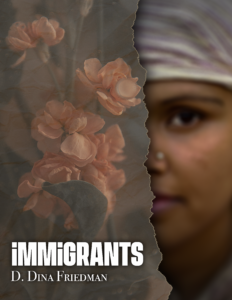
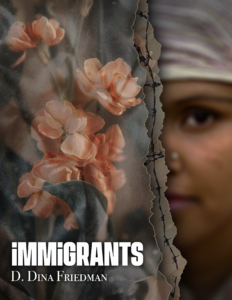
It’s amazing how many times I can edit the same piece of writing. For the last five days, I’ve hunkered over Ganesh Ascends to Heaven, about a woman who kills an Indian pedestrian in the U.S. and goes to India to try to make sense of the man’s paintings and her own life. It’s one of the stories in my forthcoming collection, Immigrants (Creators Press, Fall 2023).

So I’ve started every morning re-reading the same 14 pages, shifting pieces of paragraphs back and forth–up and down the page, deleting words and putting them back in; deleting commas and putting them back in; going back to a file of an earlier draft to splice in a sentence I’d eliminated, all in the quest of trying to make the story sail more smoothly.

And the dirty truth: I couldn’t tell you with certainty whether what I’ve come up with is better than what I had before. But I think it is! At least–today–I like it a whole lot better!

I will say this: it absolutely helps me to take breaks from my writing, long breaks, where I can return to what I’ve written with my mind in a totally different place and assess the story as if I’m reading it, rather than writing it. I just have to hope that I don’t have too many “What Was I Thinking” moments that Christine Lavin totally nails in her very funny song.

The important thing to remember is that everything is changeable, but also to take care not to throw the baby out with the bathwater.

What I noticed on the initial read this round, having not looked at the story for a couple of months was a clunkiness to the writing–details that didn’t need to be there that slowed the story down. So, I was able to chop out 300 words, shortening the story by an entire page, with no essence lost.

And I noticed more sloppiness–places where I used the same verb or a weak verb, or too many instances of words like “that” or “just.” (And this was after spending a month last year on micro-editing the entire collection, focusing entirely on sentence structure and word choices.)

And it’s also after two rounds of editing by my publisher, who has been great at flagging larger contextual/developmental questions as well as clunky and ungrammatical phrases.

So the underlying moral of this story–perfection is elusive, like the graph going toward infinity. Yet, I feel energized pursuing it, getting closer and closer to that unreachable axis.


To subscribe to this blog, sign up at ddinafriedman.substack.com
 

Valentine’s Day on the Border

Three years ago on Valentine’s Day I woke up before dawn to witness deportation flights at the airport in Brownsville, Texas. They always scheduled these flights for the wee hours of the night, because they didn’t want others to see what they were doing. It was a cold morning for Texas, and the thirty of us who were there that morning shivered in our inadequate fleeces as we watched a plane at the ready behind a fence. As the night broke into the beginnings of a cloud-covered day, we watched a bus pull up. A man held up his shackled wrists to the window. We stood in front of the bus, holding up hearts, and for a moment, we held up “business as usual” as the bus came to standstill. We surrounded the bus, shouting “I love you,” to the shadowy faces in the windows. And “No están solos. Estamos con ustedes.” (You are not alone. We are with you.) Then, the police came and since we had not planned for a civil disobedience action that would end in arrest, we let the bus pass through the gate to the plane. They parked a truck in front of the stairway, so we couldn’t see the people limping with their shackles up the stairs into the plane’s belly, but that image, along with other accounts of abuse, has been captured in this article in the Intercept.

Quietly, we stood until the plane took off. Needless to say, Valentine’s Day will never be the same again.

With all the problems in our broken world, I don’t know what has compelled me to focus my social action energy and a big chunk of my writing on immigrant justice (including two poems about this experience on the border, published in Wordpeace, and my forthcoming short-story collection, which focuses not only on detention and deportation, but also on the myriad of ways immigrants are woven into the fabric of our daily life.) I do know that when Trump was in power, I felt his rhetoric like a dagger piercing my heart–and not in a Cupid-like way. Though I’m a fourth generation American, and nearly all of my family was here in the U.S. during the Holocaust, I still feel a visceral connection between those who are currently fleeing for their lives and those Jews in Eastern Europe who were turned away for the same xenophobic reasons that people give now for limiting the number of people who can come to this country and denying them their due process rights to seek asylum. The stories we heard from people on the border about why they left still keep me up night. And while I’m not at the border, this Valentine’s Day, I’m grateful for groups like Team Brownsville and Solidarity Engineering and so many others who are working tirelessly to provide food, shelter, sanitation, and basic humanitarian relief to people as they wait for a new chance at life. No estan solos. 

Happy Valentine’s Day.


To subscribe to this blog, sign up at ddinafriedman.substack.com
COVID in Cape Town

Two days into my South Africa trip, I started getting cold symptoms. I tested for COVID and was relieved to be negative, so I went on a safari and for a walk with rifle-carrying naturalists in the wild bush, chalking up the fatigue I was feeling to two consecutive red eye flights followed by the eight hour bus ride to Kruger National Park. A few days later, when we arrived in Cape Town, my husband was also coughing and sneezing. Our symptoms felt like a typical cold, but just to make sure, we both tested again. BINGO! For both of us, a flaming red line.

All our plans for Cape Town were now upended. We had hoped to hike on Table Mountain, visit Robben Island–where Mandela spent 25 years in prison–see the penguin colony and the Cape of Good Hope. We also were very much looking forward to observing a rehearsal of a youth choir run by a friend of my younger child’s. And I’d been hoping to spend many evenings at venues that offered the lush South African a capella music I love so much.

But now, we had to totally shift gears. Even though there are no isolation protocols in South Africa, we were determined to keep others safe. While we were glad not to be quarantined to our hotel room, since other than mild congestion, both of us felt pretty well, we didn’t want to do anything that might inadvertently infect others. So, in the heat, we put on our masks and found places we could walk to from our hotel. We rented bikes and rode along the beach, and when we were done, we sanitized the handlebars with hand-wipes. It felt like 2020 all over again, except that we were the ones everyone was supposed to be afraid of.

Meanwhile, we’re hanging onto the fantasy that perhaps we’ll test negative before we have to leave and we can do some of the things we wanted to do. It’s kind of the way I feel sometimes when I let my hopes get the better of me when I’m starting a writing project. Perhaps this will be the breakthrough book–the one that will everyone will read and love, or the poem published in the hot-shot journal. But perhaps not. When I tested again yesterday, that extra line was still flaming positive. It’s fine to dream, but even more important is to deal with what life gives you and make it work. A writing project, like a vacation, will be what it will. Despite all my leanings toward perfectionism, I feel grateful for each snippet the muse throws my way, just as I feel grateful to the bi-valent vaccine, for making my experience of this illness that we’ve feared for so long feel like not a big deal.

So, probably no music for me, this trip–other than listening to Ladysmith Black Mambazo on YouTube. How long before that red line disappears? Who knows? I’ll just have to be patient, put on my mask and be happy enough to sit on an uncrowded beach and watch the sunset.


To subscribe to this blog, sign up at ddinafriedman.substack.com
Piano Patience

As promised in the last post, more about patience–this time, on the music front. When I first came back to piano two years ago, I would constantly beat myself up mentally for not being able to play a piece well after a couple of days of practicing. Some people can fake their way through and play pretty decently just by sight-reading, but I’ve never been one of those people. I have to practice the jumps on the keyboard incessantly before I can be sure that my fingers will land in the right places. And even then, it’s never a sure thing.

What changed for me was engaging in the same process I used in writing. I’d learn a piece to the best of my ability at the current moment, then put it aside for a few weeks or months. When I came back to it, there was often a day or two where I had to ease the notes back under my fingers, but suddenly it was there, and I wasn’t thinking about the notes anymore. Instead I was thinking about the important things that differentiate “cookbook playing” from a more authentic and personal musical expression–nuance, dynamics, shading. As my fingers were finally able to fall comfortably on the notes, I had more slack to consider different ways to express the rise and fall of each phrase. Sometimes, especially with some of the technically harder pieces I’m learning, I still came across passages I couldn’t play, but I’d try as best I could to shut off the negative voices and drill some more before putting the piece away again for more simmering.

One of the first pieces I visited on my journey back to piano was Mendelssohn’s Venetian Boat Song #2. This is a fairly easy piece that I first learned somewhere between fourth and sixth grade, but I still had to struggle with all the left hand jumps and the right hand trills. And even when I got the notes down again, I could never count on a foolproof, mistake-free rendition. But recently, especially as my post-collarbone fracture arm still can’t hack too much hard practicing,  I’ve pulled it out again after the third or fourth simmer, and voilà, my hands are sailing through and I can just lose myself in the bobbling waves of the canal.


My recovery from the collarbone injury has also taught me a lot about patience. I generally have about 15 good practice minutes under my belt before my arms start to ache, which has meant that learning Chopin’s Nocturne No. 19 in E Minor, a new piece I love and have never played before is taking forever. I can practice one or two phrases at a time, and then I’m tired. And the next day when I go back to the I phrases I thought I learned, I realize they’re still far from smooth. But slowly, this, too, will change. After all, a month ago, I couldn’t even raise my left arm to the height of the piano bench. I’m not one for aphorisms, but whoever said patience was a virtue knows something I’m still learning.


To subscribe to this blog, sign up at ddinafriedman.substack.com
Patience

All we need is just a little patience…”
Guns & Roses

One of my resolutions for 2023 is to cultivate more patience in my life. It’s the same resolution I had for 2022, and 2021, and 2020, and the number one thing on my self-improvement list that has come up during the Jewish holidays as well.

I’m not sure if my innate lean toward impatience is a part of my New York City upbringing, where any long line or red light is considered an insult to our existence; or if it’s something in my own psyche that ignites my anger spark when I don’t get what I’m seeking quickly enough.

Over the years, I’ve learned to be Zen about physical long lines, though I still feel my insides quickly reaching boil when I spend too much time on hold. Maybe it’s the tacky music or the endless repetition of the vapid robot voice telling me how sorry they are for making me wait. Let’s just say that by the time I get a live person on the phone, I’m not my best self. On bad days, I’m deliberately channeling my inner bitch.


But despite not yet being perfect on the patience scale, I’m extremely patient about the writing process. Yes, I admit to falling in love with a poem five minutes after I’ve drafted it and having to hold back my urge to immediately send it out everywhere, but for the most part, I enjoy the simmering process. For poetry, that means putting the poem away for a while so I can revise it with fresh eyes–over and over again.

And patience is even more important for the longer process of writing stories, essays, and full-length books. When I’m working on a longer prose project, I try not to think about when it will be done. Instead, I set a daily habit of diving in, writing for as long as I have the energy or the time, then putting the work away for tomorrow, where I often start by reviewing and revising whatever I’ve written the day before. Then when a draft is completed, I put that away for a weeks or months before starting the whole process over again. It can sometimes take years before I finally decide something is “finished,” or at least ready to send out to journals, or agents, or small presses.

And after I send things out, I wait again. Often for a VERY LONG TIME. Yes, it tries my patience, but I try to just get onto the next project, rather than thinking too much about what’s out to market.

I have a lot more to say about patience, but I’m determined to keep these posts short and sweet, so the rest will have to wait for another time. Meanwhile, I’ll try to be patient as I wait for thoughts and reactions. 🙂


To subscribe to this blog, sign up at ddinafriedman.substack.com