When in Doubt, Go Out

Back when my children were young, and my partner and I struggled to keep them entertained, our motto was always, When in Doubt, Go Out. Even when the weather was nippy, it was worth the struggle to get on the snowsuit and the boots for a change of scenery and an infusion of fresh air. I was glad they never minded taking a walk in the stroller, and I enjoyed watching them get up close and personal with grass, rocks, snow and mud.

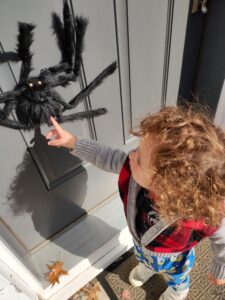
My 19-month old grandchild, Manu, doesn’t like the stroller. It can take half an hour to get him outside, but once he’s there, he does like walking around his neighborhood, exploring the lawns with the animal ornaments, looking out for cars and trucks passing by and planes flying overhead. Like my children, he loves substances and can happily entertain himself moving handfuls of grass clippings from one place to another, or splashing in a puddle, or sifting through piles of rocks. Really, it’s all about discovery.And discovery shouldn’t end when you’re 2, or 3, or 4. One of the best parts about playing with kids is that I can also enjoy the feel of clipped grass in my hand, or pay extra attention to the crescendo and decrescendo of a soaring plane as it enters and exits my orbit. There are many days sitting in the sun and having an hour-long rock exchange with Manu feels far more enticing than staring at the screen with its brain numbing cathode rays and all those murky words, even if I was the one who wrote them.

Especially if I was the one who wrote them.

Photo: D. Dina Friedman

So, whenever I get stuck in my writing, I go outside.

In the spring and summer, my go-to activity is gardening. I swear, I get my best ideas from pulling weeds.

Photo: D. Dina Friedman

Some people hate weeding, but to me getting rid of weeds feels like chaos I can control, as opposed to trying to get rid of the clutter in my house, which feels like chaos I can’t control. There’s nothing like the feel of dirt on my hands, and the satisfaction of digging up and tossing out clumps of stuff I know I don’t want. Way easier than chopping out paragraphs I struggled to perfect only to realize they just don’t serve the story.

Photo: D. Dina Friedman

In the winter, I walk in the woods and say “wow” every time I come to a landscape that delights me. I have a soft spot for the Hansel-and-Gretel look of a path through the snow-covered trees, especially when illuminated by the bright sun. But even when there’s no snow and the air is damp and raw, I try to find beauty in the gray light. This is also a good lesson for disentangling my writing messes. Somewhere in a draft that may seem hopeless, there’s often a spot worthy of a photo-op, a place to explore close-up, long view, and from different angles.

And this coming winter, I’m looking forward to exploring the tactile pleasures of the snow with a 2-year-old, feeling the joyful tingle of cold on my back as I wave my arms back and forth making angels.

Tuning In/Tuning Out

I have always claimed, only half in jest, that tuning out was my superpower.

Too much nagging or irrelevant banter by members of my family or in social situations. No problem. I nod my head and hopefully make the appropriate noises while the rest of my brain lounges in some woodsy retreat cabin of my imagination.

I’ve been thinking a lot about “tuning out” this week as I recover from a minor concussion.  For several days, my poor brain just refused to tune out anything, making it impossible to look out a bright window, or be in a space with too many clashing colors or in front of a screen with its array of flashing videos and words, words, words against the bright. blue light.

And whenever I tried to do too many of these things, my brain went haywire, and I had to spend the next hour in a dark room with the shades drawn. If only I could have had one of those float tanks!

But now that I’m–thankfully–about 80% recovered, and preparing for my book launch of Here in Sanctuary–Whirling this Sunday, I’m also thinking about tuning in.

When I went to the border in 2020 I was determined not to fall into the distant malaise I often feel when the news becomes too overwhelming. While I know that there’s just so much sorrow one can handle, I knew that my role was to tune in as much as possible–so I could feel the joy of the teenager bounding across the bridge waving his white paper. I made it! he exclaimed. I got asylum! 

He was reportedly the only person in weeks that people had heard about who  received a positive outcome form the infamous tent courts. And as witnesses gathered around to offer him a place to stay for the night and assistance to get to his brother in Florida, he told us the key to his “success.” I told them the gangs had killed my entire family. Other than my brother, I have no one.

How to fathom the depths of that?

How to comfort the woman in the writing workshop sobbing over the picture she drew of her missing child, or the beefy young father folding into his arms in tears as he recounted his kidnapping together with his seven-year-old daughter. She told me she was hungry, and I had no food to give her. I couldn’t take care of her.

Don’t Look Away! the sign read on the American side of the border, where witnesses stood every day, reminding us of our responsibility not to tune out.

As a writer, I’ve tried to take that responsibility seriously, attempting as best as I can to capture the joy, the sorrow, and the emotional complexity of salient moments, both in my work as an immigrant justice activist and every other aspect of my life. It’s a way of extending the witnessing work I did on the border, and letting others live that experience, or any other experience I feel compelled to share, with as close a lens as possible.

Yet at the same time, I recognize that to be effective in whatever we feel compelled to do, we need to take time to take care of ourselves, allowing our brains to rest in the dark room, or the land of the imagination, or whatever other equivalent a person might have in order to take a deep breath, regroup, and press on.

Hope to see some of you on Sunday! I’ll be reading poems that hold the joy as well as the sorrow.


Vulnerability

Last weekend I had the privilege of reading at the Northampton Center for the Arts with two awesome poets, Lindsay Rockwell and Mary Warren Foulk, as part of the Northampton Literary Walk. We were the intro act to a film by Chris Gentes entitled What is Poetry, where four other accomplished local poets–all worth checking out (Michael Favala Goldman, Howie Faerstein, Tommy Twilite, and L.D. Greene) discussed their work and their process.

Later, on a text thread, one poet remarked, I often feel so raw and exposed after a reading. Maybe that’s the nature of the beast.

Yes, vulnerability is the nature of the beast. Reading your work out loud is kind of like undressing, putting one’s heart and words on the dissection line, showing all the flaws in your imperfect body.

Because we go through life with a certain amout of polish–a veneer we lather on as  we learn to relate to each other, as impermeable as a long fuzzy sweater and a pair of jeans, we take care in how much we reveal to others. Even in our closer circles of friends and family, I, at least, take great pains to project an aura of strength and competence.

But when we share our work with others, especially in a public reading setting, where even the most compassionate audience cannot divorce themselves from their own need to discern what they’re hearing into what’s pleasing to them and what isn’t, it’s hard not to feel judged.

For me, this judgment has two components:

Is my writing good? Am I a real writer or an impostor? I especially worry about this with more academically oriented audiences whose banter about other writers often edges over into a line of snobbery. I also feel like an impostor when I’m among people who’ve had significantly more success than I have, often due to a far greater level of skill that I can only admire and covet.

The second question goes even deeper into the heart of vulnerability. In fact, it feels like one of those chasm-like questions whose words only graze the edges.

Do you feel me? 

We write, even when it’s flawed, from our deepest selves, that raw place inside that’s aching to be heard, validated, and understood.  Metaphorically undressing and exposing that spot, we often hide as we parade our polished selves through our daily lives, can be terrifying. Especially in a capitalistic society that values writing more as a commodity than an art–but that’s a topic for another post.

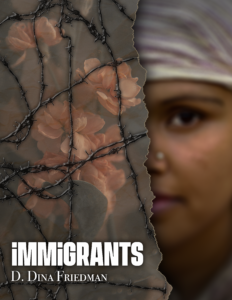
One of the most significant things I’ve done in the past few years is to share more of my writing with my parents who’ve always loved me, but really only know the polished self I choose to show them. Do they feel me? Not always, though I’ve appreciated that they’ve taken the time to try. When she read my short story collection Immigrants, my mother was pretty up front about saying she liked some stories better than others. But she took the time to read the book again, and said, I saw how well you put it together. And when she read my not-yet-published memoir, Imperfect Pitch, which was much harder for me to share because it was about our family and not always nice, she said, I think this book would be important for people in our family to read. It gave me more understanding.

These comments made all the vulnerability risk worth it. And while I’ll still parade my polished competent self in family and other settings, being felt and acknowledged, even when not as fully as I might like, has made me a little braver about reading, and  more amenable to finding moments to let the rawness shine through.

Moonstruck

Because I’ve been traveling so much and fighting off a benign but annoyingly persistent respiratory illness, I’ve been late to the table writing about the eclipse.

But I was one of many folks who drove several hours to the totality zone for a few minutes of day-time darkness and a gaze at the celestial wonder of the corona, which we shared with strangers in a community park in a small town in northern Vermont. Things seemed pleasantly normal in the hour before the big event. People donned eclipse glasses to sneak views of the disappearing sun, children ran through the grass playing, and adults waited in lines for free pizza cooked in the community stone oven or to silk-screen a t-shirt as an Eclipse Day souvenir. But when totality hit, something shifted in the energy. There was a hush among the crowd, a kind of collective “wow.” My eclipse glasses now dark, I was nervous about viewing the corona with unprotected eyes, but there it was, eerie and other-worldly, the tiny ring of light flaring in asymmetrical bursts before settling to a steady glow like a small spark of hope.

Jongsun Lee, CC BY 3.0 <https://creativecommons.org/licenses/by/3.0>, via Wikimedia Commons

Then the moon moved away and a crescent of sun reappeared. And again, I could feel the crowd’s energy shifting, a waft of ebullience, giddiness from having lived through a bewildering darkness and come out the other side.

What struck me then was not the moon, but the connectedness I felt to all these strangers. There are so many metaphors I could make out of this, it’s hard to know where to begin. But in these times of constant fractiousness, there was a poignancy in that moment that felt important, a sense of all of us humans as anthropological creatures who, deep in our DNA, know how to co-exist, especially under the awe of something so much greater than ourselves. And maybe I’ve been “moonstruck,” but I can’t stop hoping that there might be away out of a darkness that makes “othering” human beings and then harming those “others” acceptable.

So I’m offering this poem from Here in Sanctuary–Whirling as a starting point for contemplation. And I also invite all of us to take some time to close our eyes and envision the metaphor of the sun reappearing after totality. What can each of us do to bring back the ebullience and giddiness that comes with connection?


I DO NOT KNOW
                     –D. Dina Friedman

Why the wind is so fierce today. Why some people die
and others recover. Does a tornado choose its targets?
Is there a blueprint somewhere with the secret path
of my life mapped out? Will this trail I’m on
connect with the ridgeline, or will it keep crossing
the same stream? How do I get to the bunker,
and what’s hidden there now that the army no longer has it?
I do not know how dirt feels to a carrot root, or to my brother
six feet under. Is he able to read the prayer books
placed on his coffin through some double miracle
of semi-resurrection and dyslexia cured? What does it feel like
to a dyslexic when letters leave their prescribed places?
Why do bodies compartmentalize into people who love each other
hating the people across the river, who love each other
and hate the people across the river? Why do we have to teach toddlers
to share sand-buckets? Why don’t they do it naturally?
Why don’t we do it naturally?
Why don’t we do it?

In Here in Sanctuary–Whirling, Querencia Press, 2024.
Orginally published in Silkworm 15.


My Whirl Into Immigration Activism

In November 2016, waking up to the dystopian reality of Trump being elected, I told myself: complacency is no longer an option. I’ve been an activist all my life, though in the years leading up to 2016, I hadn’t done that much. But all of a sudden, everything took on a new frantic urgency.


Of all the horrible things Trump was doing, the issue that spoke to me most was immigration. While the babies in cages broke my heart, what scared me even more was the way Trump continues to talk about immigrants—as “invaders poisoning the blood of America,” language which edges far too close to my Jewish roots and the collective generational trauma we carry from the Holocaust.


So, when volunteers were needed to spend time at a local church that was harboring a man in sanctuary, I signed up. And this was where I saw the note seeking people interested in traveling to Florida to witness at the children’s detention center in Homestead, a horrid converted air force base, whose fenced boundaries were now lined with black paper to keep on-lookers from seeing what lay within.


For three days in June 2019, the eight of us who made the trip stood on ladders in the heat so we could look over the barrier at the children. We held up paper hearts and waved at them when they came out in their bright orange hats for 15-minute stints of exercise. Te amo (I love you) we shouted. Occasionally the children would take off their hats and wave them at us, though they were always reprimanded by the guards when they did.


When we came home, we spread the word about what we’d seen in speaking events with a variety of community groups. We also organized our own educational events and demonstrations, and started planning a trip to the border. This involved working in conjunction with a number of immigration support groups based in that region, including Witness at the Border, Team Brownsville, and the Resource Center of Matamoros. We prepared and served meals, observed the infamous tent courts, stood at the bridge with signs, and spoke to many of the people who were stuck in Mexico as they waited for their turn to apply for asylum, which they had an extremely low chance of getting. We also led a writing/drawing workshop for children to express their feelings about leaving home and a similar workshop for the women in the camp in a room filled with tears as each woman shared stories of loved ones killed by gangs or children left behind.


On the morning of Valentine’s Day, we woke before dawn to stand at the fence and stare at the wing of the deportation plane, (the only part not purposely blocked by a truck). Then we linked arms and headed for the parking lot, trying for a few moments to block the bus of deportees from arriving until we were warned by the cops to disperse or get arrested. Unfortunately, we were not in a position to engage in civil disobedience, so we had to settle for supporting the people on the bus with hearts and words of encouragement as they walked shackled into the plane’s belly and departed under the cover of the night.


The cover Here in Sanctuary—Whirling is from a photo taken at the refugee camp, where children followed us through the maze of crowded tents, as eager as their grown-up counterparts to talk to us.The poems in the book were born directly from our experiences. While I’ve written the occasional political poem over the years, this type of writing was a departure for me. For most of my life, my writing and my activism were separate. But my writing has always come from my heart, and my heart is now intrinsically linked with these people who are far braver than I am. While I recognize that their stories ultimately belong to them and not to me, I’m glad they gave me permission to share these hard truths about their lives, which counter the rhetoric of even the supposedly liberal people in our government, because these stories need to be heard, loudly, by as many people as possible.

(Originally posted on my publisher Querencia Press’s Blog: in response to why I wrote this book. )

Subscribe at ddinafriedman.substack.com 

The Great Firewall of China

When I was recently on vacation in China, all my regular Internet sites were blocked! I thought I could get around this by purchasing a VPN, but alas, I couldn’t even access the support page to troubleshoot the problems, nor could I contact my phone provider for more international data, which I didn’t think I would need until I discovered that my translation app wouldn’t work on the data speed I had.

So here we were, trying to talk to people when we didn’t understand a word of each other’s language, and trying to navigate without Google maps. It definitely helped to keep a sense of humor about all the getting lost and the miscommunication. One night, we were trying to explain (without the translator app–or a note in Chinese that we later got) to various restaurant people that we were vegetarian, only to get a lot of shaking heads and blank looks. Finally, we saw a place with an array of fresh vegetables displayed in a cooler behind the counter and thought we could explain ourselves with sign language. The server, who miraculously had her own translator app, told us to point to the vegetables we wanted and she would make them. We pointed to a lot of vegetables, because we thought she was going to throw them all in a stir fry, but we ended up with  separate dishes for each veggie, plus scallion broth, rice and tea. The delicious food just kept on coming!

Being blocked from the Internet also made me hyper aware of how much time I spend (waste) on Google, Facebook, Instagram, etc. It felt both odd and welcoming to be forced to go to my writing files whenever I felt the urge to use my laptop. Over the course of the trip, I spent several hours working on a spring clean-up I try to do at least every other year, where I go through all the unpublished poems in my “Active” folder and figure out which ones I want to keep sending out for another year, and which ones no longer hold interest and need to be moved to “Inactive” or “Meh.” This always leads to tons of revision as I look at old work with a fresh eye.

Though being forced to write was a good thing, I have to admit I regretted not getting the immediate gratification of people’s reactions to the cherry blossoms in Kunming, or my musings on Substack, which made me wonder–what is it about we humans in the social media age that makes us feel that everything we do needs to be immediately validated? True confessions, I am one of those people who obsessively looks for likes and feedback for anything I post on the big cyber cloud. Sometimes I worry that this has a negative impact on my writing–whether in sharing groups, I’m too quick to read something half-finished, simply for the joy of hearing people’s reactions to it. But I do like to think that reading things out loud, even  early drafts, sharpens my own ear for what’s working or not working in a piece. In fact, one of my favorite revision techniques is to read a piece out loud even if I’m the only person listening.

I didn’t write a lot in China; I rarely do on vacation. I mostly enjoyed the distraction of sightseeing, the feeling that I was amassing thoughts and experiences I could synthesize later. But when I did sit down with my writing–just me and the page, and the Great Firewall surrounding us, it felt like a lovely ink-brush wash of inner peace because I couldn’t quick-click to headlines blaring at me from news or email or social media sites. What a wonderful feeling of insouciance to have no idea what was going on in the news! T–mp could die, I remarked to my partner and I wouldn’t even know.

Now that I’ve been back home for a week, I hate to admit how enticing the old habits have become. I’m letting my distraction demons take hold more often than not, as if making up for lost time, partly because I worried that all the work I’d done to publicize my books by building up my writer presence on social media had dissipated with my two weeks of complete silence. But really, what people seem to want to see from me are not more book or writing-related posts; they want to see my pictures of China, which I’m putting out day by day on my Facebook page. I guess many of us respond to the urge to experience travel vicariously when we can’t do it directly. And perhaps, through looking at some of the astounding images, we can find our way behind the Great Firewall of China, capturing both some of the magic, as well as the shift to a more peaceful perspective that can come from letting the anxiety-producing headlines fade to a gentle blur.

Why I Travel

When a friend of mine asked me what I was looking forward to about my upcoming China trip, I found it hard to come up with an answer. While I had done a lot of research in choosing the string of destinations in this part of China less traveled by westerners, there was nothing in particular that I needed to see. I was simply attracted to the region because it was the home of many of China’s ethnic minorities, and the gorgeous pictures of places like Black Dragon Pool, Jade Snow Mountain, and Leaping Tiger Gorge were too enticing to pass up.

Now that I’m here, I’m not disappointed. Eye candy is abundant everywhere. Despite the general hassles of travel and the rather exhausting pace of very full days, I feel nurtured by the serenity as I slowly circumambulate the reflecting pool by the three pagodas temple, where the cherry blossoms–an added bonus–shine pink, in both the water and sky! I’m awed by the white-capped spiky peaks of Jade Snow Mountain looming in and out of the fog, reminding me of an ink brush painting. I’m buoyed by seeing people dancing in the streets in the ancient cities of Dali and Lijiang, some in their colorful traditional dress, and some in jeans and sweaters, and how so many people in the crowd from parents with toddlers to gray-haired elders, join in the flow. And these old towns are a tasting paradise. In any 2-3 block radius you can sample homegrown tea, coffee, fruit juices, fruit tea, homemade plum wine, milk powder candy, sesame candy, hot pepper relishes, dried fruits of all persuasions including persimmon, mango, hawthorne bark, and–if you want it–yak jerky.

But was my desire to travel here based on a need to see any of this? I could have stayed home and walked in my own comforting woods. Or traveled only as far as New York to see spontaneous exuberant dancing among strangers in public places. Or been content with past trips to Mount Ranier or the Alps if my penchant was to see snow-covered mountains. And I could likely find many of the street treats at one of my local Asian stores.

What would be missing, however, is the serendipity.

It has been consistently the unplanned, unanticipated moments that have engorged my inner travel bug. There’s an exhilarating feeling (at least, for me) that comes with being in a new place, an invigorating sense of wonder in rounding the next corner, whether the discovery will be an exquisitely ornate pagoda roof, a man carving marble, or a store selling tacky toys and souvenirs that still look totally different from American tacky toys and souvenirs.

Keying into serendipity keeps my writing brain fresh. It reminds me when I’m frowning at the blank page or the blank screen, to lean into that wonder of discovery. The experiences I’ve had here are now part of my brain’s bank of images and memories, ready to be resurrected at just the right moment as fodder for an poetic image, a metaphor, or scene in some future work of fiction or non-fiction.

This doesn’t mean that I’m taking home an assignment to write a poem or story about China. In fact, these blog posts–along with occasional emails and texts to family and friends–will likely be the only types of “straight writing about China” I’ll do. In my own writing process nothing is more of a creativity killer than to intentionally sit down with the purpose of writing about something I’ve recently done. Instead, I’ll try to integrate these experiences into other issues that suddenly call to me, as I did in Ganesh Ascends to Heaven–a story in Immigrants about someone trying to put their life back together by traveling to India after unintentionally killing someone.

And even if I don’t remember everything I’ve seen and done, because I haven’t bothered to take a lot of notes or write much down, I’ll have to trust that when I need it, the muse (like the Black Dragon god of the Naxi people, who lives under the water here and wakes up in spring to give the people luck and prosperity) will dive down into the muck of all my travel images and resurrect just the right one.


Truth, Dare or Balderdash

I got my first Amazon review of my new poetry book, Here in Sanctuary–Whirling, a few days ago. It was a 5-star rating, filled with wonderful phrases like “lyrical and evocative,” “alive and immersive,” “a sensory experience that is both enchanting and exhilarating.”

Only one problem: the reviewer depicted the book as “a mesmerizing fantasy novel …set against the backdrop of the mystical land of Sanctuary… At the heart of the novel is Whirling, a young girl with a deep connection to the elemental forces of wind and air.”

Ahem! This is a book of poems centered on my work in immigration justice and my witnessing trip to the border.

LOL!

Apparently, fake reviews–usually written by AI-bots–are a thing. Despite the many times I’ve had to go through hoops to post an Amazon review (I’m often told I hadn’t bought enough on Amazon recently to attain the privilege of posting on their site, or told to wait a few days while they verify my identity and authenticity) several writers in my network recounted similar experiences. “My poetry collection was called More Money Than God,” said Rich Michelson. “And one person gave me a one-star review, claiming I didn’t write enough about hedge funds.”

Still, I can’t help wondering–why are people doing this? Is this the new middle-school equivalent of making prank phone calls? At least then you had the pleasure of listening to someone’s reaction when you asked if their refrigerator was running and told them to catch it. I doubt whoever put up this review is hanging out in Cyberspace waiting for my reaction. (And there’s nowhere to put reactions or comments in Amazon reviews, anyway.)

And, if you’re going to write a fake review, why give a Bot the job? It’s much more fun to write these yourself. My family has spent many laugh-filled hours playing a game called Balderdash where you make up definitions to unusual words, write biographies for people you’ve never heard of, explain what various acronyms stand for, and write brief plot summaries for titles of obscure movies.

So, whoever you are, dear reviewer who goes by the name of Piper N., I dare you: next time, get together with a group of friends and write your own Balderdash. It’ll be a lot more fun–and even if you don’t sound as smooth as the AI-bot, you’ll get to stretch your creative muscles. But thanks for the five stars. And if I ever attempt a fantasy novel, I hope my main character, like “Whirling” will emerge “as a fierce and courageous protagonist who defies expectations and challenges the status quo.”–I’m all for that.

And perhaps, reviewers to come might call my poetry book, just as you called “Whirling’s” journey, “a testament to the power of resilience and determination in the face of adversity.” That would certainly make me feel like the poems in the book had been truly heard.

Any artists out there—I’d love to see what “Whirling” looks like.