It seems fitting to start the new year with a post on gratitude.
Even if it at times it might feel like too much of a cliché to switch up the angst of the day with thoughts about what we’re grateful for, I do believe the recipe works. Expressing gratitude may not always result in the gourmet meal of your life, but it can be like a sauce you pour over your food to make it taste better. Or what was that line from Mary Poppins, Just a spoonful of sugar helps the medicine go down. In the most delightful way. Emphasis on delightful.
And for the new year, I’m trying a new way of thinking about gratitude. Instead of generically thinking about what I’m grateful for, which often brings up variations on the same list: my partner, my children and grandchildren, my close friends, the beautiful area in which I’m lucky to live, having good health and privilege, yada, yada, I’m mentally cataloging my day with discrete moments that brought me gratitude. I got this idea from my friend and colleague Tzivia Gover’s book, Dreaming on the Page. 
Tzivia suggests the prompt, If I could preserve just one thing from this day it would be….
On Monday, January 1, what sprung to the top of the list was the long, leisurely brunch conversation over homemade crepes in our dining room with my partner, Shel, my younger child, Raf, and their partner, Nick. It wasn’t so much that any topic stood out as much as an ease of being and connection that felt precious. And even sweeter: gone was the usual nagging voice reminding me of all the tasks I had yet to complete and should be doing instead.
Yesterday (Tuesday January 2), the moment that edged its way to the top was visiting the tree I call my friend–a stout and stately presence on the Bachelor Brook Trail. I always stop to say hello, and this time, I took a picture of the view upward, made even more special in the bright blue sky on the first sunny day we’ve had in over a week.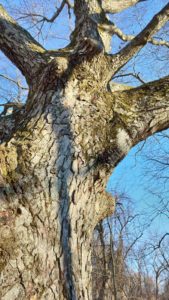
Today (Wednesday January 3) is young yet, but in the running at this moment is that feeling of my chest expanding and energy releasing from my body when doing a cardio-work out earlier this morning. It’s not uncommon for me to experience those endorphin rushes, but it was still different to stop and appreciate the feeling as a discrete and special moment.
I often feel flummoxed and shut down when I think about what I can do to prepare for aging, because ultimately, none of us know what challenges might lie on the horizon. But I do think gratitude can be an important foundational practice, and better to institute now when I’m healthy and strong, rather than waiting to find silvers of good in the midst of more challenging times.
So I’m looking forward to continuing this practice for a while, and perhaps, mining these moments that give me joy and finding homes for some of them in poems and stories.