Thousands of people filled Peace Memorial Park on August 6. It felt, in some ways, like many of the large demonstrations I’ve attended over the years, with people displaying colorful posters and handing out flyers. A small group of girl scouts looked quite serious as they handed out programs, but also proud that they were doing such an important job.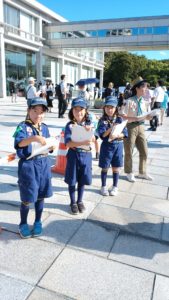 And the security people who searched bags in the extremely orderly array of lines were efficient and respectful as they handed people shrink-wrapped cooling towels, which seem to be a staple in the “wicked hot” Japanese summer–consistent temperatures in the 90s that feel even hotter due to the high humidity.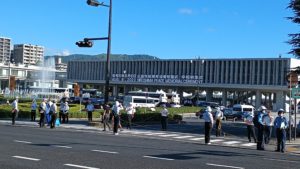
My husband and I got there too late to get seats under the tent, but with our NYC superpowers of threading our way through crowds, we found a small shaded spot on the ground at the tent’s periphery where we could hear well and see the speakers on the Jumbotron if we stood up. The ceremony was short, centering on the ringing of a bell at exactly 8:15 AM, followed by a moment of silence. Then, a whoosh of doves made spectacular shadows against the white tent canopy before they soared off, staying in our view-scape for barely a moment.
And yet, a moment was all it took for the bomb to drop and change everything.

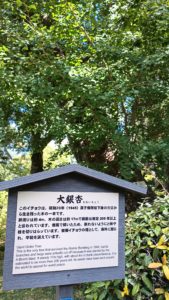 The day before, we had gone to the city gardens and seen a large ginkgo, one of only three trees that survived the bombing. We also went to the Peace Museum and barely made it through picture after picture of burnt bodies, story after story of people wracked with despair as they stumbled through rubbled streets, trying to find their loved ones. This was made even worse by the short political exhibit that followed, which emphasized how the U.S. felt it was “worth it” to drop this new weapon on already nearly defeated Japan if it would keep the Soviet Union from entering the war and sharing the spoils.
How could anyone do this? The question, like a heavy bell clapper, pounded against my head. And especially, after learning about the unspeakable devastation and suffering in Hiroshima, how could they drop another bomb three days later in Nagasaki?
And what is it in humans that give us the capacity to torture and kill others when ordered, from instances of all-out-war, to the countless genocides of one group against another, to the shocking Milgram experiments?
But on the flip-side of such evil, one story that emerged was a story of goodness and hope. In 1945, medical people came from all over, risking their own health to help the victims. In each continuing generation since then, the city has continued to take it upon itself to educate people about the bombing, not in order to sink into the horror, but to come through it to a better place. As the mayor declared at this year’s ceremony, (referring to the city’s recent hosting of G-7 leaders this past spring) “Enduring past grief, overcoming hatred, we yearn for genuine world peace with all humanity living in harmony and prosperity. I believe our spirit is now engaged in their hearts.”
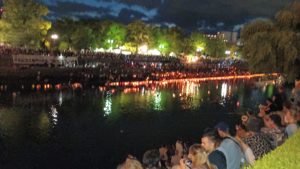
Later that night we went to see the lanterns in the river: hundreds upon hundreds of lights along the blank, each light symbolizing a dead body that was found in the river after the bomb exploded. While the mood was mixed, the thousands on the river’s banks were more hopeful than sunk. And, I too, was struck more by the beauty of the image than by its symbolism, a sentiment echoed by the two children who read a poem in the morning ceremony that gives hope for the future. I’m grateful for these children and their authentic, hopeful words. Here’s a piece of the poem:
Today Hiroshima is a city full of greenery and smiling faces.
Thank you for surviving
It’s because you survived that we were given our lives.
And there is something that we can do for others, too.
Thinking about how others feel before saying how we feel.
Finding the good in our friends.
Doing what we can to make others smile.
To subscribe to this blog, sign up at ddinafriedman.substack.com
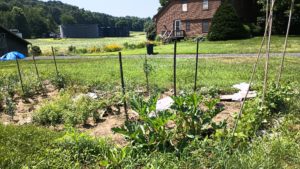
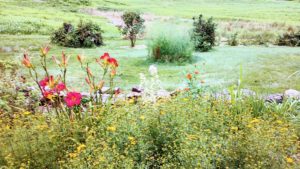 Of course, I’m not a bad person, even if I return to find my walkway a snarling mess. Nevertheless, I felt deluged with shame last year when I had to admit defeat with the driveway and call for professional help–the same kind of shame I felt when I first returned to playing the piano and couldn’t get through any of the pieces I wanted to play without a million mistakes. But somewhere in the past three years with piano, in addition to acquiring more dexterity through frequent practicing, I’ve learned to laugh when I mess up, then patiently go over the tricky passages. And then, even if I still can’t play the hard parts perfectly, I tell myself I’ve done well enough for today. And that playing the piece still brought me joy. Like my flower garden, which is NEVER weed-free, but still a pleasing, cultivated chaos.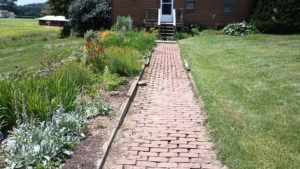
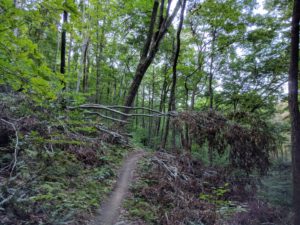
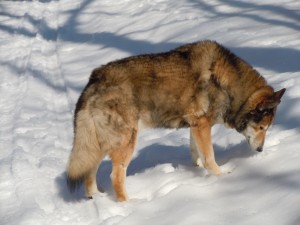 One of my favorite suggestions (and a practice I already regularly engage in) is walking in nature. I learned this from my husky-shepherd, Lefty, who quickly made it clear that the key to keeping him calm was a long off-leash walk in the woods every day. I found this break so nourishing, I’ve continued the practice. Even though he’s been gone for 12 years, I make a point of walking daily in all kinds of weather. And when I need an extra nudge to get my tired or tense torso out the door, I channel the ghost of my four-legged personal trainer, remembering that even at the very end of his life, he’d battle his own demons of arthritis, fatigue and lethargy for the joy of being in the woods.
 And when a new path opens up (i.e. in the middle of doing submissions, a poem begs for a rewrite or a few lines pop into my head, or I get a brilliant idea for a new story) I let myself wander off the path, the way my husband and I often follow unmarked trails in the woods, confident that we know the local forests (just as I know my own internal map) well enough to find our way back home.
 I highly recommend writing dates with friends (either in-person or on Zoom) as a way of getting going. In addition to enjoying a brief visit before writing, I couldn’t just tweak a poem or two and then get up to succumb to the call of the unpaid bills or the weedy garden, because at the end of the session I knew we’d be reporting to each other on what we’d done and possibly sharing some of our work. Even as I flitted from poem to poem and took several breaks for Wordle and its Dordle and Quordle variants, not to mention checking email and social media, I kept coming back–until I could look at a poem and remember why I wrote it and why it might still matter. And that helped me finally make the shift back to my creative center.