Marie Kondo-izing My Poems

Every two years in late February/early March I go through a process of reviewing my file of “active poems:” and revise my send-out A and B lists by consigning the poems that are no longer speaking to me as well as I want them to, to one of three places: “Poems to Work On,” “Meh,” or “Inactive.”

Anyone who has seen my house will know immediately that while I might admire Marie Kondo in theory, I don’t put any of her principles into practice. But for some reason, I find revisiting and re-categorizing my poems highly soothing. And I like her simple criteria for deciding on whether or not to “keep” a poem: Does it spark joy?

Diarmuid Greene / SPORTSFILE / Web Summit, CC BY 2.0 <https://creativecommons.org/licenses/by/2.0>, via Wikimedia Commons

So far, I’ve gone through all the poems in my send-out list re-evaluating them according to the following criteria:

  • If it still packed a meaningful punch (at least in my own mind) when I read each of my A-list poems over, the poem stayed where it was.
  • If I wavered, or if the poem felt still good, but just not as crucial to what I wanted to say to the world right now, it went to the B-list.
  • If there seemed to be something missing or unfinished, I stuck it into my folder of “poems to work on”
  • If the poem felt as finished as it was going to be, but held no energy for me, it went to the “Meh,” folder
  • And for the poems that no longer sparked any joy, either because they lacked craft, clarity, or relevant meaning for me. Or, if they felt dated in some way (too connected to a past event) off they went into the Inactive folder

Like Kondo, I tried not to overthink my choices. I simply read each poem and thought, Does it spark joy? 

After I went through the A-list poems, I went through the same process for the B-list poems, leaving some where they were and moving the rest to one of the folders. The best moments were finding a few B-list poems that sparked a lot of joy for me, which I moved to the A-list, either before or after some minor tweaking.

Part of my B-list consists of the poems that have “been around…” i.e. rejected more than 20 times. If I like these poems, I still send them out, just not as often. And while I didn’t move any of these back to the A-list, I found a few that I thought could be improved with some work and others that no longer held interest for me, whittling down my list a little further.

Then I read through the poems in the “Meh” folder, many of which I demoted to “Inactive.” But there were a couple of surprises that found themselves on the A or B lists, and a few others I put into “poems to work on.” And, of course, several stayed where they were.

Next up will be the poems in my Inactive folder. There’s nowhere lower on my classification that these poems can go–I don’t throw anything in the digital trash unless it’s so embarrassing or so personal I wouldn’t want anyone to find it after I’m dead. But I do try to sift through this pile every couple of years to find a few sparkles of joy in the dust. Unlikely any of these will go straight to the A-list, but I’m hoping a few will find their way into poems to work on.

And finally–where the real work will begin–the now swollen folder of poems to work on promises to keep me busy for several weeks, if not months. I won’t necessarily “finish” all the poems here to any level of satisfaction. In fact, some I’ll grow frustrated with and put back in the “Meh” or “Inactive” folders. And some poems have already been sitting in this folder for months or years. They will also need a Kondo assessment as to whether they still spark joy. But I am hoping that with some intensive revision, some of these poems will make it into either the A or B lists.

Of course, my favorite folder is the one marked “Published.” I don’t Kondo-ize this folder because once someone else has “claimed” the poem for their little corner of the universe, the best thing is to let it go–even if I can still find its imperfections. Yet, I do enjoy looking through this folder when I’m searching for poems to read at readings, or come across journals willing to accept reprints, or when I simply want to read some poems that spark joy for me.

But the big question remains: even though I do find “Kondo-izing” my poems so satisfying, will I ever get up the nerve to tackle my closet?

Subscribe at https://ddinafriedman.substack.com



Calm, balanced, and focused

Daily intention-setting has become a regular practice for me. And I’ve finally managed to veer away from the laundry list of all I’d might like to get done to more helpful guiding questions like: How would I like to feel today? Or, With what qualities will I approach my day? Sometimes I lean into joy, or appreciation, or kindness. But what comes up more than anything else are three words: calm, balanced, and focused.

Calm has never been my modus operandi. And I may have even convinced myself at various points in my life that it was fine not to be calm, because too much calmness would flatten the angsty juice that drives my writing and other modes of creative expression. But especially in the last ten years, as my anxiety and blood pressure increased and I began to feel world issues on a more visceral level, the absence of calm began to feel like a tunnel in the shelter I built around myself that kept widening, leaving a clear path for termites.

Calm by Nick Youngson CC BY-SA 3.0 Alpha Stock Images

Still, it’s hard to both lean into calm and also to feel the pain of all that’s askew in the universe. How many violent videos and horrible news stories can we take in before feeling flat and numb? It took me a while to realize that calm is not the same as numb, and that I could let myself feel and acknowledge painful realities without having to feel subsumed by them. In fact, being calm has made me a better activist, and I no longer fault myself for putting down the phone, and choosing not to read a particular post or article because I’ve had enough.

What this is about is being balanced. While I certainly take in my share of bad news and many times find myself ensconced in the sadness of either a personal or worldly situation, I’m at my best when I can stay out of overwhelm and balance my emotional responses with steady and thoughtful action. Balance also means tempering my day by adding nurturing and self-care to the things I put on my task list. And it also means balancing my expectations because I never get everything done on my task list!

And being balanced also means applying a steady focus on whatever I’m doing, rather than being distracted and trying to too many things at once–which, of course affects my ability to stay calm. And I’ll admit, right now, I’m feeling a bit frenetic because I only have 45 minutes to revise and post this blog before I’m called to other tasks that have times assigned to them for the rest of the evening. And I’ll also admit that I haven’t been very focused while writing this, as I keep veering off to answer emails or texts, or check social media. Intentions, at best, are aspirations that aren’t always met. So in addition to addressing my tendency to distract myself instead of focusing, I also need to be gentle–if firm–when corralling myself back to the task at hand, without beating myself up with a barrage of self-criticism.

Despite not always fulfilling my intentions, I find setting them useful. Because the ratio of calm/focus/balance to frenetic/distracted/overwhelmed has definitely increased–significantly–just by putting forth the desire. And the best is when I notice times that I’m deliberately cultivating calm and focus and choosing to ignore the urges toward reactiveness and self-distraction bubbling up inside me.

Subscribe at https://ddinafriedman.substack.com
Detaching Ourselves from Our Stories

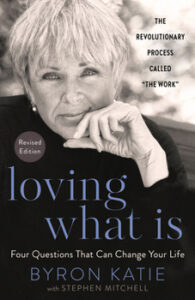
One of my favorite self-help books is Byron Katie’s Loving What Is. Katie’s method for getting to self-acceptance is quite simple on the surface; yet, delving into it can reveal all the complicated knots we tie around ourselves to make our lives sadder and more stressful than they need to be.

The process works like this: First, write about the situation that’s affecting your ability to be joyful in as much detail as you can muster, focusing on what angers, upsets or disappoints you. Likely, a “story” will emerge from your writing. This may be a familiar story you tell yourself, emphasizing common themes of self-judgment. (i.e. I’m always so disorganized, I never get things done on time…)


Then, Katie advises, ask yourself the following four questions:


  • Is it true?
  • Can you absolutely know that it’s true?
  • How do you react? What happens when you believe that thought?
  • Who would you be without that thought? Turn it around: Find three specific examples of how the turnaround is true in your life.

For years, the story I told about my piano playing was that I had huge family expectations placed on me because I had perfect pitch and also came from a family with many professional-level musicians. But I realized when I was 14 that I couldn’t play as well as I wanted to, so I quit piano. And that was the worst decision I made in my life, because if I hadn’t quit, somehow, I could have pushed through the technical obstacles and played at a higher level. So, to compensate for my failure, I pushed my children into music and piled all the leftover family expectations on them, which made me a terrible parent.

Is it true? Not really. But I had to wait 50 years, return very cautiously to piano, and write a memoir to figure that out.

Can you absolutely know that it’s true? Apparently not. My children said there was no need for me to ask their forgiveness. And neither they, nor anyone else in my immediate or extended family, experienced the generations of family pressure that I felt.

How do you react, what happens when you believe that thought? Even now, when I replay that familiar story in my mind, tears come to my eyes. I feel sad, angry, and like a complete and utter failure.

Who would you be without that thought? I would be free—able to make music on my own terms without self-judgment or generational baggage.

My Turnaround: I was a musical child with challenged fingers. This prevented me from going on a serious track with piano, but I had an inner understanding of music that shone through my expression. After quitting lessons, I never really gave up playing the piano because I loved it so much. And later, I explored other modes of music—guitar, chimes, klezmer music, singing in choruses. My brain, heart, and soul thrive on music as a staple in my life. Now, I’ve gone back to practicing piano more diligently and I’m amazed at how much progress I’ve made. What’s most gratifying is that I’ve stopped putting myself down for mistakes. Instead, I’m focusing on transmitting mood, color, and the ebullience I’m feeling as I vary tempos and dynamics. I’ve gotten to a place where I’m owning the piano again.

What stories do you tell yourself? How can you turn them around?

Subscribe at https://ddinafriedman.substack.com
When Do Stories End

Every time I ask my 3-year old grandson, Manu, “Do you want to hear a story?” he stops what he’s doing and fixes his gaze on me, his eyes wide in anticipation, shooting me a little dose of performance pressure. But I don’t have to worry because if he doesn’t like the story, he intervenes to change it. He has a strong preference for the characters to be people he knows, so I can’t resort to folk or fairy tales unless he, or my cat, or the members of the Tokyo Paradise City Ska Band make an appearance and take over the action. Even then, he likes to interrupt and add salient or deliberately funny details on his own, so that the story quickly becomes a joint effort.

But sooner or later, we both run out of gas, as we did about a week ago, when I said, “That’s the end of the story.”

“Why?” I could tell from his tone that he was clearly upset.

“Because I don’t know what comes next. Do you?”

Manu followed up with a sentence or two, and then looked at me to continue. I added what I hoped was a closing sentence, and then asked him if he knew what happened next, He said he didn’t.

“Neither do I,” I told him. “So that’s the end.”

A couple of days later in one of my writing groups, a fellow writer lamented the elusiveness of plot. “I have so many words, but not plot” she said. And without a plot, how do we manage our words? How do we translate that hidden precious bud of whatever we’re trying to express while still making it conform to the parameters of fiction that people expect: plot, being an essential element.

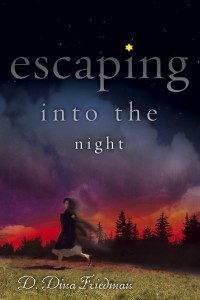
Even though I’ve been told by many teachers that my first published book–a YA Holocaust novel, Escaping Into the Night–was so well-plotted that “even the boys who preferred more action-oriented books liked it,” I’ve never considered myself a master at plot. There are many fiction-writing books that can teach you how to map out your plot in advance, designating turning points one-third, two-thirds, and just before the end that raise the stakes–a common outline for Hollywood movies. This is probably a good exercise to do, though I’ve never done it. Whatever plots I’ve managed to nudge out of my writing have emerged out of deep attention to character and setting, and intensive pondering of what could possibly happen next.

Often I go through several periods of trial and error before settling on what feels both realistic and meaningful in terms of getting across whatever underlying theme I’m struggling with. It’s not that different from riffing with Manu on my cat’s adventures in the backyard, except that instead of abandoning plot points that don’t work, we just keep going on one wacky tangent after another.

Lately in my own writing, I’m coming across another issue in plotting and determining where stories end. Even though I’ve already written and published a book of short stories on immigrants, the issue keeps tugging at both my activist and creative heart. But in the new fiction projects I’ve started on the topic (a couple of short stories and a YA novel) I keep getting to the point where every answer I can imagine to “what happens next” is so horrible, I can’t even write it down.

Maybe, I just need to follow Manu’s example when it comes to the issue of ending stories, and just refuse to say, that’s the end. At least, not until I can see past these awful moments into a brighter and more hopeful future.

Subscribe at https://ddinafriedman.substack.com


Washing Away the Numbness

Like most writers, I’m constantly trying to strike the perfect balance between time for my writing and time for the rest of my life. And, like many activists, I struggle to balance responding to the demands of a situation, while setting boundaries so I can stay focused and not burn out too quickly. This past week has certainly been a test in maintaining all these balances. Nearly every day I’ve had 2 or 3 long meetings, some of them highly frustrating in the amount of disappointing new information revealed, or in their lack of productive outcomes.

This doesn’t even include time dealing with the text threads and email chains to plan and debrief these meetings, and sorting through the hundreds of issue-related texts and emails that have come into my inbox–many of which need to be responded to or forwarded to the right people.

Nor does it include the demonstration a few of us planned last Saturday as part of a regional day of action to boycott Citizens Bank, one of the few banks that still provides loans to CoreCivic and GeoGroup, two major players that run most of the ICE detention centers. And it doesn’t include the insomniac hours I spent worrying about the zero-degree wind chill forecast for that day and pondering whether or not we should postpone. (We decided to go for it, but set a shorter time frame. Happy that we got a good turnout and the sun kept the cold tolerable.)

It also doesn’t include dealing with the numbing grief as one shocking news story after another unfolds in Minneapolis and elsewhere. A second murder of a protester, the abduction of a preschooler used as bait to detain his parents (my grandson has the same bunny hat), a gunpoint wrongful arrest of a US citizen who was taken in his underwear in the frigid cold, and 5-year old twins being denied release after 8 months in detention in Texas because the judge said they have no access to collateral.

These are just a few of the horrific stories that can easily send me reeling into a state of numbness.

While people now seem to be galvanized by DHS’s murders of Tim Pretti and Renee Nicole Good, it’s important to know that they are only 2 of the 8 people who died in dealings with ICE just in the past month. Perhaps it’s easier to see ourselves in Pretti and Good, since they were protesters, but let’s not forget the other six people who died in ICE detention centers this January, often under questionable circumstances: Luis Gustavo Núñez Cáceres, Geraldo Lunas Campos, Víctor Manuel Díaz, Parady La, Luis Beltrán Yáñez–Cruz, and Heber Sánchez Domínguez. Campos’s case is particularly disturbing, as ICE claimed he committed suicide, but the medical examiner determined that his death was clearly a homicide.

So, yes, friends, it has been hard to find balance. And hard to find the psychic space to write, though in some ways being inundated with all these meetings and emails and events and projects does make me feel like I’m doing something to fight the tsunami, even if at times, I worry that I’m just wading right into it with my surfboard. Still, the cold water pouring over me does help wash away the numbness. And somehow, I’m still managing to stay afloat. And if you’re moved to take a small but important action right now, you can ask your Senator to vote against continued funding for ICE, using this call script from Indivisible.

Image by Elias from Pixabay: https://pixabay.com/photos/wave-ocean-sea-storm-tsunami-1913559/

Subscribe at https://ddinafriedman.substack.com


The Power of Not Giving Up

Yesterday, I spent a grueling day flying from my home in New England to DC and back for the funeral of my aunt, Amy Loeserman.

I wasn’t close to my aunt. In fact, most of my strongest memories of her were mixed, at best. The one that stands out was when I was around nine. She was bragging that she was the best Monopoly player ever. So, more out of curiosity than bravado–because even then I rarely cared about winning or losing board games–I challenged her. The image of all my mortgaged properties spread out on my grandma’s gray rug as I tearfully handed over my last pink $5 bill is burned in my memory. I hadn’t merely lost. I had been humiliated. And she was gleeful about it.

For years after that, I was convinced she didn’t like me. Maybe that was true. She wasn’t what you would call, “a kid person” and her relationship with my mother, her only sibling, had–until their old age–always been bumpy. Despite being a kid, I could feel the reverberations.

In retrospect, I think this was one of those harmful assumptions we tend to make about unpleasant life events in order to put them in a palatable context. And that assumption, backed by a number of less-than-perfect interactions over the years that followed, prevented us from having more of a relationship.

But relationship or not, my relationships with my cousins (her children) are important to me, so I wanted to show up. And despite the grueling day, which started at 6am and ended at midnight, I’m glad I did. For one thing, I learned in my cousin’s eulogy that Amy’s ruthlessness at board games was not a personal vendetta against me. She was known for not letting her children or her grandchildren win, no matter how young they were. When I told the Monopoly story to my cousins and their children, they laughed out loud. “Classic!” they agreed.

I also learned things about Amy I never knew. She was one of only four women in her U. of Chicago law school class in 1959. Her original intent was to use law for social justice, but no social justice oriented law firms would hire women in those days. The only firm that was willing to hire her was involved with shipping law, so that became her field, and she even got to argue a case before the Supreme Court. She also volunteered for the ACLU and handled pro bono cases on racial and gender discrimination.

I’m sorry I didn’t know how much of an interest in social justice we had in common. But I’m thankful for the small ways we did bond around music. I appreciated her frank honesty in talking about her own musical journey and how it fit into our family dynamics when I interviewed her for my piano memoir–one of the best conversations I ever had with her. She talked about how hard she worked, since she didn’t believe she had much musical talent, and how her father (my grandfather), the family music god whom we all venerated but could never live up to, would be shouting out from the back of the house… higher… lower… when she couldn’t get exactly the right pitch on the violin. It got to the point where she couldn’t stand it any more and decided to play flute instead, as well as piano.

When I saw her for the last time, last month at a family Bat Mitzvah, I was glad to have a the common topic of piano to talk about. She had recently moved to assisted living where she had the opportunity to take piano lessons again. We asked each other about which pieces we were learning. Even at 89, she was still working hard, not giving up. In fact, Amy’s life was about not giving up. From dealing with gender discrimination in the legal field, to feeding her musical passion despite not thinking she was “talented,” to going to graduate school at age 54 and getting a Ph.D. in French literature 14 years later simply because she loved French, Amy was someone whose perseverance we could all learn from, even if at times this same trait manifested in useless arguments about honoring an expired coupon (another story told at the funeral).

In these tough and scary times in our world, I’m hoping I can carry some of Amy’s perseverance with me and be as willing as she was to work hard–even when it’s not easy. And to be as stubborn as she was about not giving up.

Subscribe at https://ddinafriedman.substack.com


Submissions Game Stats for 2025

Still reeling from the news cycle, but the advice I took away from my trusty meditation app today was to soften into acceptance/resistance, rather than tensing up and making myself crazy, or giving up and crumbling away into some useless ball of powdery nothing.

So, returning to “my little life” with hopes that some of this will inspire others who are also playing (or thinking about playing) “The Submissions Game”–and it really does help to think of it as a game unless you are someone who can’t stand losing, here are my stats for 2025.

In poetry, my biggest focus, 17 journals accepted 28 poems. Of these, 13 of the journals were new to me, and 4 I’d been published in before. Of the poems, 4 were accepted on the first try, 8 had been rejected less than 5 times, 7 less than 10 times, 7 others had been rejected less than 15 times, and 2 were rejected less than 20 times (I generally stop submitting a poem when it hits 20 rejections.)

As for poetry rejections, the grand number was 83, with 25 submissions from 2025 still outstanding.

Short stories and essays, as usual, were less successful, with one acceptance (of a story that had previously been rejected 12 times.) I could also count two of the poems accepted as “flash fiction,” as they were prose poems that bordered on both genres.

Two other stories were rejected 14 times combined, and the essays I submitted were rejected 9 times.

I did get 2 “send more” or “made final round” notes with my fiction/essay submissions. Three essay/fiction submissions from 2025 are still outstanding.

Bigger projects also made little headway. A chapbook I’ve been circulating got 7 rejections. (And 3 more in the first week of 2026). One submission from 2025 is still outstanding.

I didn’t spend too much energy submitting my piano memoir this year, as most of the time I fretted over conflicting advice on how to revamp it into more of a self-help book. Two revisions later, at the end of December, it became clear to me that the new format wasn’t working so I went back to the original version and sent that to seven small press just before New Year’s Day. So far I’ve only heard back from one: a rejection.

I also haven’t done too much with the eleven novels in the drawer, but I did send one of them to three agents. One ghosted me, one answered with a scam offer, and one was nice enough to write an actual letter of rejection. It’s still out at one small press.

So, my grand total of overall rejections for 2025 was 134–well surpassing my goal of 100!

And I’m hitting the ground at a good rate for 2026, with 6 rejections in the first two weeks–that’s like a rejection almost every other day! But two nice things, as well: an acceptance of a poem from a new journal, and notification from a journal that I was accepted in last year that my poem had won one of their prizes, which comes with a cash award and a Pushcart Prize nomination.


https://pngimg.com/image/54797

As I’ve said before, while I’m compelled to keep getting my work out there–mostly so more people will read it than for any uncontrollable need for outside validation–I find I can soften into thinking of this as nothing more than a game I play with myself. So, if you’re interested in offering your work (and totally fine, if you’re not) I encourage you not to take the process too seriously, and certainly not as a judgment on the quality of your writing.

Now onto doing my part to change the world. If only I could approach that with the same softness and ease! Of course, the stakes are much higher!

Subscribe at https://ddinafriedman.substack.com

Grandma, Dance!

Once again, I was in the middle of preparing a blog post on my submissions stats from 2025. And once again, life happened. Or, should I say, death happened.

Renee Nicole Good. 37 years old. A poet, and the mother of three young children.  Sitting in her car as a legal observer during an ICE raid in Minneapolis. Shot four times in the face after being harassed by ICE agents as she attempted to drive away.

The feds are spinning this story by painting her as a domestic terrorist who was trying to run over ICE agents with her vehicle. An outright lie, but what else would you expect from an administration who had the audacity to rewrite the events of January 6? The videos made by numerous bystanders show otherwise. No ICE agents were in the vehicle’s path as she attempted to escape. The person who shot her–four times in the face–was standing by the side of the car, not in its path. And besides, as my partner pointed out so matter-of-factly, if you want to stop a car, you don’t need to shoot the occupant. You can shoot the tires.

And after she had collapsed and crashed into a utility pole, ICE refused to allow a physician in the crowd to provide medical treatment, claiming they had their own medics, who, at the moment, were nowhere to be found.

I first read accounts of this story yesterday, sitting in the dark in my grandson’s room while he napped. And two things came to mind. First was a blurry melange from Schindler’s List and other Holocaust movies where Nazi guards randomly and blithely shot any Jew who wasn’t immediately conforming to whatever order was given.

The second was an event that happened to me when I was about Renee’s age. I was backing out of a parking space with my one-year-old in the car, when all of a sudden I heard this man knocking on my trunk. You hit me! he shouted. He told me he had fallen from the impact and re-injured his knee. Mortified, I dropped off the baby to my partner at home, a few blocks away, then drove the man to the ER. When he said he didn’t need me to come and wait with him, I drove to the police station to report the accident. When I gave the name of the victim, the policeman rolled his eyes. That guy’s a known scammer. I’d be very careful, he said. He probably didn’t even go into the ER. You probably didn’t even hit him.

And I had stupidly just shown him exactly where I lived!

The next day he called me and asked for money for medical expenses. I took the easy way out. I met him in town with cash.

I was lucky. I never heard from the man again. I have my life. I watched my children grow up, as Renee never will. The feds’ story circulating about Renee, embellished and exaggerated by Kristi Noem and Donald Trump, is another scam. A scam of out-of-control proportions, which if people start believing it, will give ICE the authority to keep randomly shooting anyone they deem “non-compliant”–to be no different than the Nazi guards were, needing no justification to shoot anyone they pleased.

So today, I’m wearing dark colors, feeling a different kind of grief, a stunned sadness punctured with fear for my country. Renee’s death is not the only senseless death of a protesting activist. I think of Rachel Corrie in Gaza, Heather Heyer in Charlottesville. And I think of the hundreds of African-Americans murdered by authoritarian police for no cause: George Floyd, Sandra Bland, Daunte Wright, Breonna Taylor, Stephon Clark–just to name a few. More profiles and stories are here.

I hope all the readers of this blog–those of you who are inclined toward political action and those of you who aren’t–will think of one thing you can do in response to Renee’s death and this unraveling trajectory towards authoritarianism. Call your Congresspeople. (Jessica Craven has a script here), attend a vigil, write a poem, as Cyn Grace Sylvie did in yesterday’s poetic resistance blog, Second Coming, or make a piece of art. Post your responseon social media/and or share it with friends. Share this blog. Or share something else that might speak to you more deeply.

After I first read the news story about Renee yesterday, I only had a few minutes to absorb the severity of it all before my grandson woke up and wanted listen to clips of his favorite band, The Tokyo Paradise Ska Orchestra (an odd choice for a 3-year-old, but that’s where he’s at). He has about 50 cuts on the playlist his parents made for him, and was happy to put them on shuffle and see what came next.

Grandma, dance! He kept shouting as he bounced up and down to the beat,  a different stuffed animal in his arms for each song.

I didn’t feel like dancing. But this is life.

And as I bobbed around, I realized one more time, that this is why we must keep fighting. So we can dance.

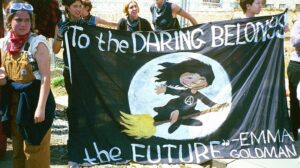
Carolmooredc, CC BY-SA 3.0 <https://creativecommons.org/licenses/by-sa/3.0>, via Wikimedia Commons

If I can’t dance, then I don’t want to be part of your revolution.–Emma Goldman

Subscribe at https://ddinafriedman.substack.com