When Do Stories End

Every time I ask my 3-year old grandson, Manu, “Do you want to hear a story?” he stops what he’s doing and fixes his gaze on me, his eyes wide in anticipation, shooting me a little dose of performance pressure. But I don’t have to worry because if he doesn’t like the story, he intervenes to change it. He has a strong preference for the characters to be people he knows, so I can’t resort to folk or fairy tales unless he, or my cat, or the members of the Tokyo Paradise City Ska Band make an appearance and take over the action. Even then, he likes to interrupt and add salient or deliberately funny details on his own, so that the story quickly becomes a joint effort.

But sooner or later, we both run out of gas, as we did about a week ago, when I said, “That’s the end of the story.”

“Why?” I could tell from his tone that he was clearly upset.

“Because I don’t know what comes next. Do you?”

Manu followed up with a sentence or two, and then looked at me to continue. I added what I hoped was a closing sentence, and then asked him if he knew what happened next, He said he didn’t.

“Neither do I,” I told him. “So that’s the end.”

A couple of days later in one of my writing groups, a fellow writer lamented the elusiveness of plot. “I have so many words, but not plot” she said. And without a plot, how do we manage our words? How do we translate that hidden precious bud of whatever we’re trying to express while still making it conform to the parameters of fiction that people expect: plot, being an essential element.
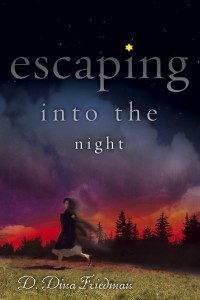
Even though I’ve been told by many teachers that my first published book–a YA Holocaust novel, Escaping Into the Night–was so well-plotted that “even the boys who preferred more action-oriented books liked it,” I’ve never considered myself a master at plot. There are many fiction-writing books that can teach you how to map out your plot in advance, designating turning points one-third, two-thirds, and just before the end that raise the stakes–a common outline for Hollywood movies. This is probably a good exercise to do, though I’ve never done it. Whatever plots I’ve managed to nudge out of my writing have emerged out of deep attention to character and setting, and intensive pondering of what could possibly happen next.

Often I go through several periods of trial and error before settling on what feels both realistic and meaningful in terms of getting across whatever underlying theme I’m struggling with. It’s not that different from riffing with Manu on my cat’s adventures in the backyard, except that instead of abandoning plot points that don’t work, we just keep going on one wacky tangent after another.
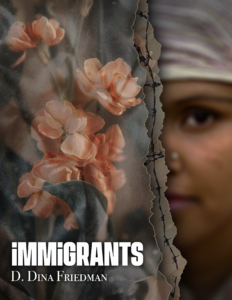
Lately in my own writing, I’m coming across another issue in plotting and determining where stories end. Even though I’ve already written and published a book of short stories on immigrants, the issue keeps tugging at both my activist and creative heart. But in the new fiction projects I’ve started on the topic (a couple of short stories and a YA novel) I keep getting to the point where every answer I can imagine to “what happens next” is so horrible, I can’t even write it down.

Maybe, I just need to follow Manu’s example when it comes to the issue of ending stories, and just refuse to say, that’s the end. At least, not until I can see past these awful moments into a brighter and more hopeful future.

Subscribe at https://ddinafriedman.substack.com

 

Chainsaws Gone Wild

Photo by haemd: https://art.ngfiles.com/medium_views/ 6994000/6994772_2373943_haemd_ chainsawman.88461deeb7794d08f5f 382a77717451f.webp?f1756587284

Last fall, I was outside with my grandchild, Manu, when he heard a motorized noise and asked me what it was.

It didn’t exactly sound like a lawn mower, or a weed whacker. “Maybe it’s a chainsaw,” I said.

“Let’s go see it.”

He got in the stroller and we took off in search of the noise, taking a few wrong turns before we found the perpetrator–a very scary industrial-size leaf-blower, sucking up everything around it.

“I want to go home!” Manu shouted as soon as he realized what it was. He’s always hated leaf blowers.

At the time I didn’t find this incident particularly significant, except that Manu wouldn’t let go of his desire to see a chainsaw. In fact, for nearly a year after, every time he heard any kind of motor after that, he asked me if it was a chainsaw, even if the lawn mower, or the motorcycle, or the helicopter was clearly in sight. And he also asked me–often–to tell him the story of “Manu and the Chainsaw,” where I’d recount the chainsaw-turned-leaf-blower-search” in detail, embellishing shaggy dog style with my purplest toddler-appropriate prose.

The story always ended like this: Manu was very, very sad that he didn’t see a chainsaw, but Grandma said, ‘That’s okay, Manu. We’ll get to see a chainsaw some day.’

Last week, two houses down from his, the neighbors were cutting up a dead tree. Manu stood mesmerized, holding my hand at the edge of the grass, a little scared, a little awed, as the neighbors ran the chainsaw over and over through the dead wood.

***

I’ve been thinking a lot about this story, and its relationship to how we deal with things we anticipate once we see them.

Especially things that are unpleasant.

For months, we’ve been told fascism is coming, hovering at the edges of our democracy, eating away at it in small bites. We’ve been told that if we don’t turn the tides in three months, six months, nine months, or by the mid-terms at the latest, we’ll be doomed.

But fascism is here. Because ICE is here: Masked thugs over-running our communities, lawlessly breaking car windows, pushing their way into houses, taking undocumented people who have been here for years, as well as people with legal status, green card holders and even U.S. citizens.

In other words, kidnapping.

We may not have personally seen ICE yet; those of us who are privileged may feel like we still have time because in our day-to-day lives, everything is normal. We still wake up in the morning, work, exercise, garden, parent, make dinner, watch our daily TV shows. If we don’t pay attention to the news, we can live happily in a pretend world where nothing has changed.

On Labor Day, I went to a rally in support of a local farmworker who is one of over 2500+ victims taken by ICE in Massachusetts alone. An organizer who spoke said she was in the car accompanying this man to a court hearing when three cars surrounded them, threatening a head-on collision if they didn’t stop. Six men surrounded the car, pointed a gun at her face, and dragged him out.

This man’s only crimes: a broken tail light and wanting a better future for his family.

The whole incident took two minutes.

This man was following government protocols. He was on his way to a court hearing. If the government wanted to get rid of him so badly, they could do that through due process. But due process is no longer a given in our fascist state.

I’m pretty sure Manu had no idea what a chainsaw was when he first asked to see one. And while he’s now seen one in action, I’m still pretty sure he has no idea what a chainsaw can do when used inappropriately. If his parents, and I, and the other caring adults in his life have our way, he’ll never find out about the Texas Chainsaw Massacre.

But too many of the authorities in our country–ICE, CBP, and any police department that cooperates with them–are chainsaws out of control.

Meanwhile, like my grandchild, too many of us are just standing at the edge of the sidewalk gaping. Not because we’re bad people, because we just don’t know what else to do.

This is not meant to guilt-trip. If I knew what to do, I would happily end this post by saying so. I do believe, however, that acknowledging the reality of what’s happening is an important first step. And that art and activism; connection, community, and kindness all have a role in bringing about the world we want to see. Let’s hope it will ultimately be enough. #artforchange

To subscribe: https://www.ddinafriedman.substack.com


Spiders and Rocks and Poems, Oh My!

Once again, I’ve signed up to write 30 Poems in November to benefit the Center for New Americans, which provides English classes and many other types of advocacy for immigrants here in western Mass. And once again, as October draws to a close, I’m feeling that trepidation of adding one more item to my to-do list, wondering how I’m ever going to churn out 30 poems in a month–even poems that are unfinished and far less than stellar.

It hasn’t helped that my writing life has slowed to a crawl. Paperwork related to my father-in-law’s death, last minute election volunteering, putting the garden to bed, health issues with relatives, the Jewish holidays, my grandchild’s birthday, editing deadlines, and a flurry of visits with friends and family have made it hard to get to my desk as often and regularly as I’d like. Even this blog post–which I usually aim for mid-week–is late. (I just got a warning post from SubStack, letting me know that I had only two more days to fulfill my pledge of blogging weekly, LOL!)

But one of the things I love about writing 30 Poems in November is that permission to slow down. To make writing practice front and center again.

I find I’m most successful at birthing poems when I can be out of my to-do list and into what I think of as the fuzzier part of my brain. Then, I just let the pen flow and the words come–sometimes easily, and sometimes with a bit of effort, but the trick, for me, is not to try too hard to construct *a poem* as much as let myself sense what I’m sensing and free associate from there. And from that pile of words, I can often sift through and find the gems, threading my path forward.

The hardest part is to let the chaff fall away–the distractions, the judgment– and let myself fall into the “wow” of whatever is underneath all that detritus.

Photo: D. Dina Friedman

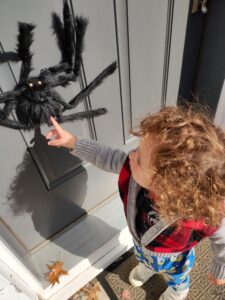
And lately, when I need lessons in falling into the sensual wonder of discovery, I get them from my two-year-old grandchild Manu. Recently, he’s been entranced with the abundant display of Halloween decorations in his neighborhood: the furry spiders perched on the hedges, the life-sized dragon with the blinking red eyes, the pumpkin faces, the creepy hands sticking out of the ground, the lanterns hanging from the trees.

Photo: D. Dina Friedman

Every day, he asks to see the dragon and the spiders. He takes his time, exclaiming, Oh, there’s another spider! before rushing over to investigate and dig his little hands into the fur.


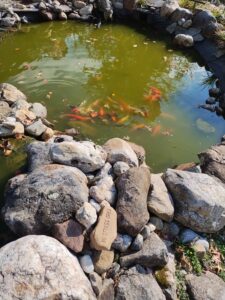
After the “spider house,” we go next door to the Japanese rock garden, where he watches the brightly colored fish, and rains handfuls of small, cool rocks, listening to the pleasing sound they make when they hit the ground.

Poems are everywhere. Hopefully, some will come to me this November.

Photo: D. Dina Friedman

And yes, please consider contributing to my fundraising page for this worthy cause. No donation is too small! Many thanks. Happy Halloween and Happy November!


The Power of Perseverance: Lessons from a Dreidel

My 20-month old grandson, Manu, has become obsessed with his dreidel, a toy top typically played with on the Jewish holiday of Hanukkah for “gelt,” which are coins or coin-shaped pieces of chocolate.

But Manu doesn’t know about chocolate, yet. And he’s shown no interest in the letters on the dreidel, which traditionally determine whether you win or lose, depending on where the dreidel lands. In fact, he rarely waits for the dreidel to land. For him, the joy is in the spinning.

“Spin it here!” he shouts, trying out his toy stove, my knee, the couch, the piano. “Grandma, spin it!”

Photo by Shel Horowitz

I never knew a dreidel could spin so well on upholstery.

He also tries places that never work: the curved handle on the umbrella stroller, the side of the bookshelf, the pointy roof of a Lego block. There is a thing called gravity–LOL.

But Manu doesn’t mind at all. He picks up the fallen dreidel and hunts around for another cool place to launch an attempted spin.

His optimism is a good lesson in not being afraid to try out what might seem impossible. This week I took my first tentative steps toward diving into a longer project, another YA novel. Writing bland and sketchy prose, I tried to let the characters in my head take their first few breaths on stage, figuring they’d reveal more about who they really were when they got to trust me–and I, them. My five handwritten pages are looking very much like the beginning of a “shitty first draft,” as coined by Anne Lamott in her wonderful book, Bird by Birda must-have for any aspiring (or semi-established) writer.

And from Manu’s perseverance I’ve learned something about approaching work that’s past the “shitty-first-draft” stage. Just as he refuses to be put off by places the dreidel won’t spin, I need to do a better job on not giving up so quickly on places where my writing doesn’t sing. Often I can substantially improve a piece by finding a better verb (or sometimes noun or adjective). If a word sounds flat to me–either too overused, not clear enough, or having a sound that clashes with everything else, I can painstakingly search for a word that comes closer to what I’m seeking. And I’m not at all ashamed to admit that my best buddy in this process is a fabulous on-line thesaurus called wordhippo.com, which breaks each word down to its possible meanings, and gives quick and clear definitions of the alternative selections to prevent me from falling further into the muck.

Who would have thought I could have learned so much from spinning a dreidel. I guess, as the words on the dreidel say–a great miracle happened here.

Mindfulness and Found Poems

We’re a week into 30 Poems in November, and I have eight poems. The days leading up to this practice (as I wrote about last week) always feel like the hardest, especially in those moments before I squeeze out the first poem and realize, hey, it isn’t so bad. I can do this. And suddenly something shifts. I enter November, a month that’s always been a downer for me due to the sudden onslaught of afternoon darkness, in a new state of mindfulness that starts to mitigate the pressure to produce. I can’t explain exactly what that is, but the practice of capturing something in a poem every day puts me in a headier zone, and I start to look at things differently. Even today, when I sat down to try to write Poem #9 and came up empty (so I started to write this blog post instead), I found myself intrigued by the leaves’ dance outside my window in that brilliant, but all-too-fleeting  sun.
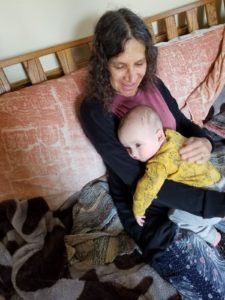
Knowing that I’m impacted by Seasonal Affective Disorder raises the stakes on my personal to-do list. Not only do I have to write 30 poems in November, I have to get outside every day, targeting the time when the sun is at its strongest. This puts a crimp in my writing schedule since the morning light is the best. There’s nothing more demoralizing than watching the sun beginning to sink over horizon at 2 o’clock in the afternoon. But morning is also when my writing brain is at its best, so something has to give.

Still, outdoors is a great place to be mindful. When I’m out with my 13-month old grandchild, I try to tune in to what he might be noticing: the birds tweeting, the random ding dong of the wind-chimes, the thrill of a spread of cool garden rocks to sift through, and hold, and fling down, listening to the satisfying clink. These were some of the images that made it into my poem yesterday.

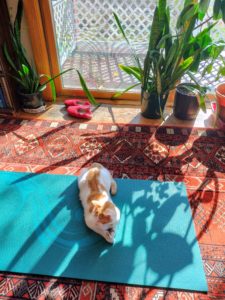
And even though I strongly recommend it, you don’t really need to go outside if that doesn’t call to you. Today, one of the prompts I received in my Zoom writing group was to use found words to create a poem. Simply open up a book and circle random words, or pick a passage and erase sections of it, creating a poem out of what’s left. Or, make a poem out of random newspaper headlines (if you can stand writing something that’s likely to be depressing). Or, as I started to do, list what you notice about your surroundings. My cat, who has taken over my yoga mat, is SO content basking in the sun. And those fuzzy empty slippers by the porch door sure look cozy.

I didn’t end up using these images this time, but I did write a found poem from a cookbook I have called Flavors of Jerusalem, which helped me process a lot of the difficult feelings I’ve had about the conflict without the need to be didactic or even mention the war. Metaphors are great in that way. I’d much rather write about cumin and paprika than airstrikes. And mindfulness is a way of thinking about what these spices evoke, and tuning in to which images: spices, cats, slippers, or whatnot, you might need to enhance the flavor of your writing.

Babies, Blessings, and the Bird’s Eye View

For the past five days I’ve been living with my daughter, helping to take care of seven-month-old Baby Manu while her husband is away. Like most of life, there have been moments of  joy, moments of challenge, moments of laughter, drudgery, frustration, profound peacefulness, you-name-it. The only thing certain about life with a baby is that there’s rarely a dull moment.

As a grandparent I feel blessed by having a lot more perspective than I had when my own children were young. In my years of early motherhood, whenever my kids screamed, I worried that not addressing on some immediate need they were expressing would scar them for life, the fog of sleep-deprivation only adding to my anxiety. Now, as I carry Baby Manu around the house and try with my old arms to satisfy his need for incessant “jumping” (i.e. lifting him up and down as he flexes his leg muscles as a launching point on my lap) I feel wiser and calmer–even when he’s screaming. And I’ve thought about how like writing, taking care of a baby is really just an exercise in plunging in and dealing with a lot of trial and error as I try to find that “true north” point of connection.

With Manu this might mean reading a book and taking stops between each page for jumping breaks, or tango dancing around the house while humming riffs from Raffi’s greatest hits or rap songs I’m making up on the spot–all on the theme of Manu: The Life. It might mean playing hand games, or making funny noises, or going through an entire array of animal sounds. Or taking a moment to put him down to play by himself, recognizing in my new found older-age wisdom that both of us could use a little time to chill.  “Little” is the defining word here. All of these activities have proven successful–but generally none of them work for more than 5 to 10 minutes at a time.

The writing process can sometimes feel similar. While I welcome the blessings of the time I feel “in the groove,” other times my words–and my brain–can feel jumpy and fragmented. These are the days I go into the garden to chill, just as I put Manu under his playstation, so he can shake his rattles and babble to himself without Grandma’s interference. And other times, when I’m struggling with trying to write that “one true sentence,” I realize I need to switch up the activity, which for me usually means putting a story aside to revise a poem, or putting the poem aside to work on another poem, or another story or essay until I find something I’m connected to enough in that moment to “re-see.”

But I’m counting my blessings and taking the “birds-eye view” as both a grandparent and a writer. Eventually Manu will grow old enough to tell me what he wants–and so, I hope, will my baby poems and prose in progress.

To subscribe, sign up at ddinafriedman.substack.com

Dayeinu

In the last few weeks, I’ve been doing some of the exercises from Julia Cameron’s classic book, The Artists’ WayAs my children are grown and I’ve been blessed with the luxury of retirement and the ability to structure my “Act III” life to center around creativity, the book doesn’t speak to me as much as it would to those who trying to pull off whatever tiny pieces of life they can from the morass of work and family demands to nurture their creative selves. Yet, I’ve found the process of “morning pages,” (brain-dumping three pages of long-hand uncensored meanderings before I get out of bed in the morning) useful. And I’ve been glad to discover that unloading my mind’s detritus in purposefully pedantic prose hasn’t seemed to affect my ability to write more creatively in other contexts, as I first feared it would. It actually can be liberating to write without worrying about creating flow or metaphor, a clear difference from other stream-of-consciousness prompt writing that I try to load up with gems I can later grow into poems.

I usually end my morning pages with an intention for the day. And while I know that an intention is simply a way of focusing on the day’s array of opportunities, rather than some set of goals I must meet or feel bad about myself for not meeting, the tightrope between goal and intention is a fine line to balance on. In the last few weeks, prepping for Passover (extensive cooking and curating a new Haggadah) along with trying to meet my self-imposed deadline of revising an old novel and submitting it to my publisher have made it difficult to get through my general daily list of writing/revising/submitting poetry or short fiction, playing the piano, taking a walk in the woods, doing a cardio or yoga tape, and meditating–creative and self-care activities that have become essential markers of my day.

Then there are all the other weekly to-dos to fit in: writing political calls-to-action and doing immigration justice work, editing/giving feedback on writing to others, spending time (in person or virtually) with friends I care about, cooking dinner, making sure the house doesn’t fall into utter chaos–and what I call admin: emails to answer, calls and texts to return, bills to pay. The list can be endless.

And, in the last six months, I’ve spent several afternoons each week putting all of this aside to babysit for my grandchild, Manu, which is the best thing of all. In fact, for this moment with Manu, I say what we say every year on Passover, Dayeinu: It would have been enough for us.

Julia Cameron talks about the importance of making dates with your inner artist that are geared solely for playing rather than to get projects done. And in my experience, there is nothing more purely playful as putting your whole self–heart and soul–into the space of a baby newly exploring the world.

So, today, even as I will still stress about being behind on deadlines, intentions, goals, whatever, I will try to remind myself–Dayeinu. Gratitude. It’s all good.

To subscribe, sign up at ddinafriedman.substack.com

Taking Stock of 2022–Part I: Won’t Get Fooled Again

“An artist needs to be something like a whale swimming with his mouth wide open, absorbing everything until he has what he really needs.”–Romare Beardon
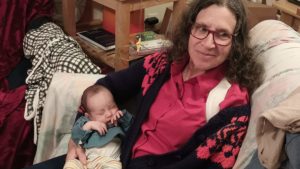
Ten days into 2022, I lost my brother, Danny–an unexpected death due to an imploded port. The malfunction had scheduled for repair, but that had been delayed due to COVID (one of many statistics that would not be included in the pandemic’s path of destruction). Beset with mental illness from the age of 15, which was later accompanied by a host of physical problems, Danny’s life was not easy and neither was our relationship. Yet, as teens, we bonded over baseball and rock music. I’d play the guitar and we’d sing together. Danny would ask me to listen as he turned the amp on high and belted along with The Who’s “Won’t Get Fooled Again.” As his illness became worse, he got more delusional about being a rock star, his stubborn insistence occasionally edging on violence when my parents tried to curtail the raucous sound from being blasted out into the neighborhood.

When I think of what I “absorbed” this year, this sad life event from early January continues to stand out despite its countering with one of my happiest life events: the birth in September of my grandchild, Manu. Both have inspired a lot of writing, and watching the awe and wonder with which Manu approaches the world fills me with a poignancy hard to describe without resorting to clichés about both the preciousness and fragility of life, and how one of the most healing things we can do for grief (at least for me) is to continue to practice gratitude and look forward, even as we continue to struggle to make sense of the cracks in our past.

Meanwhile, the echoes of Won’t Get Fooled Again continue to resonate as a backdrop on my musings, as in the song I can feel both the anger at the state of the world and (despite the sarcasm) the hope of better tomorrows that don’t need to be mere delusions. I say this after reading about the Governor of Texas sending busloads of migrants to the Vice President’s House in subfreezing weather on Christmas Eve–an anti-nativity story if there ever was one. However one feels about the situation at our borders, it’s this kind of deliberate cruelty that triggers my anger at both sides of the government for “fooling us” into thinking that they care. And yet, I hang on to the hope of better tomorrows, reflected in the many people who are on the streets, helping migrants and other unhoused people who are stranded in the cold.

I’m determined not to get fooled (or worse, despondent) in 2023. Out of grief comes hope, the awe of new discovery, and the determination to work for a better world.


To subscribe to this blog, sign up at ddinafriedman.substack.com