When I was a child in New York City, I was one of the few kids who wasn’t an immigrant or a child of immigrants. I remember being awed when I’d visit my friends in their homes and listen to them speaking animatedly in another language–Spanish, or Chinese, or Greek–before switching back to me and talking in just as fluent English. I felt envious and ripped off that my family couldn’t speak any other languages.
In elementary school, nearly every year our teacher would give us a homework assignment to describe the country we, or our parents, or grandparents had come from, and then present that to the class so everyone could learn about it. “You come from many different countries,” my parents would tell me, as they ticked off the different areas on the map that my great grandparents (and sometimes great-great grandparents) had lived before sailing to Ellis Island: Lithuania, Germany, Holland, Russia, the Ukraine, Poland…
This was an odd assignment for me because I felt no connection to any of these places. We had no legacy of language. My parents didn’t know Yiddish. Even my grandparents–all of whom were born here–knew very little. I felt so American, so boring, and sad that I had absolutely nothing for “Show and Tell”
But the point isn’t to complain about my experience as much to reflect back on an instance when being an immigrant was celebrated. And I did not go to a “lefty commie school.” This was a regular public school in New York City where we pledged allegiance to the flag every morning, and learned about how “great” America was. And part of what made it “great,” we learned, was immigrants. New York was a “melting pot.”
I currently prefer the term salad bowl, a metaphor that allows us to acknowledge everyone’s individual culture rather than envisioning us all melting into some unidentifiable assimilated conglomeration. However, neither image does the kind of harm as the recent outrageous lies about immigrants in Springfield, Ohio, and the overall vilification of immigrants put out by MAGA Republicans–who are calling for a large-scale deportation of not only undocumented residents, but also those who have obtained a legal path to be in this country.
Had this been carried out when I was a kid, it would have included nearly everyone in my class.
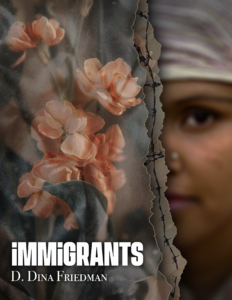
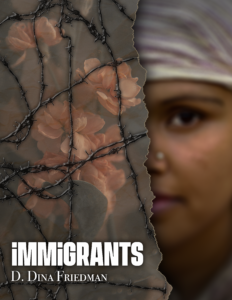 When I wrote my collection of short stories, I wanted to emphasize how immigrants are everywhere, just as they were everywhere in my childhood. Some of my stories are overtly political, drawing on my experiences as an activist, but most of them aren’t. They’re simply tapestries woven with real people–some of whom simply weren’t born in the U.S. I write about humans in situations with issues. That’s what’s always grabbed me in fiction–the ways we struggle to love the world, each other, and ourselves.
So I guess that’s my “show-and-tell”–only 50 years late. Hoping we can get a little of that immigrant love back. All of us belong in the salad.

 But now that I’m–thankfully–about 80% recovered, and preparing for my
 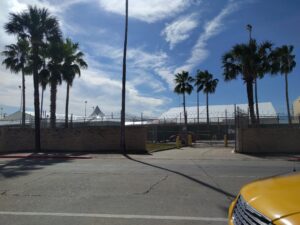 He was reportedly the only person in weeks that people had heard about who received a positive outcome form the infamous tent courts. And as witnesses gathered around to offer him a place to stay for the night and assistance to get to his brother in Florida, he told us the key to his “success.” I told them the gangs had killed my entire family. Other than my brother, I have no one.
 Don’t Look Away! the sign read on the American side of the border, where witnesses stood every day, reminding us of our responsibility not to tune out.
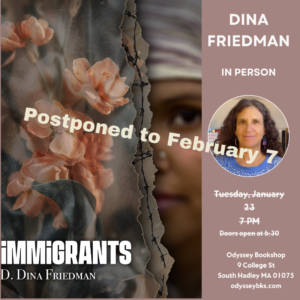 While I’m an admitted snowphobe when it comes to driving, I knew I’d likely be able to make it to the bookstore, which is only 5 minutes away from my house. But I also knew that others who were planning to come were driving much longer distances. I didn’t want to ask people to risk their safety. And I didn’t want to risk a low turnout. Even though I’d already bought the snacks and the ingredients for brownie-making, I decided it would be best to postpone.
 As the night broke into the beginnings of a cloud-covered day, we watched a bus pull up. A man held up his shackled wrists to the window. We stood in front of the bus, holding up hearts, and for a moment, we held up “business as usual” as the bus came to standstill. We surrounded the bus, shouting “I love you,” to the shadowy faces in the windows. And “No están solos. Estamos con ustedes.” (You are not alone. We are with you.)
 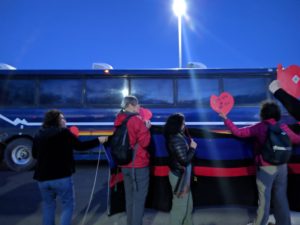 Then, the police came and since we had not planned for a civil disobedience action that would end in arrest, we let the bus pass through the gate to the plane. They parked a truck in front of the stairway, so we couldn’t see the people limping with their shackles up the stairs into the plane’s belly, but that image, along with other accounts of abuse, has been captured in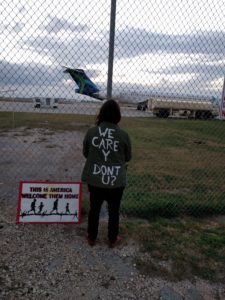
 “An artist needs to be something like a whale swimming with his mouth wide open, absorbing everything until he has what he really needs.”–Romare Beardon
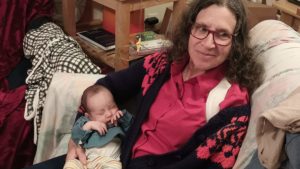 Both have inspired a lot of writing, and watching the awe and wonder with which Manu approaches the world fills me with a poignancy hard to describe without resorting to clichés about both the preciousness and fragility of life, and how one of the most healing things we can do for grief (at least for me) is to continue to practice gratitude and look forward, even as we continue to struggle to make sense of the cracks in our past.