Protest Poems

Today I woke up to some good news. Two more of my poems were today’s offerings on the Substack site Second Coming, a poem-a-day protest against the threats to our democracy by our current administration.
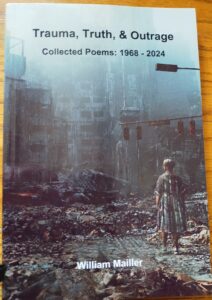
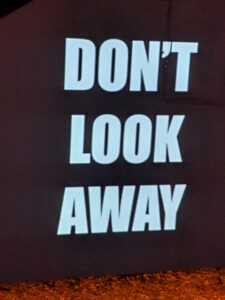
And last night, I went to hear a writing colleague, Bill Mailler read from his new book of social justice poetry, Trauma, Truth, and Outrage. Bill’s poems tend to be gut-punches. He doesn’t shy away from horror or attempt to beautify it through language. His work is like that sign our small group of witnesses illuminated at the border in 2020: Don’t Look Away.


What I liked most about Bill’s work were the questions relating to our human capacity for meanness, a key component of the poem, Meditations on My Whiteness, where he asks directly:

For what possible reason
could good or well-meaning people perpetuate or participate….

before offering a long lamentation of possibilities including:

because we are cowards and cannot acknowledge
the consequences of our actions?

because we teach our children to deny their natural empathy
for others, themselves, animals, and the earth itself? 

I also think constantly about the issue of human cruelty. Though my own work tends to take a less direct approach to writing about political issues, neither is wrong or right. They’re just different. The point, I think, is to enter the world through a lens of empathy, rather than simply ranting or trying to be prescriptive about what you think should be done. Poet Kwame Dawes talks eloquently about this issue in his own writing: When I write the poems about Haiti, people living with the disease, I’m not writing poems so that people will give.. but so the person who experiences when they read the poem, they’ll say to me… that’s it. That’s what I’ve been feeling but I didn’t know how to say it.

As many of us are staggering through these times with deep and heavy feelings about what’s happening in the world, reading a protest poem or a political piece of artful prose can help us feel less isolated as we try to make sense of our grief and uncover a path through it into some kind of meaningful action. That’s why when I’ve read my own protest poems at workshops or readings, even raw and unfinished generative responses to prompts, I often got more positive feedback than I expected because I was able to verbalize something that someone else had not yet been able to verbalize–touched a nerve, so to speak.

This isn’t to say writing protest poetry is easy. While I do believe that all attempts at creative expression should be acknowledged, respected, and validated, it’s difficult not to fall into ranting, generic abstractions, slogans, self-pitying, etc. And the problems with these pitfalls is that it becomes easier to lose the reader, who’s likely heard it all before and can gloss over or check out. Keeping empathy in the forefront can help. So can paying careful attention to language–using sensory details, fresh verbs, and unexpected metaphors. In prose, this might mean creating vivid scenes where the viewer can watch what’s happening to characters and form their own judgments.

What has made the process of writing protest poems and stories slightly easier for me in the past decade has been my being able to more fully integrate my life as a writer and an activist. While this wasn’t true in my earlier life, I now feel the fallout from political issues as viscerally as the other subjects I feel urged to write about. Allowing myself to deeply feel the horrors of all I read about in the news has certainly made it more difficult to maintain emotional balance, but I do think it’s necessary. We need, somehow, to find a path into a more deeply rooted empathy if we really want to break the pattern of ignoring atrocities–often done in our name by a system in which we are all still passively participating.

Subscribe at https://ddinafriedman.substack.com
Empathy

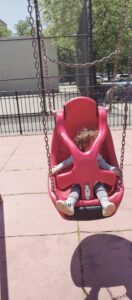
My 2.9 year old grandson, Manu, loves the playground, especially when there are no other children and he has the whole place to himself. A few days ago when we arrived, we saw another kid in the sandbox who waved to him enthusiastically. “That kid wants to play with you,” I said.

He hesitated before answering, then said, “I don’t play.”

Photo by Shel Horowitz

This surprised me because I have clear memories of being 2 and wanting nothing more than for other kids to play with me. I remember Linda, who lived a few houses down in the apartment complex we lived in and how I liked nothing better than running down the hill with her at top speed in our shared yard. And in kindergarten, I remember Mary Ann, with her perfect blond braids, how I cried because the teacher wouldn’t let me sit next to her.

While I don’t remember the specific incident, I also remember the day I came home from kindergarten crying  because some kids had said or done something mean to me. My mother simply shrugged and said, “Children are cruel.”

I was shocked! Children? My tribe? (I was already aware of divisions: that I was a child in a land of adults and a girl in a culture where boys ruled.) But how could children as an entity be labeled as cruel? I was a child and I wasn’t cruel. And why was being cruel something to be shrugged about and accepted as a fact of life?

Unfortunately, cruelty is not something confined to children. Our human history of wars, torture, and the oppression of one group by another is all the proof we need. And if we want to fast forward to the present and our own country, all we need to do is look at the initial reports from “Alligator Alcatraz” (aka “Alligator Auschwitz”) where inmates are reporting no bathing facilities, one maggot-infested meal per day, elephant-sized mosquitoes, 24-hour lights, and alternating periods of sweltering heat and chilling cold.

What should we do? Shrug, and say, “People are cruel?”

In both my most hopeful and most devastated days, I find myself pondering why we humans as a species are the way we are. How can we possibly have the capacity to harm each other in the ways we do? The “hopeful me” looks at this question as a puzzle that, once solved, can change the entire trajectory of how humans can live together on the planet, while the “devastated me” wants to curl up somewhere and cry–with many more tears than I ever shed because I couldn’t sit next to Mary Ann.

Elon Musk recently said, “the fundamental weakness of western civilization is empathy.” But that’s the voice of the dark side. Empathy is the only thing that might be able to save us from ourselves. It’s empathy for others that can catalyze those of us who have the privilege and the capacity to speak out. And we must speak out–despite empathy’s ability to also render us paralyzed because we feel the pain of others so deeply.

On a recent day at the playground, Manu wanted to climb on a rock where another little boy was standing. He stayed at the bottom of the rock for minutes looking up at the boy, who stared down at him from the top, neither of them saying anything, just staring each other down and holding their position. Finally the boy on the rock made a fist and released his index finger, as if he were shooting a fake gun. It was subtle gesture, and I wasn’t sure if I was interpreting it correctly, but I think I was, because he did it several more times.

Where did he learn that? I wondered, with horrified distaste. Who taught him?

Then I tried to use my empathy, and reason from the kid’s perspective. He was enjoying being on the rock and didn’t want anyone encroaching on his space. We humans have an innate tendency to protect what is ours, and when we’re young we often have to learn not to grab or be aggressive towards others to get what we want.

Even though neither of the little boys thought so, there was enough room on the rock for both of them. Just as there’s enough room in our country for all of us who are here to live peacefully with each other.

Eventually, the boy’s mother finally came over and picked him up, enabling Manu to climb on the rock unimpeded. Eventually, Manu, too, will need to learn how to share his space. Hopefully he’ll get to a point where he thinks it’s much more fun when other kids are also at the playground. Hopefully, we’ll also get to that point. Somehow. Some way.

Subscribe at https://www.ddinafriedman.com 


Out of the Cage

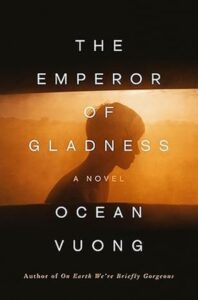
Last night, I had the special treat of seeing Ocean Vuong talk about his new novel, The Emperor of Gladness. I haven’t read the book yet, but I was wowed by his first novel, On Earth We’re Briefly Gorgeous–and struck by the sensitivity, depth and humor in the brief excerpt he read from this one. Most of all, I was moved by his thoughts on what it means to be a writer–what it means to be a human, actually–in these troubling times.

Vuong talked about “the cage” that all of us are trapped in, meaning the large set of sociocultural stereotypes and mores that hinder the definitions of who we are and the possibilities of who we can be. In his first novel, the main character, Little Dog, says: To be an American boy, and then an American boy with a gun, is to move from one end of a cage to another.

As I thought about this idea of cages, I realized that my lifelong pursuit of writing is absolutely an attempt to break out of the cages of expectation, to come as close as I possibly can to exploring absolute truth and authenticity. And perhaps that’s what makes Ocean Vuong’s work so great. He may be writing fiction, but he’s doing it without artifice. Vuong insists that his novels are not autobiographical, nor are they specifically about anyone in his actual life and claimed that he would never appropriate anyone’s life story to feed his art. Yet, there’s a truth that seeps through whatever he’s invented that pulls back the veils under which we hide.

And I do believe it’s not only the revelation, but the acceptance of our own and each other’s authenticity–provided we can even find it in ourselves–that may be our only hope of changing the world.

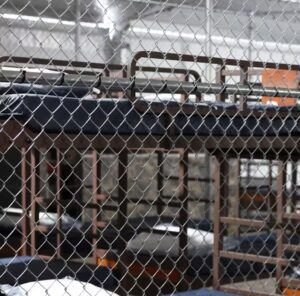
Alligator Alcatraz: From Heute.at (cropped)

Of course, I couldn’t think about cages without the intrusive images of “Alligator Alcatraz” the newest prison being build in Florida and the memories of children in cages during this administration’s first term, a practice that ended after huge public outcry.

Also, yesterday, earlier in the day, I joined eight other people dressed in black, carrying signs with names and information about people who have been disappeared in Massachusetts and sent to caged prisons near and far. We walked in silence through the streets of Northampton, banging a drum, and bearing witness, creating a stunning visual effect that made people stop what they were doing and notice.

Said Vuong in a recent interview, Maybe in another 15 years, I will write about trying to be an artist while our civil liberties are being eroded and our country is run by oligarchs who are bordering on fascism. If we make it to 15 years later, hopefully I can write a book about that. 

Hopefully, he can. And in the meantime, hopefully we’ll all continue to access whatever creative sparks we all can make to raise awareness, claw out our own truth, and make it through.

Subscribe at https://ddinafriedman.substack.com
 

I Carry… I Hope

Last weekend I attended an excellent workshop on writing protest poetry. Among the poems we talked about was this gem, I am Dark I am Forest by Jenn Givhan. I love the repetition of the phrase “I carry…” and how the poet threads us (trigger warning) through a maze of generational and societal trauma  with specific sensual imagery overlaid in a veil of surrealism.

I was struck most by the “heaviness” of what so many of us may be carrying these days. Whether we’re mired in personal issues related to health, loss, or economic instability; or whether we’re sweating anxiety, sadness and fear after the escalation of war in the Middle East and seeing reels like this one of ICE officers beating people as they take them into custody, it’s a very heavy time.

The poem inspired me to attempt my own version of a prose poem using the refrain of “I carry …” Here’s a short blip from the draft I wrote…

I carry

obedience / even as my horse body strains at the bit / the bridle trying to break the chains of normal to get to an unbroken place. / I carry

all the broken places / my little girl self in the back seat of the station wagon staring at the wall of my parents’ heads / obey / or you’ll embarrass us. /

So I’m asking all of you… what do you carry?

And an extremely relevant follow-up question: How can we put down what we’re carrying?

Not with disgust or abandon, but lovingly.

When I think of carrying, my first association is some heavy object I’ve lugged, like the old air conditioner from the 90s that my partner and I managed to drag out of the closet last weekend and shuffle it onto the hand-truck so we could wheel it to the corner of our road for someone driving by who might need it for the upcoming heat wave. Or the table on our deck we have to shlep back and forth from the garage for the winter, which involves walking backwards on uneven ground and maneuvering corners and stairs. I’ve never been adept at carrying heavy objects, and as I age, I’ve had to stop even more often to rest or find ways to balance the weight on my hips, which can take it more easily than my arms.

But while putting down the deck table for a few minutes can give me enough strength to pick it up again, it’s harder to put down the onslaught of news, or whatever dire reality any of us might be faced with.

There’s been a lot of writing out there on happiness and gratitude. However, a recent study targeted hope as the biggest key to being able to shoulder the burdens we carry. One reason for this: gratitude focuses on events in the past, happiness is usually related to the present, but hope is aimed at the future. When I’m carrying the table, it’s hope that enables me to measure the progress and see how much closer I’ve gotten to the garage each time I stop to rest. The study suggests that people notice the small wins and seek all opportunities, even the tiny ones, to move forward and then celebrate them whenever possible. This can help us strengthen our hope muscle and cultivate a hope mindset, the belief that nothing is static and change is always possible.

This is why I eagerly look forward to Jess Craven’s Sunday posts from her Chop Wood Carry Water newsletter, which are filled with all the good news of the week, which people worked for to make happen

Feel free to use the refrain, I carry… as a writing prompt…
Or perhaps, instead, (or in addition to) the refrain, I hope…

Subscribe at https://ddinafriedman.substack.com

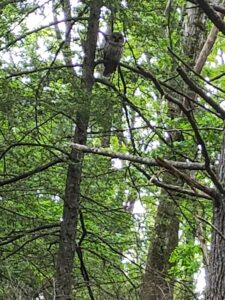
The owl I saw flying and then landing in a tree on Mt. Toby (Sunderland, MA) gave me an enormous boost of awe and hope.

Bravery

As I sit on my porch under the maple tree, on a sunny late spring day looking out at my idyllic view of the farm and the mountain behind it, I realize I have no idea what it means to be brave.

Sure, I’ve taken the plunge into social situations I might have preferred avoiding, and occasionally attempted some speedy or free-fall athletic feat that instigated a split second of terror and an adrenaline rush. But really, I always knew I’d be fine.

So I’m thinking now, as the jaws of the looming authoritarian police state are snapping loudly, about what it means to be truly brave.

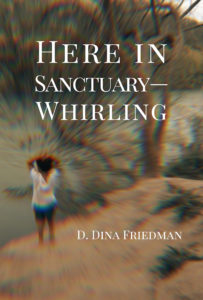
When I went to the border in 2020 I heard many stories of bravery, all of them spiced with horrific moments that made me flinch, or cry, or both: kidnappings, gang break-ins, death threats to their children, rapes…One man told me about being forced into a car with his 8-year-old daughter by kidnappers after spending weeks in the hielera (Spanish word for ice box where they keep detainees). With his permission, I chronicled his story into a poem (pasted at the end of this blog) which was first published in my book, Here in Sanctuary–Whirling, and which I’ve shared at many community talk-backs about our trip.
Holding this man’s story and the stories of others was devastating. I came back from that trip feeling smothered under the weight of such sadness, confused about how I could continue going blithely about my days feeling grateful for the trees, and my friends, and the small sweet details of my privileged life.
It’s pretty much the same as how I’m feeling now.

Except that the necessity for bravery, personal bravery of a sort that’s far greater than whatever “risks” I might have taken to enter the potentially dangerous city of Matamoros, Mexico, has reached a crucial point. As the events in Los Angeles unfold, and thousands of brave people prepare to demonstrate nationally on Saturday against the rising tide of authoritarianism, and the administration counters by launching threats against protesters, I have to ask myself: am I ready to face masked men in military gear who may be throwing tear gas and shooting rubber bullets? It’s unlikely things will escalate to that point in our relatively small and mostly rural area, but if I lived in L.A., I hope I’d be brave enough to be on the streets, protesting *non-violently* against what is happening to immigrants across the nation.

Because the point is not about the few burning cars that are being shown over and over again as justification to quell our First Amendment right to peacefully protest. The point is that ICE is breaking the law! Over and over again! They are arresting people without warrants, abandoning due process, tricking people in court by moving to close their asylum cases and then arresting them. They are bashing car windows, leaving children abandoned as they take their parents away, and sending many to prisons that are miles away from their families. They are disappearing people off the street! Nearly 44% of those arrested have no criminal history and many of those with a so-called “criminal record” have only minor infractions–traffic stops and what-not!  Some of those who have been arrested are green card holders! Some are U.S. citizens

I do not condone violence, but the violence inflicted by ICE on our local communities is evil, ruthless, and deliberately inhumane. It is an order of magnitude more violent than the actions of the protesters, of whom the huge majority are demonstrating peacefully. Much of the violence is being instigated by law enforcement, who are choosing to escalate by throwing tear gas. A so-called “unlawful assembly” is a form of non-violent civil disobedience, but it is not a riot!
Here is the poem, I wrote about one of the stories I heard from immigrants in Matamoros. When I asked this man if I could tell his story, he said, Sure. There are a thousand stories just like it.
MY FRIEND TELLS ME THERE ARE THOUSANDS OF STORIES JUST LIKE THIS ONE

Man who takes us to the Matamoros mercado
to buy food for refugiados to cook by their tents,
tosses frosted flakes in the cart with the rice,
tells us he’ll pay, man whose money
we wave away. It’s a gift, un regalo.
Man whose glow is a regalo, scrolling
through phone to show us mamá y papá.
He left without time to say goodbye;
his abuelita, who now has died.
Man who says, you must understand,

I love my country, amo mi país.
I had a good job, never wanted to leave.
El año pasado, last year, on Valentine’s Day
I called mi esposa said, Amor, let’s go out.
We took the kids and came back late,
fell happy, full of love, into our beds.
In the middle of dreams, a noise in the night,
man with a mask, black hat with holes for eyes.
When I tussled with the guy, the mask
came off; I saw a boy I knew,
then the others surging with the guns.
I told them to take whatever they wanted.
The next day, I went to la policía. All they wanted
was my phone number. I’d barely gone a kilometer
when the phone rang with amenazas de muerte, threats of death.

Man on planks of wood lashed
to an inner tube crosses the river to Mexico
in the dead of night when the guards are gone,
each daughter held in a muscled arm.
Man riding on bus after bus, north
to la frontera, bad hombres lurking in the shadows.
The guards block the way, the only opción
to pay the coyote to take his wife
and younger daughter. (He didn’t have enough
for all to go together.) On the opposite
shore, man’s wife presents herself to ICE.
She’s put in the “hielera,” where the detainees shiver,
then sent to the midwest to live with her brother.
She is one of the lucky ones.

Man raises money to cross with coyote,|
asks for asylum and taken with daughter,
put in the hielera, three days. Couldn’t bathe.
They blast sirens in the night to prevent you from sleeping.
His beary arms couldn’t stop his daughter’s shivering.
He thought they’d send him to his familia,
but they took him to Tijuana, so he could wait in Mexico.
Man who refused to go. Said,
I won’t sign these papeles. They marked him
troublemaker and sent him there anyway.
Man whose daughter tenía hambre, so hungry.
When he tells us this part, he starts to cry.
Man whose arm I touch chasms away in his dolor privado,
los memorias that could shackle a thousand hearts.

Man who clung to his daughter when the gangs grabbed her
and shoved them both in a car, demanding ransom,
which his wife had to borrow to pay. They dumped him
far away in the desert, across the border,
where for hours they wandered in the dark, coyotes howling,
until they found a woman, an angel, he thought,
who fed them and led them to the city, where she stuck
out her palm for money, and they were forced in another car.
He should have known the world, like the wall
at the border is lined with spikes. Man held

for money, then more money until all sucked dry.
If his wife didn’t pay, they said they’d kill him.
In a last gasp he retrieves the hidden,
maybe broken, phone in his daughter’s teddy bear,
with only a battery sliver, texts the location
to su esposa, who calls the cops,
who come and find seven more people
captured there, all put back
in the hielera, all sent back to Mexico
where they all wait, all hope. Esperar.
In Spanish, it’s the same word.


Holding Onto the Heavy

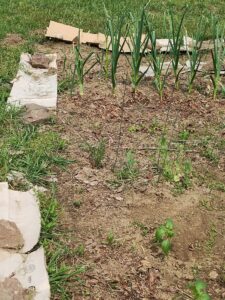
Every spring, as soon as I start gardening, my shoulder begins to ache, a dull pain that often spreads all the way down my arm. It’s not debilitating; it’s just annoying, but it’s pretty constant and I have to keep reminding myself not to overdo–set the timer and tackle the ubiquitous onion grass for no more than half an hour. Lately I’ve been feeling it most when I’m lifting heavy rocks to weigh down seed covers and cardboard mulch. And in the wee corners of my mind, I hear the niggling question of how much longer I’ll have the physical ability to keep on with this yearly seasonal ritual that brings me so much joy. Hopefully for a long time, I tell myself, deflecting with my usual optimism/denial reflex on any issue that relates to my own aging.

Photo: D. Dina Friedman

This morning I felt torn between gardening and writing group, since it’s going to get hot in the afternoon and I have a bunch of things to do then, but I chose the lure of writing group community, where someone made a random comment, “It has been a time and it’s not over.”

My friend was referring to events in her personal life, while also acknowledging that many people our age (50s and 60s with aging parents) are going through something similar. But I believe this heaviness is currently permeating among all ages as we read story after story of children starving and being indiscriminately killed in war zones, humans taken off the streets by masked men in military gear, and the myriad other ways our rights to shelter, health care, and food security are being dismantled.

I’ve encouraged people in our immigration justice advocacy network to join me in sharing some of the personal stories of immigrants who’ve been arrested, kidnapped or disappeared, knowing that reading about actual humans with lives and back story can get people in the gut in a way that vague policy statements or piles of statistics don’t. (Though one stat I will emphasize: very few of the people taken have a criminal history, unless you count trying to enter this country for a more economically secure life free from gang violence and death threats a crime. All this talk about murderers, drug dealers and rapists is a lie fabricated by the administration that’s also intended to get people right in the gut.)

However, my resolve to share these stories has gotten to the point where I can’t keep up with the flood of incidents coming into my inbox like weeds each day–high school students, families with young children, neighbors, friends…And to tell the truth, I don’t even want to read these upsetting stories any more. And if I, despite spending most of the last decade as an immigration justice activist, don’t want to read them, how can I expect others to?

Photo: D. Dina Friedman

Back at a demonstration on the border in 2020, we projected a sign. Don’t Look Away! Yet, there are some days that all I want to do is look away–curl up with the blessing of my meditation app that encourages me to simply cultivate a lens of neutrality and observation and be present in the moment.

How do we balance this appropriately mindful adage for self-care without forsaking our responsibility to our fellow humans? I keep thinking about Nazi Germany. Not the people who actively collaborated with Hitler, and not the people who risked their lives by hiding Jews in their barns and attics, but the people who may have quietly disapproved of what was going on, but did nothing and went about their lives as best they could.

Photo: D. Dina Friedman

I don’t want to be one of these people, and yet, I fear that’s what we’re all becoming. Not because we’re bad people. We’re just numb. Paralyzed by the heaviness of it all.

How do we hold onto the heavy and continue to take steps forward to address injustice, perhaps with the clarity and gentleness that mindfulness might bring? Somehow despite the pain, we need to keep lifting those heavy rocks.

Subscribe at https://ddinafriedman.substack.com

The Power of Stories

I’ve noticed over the years that I get far more likes on social media for my personal posts than my political posts. Especially if the personal post is a happy one. It makes sense. On the whole, people would rather read something uplifting, poignant, or inspirational than the gloom and doom embedded in political messages, even when they convey what I think is important information or ask people to engage in a quick, painless action.

Because of this observation, I’ve generally been judicious about posting political content, even in these trying times. But lately I haven’t been able to help myself when nearly every day I come across another story of someone being wrongfully taken by ICE and sent to prison: sometimes here in the U.S. (although often thousands of miles away from their families), and sometimes to El Salvador, where the U.S. no longer has jurisdiction over their cases and torture and abuse are even more rampant.

In many of these cases, the people taken have no criminal record. In fact, they often have legal status: a green card, a visa, an asylum case pending. In nearly all of the El Salvador deportations, the people detained have been denied the opportunity to speak to an attorney or argue the charges against them in court. Instead they are quickly loaded, shackled onto a plane simply because someone has accused them (often based on a tattoo or hearsay evidence) of being a member of a gang.

In many cases, when ICE cannot find the person they are looking for, they make collateral arrests of whoever happens to be nearby. Sometimes these people are U.S. citizens, who are eventually released, but not until they’ve dealt with the trauma of spending several nights in jail. And those who aren’t citizens–hard-working people with no criminal record–enter the detention/deportation system, even if they have parole or asylum claims pending.

Even tourists have been arrested, strip-searched and sent to jail for visa mix-ups or under suspicion of plans to work illegally.

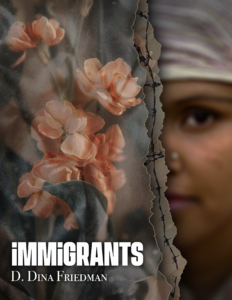
During this administration’s first term, when I wrote the stories in my collection Immigrants, I tried to envision the impact of DT’s policies on real people. While there were love stories that ended with deportation, a woman facing a dilemma of whether or not to bail out her housekeeper’s brother, and a mother in a squalid border encampment who sent her daughter over the bridge to the U.S. alone, there was a still a softness to the stories. I did not talk about the torture and abuse inherent in  detention facilities. I balanced these stories with others where immigrants played a positive and vital role in people’s everyday lives. And I took the stance that these people were victims in a system that had gone out of control due to misguided information and decision-making.

But in current times, these people are no longer victims; they’re prey. Deliberately hunted. Shredded. Devoured. And they don’t just include people who entered the U.S. without documentation. They’re people with legal status who are being imprisoned for writing op-eds or social media posts against the government’s point of view, or for organizing peaceful protests. Or they’re people who just happen to be in the wrong place at the wrong time.

I don’t feel like I can write any stories about immigrants any more because the true stories are too hard to read. And to write anything that waters down the truth is mitigating the effects of what is happening.

Yet, I know that as a writer, I have a responsibility to speak out.

So, on my Facebook feed, I’m posting these stories as I come across them. Most are from Witness at the Border, a group I worked with when I went to the children’s detention center in Homestead Florida in 2019 and the Brownsville/Matamoros border in 2020. You can read quick summaries of some of these cases in this Axios article,  but it’s the power of detail in the actual stories that really strikes a chord. In my fiction collection, one of my goals was to change people’s hearts and minds by inviting them to really know the characters I wrote about. The stories profiled by Witness at the Border do just that. I’m hoping we can get past the sadness and disempowerment and channel the power of these stories as inspiration to take whatever actions we can to make this stop.

Subscribe at https://ddinafriedman.substack.com


Taking the Plunge

One of the parts of the Passover seder I resonate with most is the story of Nachsun. Nachsun was at the head of 600,000 Israelites running away from Pharaoh’s army when he came to the frothy waters of the Red Sea–the end of the road marked by angry waves and deep water stretching all the way out to the horizon.

But, rather than succumb and turn back to the horrors of slavery, Nachsun plunged into the water. And it was only after this courageous act that God told Moses to lift his staff and part the waters, enabling the rest of the Israelites to cross over on the dry path.

https://www.flickr.com/photos/st-stev/2432121049

According to some Biblical scholars, “Nachsun’s name has become synonymous with courage and the will to do the right thing,” even when it’s f*ing scary.

So, I’ve been thinking about Nachsun as I read as much as my stomach and soul will let me: ICE smashing car windows to make arrests, taking random people who have legal status when they can’t find the ones they were looking for, arresting a man at his citizenship appointment, and grabbing an international student off the streets for having views that differ with the government, and defying Supreme Court orders and refusing to return a man who was sent to a prison in El Salvador by errorIn fact, there has been no due process for anyone sent to prison in El Salvador, and now the government is threatening to send U.S. citizens there, as well.

These are only a few of the incidents. There are more people effected, and more stories. What I learned from visiting the border in 2020 is that everyone had a personal story that made me cry and tug at my hair and fall into an awe-struck paralysis where there just were no words to fathom the cruelty of human beings.

But the people I met in 2020 were fleeing cruelty in their countries of origin. Here in 2025, they–and we–are facing an equal if not greater cruelty from our country, our fellow Americans, people that we (collectively) elected, whose lawlessness we continue to enable each day with our fear and our silence, whether or not we voted for them.

So, I’m pondering… how can we… how can I… be like Nachsun and jump into the water. Even if it’s cold and rough. Even if my swimming ability is shaky.

How can I keep my head above the rough waters and shout, NOT IN MY NAME!

Not in my name as an American, and not in my name as a Jew who rejects the contorted use of antisemitism as an excuse for this barbaric behavior and understands that the definition of a concentration camp, “a guarded compound for the mass detention without hearings or the imprisonment without trial of civilians, refugees, members of ethnic minorities, political opponents, etc.” fits this situation far too well.

In the Passover liturgy, the word for Egypt, Mitzrayim, refers to “The Narrow Place,” and some of the observance consists of reflecting on how each of us as individuals can get past the obstacles that constrict us and emerge into a wider and more abundant state of being.

I’m thinking we need to do this as a country, maybe even as a species.

How can we stop being cruel? How can we jump into the water and believe that some hidden internal goodness–divinely inspired or otherwise–will save us?