Is Gratitude Enough?

Despite my daily meditation practice, which includes listing one thing I’m grateful for each day, I have an ambivalent relationship with gratitude. It often feels unsettling to focus on the abundant amount of privilege I have–health, relationships, financial security–when so many others have more challenges in their lives. And while I do understand the benefits of centering gratitude in both the big and small moments, I worry about focusing on it too much, to the point where I’m less motivated to do what I can to make the world a better place for others.

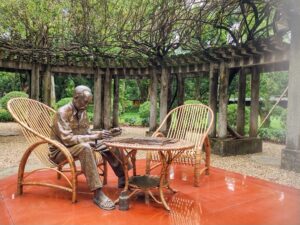
Dtobias, CC BY-SA 4.0 <https://creativecommons.org/licenses/by-sa/4.0>, via Wikimedia Commons

But today is Thanksgiving, a day we’re directed to give some attention to gratitude. For me, no Thanksgiving is complete without listening to Alice’s Restaurant, Arlo Guthrie’s classic song about how he manages to avoid being drafted into the Vietnam War by embellishing the story of his arrest for littering on a Thanksgiving Day 60 years ago. I feel grateful for Arlo: his irreverence, creativity and dry humor in a somber situation. I’ve just returned from Vietnam, where I visited the War Remnants Museum in Saigon, and saw many of the horrors close up: the countless bombs, the generations of disfigurement and health challenges from Agent Orange, the My Lai Massacre, the number of people dead on both sides.

The question weighed on me as it often does–Why do people do this sh*t to each other? What is it in the human psyche that wires us toward committing acts of cruelty that go far beyond the battlefield–as if the battlefield isn’t horrific enough. What makes it ok to shoot children, rape, torture and kill innocent civilians? I’m not just talking about the Vietnam War. These atrocities permeate all borders and all countries, stretching from ancient times to the present.

And in the wake of this, what does it mean to draw a faux border around our own Thanksgiving tables, shutting it all out? And how do we reconcile this time of gratitude with our genocidal history against Native Americans, many of whom mark this day as a time of mourning? My younger child has boycotted Thanksgiving for the past two years in order to attend their yearly protest in Plymouth. I am grateful for their activism, even though I’m not personally ready to abandon Thanksgiving, yet. But I think we need to see the holiday as aspirational, rather than celebratory. We can be thankful for the blessings in our lives, but we also need to address the holes and shadows in a tableau that falsely centers on the horn of plenty.

I’m not trying to make Thanksgiving a downer. I’m looking forward to our family cooking extravaganza, and time around the table, and pumpkin pie. And while I’m grateful for the many blessings in my personal life, I’m feeling even more grateful to the people who are following Arlo’s footsteps in being creatively subversive in not accepting the status quo: the dancing frogs in Portland, the whistle blowing in Chicago, the moms in Charlotte arranging transportation and food drop offs for immigrant families so that parents did not have to risk their safety. 

As Arlo says, “…fifty people a day walking in singing a bar of Alice’s Restaurant and
walking out. And friends they may think it’s a movement.” Today I’m grateful to all who have comprised this movement by taking actions in the last year to make life better for those endangered and at risk: whether that was protesting, donating money to people in need, writing letters to elected officials, having a difficult conversation with someone with an alternative point of view, or engaging in any small (or large) act of kindness.

Happy Thanksgiving!

How Many Words, Really, is One Picture Worth?

As someone who is much more quick to rely on auditory, analytical, or kinesthetic cues than visual ones, I’ve always been bothered by the adage that one picture is worth a thousand words. This is not to diss the importance of visual images for those who prefer that style of learning. I just think it’s important to recognize that one-size does not fit all when it comes to conveying information. There’s nothing that frustrates me more than directions that have only diagrams (no written instructions) on how to put something together. And I’ll admit, I’m a chump when it comes to trying to verify that I’m human by picking out the squares in the grid with bicycles or traffic lights. I just keep missing the images.

And while I do agree with writer/artist Leonardo Da Vinci that “a poet would be overcome by sleep and hunger before [being able to] describe with words what a painter is able to [depict] in an instant,” I find myself wanting to root for the poets, anyway–for the challenge of spending those sleepless, hungry hours trying to describe something. I guess that’s because words are the tools I’m comfortable with, while paints and brushes are not.

Nevertheless, we’re in the second week of our Vietnam/Cambodia vacation and I haven’t written anything, except last week’s blog post and a few emails to my mother. But one thing I have done is taken a lot of pictures. 132 just today at Angkor Wat.

There are some bad ones and repeats, which I’ll delete, but I’ll probably end up with around 100. Then I’ll post somewhere from 8-20 on social media with a very cursory description of what we did. Whatever semblance of poetry will not be in the words but in the pictures.

It’s just so darn easy with the click of a cell phone.

Often I haven’t liked taking pictures when traveling, because I’ve preferred to bask in the experience of being wherever I am without the burden of figuring out how to capture all the special moments in a glossy. I’d rather cherish whatever memories happen to stick. But as I’ve gotten older, fewer memories are sticking.

So I’ve been taking more photos, and learning how to do this better by being more patient–not snapping so spontaneously, but taking the extra second to think more about the frame, waiting for people to pass out of the way, playing more with zooming in and out to get the optimal perspective. I’m sure on some level, this more mindful attention to detail will bear fruition in my writing life, when I’m ready to settle into writing what I see, whether in the present moment, in past memories, or in my imagination.

In the meantime, here are 3 pictures of Angkor Wat and the surrounding temples. Probably better than writing 3,000 more words–or asking you to read them!

Subscribe at https://ddinafriedman.substack.com


Ho Chi Minh is Everywhere

Photo: D. Dina Friedman

Photo: D. Dina Friedman

We’ve been in Vietnam for just a few days and I’ve probably seen the face of Ho Chi Minh more than a hundred times: on statues, on banners along the sides of buildings, in posters in store windows, on book covers, on the money. It’s a name and face from my deep past. I was a child during the Vietnam War (which is referred to here as “the American War,” “the Bomb War,” or “the Destroy War”). I was too young to have much understanding of what was going on. I knew that my family was divided. My parents, while not activists, were firmly against the war, and my grandparents and great aunt were convinced that the war was absolutely necessary to stop the “great evil” of communism. I remember their arguments at the Thanksgiving dinner table, my grandfather reciting the name of Ho Chi Minh as synonymous with an evil my child-brain could only associate with monsters.

Photo: D. Dina Friedman

Yet, here I’m hearing a very different story, of a man who never married because he gave his life to the country, of someone who lived simply, in a two-room house on stilts, saving the opulent government residence for official events. Of someone who had hope and vision, and persistence, and did not give up despite the long struggle to shepherd the Vietnamese people toward independence after 100 years of French colonization, and a thousand years of Chinese colonization before that.

While I know that freedom of speech is not a given here, and that I may not be hearing the entire truth, I think it’s important to acknowledge the varying perspectives  surrounding this important figure in history, who seems so clearly loved and venerated by many as a national hero. And I think this serves as an important lesson for current times in how those in power try to villainize those who challenge that power, especially when these challengers attack the status quo.

Take the recent mayoral election in New York, for example. Zohran Mamdani, the mayor-elect is a 34-year old Muslim Democratic socialist who focused his campaign on affordability. Mamdani’s campaign promises included stabilizing rents, creating more free trasnportation and childcare, and initiating city-owned grocery stores, all of which he proposed to pay for by adding taxes on the 1% and on corporations. Needless to say, these ideas felt threatening to many of those who uphold or are benefited by the power structure, so they went on the attack–but not by refuting the ideas in Mamdani’s campaign platform or offering alternatives. Instead, they tried to delegitimize his platform and brand Mamdani as an enemy by using words like “terrorist,” “communist,” and “anti-semite,” words that are deliberately loaded and are designed to evoke fear and undermine people’s sense of safety and security.

And the more we get sucked into ignoring the nuance and complexity of any individual and rely instead on portrayals of people as cardboard cut-outs of heroes and villains, the less chance we have of truly understanding our fellow humans and making our troubled world more livable for all of us.

In fiction-writing we’re warned to avoid flat characters–two-dimensional stereotypes who have no depth, and may help move the plot but don’t undergo any real change. And one exercise we’re often asked to do to add more nuance and depth is to take a scene we’ve already written and write it from a different character’s point of view. The Nigerian writer Chimamanda Ngozi Adichie also urges us to embrace the multiplicity of perspectives in her excellent TED talk, The Danger of a Single Story.

I don’t want to go all Pollyanna about this. I freely admit to harboring many negative thoughts filled with villainizing loaded words about a certain political leader we won’t honor with a name, who, unsurprisingly has used this villainizing tactic quite effectively to delegitimize his opponents. But I can also see how this isn’t useful in the world of our better angels–both in terms of my own mental health and in terms of creating the world I’d prefer to live in.

I never thought–during the war, and after Vietnam “fell” (as we claimed in our loaded-word way) to the Communists that one day I’d be vacationing in Vietnam. And that the place would be thriving with music and restaurants and people dancing in the streets. But here I am. And Ho Chi Minh is everywhere.

Subscribe at https://ddinafriedman.substack.com


Taming the Baby Raccoon

While I’ve written before about the joy I find in traveling, I haven’t written about the creeping anxiety that looms larger and larger as I get close to departing on a trip.

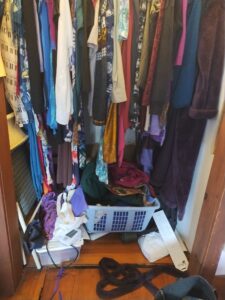
My to-do list swells so much, it feels like it’s on steroids. I get fixated on things that don’t really need to happen and try to convince myself I can’t leave until I’ve cleaned my closet–even if I haven’t cleaned my closet in the last six months–or six years. Even when I’m aware of the pattern, the niggling will not let go. Here’s the messy closet I will NOT clean before I leave.

But that doesn’t mean, I won’t scour the nooks and crannies of my life for other household and administrative loose ends that would be better off tied. And it’s not just me. My partner, Shel, decided a couple of days ago that it would be good idea to put away all the herbs we hung to dry on the window frames months ago. (So far he’s only gotten through a quarter of them, LOL!)

The rationale is valid, if it didn’t up the ante on the anxiety arising from the pressure of getting all these things done on time. Because time, as any stress management course will tell you, is finite. And at some point, it will be gone. The plane will take off, and, providing all goes according to plan, you will be on it, regardless of what has and hasn’t gotten done. So I’m trying this time to simply laugh at some of these unnecessary inclinations and focus on the things I absolutely have to do to get ready for this trip, while at the same time trying to tame that rising since of dread in my chest.

A recent meditation tape suggested that I think of anxiety not as a monster but as a baby animal that needed love and reassurance. For some reason I envisioned a raccoon, its large eyes and black mask a prominent focal point of its tiny body. Even as the image first arose, I found myself wondering why I’d chosen a feral scavenger and if there was some metaphor about the mask. Not sure, though I think there might be something about the scavenger bit. Anxiety does feed on anything it can find, which may be why I keep adding things to my to-do list that I don’t really need to do. And “feral” makes sense, too, because you can only control anxiety so much.

But you can also let a feral animal go off and do its own thing. And that’s what I intend to do with this pre-trip anxiety: look out the window and wave to it, wishing it well on its scavenging journey. Then I will focus on what’s essential–and if there’s extra time, what’s realistic–to accomplish in the 48 hours I have left before I leave.

And once I’ve closed the door to my house for the final time and checked my bag for the super essentials–passport, wallet, phone, computer, chargers, glasses, etc.–I’ll remind myself that I’m not venturing off into thin air. Likely, if I have a problem with a lost or forgotten item, or something essential that needs to be done, there will be a way to address the issue. And then, I’ll appreciate myself for being resourceful and remind myself of some past travel mishaps that may have been frustrating at the time, but now make good laughable stories.

And I’ll watch as that little raccoon in the corners of my mind trots off and buries itself for a nice nap in that pile of brush I did manage to clear from my garden before we left–even if I didn’t nearly tackle all of it!

Subscribe at https://ddinafriedman.substack.com