Speaking Truth to Power

A few years ago, shortly after George Floyd’s murder by the Minnesota police, my late brother, Danny, asked me if I believed in critical race theory. He wasn’t particularly interested in my answer; he was just trying to goad me as he’d done all our lives, making fun of my favorite baseball players when we were kids, dissing the few rock stars I admired that he didn’t like when we were teens, and later tuning into our political differences as he sunk deeper and deeper into the influence of Fox News.

“I don’t call it critical race theory,” I told him. “I call it truth.”

I earnestly began to explain why I thought it was so important that we learn a true accounting of our history–the good, the bad, and the ugly–rather than a white-centered version that discounted or trivialized the experience of black people in the US. He didn’t really listen. I would have liked to chalk that up to ADHD rather than to our past history, except that he kept interrupting me with sound bites he’d clearly heard on TV that had little to do with the points I was trying to make.

Not so different from the sound clips from news pundits about a recent assassination of a right wing leader that Jon Stewart used in his “government-approved monologue” recorded after Jimmy Kimmel’s firing.

Just to be clear, I don’t condone political violence. No matter who does it to whom, and no matter what the underlying motivations might be.

But I also don’t condone this administration’s vilifying those that oppose their policies. I don’t condone their outright lying, or–as they would call it–“alternative facts.” I don’t condone their attempts to simply remove information that doesn’t speak to their political agenda, such as scrubbing DEI from government websites, removing the mention of slavery from national parks, and targeting exhibits at the National Museum of African American History, just to name a few of many examples.

While I agree that those grieving the dead should be respected, I don’t condone the administration’s and right-wing news media’s sanctification of the recently assassinated MAGA influencer after they ignored they ignored the assassination of Minnesota State House Speaker, Melissa Horton, for whom the flag was not lowered.
Narih Lee, CC BY 2.0 <https://creativecommons.org/licenses/by/2.0>, via Wikimedia Commons

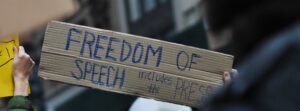
Sadly, this is the first time in my life that I feel I need to choose my words very carefully. The freedom of the press and the freedom to express our opinions that our (quite conservative) teachers taught us about so proudly in elementary school is at risk. Even though Jimmy Kimmel has now been reinstated on some, but not all, of the ABC-affiliate stations, others who commented with concern about some of the things this leader said about black people, Jews, LGBTQ, women and other marginalized groups permanently lost their jobs.

But as writers and as human beings, our moral imperative is to speak truth to power, no matter how much we might dislike being goaded, or cowed, or threatened to stay quiet. Coming out of Rosh Hashanah, I realize this one of the things I need to do more of in the New Year.

Poet Ilya Kaminsky nails it here:
WE LIVED HAPPILY DURING THE WAR
And when they bombed other people’s houses, we
protested
but not enough, we opposed them but not
enough. I was
in my bed, around my bed America
was falling: invisible house by invisible house by invisible house.
I took a chair outside and watched the sun.
In the sixth month
of a disastrous reign in the house of money
in the street of money in the city of money in the country of money,
our great country of money, we (forgive us)
lived happily during the war.
#art for change


Leaning Into the Light

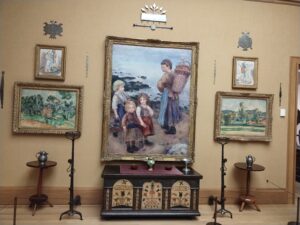
I spent a couple of days this week playing tourist in Philadelphia. A highlight was the Barnes Foundation, where one person’s awe-inspiring collection of impressionist, post-impressionist, Greek, Egyptian, African, and early American art is crowded together in a fairly random way in 23 compelling rooms.

  Notable was the number of paintings by Cezanne and Renoir. There were at least one or two, if not more, works by these artists in every room. In fact, there were so many paintings by Renoir, I found myself wondering how he ever had time to create all of these in addition to the many I’d seen at other museums in the world.
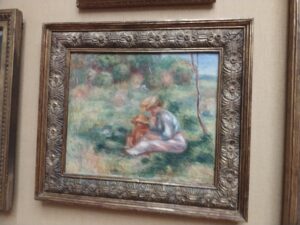
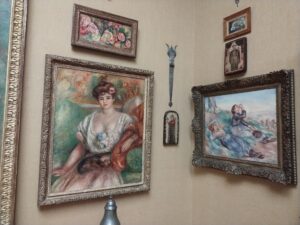
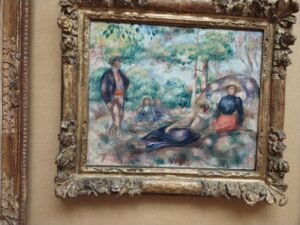
Back in my teenage and early adult years in New York City, where I spent many hours wandering the halls of the Metropolitan Museum of Art with friends, learning from several who were serious visual artists, I, along with them, was a bit disdainful of Renoir. Too romanticized, we agreed. Too much focus on what’s pretty. But looking at Renoir’s paintings in these unsettled times gave me a new layer of appreciation. He’s zeroing in on gratitude, I thought. On what’s good in the world. He’s leaning into the light.

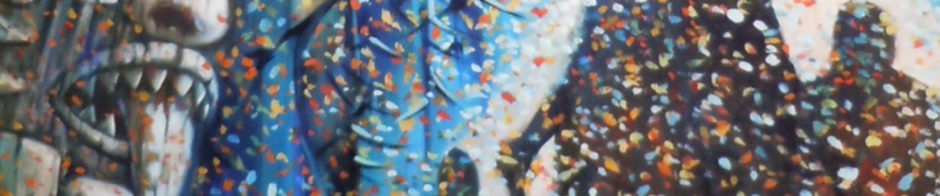
And, indeed, it was the way light shone so brilliantly through the canvas that kept my eyes drawn to his work. Unfortunately, the pictures I took (below) don’t really show how brilliant the light was and how much it warmed the colors.

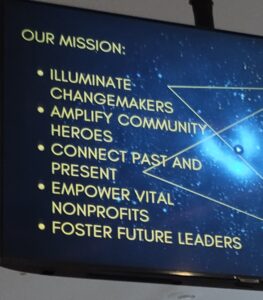
Later that evening, I was invited by an old friend to attend a different arts-oriented event celebrating the city’s community leaders. This was organized and sponsored by Philadelphia Legacies, whose mission is to uplift the work of individuals who are giving back to the city. Among them were Rev. Dr. Respie M. Warren, a woman who has dedicated her life to bridging the gap between deaf and hearing communities; Georgie Woods, an influential media figure and civil rights activist; and Wilson Goode, first African American mayor of Philadelphia, who has continued his work as a change-maker through mentoring children impacted by incarceration. Local artists were commissioned to make portraits of these and other community leaders (media and social change pioneer, Tiffany Bacon; and Tennis Hall of Fame inductee and President of Black Women in Sports, Traci Green) so that residents of the city would learn about these people in their community and be inspired by them.
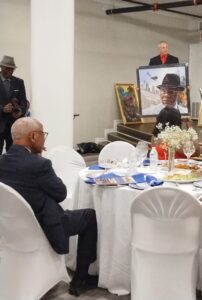
Wilson Goode (seated) looks at his portrait created by artist Oranda Curry Johnson

One might think of my trip to the Barnes Foundation and time at the Philadelphia Legacies dinner as two separate events in my day, and it’s certainly true that there was a huge difference in the style and ambiance of the art itself and the general demeanor of both events. But I found it inspirational to think of these as examples of the many ways that art can lean into the light and change lives by inspiring people to be their best selves, whether it’s used to remind us to seek gratitude in the small pleasures of daily life, or to take larger, braver steps toward making the type of world we want to see. #artforchange

Subscribe at https://ddinafriedman.substack.com

Chainsaws Gone Wild

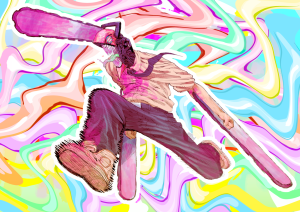
Photo by haemd: https://art.ngfiles.com/medium_views/ 6994000/6994772_2373943_haemd_ chainsawman.88461deeb7794d08f5f 382a77717451f.webp?f1756587284

Last fall, I was outside with my grandchild, Manu, when he heard a motorized noise and asked me what it was.

It didn’t exactly sound like a lawn mower, or a weed whacker. “Maybe it’s a chainsaw,” I said.

“Let’s go see it.”

He got in the stroller and we took off in search of the noise, taking a few wrong turns before we found the perpetrator–a very scary industrial-size leaf-blower, sucking up everything around it.

“I want to go home!” Manu shouted as soon as he realized what it was. He’s always hated leaf blowers.

At the time I didn’t find this incident particularly significant, except that Manu wouldn’t let go of his desire to see a chainsaw. In fact, for nearly a year after, every time he heard any kind of motor after that, he asked me if it was a chainsaw, even if the lawn mower, or the motorcycle, or the helicopter was clearly in sight. And he also asked me–often–to tell him the story of “Manu and the Chainsaw,” where I’d recount the chainsaw-turned-leaf-blower-search” in detail, embellishing shaggy dog style with my purplest toddler-appropriate prose.

The story always ended like this: Manu was very, very sad that he didn’t see a chainsaw, but Grandma said, ‘That’s okay, Manu. We’ll get to see a chainsaw some day.’

Last week, two houses down from his, the neighbors were cutting up a dead tree. Manu stood mesmerized, holding my hand at the edge of the grass, a little scared, a little awed, as the neighbors ran the chainsaw over and over through the dead wood.

***

I’ve been thinking a lot about this story, and its relationship to how we deal with things we anticipate once we see them.

Especially things that are unpleasant.

For months, we’ve been told fascism is coming, hovering at the edges of our democracy, eating away at it in small bites. We’ve been told that if we don’t turn the tides in three months, six months, nine months, or by the mid-terms at the latest, we’ll be doomed.

But fascism is here. Because ICE is here: Masked thugs over-running our communities, lawlessly breaking car windows, pushing their way into houses, taking undocumented people who have been here for years, as well as people with legal status, green card holders and even U.S. citizens.

In other words, kidnapping.

We may not have personally seen ICE yet; those of us who are privileged may feel like we still have time because in our day-to-day lives, everything is normal. We still wake up in the morning, work, exercise, garden, parent, make dinner, watch our daily TV shows. If we don’t pay attention to the news, we can live happily in a pretend world where nothing has changed.

On Labor Day, I went to a rally in support of a local farmworker who is one of over 2500+ victims taken by ICE in Massachusetts alone. An organizer who spoke said she was in the car accompanying this man to a court hearing when three cars surrounded them, threatening a head-on collision if they didn’t stop. Six men surrounded the car, pointed a gun at her face, and dragged him out.

This man’s only crimes: a broken tail light and wanting a better future for his family.

The whole incident took two minutes.

This man was following government protocols. He was on his way to a court hearing. If the government wanted to get rid of him so badly, they could do that through due process. But due process is no longer a given in our fascist state.

I’m pretty sure Manu had no idea what a chainsaw was when he first asked to see one. And while he’s now seen one in action, I’m still pretty sure he has no idea what a chainsaw can do when used inappropriately. If his parents, and I, and the other caring adults in his life have our way, he’ll never find out about the Texas Chainsaw Massacre.

But too many of the authorities in our country–ICE, CBP, and any police department that cooperates with them–are chainsaws out of control.

Meanwhile, like my grandchild, too many of us are just standing at the edge of the sidewalk gaping. Not because we’re bad people, because we just don’t know what else to do.

This is not meant to guilt-trip. If I knew what to do, I would happily end this post by saying so. I do believe, however, that acknowledging the reality of what’s happening is an important first step. And that art and activism; connection, community, and kindness all have a role in bringing about the world we want to see. Let’s hope it will ultimately be enough. #artforchange

To subscribe: https://www.ddinafriedman.substack.com