Art for Change

Next week, I’ll be launching a month-long series of social media posts on the theme of Art for Change. I’ll be spotlighting various artists and artistic projects, posting questions for us to contemplate in our own creative journeys, and offering thoughts in text and short videos on issues related to writing in dark times. I hope you’ll stay tuned and tell others who might be interested. (People can follow me on Substack, Facebook, or Instagram.)

But today, I want to write about joy.

We could think of joy as the flip side of darkness, but I think it’s more integrated than that. As I walked through the woods early this morning, contemplating my Elul challenges this year (Elul is the month before Jewish New Year, where it’s traditional to do an extensive “soul-accounting” of places where you’ve “missed the mark” and then work on setting new intentions and forgiving both yourself and others you may have inadvertently wronged), I had an insight that the biggest challenge for me would be figuring out how to simultaneously hold onto the joy and gratitude of being alive without abandoning my responsibility to do as much as I can to work for a more just, equitable and humane world.

As beloved Charlotte’s Web author E.B. White articulated so perfectly,

“I arise in the morning torn between a desire to improve (or save) the world and a desire to enjoy (or savor) the world. This makes it hard to plan the day.”

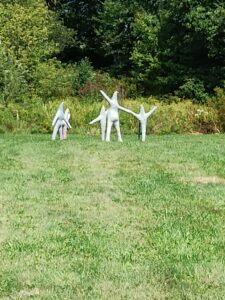
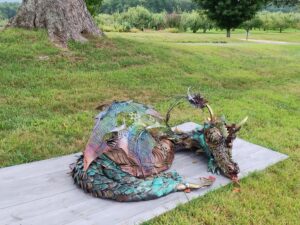
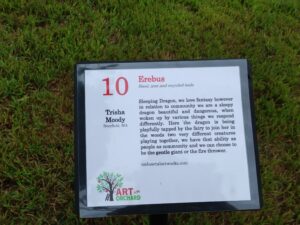
I got some inspiration from the offerings of our local biennial Art in the Orchard show, which I went to this past Monday. So many of this year’s works evoked fantasy or whimsy, and many of the artists said in their statements that the darkness of the times inspired them to look even more purposefully for a way to showcase joy. Maybe we need a little bit of magical thinking, like imagining this sleeping dragon playing with a fairy, rather than breathing fire, as explained in the artist’s statement below the photo. (All the pictures are mine.)
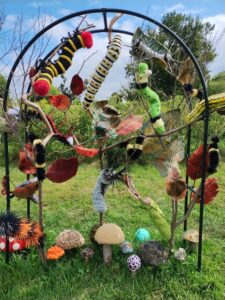
And I loved these playful caterpillars–and these rocks, dancing for joy.
 

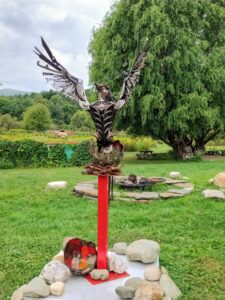
And here’s another image worth holding onto: the phoenix rising again!

My first question (a bonus before we get to the campaign): How do you manage to balance the heaviness and the joy? I’d love to hear your thoughts.

Subscribe at https://ddinafriedman.substack.com


Or one of my favorites–the phoenix rising again.
Re-Claiming Voice

A few years ago, I started to lose my singing voice. It was a long, slow process where first occasionally, and then more and more often, I’d find myself in mid-song and unable to reach the next set of notes, my voice unraveling into some gravelly, raspy shadow of itself.

When the issue first started, I could usually get some semblance of my voice back by drinking some water and singing more softly, but it got to the point where I could barely get through a line without croaking. And while I’ve never been a diva singer or even a karaoke regular, singing has always been extremely important to me. I mourned the loss of my ability to sing as an inevitable consequence of aging, exacerbated by vocal disuse (I’d abandoned weekly singing in various choruses when the pandemic started in 2020) and felt so sad that I’d ever again be able to feel the ecstasy and musical rush I got from singing in harmony with others.

I tried to console myself with reminders to feel grateful that compared to all the aging ailments I could have, this one didn’t significantly threaten my health or functionality, but I couldn’t quite let go of the grief. Mental health is also important, and while it’s not my “art,” the way writing might be, singing is a key piece in my creative and emotional expression toolkit that keeps me balanced and happy.

For more than a year, I didn’t do anything other than complain about my loss. Then, I did something that felt really risky: I took voice lessons. I’d never had a voice lesson in my life, because I never really considered myself a singer. But I thought if I could just take a few lessons, I’d learn to do some exercises that might help restore at least some of my voice, kind of like vocal PT.

Of course, it wasn’t that simple–or that quick–but a year later, I have nearly my entire voice back–including some notes that have always been hard to reach. It’s such a thrill to practice with karaoke sound tracks on YouTube. And last week, for the first time in years, I went to a community sing, and instead of feeling frustrated and shut down, I was euphoric.

In addition to now thinking about re-joining a chorus sometime soon, I’m also thinking about the metaphor of finding voice. We writers talk all the time about the importance of establishing a credible and consistent voice, and how that voice functions to engage a reader and drive a piece forward. But voice does more than that. Writer Meg Rosoff says, voice is “about finding out who you are.” In addition, she makes the following three important points.

  1. You need confidence and self-knowledge to speak in your own Voice.
  2. The only real block to writing truthfully is being unable to access what is in your head and heart.
  3. A distinctive voice will not just help you write well. It will help you do anything at all well. (https://www.megrosoff.co.uk/blog/2011/11/14/how-to-find-a-voice)

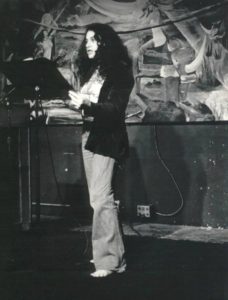
Not singing, but one of the first times I publicly used my voice, reading poetry at age 22 at Eric’s Backroom in New York City, Photo by Lew Holzman

I’m thinking about this third point as I consider another aspect of voice: the need to raise our collective voices against injustice. And I hope that this mini-miracle of re-claiming my literal voice will help me believe in the much bigger miracle: that our voices matter and can–and will–make a difference, whether we use them for activism, writing, or singing.

Subscribe at https://ddinafriedman.substack.com

Intentions

I have a great meditation app called Insight Timer. In addition to guided meditations of various time lengths from a wide range of practitioners, it also has breathwork, yoga, motivational courses, music, and occasional challenges to focus on an area that challenges us from being our calmest, happiest, and most productive selves.

Most recently, I’ve joined a 10-day “morning routine challenge,” where each day introduces a new tip for starting the morning in a more healthy and meaningful way than my current habit of lazing in bed skimming the news and doom-scrolling social media. It’s enough to feel like I’ve started any day on “the wrong side of the bed,” but somehow I can’t bring myself to stop.

Even worse, I usually ignore the daily poems (from Rattle, SWIMM, Only Poems, the Slowdown, and the Academy of American Poets) that pop into my inbox, opting instead for political pundits. True, I may not be awake enough to take a deep dive into the more difficult to decipher poetry, but wouldn’t it still be better to carry a few precious smidgeons of imagery and language into my day, rather than the reminders of all that’s going wrong in the world?

Interestingly enough, today’s morning routine challenge session was about setting intentions. Not a new topic for me, and likely familiar to many of us. But I still need to be reminded that an intention is not a to-do list (which I’m way better at); it’s a mindset, focused on the qualities we want to embody as we go about our day. Insight Timer asks me every day what my intention is, but since (other than during this morning routine challenge) I generally only use it before bedtime, I always ignore the question. Still it’s an important one. Today, I set the intention to be more balanced and focused, as I knew this mostly unscheduled day would offer many choices on how I might spend my time, all of which seem like high priority. And one of my challenges when projects pile up is not being able to focus on anything, because I’m too worried about the things I’m not doing.

Photo: D. Dina Friedman

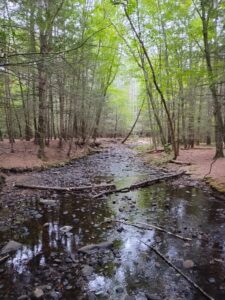
I can’t yet say whether I’m meeting my intention as we close in on midday, although I can say that so far I’m not feeling as worried about all I won’t get done today. And perhaps I was a tad more mindful in focusing on the amazing sunlight and appreciating the cool breeze before the impending heat when I went for a walk earlier this morning at Amethyst Brook in Amherst, rather than thinking too much about all I needed to do when I got home. (One of my priorities is and will always be exercise–especially walking in nature.)

Even though I still haven’t made intention-setting a habit, I can see that this practice would be especially helpful to writers, musicians, artists, etc., because it can help focus our attention on process rather than on product. Instead of mentally beating ourselves up for not writing when we sit down to write, or writing something we think is “bad,” we can set an intention, for example, to simply be open to whatever sensory observation or language pops into our heads. I know that when I returned to playing piano after a many-decade hiatus, what got me through several months of frustration and the heavy weight of generational shame for not originally “making it” as a musician was the very specific intention I set to play without judgment. In fact, I made a deal with myself that whenever I started judging, I needed to close the piano lid and walk away.

However, whenever I walked away from the piano, I felt sad and disappointed because I had enjoyed playing. So, eventually, I was able to quiet my inner judge and simply be open to the moment, complete with all its bliss and all its flaws.

I hope we can all get to a place where our intention-setting leaves us more open to embracing the whole of ourselves–the creative places and the stuck ones.

Subscribe at https://ddinafriedman.substack.com


Protest Poems

Today I woke up to some good news. Two more of my poems were today’s offerings on the Substack site Second Coming, a poem-a-day protest against the threats to our democracy by our current administration.

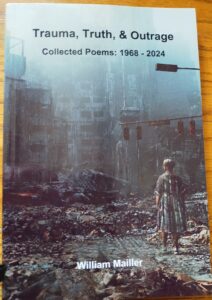
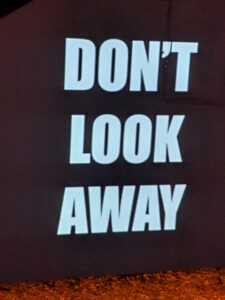
And last night, I went to hear a writing colleague, Bill Mailler read from his new book of social justice poetry, Trauma, Truth, and Outrage. Bill’s poems tend to be gut-punches. He doesn’t shy away from horror or attempt to beautify it through language. His work is like that sign our small group of witnesses illuminated at the border in 2020: Don’t Look Away.


What I liked most about Bill’s work were the questions relating to our human capacity for meanness, a key component of the poem, Meditations on My Whiteness, where he asks directly:

For what possible reason
could good or well-meaning people perpetuate or participate….

before offering a long lamentation of possibilities including:

because we are cowards and cannot acknowledge
the consequences of our actions?

because we teach our children to deny their natural empathy
for others, themselves, animals, and the earth itself? 

I also think constantly about the issue of human cruelty. Though my own work tends to take a less direct approach to writing about political issues, neither is wrong or right. They’re just different. The point, I think, is to enter the world through a lens of empathy, rather than simply ranting or trying to be prescriptive about what you think should be done. Poet Kwame Dawes talks eloquently about this issue in his own writing: When I write the poems about Haiti, people living with the disease, I’m not writing poems so that people will give.. but so the person who experiences when they read the poem, they’ll say to me… that’s it. That’s what I’ve been feeling but I didn’t know how to say it.

As many of us are staggering through these times with deep and heavy feelings about what’s happening in the world, reading a protest poem or a political piece of artful prose can help us feel less isolated as we try to make sense of our grief and uncover a path through it into some kind of meaningful action. That’s why when I’ve read my own protest poems at workshops or readings, even raw and unfinished generative responses to prompts, I often got more positive feedback than I expected because I was able to verbalize something that someone else had not yet been able to verbalize–touched a nerve, so to speak.

This isn’t to say writing protest poetry is easy. While I do believe that all attempts at creative expression should be acknowledged, respected, and validated, it’s difficult not to fall into ranting, generic abstractions, slogans, self-pitying, etc. And the problems with these pitfalls is that it becomes easier to lose the reader, who’s likely heard it all before and can gloss over or check out. Keeping empathy in the forefront can help. So can paying careful attention to language–using sensory details, fresh verbs, and unexpected metaphors. In prose, this might mean creating vivid scenes where the viewer can watch what’s happening to characters and form their own judgments.

What has made the process of writing protest poems and stories slightly easier for me in the past decade has been my being able to more fully integrate my life as a writer and an activist. While this wasn’t true in my earlier life, I now feel the fallout from political issues as viscerally as the other subjects I feel urged to write about. Allowing myself to deeply feel the horrors of all I read about in the news has certainly made it more difficult to maintain emotional balance, but I do think it’s necessary. We need, somehow, to find a path into a more deeply rooted empathy if we really want to break the pattern of ignoring atrocities–often done in our name by a system in which we are all still passively participating.

Subscribe at https://ddinafriedman.substack.com