Metaphors

slowking4, CC BY-SA 2.5 <https://creativecommons.org/licenses/by-sa/2.5>, via Wikimedia Commons

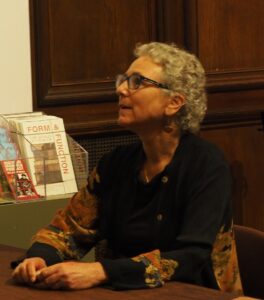
I finally dived into Ellen Bass’s Living Room Craft Talk Series (half-price sale ends today) and so far, I’m finding it well worth the value. Though I usually find it hard to focus when listening to online lectures, Ellen has a way of making you feel as if you are truly in her living room. But make sure to have a notebook at your side to jot down the countless gems of tips and inspirational tidbits, and be prepared to press pause to play things over. However, even if you miss stuff, Ellen has graciously included handouts of all the quotes from her lecture in their entirety, as well as the sources of the books they’re in, so you can read more of what grabs you most.

While I might have arrogantly thought that after a lifetime of writing poetry I knew everything I needed to know about metaphor, I was surprised how much I learned from Ellen’s examples of the different ways writers use metaphor. And while I often express things in metaphors in all sorts of writing–including even emails–I’m often not super conscious of when and how I’m using metaphors in my poems, and whether I’m milking their impact to the fullest.

So yesterday I reviewed all the poems in the packet Ellen used to supplement her lecture and highlighted all the metaphors. While on my first read I’d recognized the ones that stood out in the wow zone… (e.g. grief as a homeless dog from Denise Levertov’s Talking to Grief & hands that “fly up like two birds while I speak” from Tim Siebel’s Ode to my Hands) I was amazed at how many metaphors there were, and how smoothly they flowed through the poem… to the point where I barely noticed the comparisons.

This led me to thinking more about metaphor as a conscious tool, rather than a momentary flash of subconscious inspiration (which is where I probably get 90% of my metaphors). Ellen talks about the importance of really working metaphors… choosing where to insert them by creating little slits in a poem in places where the message/meaning/image can be unpacked to create more emotional resonance or exploration of nuance. So I looked at one of my poems in progress, surprised to discover that in this particular poem there were no metaphors–just a generative rehash of a difficult emotional situation broken up into lines and made to look like a poem. I wasn’t sure this poem would have legs for anyone but me, but I spent some time consciously inserting metaphors and detail… and lo and behold, something with perhaps a little more staying power began to emerge. I’m still not sure whether the poem will have enough meaning for others, but I do believe the details and the comparisons have the capacity to generate more places for others to connect.

I know that people have different degrees of tolerance for metaphors. There are some folks who can find meaning in an amorphous avante garde play and others who prefer more directness and clarity. So, it’s important to think about what our audience(s) might need and how we want them to respond to our writing, and then craft our metaphors with care. Ellen points out the importance of grasping for the unusual metaphor, rather than the expected one, but not so unusual that people can’t make the leap. But I also know that not only have metaphors improved my  writing by giving more life and possibility to images and details, they’ve also helped me communicate hard stuff to others through a story or image that’s more relatable than a common abstraction.

And I love how metaphors often take on more than I might have originally intended through the lens of a reader/listener’s interpretation, unveiling possibilities that neither of us might have previously considered.

Subscribe at https://ddinafriedman.substack.com

 

A Sense of Place

I’m always surprised that no matter how much I might originally intend otherwise, the bulk of my fiction (including nearly half of the stories in Immigrants) is set in New York City–with a large percentage in the immediate neighborhood where I grew up. While I’ve often joked, You can take me out of New York, but you can’t take New York out of me, this is really more of a truism than a joke. Each time I visit, I can feel the city’s resonance and vibrancy, even as I recoil at the noise of the subway chugging on the elevated tracks, or the food wrappers and soda cans tossed into people’s yards and the flyers disintegrating into muck in the puddles along the curb.
As a child, I never noticed these kinds of details. Tuning out was my superpower. I kind of had to in order to stay sane. As someone who had a rich fantasy life with imaginary friends since I was very young, it always felt way more easy and pleasant to pay more attention to the world in my head rather than the world around me. So all the ugliness of New York, or anywhere, never seemed like a problem. But tuning out is a problem when you’re trying to establish detail in your writing and develop a strong sense of place.

In the book I’m working on now (in fits and starts), the two teenagers who center the story both live near where I grew up in Queens. One lives in the rows of brick apartments in Jackson Heights, and the other lives a couple of miles closer to Manhattan in a row house on a rundown block in Woodside. So, on my most recent trip to New York to visit my mom earlier this week, I spent some time exploring both neighborhoods for street details I could use, trying to pay attention to who was on the street in both locales, what public places (stores, schools, parks) were nearby, and some precise specifics on what the houses looked like in detail: Peeling paint? Colors of the houses?  The arrangement of numbered addresses on the doorframes? What kind of door frames? Types of gates framing the steps? How many trees and other plantings were on the block and what kind of shape were they in? The list of questions you can ask about the concrete (pun intended) nature of a place can go on and on.

True Confession: I can think of very little that is more boring that developing lists of these kinds of details–even though I know that some people thrive on this. There are writers out there who are marvelous stylists, known for their ability to describe meticulously. And these are people who will happily lose themselves in place research and/or other types of historical research, taking days or weeks to investigate all the nuances and possibilities before committing words to paper. I admire them!

Call me lazy (though I’ll argue than in most aspects of my life I am anything but lazy!) but I just don’t do this. My descriptions aim for just a few salient but highly sensory details, which, when I feel I need to, I flesh out with metaphors, rather than more particulars.

Neither way of describing is better–or worse–they’re just different.

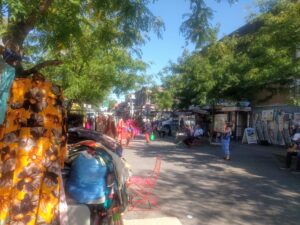
Diversity Plaza, Jackson Heights, NY (I took this pic on a previous trip.)

And another true confession–though not necessarily what I’d recommend: I didn’t take notes on my walks through these neighborhoods. I didn’t even take pictures (though I might be able to rely on some pics my partner, Shel, took.) Instead, I plan to rely on what I remember, perhaps a bit blurred or distorted from what I really sensed, but, hey, I’m writing fiction, not documentary.

And like a watercolor wash over whatever details I try to bring to life will be my long history with the city where I grew up and came of age–a melding of what’s actually there and my inner response to it. Because even as I grooved in my fantasy world in the countless hours where I walked the streets of New York as a younger person, it seeped inside me and will be there forever. As I said, you can’t take New York out of me. 

Subscribe at https://ddinafriedman.substack.com


Putting Your Work Away and Bringing It Back

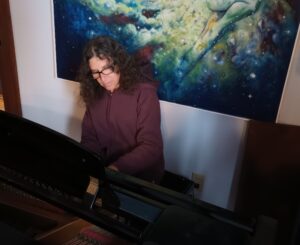
My daughter’s piano teacher used to tell her that when you put a piece away for a while and then bring it back, it comes back better.

I think this is also true for writing–at least it’s true for me.

Most recently, I “put away” my piano memoir, Imperfect Pitch, for several months. I had been shopping it around unsuccessfully for a couple of years, and then I was offered a consultation with an agent who told me she thought it would be more marketable if I turned it into a “self-help memoir.” So, last summer I added a bunch of short sections reflecting on the themes I’d raised and offering prompts and prescriptions people could use to tackle perfectionism and self-judgment while amplifying joy and forgiveness. I was excited to give that version to a few readers, but then disappointed when they uniformly said that the self-help voice was intrusive and detracted from the thread of the story.

I put the book away for a couple of months so I could read it fresh. But other than realizing that they were right, I couldn’t figure out what to do.

Then winter hit, along with the new administration and my father’s illness and death, and I was too depressed to do any substantive writing for a while. But the book was there at the back of my mind, niggling me. The project was too important to me to abandon. In fact, of all the things I’ve written, this is the book I most want people to read, because I believe its messages about creativity and mattering are essential to healing ourselves–both individually and as a culture. That was why I was going for an agent and the big publishing houses, rather than the small ones–and why I was willing to take this agent’s advice about so-called “marketability.”

But as the months passed and my writing fog started to clear, I realized it was ok for me to loosen my expectations on the marketability angle. I’ve always personally been an outlier when it comes to popular culture. So why should my book be any different? Yet, there was something in the added sections I liked–a wiser voice that could look back on the memoir incidents I wrote about and make sense of them. It was the poplike “you-too” voice that felt insincere and inauthentic to my newly attuned ears.

So, I took out that voice and shortened the reflections, making sure they all sounded like me–a wiser, calmer me than the me in the throes of wrestling all my musical baggage, but still me, without artifice. I hope they now feel like a cool wave momentarily breaking the heat. We’ll see. I’ve given the book to at least one more reader. And then, after what will likely be another round of revisions, it’s off to market one more time–perhaps no longer exclusively on the big press circuit. While I’ll continue to attempt to build my platform, I’m no longer interested in being anything less (or more) than who I am, whether or not my messaging ever gets popular enough to build a huge following.

Photo by Shel Horowitz

Incidentally, I also put away the Brahms Intermezzo I fell in love with and worked diligently on for two months. I got it down pretty well, but far from perfect. Which is ok, now that I’m no longer mentally beating myself up for piano imperfections. Still, I hope I’ll be able to make it way better when I pull it out again.

Have a listen here from pianist Jean Marc Luisada.

Subscribe at https://ddinafriedman.substack.com


Empathy

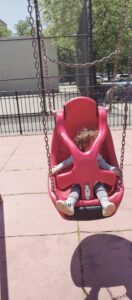
My 2.9 year old grandson, Manu, loves the playground, especially when there are no other children and he has the whole place to himself. A few days ago when we arrived, we saw another kid in the sandbox who waved to him enthusiastically. “That kid wants to play with you,” I said.

He hesitated before answering, then said, “I don’t play.”

Photo by Shel Horowitz

This surprised me because I have clear memories of being 2 and wanting nothing more than for other kids to play with me. I remember Linda, who lived a few houses down in the apartment complex we lived in and how I liked nothing better than running down the hill with her at top speed in our shared yard. And in kindergarten, I remember Mary Ann, with her perfect blond braids, how I cried because the teacher wouldn’t let me sit next to her.

While I don’t remember the specific incident, I also remember the day I came home from kindergarten crying  because some kids had said or done something mean to me. My mother simply shrugged and said, “Children are cruel.”

I was shocked! Children? My tribe? (I was already aware of divisions: that I was a child in a land of adults and a girl in a culture where boys ruled.) But how could children as an entity be labeled as cruel? I was a child and I wasn’t cruel. And why was being cruel something to be shrugged about and accepted as a fact of life?

Unfortunately, cruelty is not something confined to children. Our human history of wars, torture, and the oppression of one group by another is all the proof we need. And if we want to fast forward to the present and our own country, all we need to do is look at the initial reports from “Alligator Alcatraz” (aka “Alligator Auschwitz”) where inmates are reporting no bathing facilities, one maggot-infested meal per day, elephant-sized mosquitoes, 24-hour lights, and alternating periods of sweltering heat and chilling cold.

What should we do? Shrug, and say, “People are cruel?”

In both my most hopeful and most devastated days, I find myself pondering why we humans as a species are the way we are. How can we possibly have the capacity to harm each other in the ways we do? The “hopeful me” looks at this question as a puzzle that, once solved, can change the entire trajectory of how humans can live together on the planet, while the “devastated me” wants to curl up somewhere and cry–with many more tears than I ever shed because I couldn’t sit next to Mary Ann.

Elon Musk recently said, “the fundamental weakness of western civilization is empathy.” But that’s the voice of the dark side. Empathy is the only thing that might be able to save us from ourselves. It’s empathy for others that can catalyze those of us who have the privilege and the capacity to speak out. And we must speak out–despite empathy’s ability to also render us paralyzed because we feel the pain of others so deeply.

On a recent day at the playground, Manu wanted to climb on a rock where another little boy was standing. He stayed at the bottom of the rock for minutes looking up at the boy, who stared down at him from the top, neither of them saying anything, just staring each other down and holding their position. Finally the boy on the rock made a fist and released his index finger, as if he were shooting a fake gun. It was subtle gesture, and I wasn’t sure if I was interpreting it correctly, but I think I was, because he did it several more times.

Where did he learn that? I wondered, with horrified distaste. Who taught him?

Then I tried to use my empathy, and reason from the kid’s perspective. He was enjoying being on the rock and didn’t want anyone encroaching on his space. We humans have an innate tendency to protect what is ours, and when we’re young we often have to learn not to grab or be aggressive towards others to get what we want.

Even though neither of the little boys thought so, there was enough room on the rock for both of them. Just as there’s enough room in our country for all of us who are here to live peacefully with each other.

Eventually, the boy’s mother finally came over and picked him up, enabling Manu to climb on the rock unimpeded. Eventually, Manu, too, will need to learn how to share his space. Hopefully he’ll get to a point where he thinks it’s much more fun when other kids are also at the playground. Hopefully, we’ll also get to that point. Somehow. Some way.

Subscribe at https://www.ddinafriedman.com 


Out of the Cage

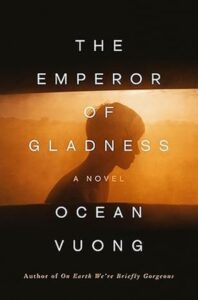
Last night, I had the special treat of seeing Ocean Vuong talk about his new novel, The Emperor of Gladness. I haven’t read the book yet, but I was wowed by his first novel, On Earth We’re Briefly Gorgeous–and struck by the sensitivity, depth and humor in the brief excerpt he read from this one. Most of all, I was moved by his thoughts on what it means to be a writer–what it means to be a human, actually–in these troubling times.

Vuong talked about “the cage” that all of us are trapped in, meaning the large set of sociocultural stereotypes and mores that hinder the definitions of who we are and the possibilities of who we can be. In his first novel, the main character, Little Dog, says: To be an American boy, and then an American boy with a gun, is to move from one end of a cage to another.

As I thought about this idea of cages, I realized that my lifelong pursuit of writing is absolutely an attempt to break out of the cages of expectation, to come as close as I possibly can to exploring absolute truth and authenticity. And perhaps that’s what makes Ocean Vuong’s work so great. He may be writing fiction, but he’s doing it without artifice. Vuong insists that his novels are not autobiographical, nor are they specifically about anyone in his actual life and claimed that he would never appropriate anyone’s life story to feed his art. Yet, there’s a truth that seeps through whatever he’s invented that pulls back the veils under which we hide.

And I do believe it’s not only the revelation, but the acceptance of our own and each other’s authenticity–provided we can even find it in ourselves–that may be our only hope of changing the world.

Alligator Alcatraz: From Heute.at (cropped)

Of course, I couldn’t think about cages without the intrusive images of “Alligator Alcatraz” the newest prison being build in Florida and the memories of children in cages during this administration’s first term, a practice that ended after huge public outcry.

Also, yesterday, earlier in the day, I joined eight other people dressed in black, carrying signs with names and information about people who have been disappeared in Massachusetts and sent to caged prisons near and far. We walked in silence through the streets of Northampton, banging a drum, and bearing witness, creating a stunning visual effect that made people stop what they were doing and notice.

Said Vuong in a recent interview, Maybe in another 15 years, I will write about trying to be an artist while our civil liberties are being eroded and our country is run by oligarchs who are bordering on fascism. If we make it to 15 years later, hopefully I can write a book about that. 

Hopefully, he can. And in the meantime, hopefully we’ll all continue to access whatever creative sparks we all can make to raise awareness, claw out our own truth, and make it through.

Subscribe at https://ddinafriedman.substack.com