I Carry… I Hope

Last weekend I attended an excellent workshop on writing protest poetry. Among the poems we talked about was this gem, I am Dark I am Forest by Jenn Givhan. I love the repetition of the phrase “I carry…” and how the poet threads us (trigger warning) through a maze of generational and societal trauma  with specific sensual imagery overlaid in a veil of surrealism.

I was struck most by the “heaviness” of what so many of us may be carrying these days. Whether we’re mired in personal issues related to health, loss, or economic instability; or whether we’re sweating anxiety, sadness and fear after the escalation of war in the Middle East and seeing reels like this one of ICE officers beating people as they take them into custody, it’s a very heavy time.

The poem inspired me to attempt my own version of a prose poem using the refrain of “I carry …” Here’s a short blip from the draft I wrote…

I carry

obedience / even as my horse body strains at the bit / the bridle trying to break the chains of normal to get to an unbroken place. / I carry

all the broken places / my little girl self in the back seat of the station wagon staring at the wall of my parents’ heads / obey / or you’ll embarrass us. /

So I’m asking all of you… what do you carry?

And an extremely relevant follow-up question: How can we put down what we’re carrying?

Not with disgust or abandon, but lovingly.

When I think of carrying, my first association is some heavy object I’ve lugged, like the old air conditioner from the 90s that my partner and I managed to drag out of the closet last weekend and shuffle it onto the hand-truck so we could wheel it to the corner of our road for someone driving by who might need it for the upcoming heat wave. Or the table on our deck we have to shlep back and forth from the garage for the winter, which involves walking backwards on uneven ground and maneuvering corners and stairs. I’ve never been adept at carrying heavy objects, and as I age, I’ve had to stop even more often to rest or find ways to balance the weight on my hips, which can take it more easily than my arms.

But while putting down the deck table for a few minutes can give me enough strength to pick it up again, it’s harder to put down the onslaught of news, or whatever dire reality any of us might be faced with.

There’s been a lot of writing out there on happiness and gratitude. However, a recent study targeted hope as the biggest key to being able to shoulder the burdens we carry. One reason for this: gratitude focuses on events in the past, happiness is usually related to the present, but hope is aimed at the future. When I’m carrying the table, it’s hope that enables me to measure the progress and see how much closer I’ve gotten to the garage each time I stop to rest. The study suggests that people notice the small wins and seek all opportunities, even the tiny ones, to move forward and then celebrate them whenever possible. This can help us strengthen our hope muscle and cultivate a hope mindset, the belief that nothing is static and change is always possible.

This is why I eagerly look forward to Jess Craven’s Sunday posts from her Chop Wood Carry Water newsletter, which are filled with all the good news of the week, which people worked for to make happen

Feel free to use the refrain, I carry… as a writing prompt…
Or perhaps, instead, (or in addition to) the refrain, I hope…

Subscribe at https://ddinafriedman.substack.com
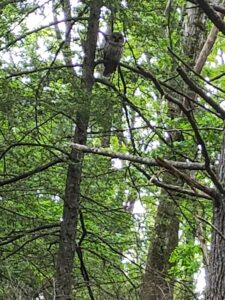
The owl I saw flying and then landing in a tree on Mt. Toby (Sunderland, MA) gave me an enormous boost of awe and hope.
The Stories You Tell Yourself

Since my father died in early March, my writing has gone from a fairly steady stream to mostly drought with an an occasional faucet drip. I’ve told myself this is okay. It’s hard to write when your mind is fogged in by grief–hard to focus on anything. And when my attention wasn’t focused on my own personal loss, the onslaught of news–particularly the kidnapping and forced disappearance of people off our city streets and reports of humanitarian aid being blocked for the sick and starving in Gaza–has generated a lot of tears, but not too many new words.

Still, like the trouper I am, I’ve kept at it, sitting down at the prescribed moments in my schedule to write, but mostly using the time to send things to journals, which did involve some occasional tweaking, but mostly felt like dropping in on my work for a brief visit, rather than living with it.

However, yesterday I received a gift that might have shifted things.

If you subscribe to Lori Snyder’s Substack, Splendid Mola, you, too, can receive a 5-minute Writers Happiness Exercise delivered to your inbox every Tuesday. This one invited people to “Set the Thermostat for your Heart” by reframing negative stories into positive ones. We were asked to take 30 seconds to focus on one thing that was important in our lives–which could be writing, or could be something else, whatever resonated most at the moment. The next step was to take 3 minutes to brainstorm success stories about what was working well, or–in my case, and perhaps many other people’s cases–what had worked well in the past, even if it wasn’t working well now.

So I chose writing, and this is what I wrote for my brainstorm:

  • Regular times with my words
  • Lots of publications
  • Having the drive to finish and keep going
  • Belief that it mattered
  • Spiritual uplift and “oomph”
  • Wow moments

The final step in the process (1.5 minutes) was to whittle these moments into a one-sentence success story that you can keep telling yourself. Mine was: People care about my message. Lori suggested setting reminders to tell yourself this success story at least once a day, if not more.

But before I even needed to do that, I immediately got the inspiration to pick up with a YA manuscript I’d abandoned after 10,000 words about a neurodiverse middle school girl whose only friend, the daughter of Chinese immigrants, suddenly disappears. Interestingly enough, about an hour after the euphoric high of squeezing out two more pages and the thrill of congratulating myself for inserting new life into what I felt had been a dead project, I started to feel like crap–teary, angry, unfocused. I knew that part of the reason I hadn’t gone back to the book was that I hadn’t yet formulated exactly what had happened to the disappeared girl and her family, and consistently reading real accounts on what happened to similar people for research had become too paralyzing to dive into. But even though I wasn’t writing that part of the book in the smidgeon I drafted yesterday, I realized that being that deep into my words again had brought me to the spiky edge of feelings I might prefer to sidestep. No wonder I’d been playing the avoidance game.

Photo: D. Dina Friedman

What I hope will keep me going this time is that little success story sentence–People care about my message–instead of the story I’ve told myself for the last three months, which is, I’m not writing because I’m grieving. Of course I’m still grieving, but the major fog has cleared. And while I still want to honor the truth of the “not writing/grieving story,” it can’t be the final chapter in the book of my life. There’s never been a more important time to believe in happy endings.

Subscribe at https://ddinafriedman.substack.com


Bravery

As I sit on my porch under the maple tree, on a sunny late spring day looking out at my idyllic view of the farm and the mountain behind it, I realize I have no idea what it means to be brave.

Sure, I’ve taken the plunge into social situations I might have preferred avoiding, and occasionally attempted some speedy or free-fall athletic feat that instigated a split second of terror and an adrenaline rush. But really, I always knew I’d be fine.

So I’m thinking now, as the jaws of the looming authoritarian police state are snapping loudly, about what it means to be truly brave.

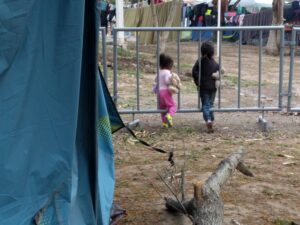
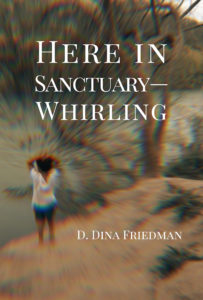
When I went to the border in 2020 I heard many stories of bravery, all of them spiced with horrific moments that made me flinch, or cry, or both: kidnappings, gang break-ins, death threats to their children, rapes…One man told me about being forced into a car with his 8-year-old daughter by kidnappers after spending weeks in the hielera (Spanish word for ice box where they keep detainees). With his permission, I chronicled his story into a poem (pasted at the end of this blog) which was first published in my book, Here in Sanctuary–Whirling, and which I’ve shared at many community talk-backs about our trip.
Holding this man’s story and the stories of others was devastating. I came back from that trip feeling smothered under the weight of such sadness, confused about how I could continue going blithely about my days feeling grateful for the trees, and my friends, and the small sweet details of my privileged life.
It’s pretty much the same as how I’m feeling now.

Except that the necessity for bravery, personal bravery of a sort that’s far greater than whatever “risks” I might have taken to enter the potentially dangerous city of Matamoros, Mexico, has reached a crucial point. As the events in Los Angeles unfold, and thousands of brave people prepare to demonstrate nationally on Saturday against the rising tide of authoritarianism, and the administration counters by launching threats against protesters, I have to ask myself: am I ready to face masked men in military gear who may be throwing tear gas and shooting rubber bullets? It’s unlikely things will escalate to that point in our relatively small and mostly rural area, but if I lived in L.A., I hope I’d be brave enough to be on the streets, protesting *non-violently* against what is happening to immigrants across the nation.

Because the point is not about the few burning cars that are being shown over and over again as justification to quell our First Amendment right to peacefully protest. The point is that ICE is breaking the law! Over and over again! They are arresting people without warrants, abandoning due process, tricking people in court by moving to close their asylum cases and then arresting them. They are bashing car windows, leaving children abandoned as they take their parents away, and sending many to prisons that are miles away from their families. They are disappearing people off the street! Nearly 44% of those arrested have no criminal history and many of those with a so-called “criminal record” have only minor infractions–traffic stops and what-not!  Some of those who have been arrested are green card holders! Some are U.S. citizens

I do not condone violence, but the violence inflicted by ICE on our local communities is evil, ruthless, and deliberately inhumane. It is an order of magnitude more violent than the actions of the protesters, of whom the huge majority are demonstrating peacefully. Much of the violence is being instigated by law enforcement, who are choosing to escalate by throwing tear gas. A so-called “unlawful assembly” is a form of non-violent civil disobedience, but it is not a riot!
Here is the poem, I wrote about one of the stories I heard from immigrants in Matamoros. When I asked this man if I could tell his story, he said, Sure. There are a thousand stories just like it.
MY FRIEND TELLS ME THERE ARE THOUSANDS OF STORIES JUST LIKE THIS ONE

Man who takes us to the Matamoros mercado
to buy food for refugiados to cook by their tents,
tosses frosted flakes in the cart with the rice,
tells us he’ll pay, man whose money
we wave away. It’s a gift, un regalo.
Man whose glow is a regalo, scrolling
through phone to show us mamá y papá.
He left without time to say goodbye;
his abuelita, who now has died.
Man who says, you must understand,

I love my country, amo mi país.
I had a good job, never wanted to leave.
El año pasado, last year, on Valentine’s Day
I called mi esposa said, Amor, let’s go out.
We took the kids and came back late,
fell happy, full of love, into our beds.
In the middle of dreams, a noise in the night,
man with a mask, black hat with holes for eyes.
When I tussled with the guy, the mask
came off; I saw a boy I knew,
then the others surging with the guns.
I told them to take whatever they wanted.
The next day, I went to la policía. All they wanted
was my phone number. I’d barely gone a kilometer
when the phone rang with amenazas de muerte, threats of death.

Man on planks of wood lashed
to an inner tube crosses the river to Mexico
in the dead of night when the guards are gone,
each daughter held in a muscled arm.
Man riding on bus after bus, north
to la frontera, bad hombres lurking in the shadows.
The guards block the way, the only opción
to pay the coyote to take his wife
and younger daughter. (He didn’t have enough
for all to go together.) On the opposite
shore, man’s wife presents herself to ICE.
She’s put in the “hielera,” where the detainees shiver,
then sent to the midwest to live with her brother.
She is one of the lucky ones.

Man raises money to cross with coyote,|
asks for asylum and taken with daughter,
put in the hielera, three days. Couldn’t bathe.
They blast sirens in the night to prevent you from sleeping.
His beary arms couldn’t stop his daughter’s shivering.
He thought they’d send him to his familia,
but they took him to Tijuana, so he could wait in Mexico.
Man who refused to go. Said,
I won’t sign these papeles. They marked him
troublemaker and sent him there anyway.
Man whose daughter tenía hambre, so hungry.
When he tells us this part, he starts to cry.
Man whose arm I touch chasms away in his dolor privado,
los memorias that could shackle a thousand hearts.

Man who clung to his daughter when the gangs grabbed her
and shoved them both in a car, demanding ransom,
which his wife had to borrow to pay. They dumped him
far away in the desert, across the border,
where for hours they wandered in the dark, coyotes howling,
until they found a woman, an angel, he thought,
who fed them and led them to the city, where she stuck
out her palm for money, and they were forced in another car.
He should have known the world, like the wall
at the border is lined with spikes. Man held

for money, then more money until all sucked dry.
If his wife didn’t pay, they said they’d kill him.
In a last gasp he retrieves the hidden,
maybe broken, phone in his daughter’s teddy bear,
with only a battery sliver, texts the location
to su esposa, who calls the cops,
who come and find seven more people
captured there, all put back
in the hielera, all sent back to Mexico
where they all wait, all hope. Esperar.
In Spanish, it’s the same word.


Holding Onto the Heavy

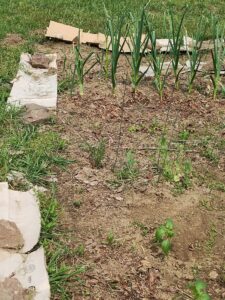
Every spring, as soon as I start gardening, my shoulder begins to ache, a dull pain that often spreads all the way down my arm. It’s not debilitating; it’s just annoying, but it’s pretty constant and I have to keep reminding myself not to overdo–set the timer and tackle the ubiquitous onion grass for no more than half an hour. Lately I’ve been feeling it most when I’m lifting heavy rocks to weigh down seed covers and cardboard mulch. And in the wee corners of my mind, I hear the niggling question of how much longer I’ll have the physical ability to keep on with this yearly seasonal ritual that brings me so much joy. Hopefully for a long time, I tell myself, deflecting with my usual optimism/denial reflex on any issue that relates to my own aging.

Photo: D. Dina Friedman

This morning I felt torn between gardening and writing group, since it’s going to get hot in the afternoon and I have a bunch of things to do then, but I chose the lure of writing group community, where someone made a random comment, “It has been a time and it’s not over.”

My friend was referring to events in her personal life, while also acknowledging that many people our age (50s and 60s with aging parents) are going through something similar. But I believe this heaviness is currently permeating among all ages as we read story after story of children starving and being indiscriminately killed in war zones, humans taken off the streets by masked men in military gear, and the myriad other ways our rights to shelter, health care, and food security are being dismantled.

I’ve encouraged people in our immigration justice advocacy network to join me in sharing some of the personal stories of immigrants who’ve been arrested, kidnapped or disappeared, knowing that reading about actual humans with lives and back story can get people in the gut in a way that vague policy statements or piles of statistics don’t. (Though one stat I will emphasize: very few of the people taken have a criminal history, unless you count trying to enter this country for a more economically secure life free from gang violence and death threats a crime. All this talk about murderers, drug dealers and rapists is a lie fabricated by the administration that’s also intended to get people right in the gut.)

However, my resolve to share these stories has gotten to the point where I can’t keep up with the flood of incidents coming into my inbox like weeds each day–high school students, families with young children, neighbors, friends…And to tell the truth, I don’t even want to read these upsetting stories any more. And if I, despite spending most of the last decade as an immigration justice activist, don’t want to read them, how can I expect others to?

Photo: D. Dina Friedman

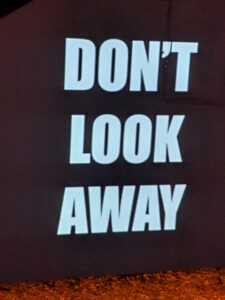
Back at a demonstration on the border in 2020, we projected a sign. Don’t Look Away! Yet, there are some days that all I want to do is look away–curl up with the blessing of my meditation app that encourages me to simply cultivate a lens of neutrality and observation and be present in the moment.

How do we balance this appropriately mindful adage for self-care without forsaking our responsibility to our fellow humans? I keep thinking about Nazi Germany. Not the people who actively collaborated with Hitler, and not the people who risked their lives by hiding Jews in their barns and attics, but the people who may have quietly disapproved of what was going on, but did nothing and went about their lives as best they could.

Photo: D. Dina Friedman

I don’t want to be one of these people, and yet, I fear that’s what we’re all becoming. Not because we’re bad people. We’re just numb. Paralyzed by the heaviness of it all.

How do we hold onto the heavy and continue to take steps forward to address injustice, perhaps with the clarity and gentleness that mindfulness might bring? Somehow despite the pain, we need to keep lifting those heavy rocks.

Subscribe at https://ddinafriedman.substack.com