Last weekend I had the privilege of reading at the Northampton Center for the Arts with two awesome poets, Lindsay Rockwell and Mary Warren Foulk, as part of the Northampton Literary Walk. We were the intro act to a film by Chris Gentes entitled What is Poetry, where four other accomplished local poets–all worth checking out (Michael Favala Goldman, Howie Faerstein, Tommy Twilite, and L.D. Greene) discussed their work and their process.
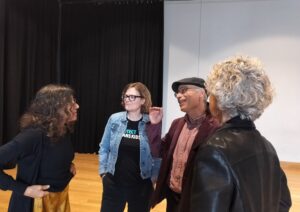
Later, on a text thread, one poet remarked, I often feel so raw and exposed after a reading. Maybe that’s the nature of the beast.
Yes, vulnerability is the nature of the beast. Reading your work out loud is kind of like undressing, putting one’s heart and words on the dissection line, showing all the flaws in your imperfect body.
Because we go through life with a certain amout of polish–a veneer we lather on as we learn to relate to each other, as impermeable as a long fuzzy sweater and a pair of jeans, we take care in how much we reveal to others. Even in our closer circles of friends and family, I, at least, take great pains to project an aura of strength and competence.
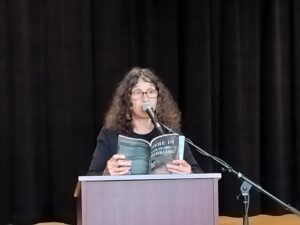
But when we share our work with others, especially in a public reading setting, where even the most compassionate audience cannot divorce themselves from their own need to discern what they’re hearing into what’s pleasing to them and what isn’t, it’s hard not to feel judged.
For me, this judgment has two components:
Is my writing good? Am I a real writer or an impostor? I especially worry about this with more academically oriented audiences whose banter about other writers often edges over into a line of snobbery. I also feel like an impostor when I’m among people who’ve had significantly more success than I have, often due to a far greater level of skill that I can only admire and covet.
The second question goes even deeper into the heart of vulnerability. In fact, it feels like one of those chasm-like questions whose words only graze the edges.
Do you feel me?
We write, even when it’s flawed, from our deepest selves, that raw place inside that’s aching to be heard, validated, and understood. Metaphorically undressing and exposing that spot, we often hide as we parade our polished selves through our daily lives, can be terrifying. Especially in a capitalistic society that values writing more as a commodity than an art–but that’s a topic for another post.
One of the most significant things I’ve done in the past few years is to share more of my writing with my parents who’ve always loved me, but really only know the polished self I choose to show them. Do they feel me? Not always, though I’ve appreciated that they’ve taken the time to try. When she read my short story collection Immigrants, my mother was pretty up front about saying she liked some stories better than others. But she took the time to read the book again, and said, I saw how well you put it together. And when she read my not-yet-published memoir, Imperfect Pitch, which was much harder for me to share because it was about our family and not always nice, she said, I think this book would be important for people in our family to read. It gave me more understanding.
These comments made all the vulnerability risk worth it. And while I’ll still parade my polished competent self in family and other settings, being felt and acknowledged, even when not as fully as I might like, has made me a little braver about reading, and more amenable to finding moments to let the rawness shine through.
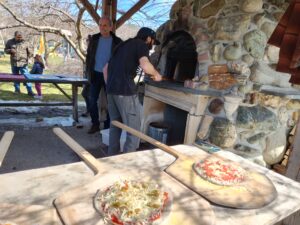
 Things seemed pleasantly normal in the hour before the big event. People donned eclipse glasses to sneak views of the disappearing sun, children ran through the grass playing, and adults waited in lines for free pizza cooked in the community stone oven or to silk-screen a t-shirt as an Eclipse Day souvenir.
  But when totality hit, something shifted in the energy. There was a hush among the crowd, a kind of collective “wow.” My eclipse glasses now dark, I was nervous about viewing the corona with unprotected eyes, but there it was, eerie and other-worldly, the tiny ring of light flaring in asymmetrical bursts before settling to a steady glow like a small spark of hope.
 We held up paper hearts and waved at them when they came out in their bright orange hats for 15-minute stints of exercise. Te amo (I love you) we shouted. Occasionally the children would take off their hats and wave them at us, though they were always reprimanded by the guards when they did.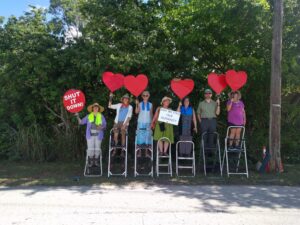
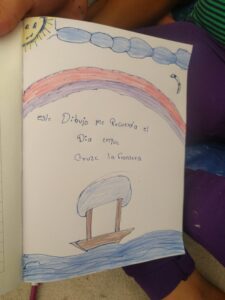
 Unfortunately, we were not in a position to engage in civil disobedience, so we had to settle for supporting the people on the bus with hearts and words of encouragement as they walked shackled into the plane’s belly and departed under the cover of the night.
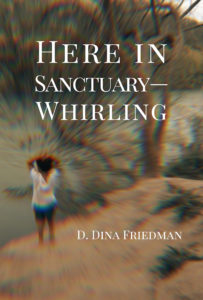 For most of my life, my writing and my activism were separate. But my writing has always come from my heart, and my heart is now intrinsically linked with these people who are far braver than I am. While I recognize that their stories ultimately belong to them and not to me, I’m glad they gave me permission to share these hard truths about their lives, which counter the rhetoric of even the supposedly liberal people in our government, because these stories need to be heard, loudly, by as many people as possible.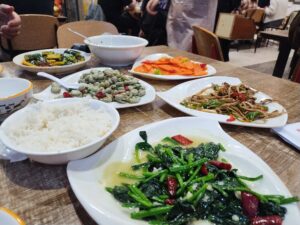
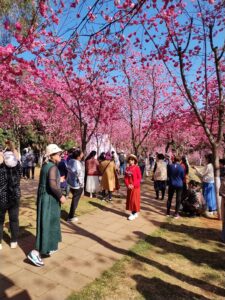 Though being forced to write was a good thing, I have to admit I regretted not getting the immediate gratification of people’s reactions to the cherry blossoms in Kunming, or my musings on Substack, which made me wonder–what is it about we humans in the social media age that makes us feel that everything we do needs to be immediately validated? True confessions, I am one of those people who obsessively looks for likes and feedback for anything I post on the big cyber cloud. Sometimes I worry that this has a negative impact on my writing–whether in sharing groups, I’m too quick to read something half-finished, simply for the joy of hearing people’s reactions to it. But I do like to think that reading things out loud, even early drafts, sharpens my own ear for what’s working or not working in a piece. In fact, one of my favorite revision techniques is to read a piece out loud even if I’m the only person listening.