Bravery

As I sit on my porch under the maple tree, on a sunny late spring day looking out at my idyllic view of the farm and the mountain behind it, I realize I have no idea what it means to be brave.

Sure, I’ve taken the plunge into social situations I might have preferred avoiding, and occasionally attempted some speedy or free-fall athletic feat that instigated a split second of terror and an adrenaline rush. But really, I always knew I’d be fine.

So I’m thinking now, as the jaws of the looming authoritarian police state are snapping loudly, about what it means to be truly brave.
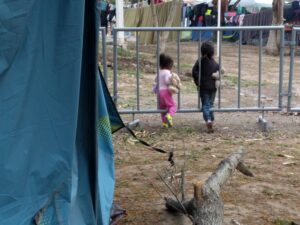
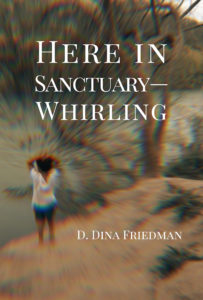
When I went to the border in 2020 I heard many stories of bravery, all of them spiced with horrific moments that made me flinch, or cry, or both: kidnappings, gang break-ins, death threats to their children, rapes…One man told me about being forced into a car with his 8-year-old daughter by kidnappers after spending weeks in the hielera (Spanish word for ice box where they keep detainees). With his permission, I chronicled his story into a poem (pasted at the end of this blog) which was first published in my book, Here in Sanctuary–Whirling, and which I’ve shared at many community talk-backs about our trip.
Holding this man’s story and the stories of others was devastating. I came back from that trip feeling smothered under the weight of such sadness, confused about how I could continue going blithely about my days feeling grateful for the trees, and my friends, and the small sweet details of my privileged life.

It’s pretty much the same as how I’m feeling now.

Except that the necessity for bravery, personal bravery of a sort that’s far greater than whatever “risks” I might have taken to enter the potentially dangerous city of Matamoros, Mexico, has reached a crucial point. As the events in Los Angeles unfold, and thousands of brave people prepare to demonstrate nationally on Saturday against the rising tide of authoritarianism, and the administration counters by launching threats against protesters, I have to ask myself: am I ready to face masked men in military gear who may be throwing tear gas and shooting rubber bullets? It’s unlikely things will escalate to that point in our relatively small and mostly rural area, but if I lived in L.A., I hope I’d be brave enough to be on the streets, protesting *non-violently* against what is happening to immigrants across the nation.

Because the point is not about the few burning cars that are being shown over and over again as justification to quell our First Amendment right to peacefully protest. The point is that ICE is breaking the law! Over and over again! They are arresting people without warrants, abandoning due process, tricking people in court by moving to close their asylum cases and then arresting them. They are bashing car windows, leaving children abandoned as they take their parents away, and sending many to prisons that are miles away from their families. They are disappearing people off the street! Nearly 44% of those arrested have no criminal history and many of those with a so-called “criminal record” have only minor infractions–traffic stops and what-not!  Some of those who have been arrested are green card holders! Some are U.S. citizens

I do not condone violence, but the violence inflicted by ICE on our local communities is evil, ruthless, and deliberately inhumane. It is an order of magnitude more violent than the actions of the protesters, of whom the huge majority are demonstrating peacefully. Much of the violence is being instigated by law enforcement, who are choosing to escalate by throwing tear gas. A so-called “unlawful assembly” is a form of non-violent civil disobedience, but it is not a riot!
Here is the poem, I wrote about one of the stories I heard from immigrants in Matamoros. When I asked this man if I could tell his story, he said, Sure. There are a thousand stories just like it.
MY FRIEND TELLS ME THERE ARE THOUSANDS OF STORIES JUST LIKE THIS ONE

Man who takes us to the Matamoros mercado
to buy food for refugiados to cook by their tents,
tosses frosted flakes in the cart with the rice,
tells us he’ll pay, man whose money
we wave away. It’s a gift, un regalo.
Man whose glow is a regalo, scrolling
through phone to show us mamá y papá.
He left without time to say goodbye;
his abuelita, who now has died.
Man who says, you must understand,

I love my country, amo mi país.
I had a good job, never wanted to leave.
El año pasado, last year, on Valentine’s Day
I called mi esposa said, Amor, let’s go out.
We took the kids and came back late,
fell happy, full of love, into our beds.
In the middle of dreams, a noise in the night,
man with a mask, black hat with holes for eyes.
When I tussled with the guy, the mask
came off; I saw a boy I knew,
then the others surging with the guns.
I told them to take whatever they wanted.
The next day, I went to la policía. All they wanted
was my phone number. I’d barely gone a kilometer
when the phone rang with amenazas de muerte, threats of death.

Man on planks of wood lashed
to an inner tube crosses the river to Mexico
in the dead of night when the guards are gone,
each daughter held in a muscled arm.
Man riding on bus after bus, north
to la frontera, bad hombres lurking in the shadows.
The guards block the way, the only opción
to pay the coyote to take his wife
and younger daughter. (He didn’t have enough
for all to go together.) On the opposite
shore, man’s wife presents herself to ICE.
She’s put in the “hielera,” where the detainees shiver,
then sent to the midwest to live with her brother.
She is one of the lucky ones.

Man raises money to cross with coyote,|
asks for asylum and taken with daughter,
put in the hielera, three days. Couldn’t bathe.
They blast sirens in the night to prevent you from sleeping.
His beary arms couldn’t stop his daughter’s shivering.
He thought they’d send him to his familia,
but they took him to Tijuana, so he could wait in Mexico.
Man who refused to go. Said,
I won’t sign these papeles. They marked him
troublemaker and sent him there anyway.
Man whose daughter tenía hambre, so hungry.
When he tells us this part, he starts to cry.
Man whose arm I touch chasms away in his dolor privado,
los memorias that could shackle a thousand hearts.

Man who clung to his daughter when the gangs grabbed her
and shoved them both in a car, demanding ransom,
which his wife had to borrow to pay. They dumped him
far away in the desert, across the border,
where for hours they wandered in the dark, coyotes howling,
until they found a woman, an angel, he thought,
who fed them and led them to the city, where she stuck
out her palm for money, and they were forced in another car.
He should have known the world, like the wall
at the border is lined with spikes. Man held

for money, then more money until all sucked dry.
If his wife didn’t pay, they said they’d kill him.
In a last gasp he retrieves the hidden,
maybe broken, phone in his daughter’s teddy bear,
with only a battery sliver, texts the location
to su esposa, who calls the cops,
who come and find seven more people
captured there, all put back
in the hielera, all sent back to Mexico
where they all wait, all hope. Esperar.
In Spanish, it’s the same word.



Submission Milestones for 2024

Each year since I’ve started this blog, I’ve included an end-of-year submission stats post, just to shed some light on the nitty-gritty of this murky game. Here’s what happened for me in 2024.

POETRY:

20 Journals/Anthologies accepted 34 poems. I also got 91 poetry rejections.

Of the 34 poems accepted, 7 were taken on the very first go-round; 8 poems were previously rejected 1-3 times; 7 poems were rejected 4-7 times; 4 were rejected 9-12 times; 3 were rejected 15-20 times, and 1 had been previously rejected 31 times! (The other 4 poems were previously published, so I didn’t track that stat.) This surprised me, as usually my poems circulate more before someone picks them up. I’m wondering if I might be getting better at selecting poems I send out and matching them to journals.

Another thing of note is that of the 20 journals that accepted my work, 8 of them had previously published something of mine in the past, so I may have been more of a known quantity. But this is a great point for anyone playing the submission game. Establishing relationships with journals and editors who like your work can be extremely gratifying and also help soften the rejections from some of the more competitive journals on your reach list. And as long as the journals you’re published in put out a good quality product, who cares that they’re not the creme de la creme in the journal world. Your work is still getting read and appreciated!

FICTION AND CREATIVE NON-FICTION:

My fiction stats are a bit more depressing. I offered stories and essays to 23 journals, and only 1 got accepted: an op-ed in my local newspaper.

Some analysis on this:

–Stories and essays are often harder to publish because they take up more room in a publication. (5-10 pages vs. a 1-2 page poem).

–Most of my better stories were already published in my collection, IMMIGRANTS, so I’ve been only circulating a few newer ones. Before the book was published I did manage to publish around half of the stories it contained in various places, but it was slow going.

–I still tend to feel overall more confident in my fiction, and therefore I submitted  to a greater number of “reach journals.”

AWARDS:

I’m personally very mixed on the “awards/contest” game for books because it seems like mostly a way of collecting a lot of exorbitant entry fees just to say your book won an award, but my publisher and I did submit to a couple of the more known ones. I was pleased to get a finalist designation (first runner up short-story and all category short-list) for the Eric Hoffer Awards, and a finalist designation in the short story category for the Independent Authors Network.
I also received two Pushcart Prize and two Best-of-the-Net nominations from various journal editors.

And I did not win a few other notable things, like an IPPY Award.

LARGER PROJECTS:

It was a thrill to have my poetry book, Here in Sanctuary–Whirling, which drew heavily on my witnessing trips to the border and the children’s detention center in Homestead, FL, come out in early 2024. With the upcoming administration’s about to take over and put their extreme deportation plans in gear, this book feels even more relevant right now, and I’m continuing to look for ways to publicize it.

I did not spend a lot of time circulating my music memoir or any of my novels. But I did receive three rejections (aka non-responses) from agents, and one non-response from a small press where I sent one of my older kid-lit novels.) So this might be an area ripe for New Year’s resolutions in 2025.

Nevertheless, I easily crossed the 100-rejection threshold (91 poetry rejections, 22 fiction/CNF rejections, and 4 agent/small press rejections) for a grand total of 117!

Onward to 2025!

Subscribe at https://ddinafriedman.substack.com


Humility and Spiders

Aside

My grandson, Manu, has become obsessed with the Eeentsy Weentsy Spider. We’ve spent large chunks of the last three days singing the song and looking at a small  strand of spider web dangling from the hallway ceiling. “That’s the eeentsy weentsy spider’s house,” I tell him. He doesn’t seem to mind that the spider isn’t there, or that I’ve chosen not to reach up and grab the web for him. I think it’s the idea of a spider and a spider web that intrigues him more than the actuality. In fact, today, I couldn’t find the spider’s web at all, but it still didn’t stop him from looking longingly at the ceiling and talking about the spider as if it were there.

I’m impressed with his ability to switch gears to imagination when reality is less satisfying–a common attribute of children that we often lose as adults. Sometimes, I still miss the imaginary friends I had when I was three (maybe because they loved me unconditionally and there were never any relationship issues to work out, LOL!)  But when I can access it, imagination has served me well in getting out of my stuck writing places, especially when I’m trying to fictionalize something that had its origin in a lived experience. The further I can get away from what really happened, whether that’s changing everything I can about a “character’s” appearance and demographics, altering the setting, re-thinking alternative ways the chain of events could have played out, etc., the freer I am to get past my own vulnerability to the emotional truth of the story I want to tell.

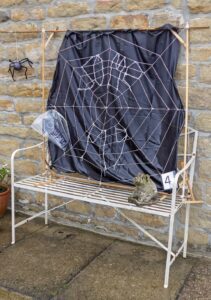
Tim Green from Bradford, CC BY 2.0 <https://creativecommons.org/licenses/by/2.0>, via Wikimedia Commons

And then, of course, it’s hard not to think about spiders without conjuring Charlotte’s Web, which we must have read to our daughter (Manu’s mom) at least ten times–before she was old enough to read it to herself at least ten more times. And I can’t even count how many times I’ve seen the movie. The book is about a pig on a farm who befriends a spider, who saves him from becoming ham and bacon by writing words in her web: “Some Pig,” “Terrific,” “Radiant,” and “Humble.”

Of these words, the one that sticks with me (with web-like sticky threads) is “humble.”

Having two books come out in the last six months has been a challenge to maintain what I consider an appropriate level of humility, especially as book marketing experts encourage me to scream, scream, scream from the social media rooftops and spend my days looking for places to plaster my “products” anywhere they might be seen.

And that is SO not my style.

I admit I may have a problem with too much humility, which the Mussar (a Jewish spiritual learning paradigm) equates with a tendency toward self-effacement. Yet, even posting about recent things I’m proud of (like getting short listed for the grand prize and winning first runner up in short stories for the Eric Hoffer Award, or doing a podcast about Here in Sanctuary–Whirling on the Bill Newman Show, or announcing/sharing upcoming readings or poems that were accepted in various journals feels like I’m on the edge of too little humility (equated in the Mussar as arrogance).

But, hey…I just got that all in, even if it was back-handed.

I don’t want this to be another “Dina Kvetches about Marketing” post. So, I’ll just say what I said to my friend, Alice, when we were studying the Mussar together: I want my writing to be recognized for what it’s saying and how it’s saying it. I don’t want it to be about me. In other words, it’s the message, not the product, and I’m not really interested in me or my books being thought of as commodities.

And if all this is just rationale for more self-effacement, I’ll counteract it right now by sharing a poem from Here in Sanctuary–Whirling, because it’s about a spider.

NOTE FROM THE AIR BNB IN TEXAS
Please Don’t Kill the Spider

He has a name: Septimus
because he lost a leg somewhere.

You might find him by the toilet.
Don’t shriek as you do your doo.

His poison is all in your head.
Didn’t you read Charlotte’s Web?

Humble is the word that matters.
Confront your failings. Take a selfie

if you’re lucky enough to spot him.
And put on your boots, hat.

This is cowboy country
land of brash bravado.

Where’s your gun?
A spider could be lurking under your pillow.

Unseen children taken at the border:
their parents’ lost limbs.


Tuning In/Tuning Out

I have always claimed, only half in jest, that tuning out was my superpower.

Too much nagging or irrelevant banter by members of my family or in social situations. No problem. I nod my head and hopefully make the appropriate noises while the rest of my brain lounges in some woodsy retreat cabin of my imagination.

I’ve been thinking a lot about “tuning out” this week as I recover from a minor concussion.  For several days, my poor brain just refused to tune out anything, making it impossible to look out a bright window, or be in a space with too many clashing colors or in front of a screen with its array of flashing videos and words, words, words against the bright. blue light.

And whenever I tried to do too many of these things, my brain went haywire, and I had to spend the next hour in a dark room with the shades drawn. If only I could have had one of those float tanks!

But now that I’m–thankfully–about 80% recovered, and preparing for my book launch of Here in Sanctuary–Whirling this Sunday, I’m also thinking about tuning in.

When I went to the border in 2020 I was determined not to fall into the distant malaise I often feel when the news becomes too overwhelming. While I know that there’s just so much sorrow one can handle, I knew that my role was to tune in as much as possible–so I could feel the joy of the teenager bounding across the bridge waving his white paper. I made it! he exclaimed. I got asylum! 

He was reportedly the only person in weeks that people had heard about who  received a positive outcome form the infamous tent courts. And as witnesses gathered around to offer him a place to stay for the night and assistance to get to his brother in Florida, he told us the key to his “success.” I told them the gangs had killed my entire family. Other than my brother, I have no one.
How to fathom the depths of that?

How to comfort the woman in the writing workshop sobbing over the picture she drew of her missing child, or the beefy young father folding into his arms in tears as he recounted his kidnapping together with his seven-year-old daughter. She told me she was hungry, and I had no food to give her. I couldn’t take care of her.

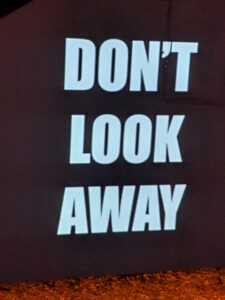
Don’t Look Away! the sign read on the American side of the border, where witnesses stood every day, reminding us of our responsibility not to tune out.

As a writer, I’ve tried to take that responsibility seriously, attempting as best as I can to capture the joy, the sorrow, and the emotional complexity of salient moments, both in my work as an immigrant justice activist and every other aspect of my life. It’s a way of extending the witnessing work I did on the border, and letting others live that experience, or any other experience I feel compelled to share, with as close a lens as possible.

Yet at the same time, I recognize that to be effective in whatever we feel compelled to do, we need to take time to take care of ourselves, allowing our brains to rest in the dark room, or the land of the imagination, or whatever other equivalent a person might have in order to take a deep breath, regroup, and press on.

Hope to see some of you on Sunday! I’ll be reading poems that hold the joy as well as the sorrow.


Birthday Parties

This Friday, February 23rd, is the official birthday of my new book, Here in Sanctuary–Whirlinga collection of poetry inspired by my work in the immigration justice movement.

So this week, I’m feeling myself floundering as I try to get all the pieces in place for a perfect birthday party.

When my children were little, birthday parties were a huge stress. My older child, especially, wanted everything exactly how she wanted it… the color of the plates, the order of activities, the guest list/seating arrangements, and where she would stand to hand out the paper for an art activity featuring red and blue food coloring. My younger child was a little more chill, but I do remember making several calls before I found a baker who would be willing to do a birthday cake with a salamander on it (a picture, thank goodness–not a real salamander, though I’m sure a live one would have been preferred!)

Keeping a bunch of pre-schoolers entertained for two hours, containing their sugar-induced energy, and making small talk with parents I didn’t know while wondering how much they were judging me for the cleanliness of my house, my parenting style, my children’s uncensored responses to gifts they didn’t like all heightened the anxiety. I loved hanging out with my children, but I dreaded birthday party season!

Luckily, a book can’t tell you want it wants the way a child can. But this also means all the pressure is on me. As I sift through a nauseating number of articles and listserv comments on book marketing, I’m recognizing some important things about myself. I did succumb, as suggested, to posting myself on video on Instagram opening up my box of books, even though I thought it was silly. But ultimately I still believe parties should be low-budget affairs. I’m not interested in the $100/day plan, or anything that requires huge monetary investments, even when I’m promised that investing a daily $100 will net a daily $150.  I got into this to be a writer, not a business person and I refuse to think of my work as a commodity that I have to manipulate an audience into buying. As it is, I’m already spending too much time in my analytical marketing brain rather than my dreamy and comfortable writing brain.

But the goody-goody schoolgirl who also lives inside me reminds me that I can’t simply do nothing. My book will be so disappointed if I don’t give it a birthday party! Yet, I’m going to delay the big launch until May, where it can be in conjunction with a photography exhibit on detention that my immigration justice group is putting on at the Anchor House of Artists. I’m still coming off my last book (Immigrants‘) birthday party (also delayed) which I’m glad to finally be on the other side of, even though I was wowed by the love and support of nearly 50 guests who showed up. I hope they liked the color of the plates (brown, compostable) and the gluten-free brownies.

In the meantime, I’ll invite people to wish Here in Sanctuary–Whirling a happy birthday on social media. And the gift this book would love more than anything else, for anyone who feels so inclined, is a review on Amazon or Goodreads. I guarantee, unlike my kids, the book will not talk back, no matter what you say. Or if you’re not someone who ever reads poetry, you can say happy birthday by adding the book to your Goodreads “want to read” shelf.

One birthday party I am co-planning and looking forward to is my mother’s. She’s turning 90 just a few days after my book is officially born. I’m thankful she’s never cared about the color of the plates. I got to order the cake. It will not have a salamander.


The Second Child

Ironically, the day after I wrote the last post about my love/hate relationship with the spotlight, this wonderful feature of me in the Substack Starry, Starry Kite appeared. (Please check out this newsletter and subscribe!) So, I guess that means I’m doing my marketing homework.

It feels overwhelming, but in the past few weeks I’ve doubled the time I’ve spent on social media, mostly searching for and posting to groups. I also culled lists for a final email blast inviting people to my book launch next week, updated my Amazon and Goodreads author pages, revised my website, talked up the book at local bookstores, wrote an article for my alumni association, and connected with a number of editors of journals I’ve been published in to ask them to spread the word about the book. Still on my list is to set up and publicize a Youtube channel, investigate more blogs and podcasts, and connect more with journals and other relevant groups I know on social media, etc. etc. It never ends.

And as I was going full-steam ahead, a surprise snuck up on me. My poetry book  Here in Sanctuary–Whirling was suddenly in its final stages of pre-publication. In fact, it’s scheduled to come out from Querencia Press in late February and can already be pre-ordered at this link.

So now I have two books to drum up the buzz about. It’s kind of like having a second child, and (like the way I felt before actually having a second child) I’m worried about giving each book the love and attention it deserves. I had a similar situation in 2006, when my two children’s books, Escaping Into the Night and Playing Dad’s Song came out within months of each other. Escaping Into the Night continued to do well, since its unusual Holocaust story generated a lot of interest from middle school students and teachers. But Playing Dad’s Song, a book very close to my heart about music as a healing force from grief and aimed at a slightly younger audience, never found its niche. And several people with knowledge of the industry suggested its lack of success might have been related to being published too soon after my first book.

But these two new books are thematically related, so my plan is to market them together and let the books build on each other, treating Here in Sanctuary–Whirling as more like a late-arriving twin than a second child. There’ll be some differences in audience, since not all fiction readers like to read poetry and vice/versa. But both books center on the very human stories related to immigrants and immigration justice–one through poetry, the other via short fiction. And I believe there’s an emotional core in both these books that matters, and that we need to tell these stories to soften hearts and reject the horrible rhetoric that depicts immigrants as less than people.

And this alone is reason enough to keep marketing–and braving the spotlight.

Subscribe at https://ddinafriedman.substack.com