
A few years ago, I started to lose my singing voice. It was a long, slow process where first occasionally, and then more and more often, I’d find myself in mid-song and unable to reach the next set of notes, my voice unraveling into some gravelly, raspy shadow of itself.
When the issue first started, I could usually get some semblance of my voice back by drinking some water and singing more softly, but it got to the point where I could barely get through a line without croaking. And while I’ve never been a diva singer or even a karaoke regular, singing has always been extremely important to me. I mourned the loss of my ability to sing as an inevitable consequence of aging, exacerbated by vocal disuse (I’d abandoned weekly singing in various choruses when the pandemic started in 2020) and felt so sad that I’d ever again be able to feel the ecstasy and musical rush I got from singing in harmony with others.
I tried to console myself with reminders to feel grateful that compared to all the aging ailments I could have, this one didn’t significantly threaten my health or functionality, but I couldn’t quite let go of the grief. Mental health is also important, and while it’s not my “art,” the way writing might be, singing is a key piece in my creative and emotional expression toolkit that keeps me balanced and happy.
For more than a year, I didn’t do anything other than complain about my loss. Then, I did something that felt really risky: I took voice lessons. I’d never had a voice lesson in my life, because I never really considered myself a singer. But I thought if I could just take a few lessons, I’d learn to do some exercises that might help restore at least some of my voice, kind of like vocal PT.
Of course, it wasn’t that simple–or that quick–but a year later, I have nearly my entire voice back–including some notes that have always been hard to reach. It’s such a thrill to practice with karaoke sound tracks on YouTube. And last week, for the first time in years, I went to a community sing, and instead of feeling frustrated and shut down, I was euphoric.
In addition to now thinking about re-joining a chorus sometime soon, I’m also thinking about the metaphor of finding voice. We writers talk all the time about the importance of establishing a credible and consistent voice, and how that voice functions to engage a reader and drive a piece forward. But voice does more than that. Writer Meg Rosoff says, voice is “about finding out who you are.” In addition, she makes the following three important points.
- You need confidence and self-knowledge to speak in your own Voice.
- The only real block to writing truthfully is being unable to access what is in your head and heart.
- A distinctive voice will not just help you write well. It will help you do anything at all well. (https://www.megrosoff.co.uk/blog/2011/11/14/how-to-find-a-voice)
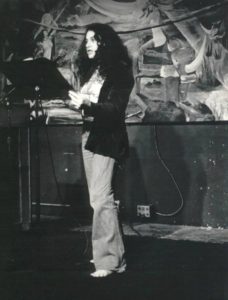
Not singing, but one of the first times I publicly used my voice, reading poetry at age 22 at Eric’s Backroom in New York City, Photo by Lew Holzman
I’m thinking about this third point as I consider another aspect of voice: the need to raise our collective voices against injustice. And I hope that this mini-miracle of re-claiming my literal voice will help me believe in the much bigger miracle: that our voices matter and can–and will–make a difference, whether we use them for activism, writing, or singing.
Subscribe at https://ddinafriedman.substack.com