
As I sit on my porch under the maple tree, on a sunny late spring day looking out at my idyllic view of the farm and the mountain behind it, I realize I have no idea what it means to be brave.
Sure, I’ve taken the plunge into social situations I might have preferred avoiding, and occasionally attempted some speedy or free-fall athletic feat that instigated a split second of terror and an adrenaline rush. But really, I always knew I’d be fine.
So I’m thinking now, as the jaws of the looming authoritarian police state are snapping loudly, about what it means to be truly brave.
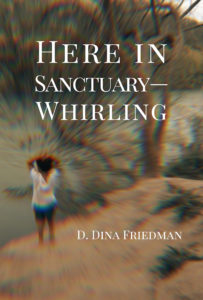
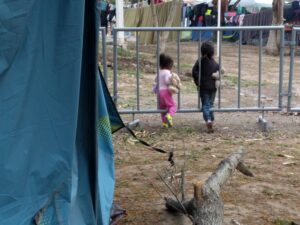 When I went to the border in 2020 I heard many stories of bravery, all of them spiced with horrific moments that made me flinch, or cry, or both: kidnappings, gang break-ins, death threats to their children, rapes…One man told me about being forced into a car with his 8-year-old daughter by kidnappers after spending weeks in the hielera (Spanish word for ice box where they keep detainees). With his permission, I chronicled his story into a poem (pasted at the end of this blog) which was first published in my book, Here in Sanctuary–Whirling, and which I’ve shared at many community talk-backs about our trip.
 Holding this man’s story and the stories of others was devastating. I came back from that trip feeling smothered under the weight of such sadness, confused about how I could continue going blithely about my days feeling grateful for the trees, and my friends, and the small sweet details of my privileged life.
It’s pretty much the same as how I’m feeling now.
Except that the necessity for bravery, personal bravery of a sort that’s far greater than whatever “risks” I might have taken to enter the potentially dangerous city of Matamoros, Mexico, has reached a crucial point. As the events in Los Angeles unfold, and thousands of brave people prepare to demonstrate nationally on Saturday against the rising tide of authoritarianism, and the administration counters by launching threats against protesters, I have to ask myself: am I ready to face masked men in military gear who may be throwing tear gas and shooting rubber bullets? It’s unlikely things will escalate to that point in our relatively small and mostly rural area, but if I lived in L.A., I hope I’d be brave enough to be on the streets, protesting *non-violently* against what is happening to immigrants across the nation.
Because the point is not about the few burning cars that are being shown over and over again as justification to quell our First Amendment right to peacefully protest. The point is that ICE is breaking the law! Over and over again! They are arresting people without warrants, abandoning due process, tricking people in court by moving to close their asylum cases and then arresting them. They are bashing car windows, leaving children abandoned as they take their parents away, and sending many to prisons that are miles away from their families. They are disappearing people off the street! Nearly 44% of those arrested have no criminal history and many of those with a so-called “criminal record” have only minor infractions–traffic stops and what-not! Some of those who have been arrested are green card holders! Some are U.S. citizens!
Man who takes us to the Matamoros mercado
to buy food for refugiados to cook by their tents,
tosses frosted flakes in the cart with the rice,
tells us he’ll pay, man whose money
we wave away. It’s a gift, un regalo.
Man whose glow is a regalo, scrolling
through phone to show us mamá y papá.
He left without time to say goodbye;
his abuelita, who now has died.
Man who says, you must understand,
I love my country, amo mi país.
I had a good job, never wanted to leave.
El año pasado, last year, on Valentine’s Day
I called mi esposa said, Amor, let’s go out.
We took the kids and came back late,
fell happy, full of love, into our beds.
In the middle of dreams, a noise in the night,
man with a mask, black hat with holes for eyes.
When I tussled with the guy, the mask
came off; I saw a boy I knew,
then the others surging with the guns.
I told them to take whatever they wanted.
The next day, I went to la policía. All they wanted
was my phone number. I’d barely gone a kilometer
when the phone rang with amenazas de muerte, threats of death.
Man on planks of wood lashed
to an inner tube crosses the river to Mexico
in the dead of night when the guards are gone,
each daughter held in a muscled arm.
Man riding on bus after bus, north
to la frontera, bad hombres lurking in the shadows.
The guards block the way, the only opción
to pay the coyote to take his wife
and younger daughter. (He didn’t have enough
for all to go together.) On the opposite
shore, man’s wife presents herself to ICE.
She’s put in the “hielera,” where the detainees shiver,
then sent to the midwest to live with her brother.
She is one of the lucky ones.
Man raises money to cross with coyote,|
asks for asylum and taken with daughter,
put in the hielera, three days. Couldn’t bathe.
They blast sirens in the night to prevent you from sleeping.
His beary arms couldn’t stop his daughter’s shivering.
He thought they’d send him to his familia,
but they took him to Tijuana, so he could wait in Mexico.
Man who refused to go. Said,
I won’t sign these papeles. They marked him
troublemaker and sent him there anyway.
Man whose daughter tenía hambre, so hungry.
When he tells us this part, he starts to cry.
Man whose arm I touch chasms away in his dolor privado,
los memorias that could shackle a thousand hearts.
Man who clung to his daughter when the gangs grabbed her
and shoved them both in a car, demanding ransom,
which his wife had to borrow to pay. They dumped him
far away in the desert, across the border,
where for hours they wandered in the dark, coyotes howling,
until they found a woman, an angel, he thought,
who fed them and led them to the city, where she stuck
out her palm for money, and they were forced in another car.
He should have known the world, like the wall
at the border is lined with spikes. Man held
for money, then more money until all sucked dry.
If his wife didn’t pay, they said they’d kill him.
In a last gasp he retrieves the hidden,
maybe broken, phone in his daughter’s teddy bear,
with only a battery sliver, texts the location
to su esposa, who calls the cops,
who come and find seven more people
captured there, all put back
in the hielera, all sent back to Mexico
where they all wait, all hope. Esperar.
In Spanish, it’s the same word.