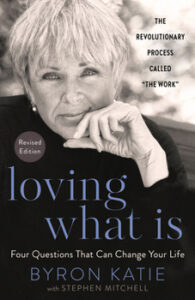
One of my favorite self-help books is Byron Katie’s Loving What Is. Katie’s method for getting to self-acceptance is quite simple on the surface; yet, delving into it can reveal all the complicated knots we tie around ourselves to make our lives sadder and more stressful than they need to be.
The process works like this: First, write about the situation that’s affecting your ability to be joyful in as much detail as you can muster, focusing on what angers, upsets or disappoints you. Likely, a “story” will emerge from your writing. This may be a familiar story you tell yourself, emphasizing common themes of self-judgment. (i.e. I’m always so disorganized, I never get things done on time…)
Then, Katie advises, ask yourself the following four questions:
- Is it true?
- Can you absolutely know that it’s true?
- How do you react? What happens when you believe that thought?
- Who would you be without that thought? Turn it around: Find three specific examples of how the turnaround is true in your life.
For years, the story I told about my piano playing was that I had huge family expectations placed on me because I had perfect pitch and also came from a family with many professional-level musicians. But I realized when I was 14 that I couldn’t play as well as I wanted to, so I quit piano. And that was the worst decision I made in my life, because if I hadn’t quit, somehow, I could have pushed through the technical obstacles and played at a higher level. So, to compensate for my failure, I pushed my children into music and piled all the leftover family expectations on them, which made me a terrible parent.
Is it true? Not really. But I had to wait 50 years, return very cautiously to piano, and write a memoir to figure that out.
Can you absolutely know that it’s true? Apparently not. My children said there was no need for me to ask their forgiveness. And neither they, nor anyone else in my immediate or extended family, experienced the generations of family pressure that I felt.
How do you react, what happens when you believe that thought? Even now, when I replay that familiar story in my mind, tears come to my eyes. I feel sad, angry, and like a complete and utter failure.
Who would you be without that thought? I would be free—able to make music on my own terms without self-judgment or generational baggage.
My Turnaround: I was a musical child with challenged fingers. This prevented me from going on a serious track with piano, but I had an inner understanding of music that shone through my expression. After quitting lessons, I never really gave up playing the piano because I loved it so much. And later, I explored other modes of music—guitar, chimes, klezmer music, singing in choruses. My brain, heart, and soul thrive on music as a staple in my life. Now, I’ve gone back to practicing piano more diligently and I’m amazed at how much progress I’ve made. What’s most gratifying is that I’ve stopped putting myself down for mistakes. Instead, I’m focusing on transmitting mood, color, and the ebullience I’m feeling as I vary tempos and dynamics. I’ve gotten to a place where I’m owning the piano again.
What stories do you tell yourself? How can you turn them around?
Subscribe at https://ddinafriedman.substack.com