
 I’m always surprised that no matter how much I might originally intend otherwise, the bulk of my fiction (including nearly half of the stories in Immigrants) is set in New York City–with a large percentage in the immediate neighborhood where I grew up. While I’ve often joked, You can take me out of New York, but you can’t take New York out of me, this is really more of a truism than a joke. Each time I visit, I can feel the city’s resonance and vibrancy, even as I recoil at the noise of the subway chugging on the elevated tracks, or the food wrappers and soda cans tossed into people’s yards and the flyers disintegrating into muck in the puddles along the curb.
As a child, I never noticed these kinds of details. Tuning out was my superpower. I kind of had to in order to stay sane. As someone who had a rich fantasy life with imaginary friends since I was very young, it always felt way more easy and pleasant to pay more attention to the world in my head rather than the world around me. So all the ugliness of New York, or anywhere, never seemed like a problem. But tuning out is a problem when you’re trying to establish detail in your writing and develop a strong sense of place.
In the book I’m working on now (in fits and starts), the two teenagers who center the story both live near where I grew up in Queens. One lives in the rows of brick apartments in Jackson Heights, and the other lives a couple of miles closer to Manhattan in a row house on a rundown block in Woodside. So, on my most recent trip to New York to visit my mom earlier this week, I spent some time exploring both neighborhoods for street details I could use, trying to pay attention to who was on the street in both locales, what public places (stores, schools, parks) were nearby, and some precise specifics on what the houses looked like in detail: Peeling paint? Colors of the houses? The arrangement of numbered addresses on the doorframes? What kind of door frames? Types of gates framing the steps? How many trees and other plantings were on the block and what kind of shape were they in? The list of questions you can ask about the concrete (pun intended) nature of a place can go on and on.
True Confession: I can think of very little that is more boring that developing lists of these kinds of details–even though I know that some people thrive on this. There are writers out there who are marvelous stylists, known for their ability to describe meticulously. And these are people who will happily lose themselves in place research and/or other types of historical research, taking days or weeks to investigate all the nuances and possibilities before committing words to paper. I admire them!
Call me lazy (though I’ll argue than in most aspects of my life I am anything but lazy!) but I just don’t do this. My descriptions aim for just a few salient but highly sensory details, which, when I feel I need to, I flesh out with metaphors, rather than more particulars.
Neither way of describing is better–or worse–they’re just different.
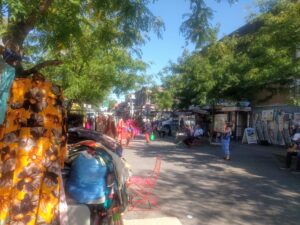
Diversity Plaza, Jackson Heights, NY (I took this pic on a previous trip.)
And another true confession–though not necessarily what I’d recommend: I didn’t take notes on my walks through these neighborhoods. I didn’t even take pictures (though I might be able to rely on some pics my partner, Shel, took.) Instead, I plan to rely on what I remember, perhaps a bit blurred or distorted from what I really sensed, but, hey, I’m writing fiction, not documentary.
And like a watercolor wash over whatever details I try to bring to life will be my long history with the city where I grew up and came of age–a melding of what’s actually there and my inner response to it. Because even as I grooved in my fantasy world in the countless hours where I walked the streets of New York as a younger person, it seeped inside me and will be there forever. As I said, you can’t take New York out of me.
Subscribe at https://ddinafriedman.substack.com