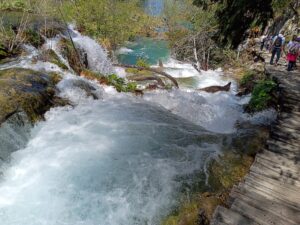
One of my favorite days on our recent trip to Croatia was the day we went to Plitvice Lakes National Park, on an incredible three-hour meander with more waterfalls than I could possibly count. Some were the gigantic gawker spray-in-your face variety, while others were trickles of various intensity sheltered by rocks and shaded by trees that stretched out over the lake, often merging into a more significant outpour. Whatever their size or relative ferocity, all of them pressed the happy button. So much beauty in the sound of the spill and the patterns it creates: a glorious cascade. A day of glorious cascades.
At the same time I was reading a book, I didn’t want to finish because it was so good: Apeirogon by Colum McCann, a novel, about Combatants for Peace, a group of Israelis and Palestinians who have lost close relatives in the conflict and yet have been moved to embrace trust and mutual respect for each other, rather than fear and revenge. Based on real life characters, that was enough of a reason to read it. But what made the book SO exceptional was the way it was written, in small and larger bursts of intensely poetic but also clear and accessible prose, with some sections going on for a few pages and others compressed into just a paragraph or two, sometimes a single sentence. In every section, a cascade of images, emotions, history, context, and open ambiguity circled around and around in itself like the whirlpool of a fall once it hits the water.
In his poetic cascades, McCann weaves through many topics that seem to be unrelated to the plot and theme of the book, but he brings them back beautifully again and again, showing how everything reverberates on everything else and nothing can be viewed without looking at it from an infinite number of angles. In fact, the book’s title, Apeirogon, refers to a mathematical shape with an infinite number of sides and vertices. And that’s how I felt when reading this book. Whether I was reading about birds, or a 19th century failed expedition across the Dead Sea, or the tragic stories of one man’s daughter killed by a rubber bullet shot by Israeli border guards and another man’s daughter dead from a suicide bomb in Jerusalem, I wasn’t asked to park myself in any given spot. I was just asked to sit and observe what felt like a beam of light bouncing off a room full of angled mirrors.
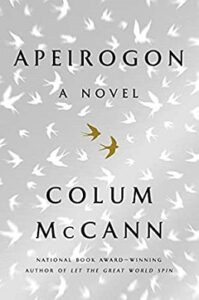
https://www.abebooks.co.uk/ servlet/BookDetailsPL? bi=30665233510, Fair use, https://en.wikipedia.org /w/index.php?curid=67793592
In my MFA program as well as in previous fiction writing workshops, lectures, and books, there’s a strong emphasis on the notion of scene. In very basic terms, a novel or a story should consist of a set of scenes where action happens based on what the characters do within these scenes. And these actions are motivated by what the characters need or want. There is certainly room for exposition, description, and (if one wanted, but it wasn’t required) poetic prose, but the basic questions asked at workshops were things like What’s at stake? Who are these characters? What do they want? We were warned, strongly, not to let our love of the written word go wandering off into nowhere.
I’m not dissing these questions and this approach. It’s definitely important to understand these basic fictional elements. And I also know that once someone becomes skilled in a convention, they can more easily and successfully break it. This book’s strength was in its exposition and description; yet, all of it masterfully flowed back to the main theme. It stood out from other so-called “experimental” books I’ve read that broke from heavy scene/character mold because each “cascade” was a mini-story that landed somewhere and I could be on its journey as it sheeted over rocks, or pooled in a corner, or joined another tributary and kept on swirling.
I’m tempted and inspired to see if I can write a selection of prose poems that works as story. Or a story in the shape of a heartbreakingly beautiful series of cascades. Perhaps some of you may be as well, but whether or not that idea calls, and no matter where you might stand on issues regarding Israel and Palestine, I highly recommend this novel. It will open your heart and your sense of what’s possible–on the page, and perhaps even in the world.
Subscribe at https://ddinafriedman.substack.com