
Every time I ask my 3-year old grandson, Manu, “Do you want to hear a story?” he stops what he’s doing and fixes his gaze on me, his eyes wide in anticipation, shooting me a little dose of performance pressure. But I don’t have to worry because if he doesn’t like the story, he intervenes to change it. He has a strong preference for the characters to be people he knows, so I can’t resort to folk or fairy tales unless he, or my cat, or the members of the Tokyo Paradise City Ska Band make an appearance and take over the action. Even then, he likes to interrupt and add salient or deliberately funny details on his own, so that the story quickly becomes a joint effort.
But sooner or later, we both run out of gas, as we did about a week ago, when I said, “That’s the end of the story.”
“Why?” I could tell from his tone that he was clearly upset.
“Because I don’t know what comes next. Do you?”
Manu followed up with a sentence or two, and then looked at me to continue. I added what I hoped was a closing sentence, and then asked him if he knew what happened next, He said he didn’t.
“Neither do I,” I told him. “So that’s the end.”
A couple of days later in one of my writing groups, a fellow writer lamented the elusiveness of plot. “I have so many words, but not plot” she said. And without a plot, how do we manage our words? How do we translate that hidden precious bud of whatever we’re trying to express while still making it conform to the parameters of fiction that people expect: plot, being an essential element.
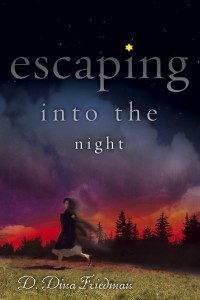 Even though I’ve been told by many teachers that my first published book–a YA Holocaust novel, Escaping Into the Night–was so well-plotted that “even the boys who preferred more action-oriented books liked it,” I’ve never considered myself a master at plot. There are many fiction-writing books that can teach you how to map out your plot in advance, designating turning points one-third, two-thirds, and just before the end that raise the stakes–a common outline for Hollywood movies. This is probably a good exercise to do, though I’ve never done it. Whatever plots I’ve managed to nudge out of my writing have emerged out of deep attention to character and setting, and intensive pondering of what could possibly happen next.
Often I go through several periods of trial and error before settling on what feels both realistic and meaningful in terms of getting across whatever underlying theme I’m struggling with. It’s not that different from riffing with Manu on my cat’s adventures in the backyard, except that instead of abandoning plot points that don’t work, we just keep going on one wacky tangent after another.
 Lately in my own writing, I’m coming across another issue in plotting and determining where stories end. Even though I’ve already written and published a book of short stories on immigrants, the issue keeps tugging at both my activist and creative heart. But in the new fiction projects I’ve started on the topic (a couple of short stories and a YA novel) I keep getting to the point where every answer I can imagine to “what happens next” is so horrible, I can’t even write it down.
Maybe, I just need to follow Manu’s example when it comes to the issue of ending stories, and just refuse to say, that’s the end. At least, not until I can see past these awful moments into a brighter and more hopeful future.
Subscribe at https://ddinafriedman.substack.com