

Photo: D. Dina Friedman
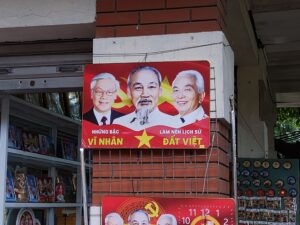
Photo: D. Dina Friedman
We’ve been in Vietnam for just a few days and I’ve probably seen the face of Ho Chi Minh more than a hundred times: on statues, on banners along the sides of buildings, in posters in store windows, on book covers, on the money. It’s a name and face from my deep past. I was a child during the Vietnam War (which is referred to here as “the American War,” “the Bomb War,” or “the Destroy War”). I was too young to have much understanding of what was going on. I knew that my family was divided. My parents, while not activists, were firmly against the war, and my grandparents and great aunt were convinced that the war was absolutely necessary to stop the “great evil” of communism. I remember their arguments at the Thanksgiving dinner table, my grandfather reciting the name of Ho Chi Minh as synonymous with an evil my child-brain could only associate with monsters.

Photo: D. Dina Friedman
Yet, here I’m hearing a very different story, of a man who never married because he gave his life to the country, of someone who lived simply, in a two-room house on stilts, saving the opulent government residence for official events. Of someone who had hope and vision, and persistence, and did not give up despite the long struggle to shepherd the Vietnamese people toward independence after 100 years of French colonization, and a thousand years of Chinese colonization before that.
While I know that freedom of speech is not a given here, and that I may not be hearing the entire truth, I think it’s important to acknowledge the varying perspectives surrounding this important figure in history, who seems so clearly loved and venerated by many as a national hero. And I think this serves as an important lesson for current times in how those in power try to villainize those who challenge that power, especially when these challengers attack the status quo.
Take the recent mayoral election in New York, for example. Zohran Mamdani, the mayor-elect is a 34-year old Muslim Democratic socialist who focused his campaign on affordability. Mamdani’s campaign promises included stabilizing rents, creating more free trasnportation and childcare, and initiating city-owned grocery stores, all of which he proposed to pay for by adding taxes on the 1% and on corporations. Needless to say, these ideas felt threatening to many of those who uphold or are benefited by the power structure, so they went on the attack–but not by refuting the ideas in Mamdani’s campaign platform or offering alternatives. Instead, they tried to delegitimize his platform and brand Mamdani as an enemy by using words like “terrorist,” “communist,” and “anti-semite,” words that are deliberately loaded and are designed to evoke fear and undermine people’s sense of safety and security.
And the more we get sucked into ignoring the nuance and complexity of any individual and rely instead on portrayals of people as cardboard cut-outs of heroes and villains, the less chance we have of truly understanding our fellow humans and making our troubled world more livable for all of us.
In fiction-writing we’re warned to avoid flat characters–two-dimensional stereotypes who have no depth, and may help move the plot but don’t undergo any real change. And one exercise we’re often asked to do to add more nuance and depth is to take a scene we’ve already written and write it from a different character’s point of view. The Nigerian writer Chimamanda Ngozi Adichie also urges us to embrace the multiplicity of perspectives in her excellent TED talk, The Danger of a Single Story.
I don’t want to go all Pollyanna about this. I freely admit to harboring many negative thoughts filled with villainizing loaded words about a certain political leader we won’t honor with a name, who, unsurprisingly has used this villainizing tactic quite effectively to delegitimize his opponents. But I can also see how this isn’t useful in the world of our better angels–both in terms of my own mental health and in terms of creating the world I’d prefer to live in.
I never thought–during the war, and after Vietnam “fell” (as we claimed in our loaded-word way) to the Communists that one day I’d be vacationing in Vietnam. And that the place would be thriving with music and restaurants and people dancing in the streets. But here I am. And Ho Chi Minh is everywhere.
Subscribe at https://ddinafriedman.substack.com