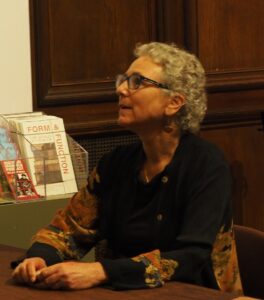
slowking4, CC BY-SA 2.5 <https://creativecommons.org/licenses/by-sa/2.5>, via Wikimedia Commons
I finally dived into Ellen Bass’s Living Room Craft Talk Series (half-price sale ends today) and so far, I’m finding it well worth the value. Though I usually find it hard to focus when listening to online lectures, Ellen has a way of making you feel as if you are truly in her living room. But make sure to have a notebook at your side to jot down the countless gems of tips and inspirational tidbits, and be prepared to press pause to play things over. However, even if you miss stuff, Ellen has graciously included handouts of all the quotes from her lecture in their entirety, as well as the sources of the books they’re in, so you can read more of what grabs you most.
While I might have arrogantly thought that after a lifetime of writing poetry I knew everything I needed to know about metaphor, I was surprised how much I learned from Ellen’s examples of the different ways writers use metaphor. And while I often express things in metaphors in all sorts of writing–including even emails–I’m often not super conscious of when and how I’m using metaphors in my poems, and whether I’m milking their impact to the fullest.
So yesterday I reviewed all the poems in the packet Ellen used to supplement her lecture and highlighted all the metaphors. While on my first read I’d recognized the ones that stood out in the wow zone… (e.g. grief as a homeless dog from Denise Levertov’s Talking to Grief & hands that “fly up like two birds while I speak” from Tim Siebel’s Ode to my Hands) I was amazed at how many metaphors there were, and how smoothly they flowed through the poem… to the point where I barely noticed the comparisons.
This led me to thinking more about metaphor as a conscious tool, rather than a momentary flash of subconscious inspiration (which is where I probably get 90% of my metaphors). Ellen talks about the importance of really working metaphors… choosing where to insert them by creating little slits in a poem in places where the message/meaning/image can be unpacked to create more emotional resonance or exploration of nuance. So I looked at one of my poems in progress, surprised to discover that in this particular poem there were no metaphors–just a generative rehash of a difficult emotional situation broken up into lines and made to look like a poem. I wasn’t sure this poem would have legs for anyone but me, but I spent some time consciously inserting metaphors and detail… and lo and behold, something with perhaps a little more staying power began to emerge. I’m still not sure whether the poem will have enough meaning for others, but I do believe the details and the comparisons have the capacity to generate more places for others to connect.
I know that people have different degrees of tolerance for metaphors. There are some folks who can find meaning in an amorphous avante garde play and others who prefer more directness and clarity. So, it’s important to think about what our audience(s) might need and how we want them to respond to our writing, and then craft our metaphors with care. Ellen points out the importance of grasping for the unusual metaphor, rather than the expected one, but not so unusual that people can’t make the leap. But I also know that not only have metaphors improved my writing by giving more life and possibility to images and details, they’ve also helped me communicate hard stuff to others through a story or image that’s more relatable than a common abstraction.
And I love how metaphors often take on more than I might have originally intended through the lens of a reader/listener’s interpretation, unveiling possibilities that neither of us might have previously considered.
Subscribe at https://ddinafriedman.substack.com